Article by Justin Nobel republished from DeSmog.
This story was co-published with Rolling Stone.
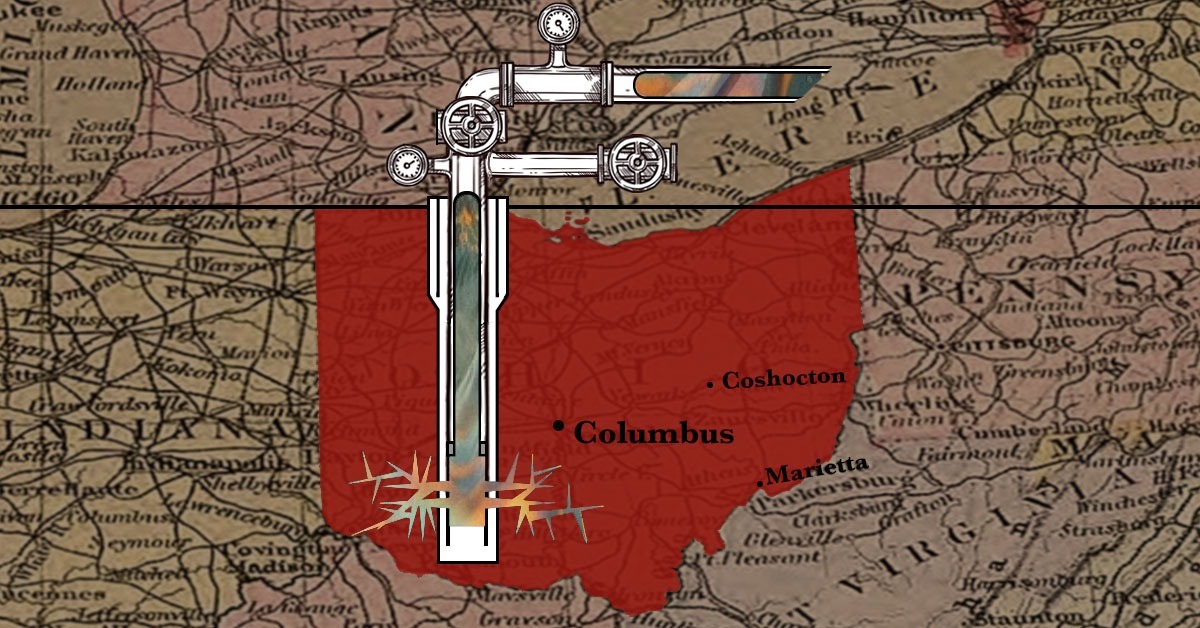
In Ohio’s rural southeastern corner, Marietta College geology professor David Jeffrey was among the residents worried that industry activity in America’s booming natural gas region could be polluting their drinking water. That’s “the biggest fear,” he said at an August meeting with top Ohio officials.
When Jeffrey and residents from advocacy groups Buckeye Environmental Network and Washington County for Safe Drinking Water met with Ohio officials, those state officials repeatedly assured residents that despite the up to 1.4 billion gallons of oil and gas wastewater injected in underground wells in their county and across Ohio each year, the state was unaware of any resulting drinking water contamination there.
“We would have heard about it,” Mary Mertz, director of the Ohio Department of Natural Resources (ODNR), which oversees both aspects of Ohio’s environment and its oil and gas industry, told residents in the August 17 virtual meeting.
“No one has called us that I’m aware of,” said Eric Vendel, ODNR’s oil and gas division chief. “We have a water investigation form that can be filled out and we would have my team down there and investigate the water.”
What officials did not tell the group that day is that five years earlier, the state did receive a call and, on Vendel’s orders, investigated a drinking water well for oil and gas wastewater contaminants in eastern Ohio, roughly 80 miles away from Washington County. Independent experts say the results are consistent with fracking wastewater contamination. Despite that and the water well’s location near two oil and gas wastewater injection wells, ODNR concluded fracking wastewater was not to blame, according to documents DeSmog and Rolling Stone obtained via public records request.
ODNR spokesperson Andy Chow told DeSmog and Rolling Stone: “When administrators were meeting with representatives in Washington County, they were discussing matters related to injection wells located in Washington County. ODNR stands by the comments made by its administrators.”
Concerns over polluted drinking water cross political and social divides, perhaps nowhere more so than rural Washington County. As intensely salty wastewater pushed below ground resurfaces, residents and officials have injected the issue into the already bitterly divided Ohio governor’s race. Susan Vessels, a Republican official in Washington County, recently appeared alongside Democratic gubernatorial candidate Dr. Amy Acton because of Acton’s pledge to pause new wastewater wells in this densely drilled area. “We have a chance to prevent the worst from happening, and we need to act now,” Acton told DeSmog and Rolling Stone.
“Drinking water is not political and it is my hope Ohioans will come together across party lines on this issue.”Susan Vessels, Marietta City Council President
Ohio ranks in the top 10 nationally for both oil and gas production. Fracking can occur within 100 feet of a school or rural home, and operators have been able to tap the gas-rich Marcellus and Utica formations by drilling directly beneath water reservoirs and state parks. But in order to maintain that production, the industry has to offload the tidal wave of toxic wastewater — rich in salts, carcinogens, heavy metals, and radioactive elements — that surfaces in the weeks and years that follow drilling an oil or gas well.
That wastewater gets pumped into injection wells deep below ground, where impermeable geological layers are supposed to keep it from leaking into oil and gas wells or drinking water supplies. Washington County, whose 19 injection wells outnumber all of Pennsylvania, has received complaints of this wastewater, or brine, flooding nearby oil and gas wells, according to the New York Times.
Now, an hour and a half drive north, in the town of Coshocton, Ohio, records show evidence of a family’s drinking water polluted by high levels of the same types of salts found in fracking wastewater.
“This is different”
In early November 2021, Bill Burgan, an eastern Ohio water well driller, called ODNR to complain about water from a 360-foot well he had drilled in 2017 for the Fisher family in Coshocton, according to ODNR documents. At the beginning of 2021, their water had become salty and corrosive. Not only did it leave a salty taste in the mouth, but it caused their hot water tanks to rust out prematurely. The couple had replaced two tanks in four years. Within weeks, the newest one became coated in an unidentifiable white precipitate.
“Sometimes we drill through pockets of salt,” said Burgan, president of American Drilling and Pump Service, in an interview with DeSmog and Rolling Stone this summer outside his Stone Creek, Ohio, shop. “But this is different, it’s fracking waste.”
Burgan told DeSmog and Rolling Stone, and, separately, ODNR according to public records, that he expressed concern that the Fishers’ drinking water well became impacted by an oil and gas wastewater injection well located less than two miles from the family’s home and operated by a Texas-based company called Buckeye Brine. The local community vigorously opposed Buckeye Brine’s installment of the injection well, where since 2014 the company has injected over 400 million gallons of waste.
After receiving Burgan’s complaint, ODNR swiftly launched an investigation that agency geologist Tamara Richards said “will focus solely on contaminants associated with oil and natural gas exploration and production,” according to public records.
The state’s results indicate signatures of possible drinking water pollution from oil and gas wastewater, according to independent experts who reviewed the findings. Ohio’s final report on the incident, completed in January 2022, found two separate indicators of potential fracking wastewater contamination — total dissolved solids, and chloride — in the Fisher family’s water. Both tested at more than five times the U.S. Environmental Protection Agency (EPA) limits. ODNR also tested for sodium, which lacks a formal EPA limit but has a threshold, as high levels can cause unpleasant taste and health problems for diabetics. In the Fishers’ water, sodium was 17 times the EPA threshold.
According to Jeffrey, the Marietta College geologist, high levels of total dissolved solids, chloride, and sodium also are found in the sea of fracking wastewater pumped into injection wells like the one operated by Buckeye Brine.
However, ODNR concluded there was “no evidence of an oilfield related impact” and pinned the cause of the contamination on a sandstone layer called the “Big Injun” that the agency, without providing any data, stated “appears to be” naturally salty and surrounded part of the family’s water well.
But Jeffrey said testing done by the state did not look at enough parameters to determine that the contamination was natural and not from fracking wastewater. “It seems ODNR is either stonewalling, misdirecting, or just doesn’t know what they are doing,” he told DeSmog and Rolling Stone.
In a separate case that would unfold over a year after ODNR tested the Fishers’ water, the agency was considering whether leaking injection wells or else the “Big Injun” sandstone formation might be contaminating conventional oil and gas wells in Athens County, just west of Washington County. This time, ODNR concluded the impacts “cannot be plausibly explained” by the sandstone formation due to its unique brine signature, citing a “June 2, 2020 technical analysis prepared by ALL Consulting.” The agency added that impacts from this natural layer would have been consistent from the start, and “it is unlikely” they would have appeared only after the injection well operator began working. ODNR ultimately suspended the permit for a set of three injection wells that were eventually shut in for leaking fracking wastewater. ODNR has not yet replied to questions regarding this case.
When asked about the state’s findings in Coshocton and their scientific evidence, Burgan was dismissive. “They are covering it up,” he said, “because they are making too much money off of this.”
Oil and gas companies pay Ohio five cents a barrel to dispose of in-state wastewater, and 20 cents for wastewater imported from other states. Much of the waste injected comes from neighboring West Virginia and Pennsylvania. With at least a billion gallons of waste injected every year, that income translates to an average of $2.4 million annually for state coffers, according to state documents.
“The ODNR Division of Oil and Gas Resources Management uses evidence and facts, testing, and the latest technologies to evaluate complaints of brine migration” and “stands by the results of its investigation,” said ODNR spokesperson Chow.
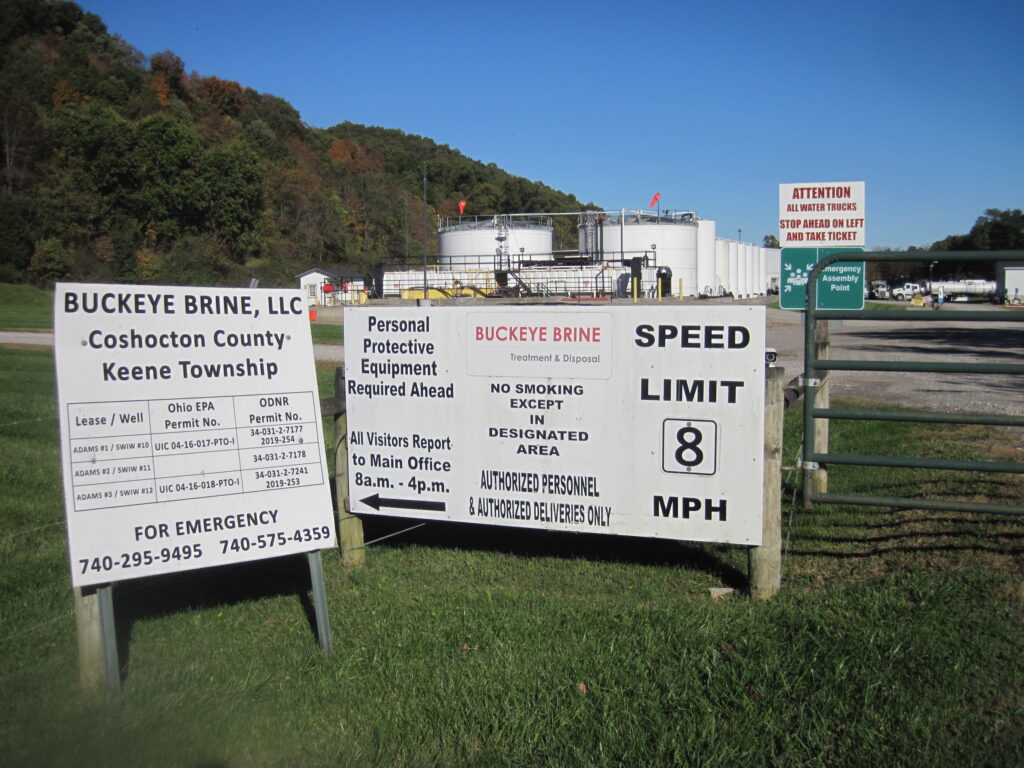
But ODNR did not investigate the Buckeye Brine injection well, subject of the original complaint, or any other injection wells. It did investigate “producing oil and gas wells within a one-half mile radius” of the family’s home.
After Burgan’s company reached out, we “contacted ODNR and ODNR was not interested in any further efforts on the matter,” said Susie Patterson, the manager at Buckeye Brine, by email. Patterson said groundwater monitoring wells installed in 2019 and sampled quarterly showed “no indication of contamination by oilfield substances,” or that “the water was not fit for consumption due to contaminants,” and pinned issues with the Fishers’ well on the water well driller.
“The wells were drilled much deeper than surrounding wells producing good drinking water,” said Patterson. “It is Buckeye’s opinion that the driller was trying to justify to the well owner the bad wells.”
The Fishers declined to participate in the story.
The Oil and Gas Industry’s Trillion-Gallon Problem
Across America, over one trillion gallons of oil and gas wastewater are generated every year — enough to fill a line of waste barrels to the moon and back 28 times. Nearly all of this waste — 96 percent — will be injected deep into the earth at disposal injection wells.
Given the oil and gas industry’s reliance on injection wells as a critical means of disposal for a dangerous waste stream, analysts have referred to injection wells as a linchpin to the sound operation of the entire oil and gas industry. Disposal of oil and gas wastewater is the industry’s “Achilles’ heel,” said Ted Auch, a researcher at the oil and gas industry watchdog Fieldnotes. A 2021 Rice University Center for Energy Studies report stated that if the industry did not have injection wells to rely on for waste disposal, the “resulting economic impacts would be profound — and likely, existential.”
The United States has more than 181,400 oil and gas wastewater injection wells, but as industry leaders testified at the Texas state capitol in August, lack of space to store this toxic brine already is threatening to curtain oil and gas production in Texas’ productive Permian Basin. Even where it has been stored, increasing evidence shows the wastewater is not always staying put.
Injection has proven particularly problematic in Ohio, where state regulators have halted operations at over half a dozen injection wells, citing concerns that fracking wastewater has leaked and has traveled up to five miles underground to contaminate conventional oil and gas wells. ODNR noted in a 2023 letter to DeepRock Disposal Solutions, a southeast Ohio company formerly run by the chair of the state senate’s energy committee, that such incidents pose a risk to public health and drinking water too.
In Texas, wastewater shot down injection wells has burst back to the surface at old oil and gas wells, at times generating 100-foot geysers of brine in the desert, and Inside Climate News reported that oilfield waste has contaminated drinking water sources in the heart of West Texas oil country. Reporting by ProPublica revealed the situation is similar in neighboring Oklahoma, where regulators have clashed over how far to rein in the injection industry, despite state evidence showing drinking water sources polluted with contaminants consistent with oilfield waste.
Independent scientists raise the question of whether other oil and gas states may be facing similar problems.
“We have always been concerned as environmental scientists and geologists in this area that there is no underground containment in these [injection] wells,” said Jen Bowman, a water chemistry expert and the director of environmental programs at Ohio University, in Athens. “What so many folks in this area don’t understand, our underground layers are just rock layers so there is no magic underground lake where you are getting water from, and there is no magic underground storage container where the waste is going.” Injecting millions of gallons of waste at high pressure means contamination miles from the site of injection is inevitable, she said.
“This is not a good plan or disposal mechanism for potentially dangerous materials,” Bowman told DeSmog and Rolling Stone, “especially given that people rely on groundwater in so much of rural Ohio.”
The concern about drinking water in Washington County is exactly what motivates Susan Vessels, the Republican president of the Marietta City Council. She has led the council in writing a resolution, passed last October, urging Ohio state legislators to introduce legislation imposing a three-year moratorium on new wastewater injection wells in Washington County. More recently she has crossed the political aisle when Amy Acton, the former state health director, came to Marietta last month as part of her gubernatorial campaign. Acton supports Vessels’ proposed moratorium and is facing an ugly, expensive race against billionaire Vivek Ramaswamy.
Acton told DeSmog and Rolling Stone that the fight over injection wells and drinking water contamination comes down to ensuring a better future for Marietta and all of Ohio.
“That is why I am committing to a three-year moratorium on wastewater injection wells in Washington County,” said Acton. “I’m fighting against the corruption in our Statehouse and the cost of that corruption that we pay for. We must act to protect our resources and our drinking water.” Ramaswamy’s campaign has not replied to questions.
“Drinking water is not political,” said Vessels, “and it is my hope Ohioans will come together across party lines on this issue.”
In an op-ed, she took to task the GOP contender Ramaswamy, who called people “whiners” for raising concerns about clean water, energy use, and other issues as proposals for AI data centers arrive in Ohio.
“I think they are full of shit, and that is point-blank my opinion.”Phillip Johnson, Washington County water well driller
Washington County water well driller Phillip Johnson said he has drilled hundreds of private water wells in the region. He disagreed with the state’s conclusion that brine from the sandstone formation caused the Fisher family well’s contamination.
“I think they are full of shit, and that is point-blank my opinion,” he said.
Johnson said that if the sandstone formation was the cause of the salt contamination in the Fishers’ drinking water, then the salty taste should have been there from the beginning, and not strengthened over time as the couple reported, according to ODNR documents.
“Just because you drill 1,000 wells and everything works fine, it just takes one well to not work right for there to be a problem,” said Johnson. “It is nature, if you pump something down under pressure, the path of least resistance is up.”
“I am all for drilling oil and gas,” he added, “but fresh natural water is the most essential natural resource there is, in this country, the state, anywhere in the world, and if you contaminate it, you essentially ruin everything.”
Dominic DiGiulio, a retired EPA scientist with a doctorate in geoscience and decades of experience investigating the movement of underground fluids, provided another assessment of the state’s conclusions in the Coshocton case.
“The ODNR’s logic for stating that the domestic well is partially screened in the Big Injun formation is flawed,” said DiGiulio, who also previously consulted for government agencies and NGOs. “ODNR does not provide compelling evidence.”
Article by Justin Nobel republished from DeSmog.