Tag: oil

  • Ohio Denies Evidence of Fracking Waste in Drinking Water. Its Own Records Show Otherwise. 

    Spread the love

    Article by Justin Nobel republished from DeSmog.
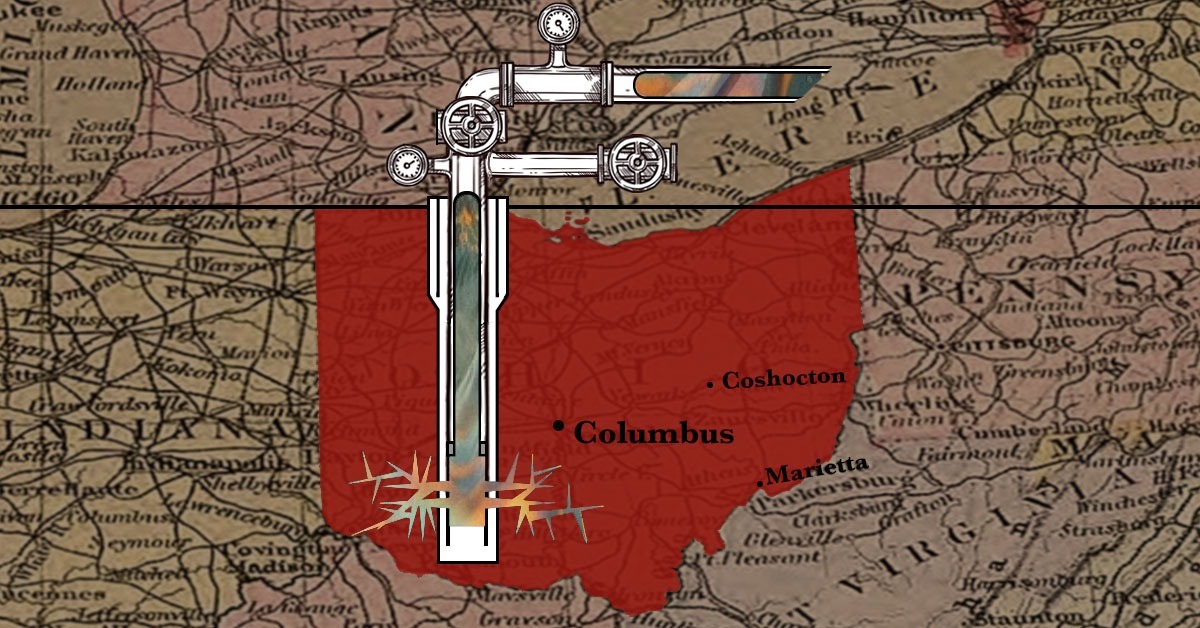
    Outline of the state of Ohio, filled red, with the locations of Columbus, Coshocton, and Marietta in central, eastern and southeastern parts. The graphic of Ohio has valves and pipes of a fracking wastewater injection well pumping waste into the state. A vintage 1900s era map surrounds Ohio.
    The influx of oil and gas wastewater into Ohio is placing new pressure on the state. Credit: Sari Williams/DeSmog

    This story was co-published with Rolling Stone.

    In Ohio’s rural southeastern corner, Marietta College geology professor David Jeffrey was among the residents worried that industry activity in America’s booming natural gas region could be polluting their drinking water. That’s “the biggest fear,” he said at an August meeting with top Ohio officials.

    When Jeffrey and residents from advocacy groups Buckeye Environmental Network and Washington County for Safe Drinking Water met with Ohio officials, those state officials repeatedly assured residents that despite the up to 1.4 billion gallons of oil and gas wastewater injected in underground wells in their county and across Ohio each year, the state was unaware of any resulting drinking water contamination there.

    “We would have heard about it,” Mary Mertz, director of the Ohio Department of Natural Resources (ODNR), which oversees both aspects of Ohio’s environment and its oil and gas industry, told residents in the August 17 virtual meeting.

    “No one has called us that I’m aware of,” said Eric Vendel, ODNR’s oil and gas division chief. “We have a water investigation form that can be filled out and we would have my team down there and investigate the water.”

    What officials did not tell the group that day is that five years earlier, the state did receive a call and, on Vendel’s orders, investigated a drinking water well for oil and gas wastewater contaminants in eastern Ohio, roughly 80 miles away from Washington County. Independent experts say the results are consistent with fracking wastewater contamination. Despite that and the water well’s location near two oil and gas wastewater injection wells, ODNR concluded fracking wastewater was not to blame, according to documents DeSmog and Rolling Stone obtained via public records request.

    ODNR spokesperson Andy Chow told DeSmog and Rolling Stone: “When administrators were meeting with representatives in Washington County, they were discussing matters related to injection wells located in Washington County. ODNR stands by the comments made by its administrators.”

    Concerns over polluted drinking water cross political and social divides, perhaps nowhere more so than rural Washington County. As intensely salty wastewater pushed below ground resurfaces, residents and officials have injected the issue into the already bitterly divided Ohio governor’s race. Susan Vessels, a Republican official in Washington County, recently appeared alongside Democratic gubernatorial candidate Dr. Amy Acton because of Acton’s pledge to pause new wastewater wells in this densely drilled area. “We have a chance to prevent the worst from happening, and we need to act now,” Acton told DeSmog and Rolling Stone.

    “Drinking water is not political and it is my hope Ohioans will come together across party lines on this issue.”Susan Vessels, Marietta City Council President

    Ohio ranks in the top 10 nationally for both oil and gas production. Fracking can occur within 100 feet of a school or rural home, and operators have been able to tap the gas-rich Marcellus and Utica formations by drilling directly beneath water reservoirs and state parks. But in order to maintain that production, the industry has to offload the tidal wave of toxic wastewater — rich in salts, carcinogens, heavy metals, and radioactive elements — that surfaces in the weeks and years that follow drilling an oil or gas well.

    That wastewater gets pumped into injection wells deep below ground, where impermeable geological layers are supposed to keep it from leaking into oil and gas wells or drinking water supplies. Washington County, whose 19 injection wells outnumber all of Pennsylvania, has received complaints of this wastewater, or brine, flooding nearby oil and gas wells, according to the New York Times.

    Now, an hour and a half drive north, in the town of Coshocton, Ohio, records show evidence of a family’s drinking water polluted by high levels of the same types of salts found in fracking wastewater.

    “This is different”

    In early November 2021, Bill Burgan, an eastern Ohio water well driller, called ODNR to complain about water from a 360-foot well he had drilled in 2017 for the Fisher family in Coshocton, according to ODNR documents. At the beginning of 2021, their water had become salty and corrosive. Not only did it leave a salty taste in the mouth, but it caused their hot water tanks to rust out prematurely. The couple had replaced two tanks in four years. Within weeks, the newest one became coated in an unidentifiable white precipitate.

    “Sometimes we drill through pockets of salt,” said Burgan, president of American Drilling and Pump Service, in an interview with DeSmog and Rolling Stone this summer outside his Stone Creek, Ohio, shop. “But this is different, it’s fracking waste.”

    Burgan told DeSmog and Rolling Stone, and, separately, ODNR according to public records, that he expressed concern that the Fishers’ drinking water well became impacted by an oil and gas wastewater injection well located less than two miles from the family’s home and operated by a Texas-based company called Buckeye Brine. The local community vigorously opposed Buckeye Brine’s installment of the injection well, where since 2014 the company has injected over 400 million gallons of waste.  

    After receiving Burgan’s complaint, ODNR swiftly launched an investigation that agency geologist Tamara Richards said “will focus solely on contaminants associated with oil and natural gas exploration and production,” according to public records. 

    The state’s results indicate signatures of possible drinking water pollution from oil and gas wastewater, according to independent experts who reviewed the findings. Ohio’s final report on the incident, completed in January 2022, found two separate indicators of potential fracking wastewater contamination — total dissolved solids, and chloride —  in the Fisher family’s water. Both tested at more than five times the U.S. Environmental Protection Agency (EPA) limits. ODNR also tested for sodium, which lacks a formal EPA limit but has a threshold, as high levels can cause unpleasant taste and health problems for diabetics. In the Fishers’ water, sodium was 17 times the EPA threshold.

    According to Jeffrey, the Marietta College geologist, high levels of total dissolved solids, chloride, and sodium also are found in the sea of fracking wastewater pumped into injection wells like the one operated by Buckeye Brine.

    However, ODNR concluded there was “no evidence of an oilfield related impact” and pinned the cause of the contamination on a sandstone layer called the “Big Injun” that the agency, without providing any data, stated “appears to be” naturally salty and surrounded part of the family’s water well.

    But Jeffrey said testing done by the state did not look at enough parameters to determine that the contamination was natural and not from fracking wastewater. “It seems ODNR is either stonewalling, misdirecting, or just doesn’t know what they are doing,” he told DeSmog and Rolling Stone.

    In a separate case that would unfold over a year after ODNR tested the Fishers’ water, the agency was considering whether leaking injection wells or else the “Big Injun” sandstone formation might be contaminating conventional oil and gas wells in Athens County, just west of Washington County. This time, ODNR concluded the impacts “cannot be plausibly explained” by the sandstone formation due to its unique brine signature, citing a “June 2, 2020 technical analysis prepared by ALL Consulting.” The agency added that impacts from this natural layer would have been consistent from the start, and “it is unlikely” they would have appeared only after the injection well operator began working. ODNR ultimately suspended the permit for a set of three injection wells that were eventually shut in for leaking fracking wastewater. ODNR has not yet replied to questions regarding this case.

    When asked about the state’s findings in Coshocton and their scientific evidence, Burgan was dismissive. “They are covering it up,” he said, “because they are making too much money off of this.”

    Oil and gas companies pay Ohio five cents a barrel to dispose of in-state wastewater, and 20 cents for wastewater imported from other states. Much of the waste injected comes from neighboring West Virginia and Pennsylvania. With at least a billion gallons of waste injected every year, that income translates to an average of $2.4 million annually for state coffers, according to state documents.

    “The ODNR Division of Oil and Gas Resources Management uses evidence and facts, testing, and the latest technologies to evaluate complaints of brine migration” and “stands by the results of its investigation,” said ODNR spokesperson Chow.
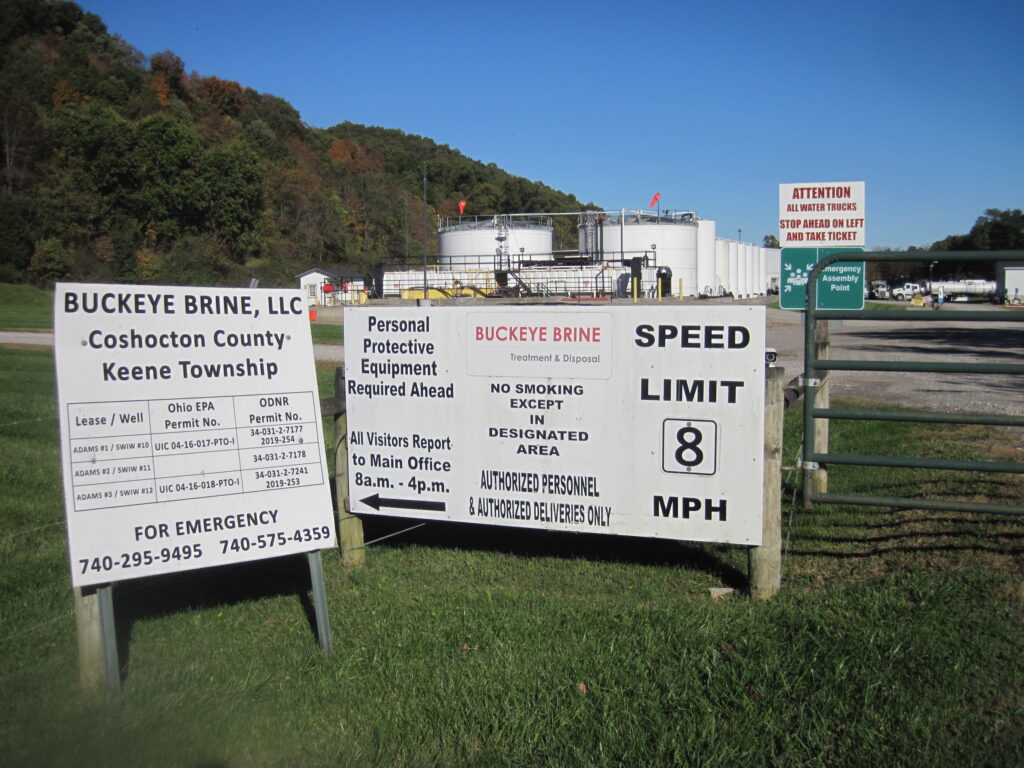
    Signs at the entrance to Buckeye Brine's injection well facility in Coshocton, Ohio.
    The entrance to Buckeye Brine’s injection well facility in Coshocton, Ohio. Credit: Justin Nobel/DeSmog

    But ODNR did not investigate the Buckeye Brine injection well, subject of the original complaint, or any other injection wells. It did investigate “producing oil and gas wells within a one-half mile radius” of the family’s home.

    After Burgan’s company reached out, we “contacted ODNR and ODNR was not interested in any further efforts on the matter,” said Susie Patterson, the manager at Buckeye Brine, by email. Patterson said groundwater monitoring wells installed in 2019 and sampled quarterly showed “no indication of contamination by oilfield substances,” or that “the water was not fit for consumption due to contaminants,” and pinned issues with the Fishers’ well on the water well driller. 

    “The wells were drilled much deeper than surrounding wells producing good drinking water,” said Patterson. “It is Buckeye’s opinion that the driller was trying to justify to the well owner the bad wells.”

    The Fishers declined to participate in the story. 

    The Oil and Gas Industry’s Trillion-Gallon Problem

    Across America, over one trillion gallons of oil and gas wastewater are generated every year — enough to fill a line of waste barrels to the moon and back 28 times. Nearly all of this waste — 96 percent — will be injected deep into the earth at disposal injection wells.

    Given the oil and gas industry’s reliance on injection wells as a critical means of disposal for a dangerous waste stream, analysts have referred to injection wells as a linchpin to the sound operation of the entire oil and gas industry. Disposal of oil and gas wastewater is the industry’s “Achilles’ heel,” said Ted Auch, a researcher at the oil and gas industry watchdog Fieldnotes. A 2021 Rice University Center for Energy Studies report stated that if the industry did not have injection wells to rely on for waste disposal, the “resulting economic impacts would be profound — and likely, existential.” 

    The United States has more than 181,400 oil and gas wastewater injection wells, but as industry leaders testified at the Texas state capitol in August, lack of space to store this toxic brine already is threatening to curtain oil and gas production in Texas’ productive Permian Basin. Even where it has been stored, increasing evidence shows the wastewater is not always staying put.

    Injection has proven particularly problematic in Ohio, where state regulators have halted operations at over half a dozen injection wells, citing concerns that fracking wastewater has leaked and has traveled up to five miles underground to contaminate conventional oil and gas wells. ODNR noted in a 2023 letter to DeepRock Disposal Solutions, a southeast Ohio company formerly run by the chair of the state senate’s energy committee, that such incidents pose a risk to public health and drinking water too.   

    In Texas, wastewater shot down injection wells has burst back to the surface at old oil and gas wells, at times generating 100-foot geysers of brine in the desert, and Inside Climate News reported that oilfield waste has contaminated drinking water sources in the heart of West Texas oil country. Reporting by ProPublica revealed the situation is similar in neighboring Oklahoma, where regulators have clashed over how far to rein in the injection industry, despite state evidence showing drinking water sources polluted with contaminants consistent with oilfield waste. 

    Independent scientists raise the question of whether other oil and gas states may be facing similar problems.

    “We have always been concerned as environmental scientists and geologists in this area that there is no underground containment in these [injection] wells,” said Jen Bowman, a water chemistry expert and the director of environmental programs at Ohio University, in Athens. “What so many folks in this area don’t understand, our underground layers are just rock layers so there is no magic underground lake where you are getting water from, and there is no magic underground storage container where the waste is going.” Injecting millions of gallons of waste at high pressure means contamination miles from the site of injection is inevitable, she said.

    “This is not a good plan or disposal mechanism for potentially dangerous materials,” Bowman told DeSmog and Rolling Stone, “especially given that people rely on groundwater in so much of rural Ohio.”

    The concern about drinking water in Washington County is exactly what motivates Susan Vessels, the Republican president of the Marietta City Council. She has led the council in writing a resolution, passed last October, urging Ohio state legislators to introduce legislation imposing a three-year moratorium on new wastewater injection wells in Washington County. More recently she has crossed the political aisle when Amy Acton, the former state health director, came to Marietta last month as part of her gubernatorial campaign. Acton supports Vessels’ proposed moratorium and is facing an ugly, expensive race against billionaire Vivek Ramaswamy. 

    Acton told DeSmog and Rolling Stone that the fight over injection wells and drinking water contamination comes down to ensuring a better future for Marietta and all of Ohio. 

    “That is why I am committing to a three-year moratorium on wastewater injection wells in Washington County,” said Acton. “I’m fighting against the corruption in our Statehouse and the cost of that corruption that we pay for. We must act to protect our resources and our drinking water.” Ramaswamy’s campaign has not replied to questions. 

    “Drinking water is not political,” said Vessels, “and it is my hope Ohioans will come together across party lines on this issue.”

    In an op-ed, she took to task the GOP contender Ramaswamy, who called people “whiners” for raising concerns about clean water, energy use, and other issues as proposals for AI data centers arrive in Ohio.

    “I think they are full of shit, and that is point-blank my opinion.”Phillip Johnson, Washington County water well driller

    Washington County water well driller Phillip Johnson said he has drilled hundreds of private water wells in the region. He disagreed with the state’s conclusion that brine from the sandstone formation caused the Fisher family well’s contamination.

    “I think they are full of shit, and that is point-blank my opinion,” he said.  

    Johnson said that if the sandstone formation was the cause of the salt contamination in the Fishers’ drinking water, then the salty taste should have been there from the beginning, and not strengthened over time as the couple reported, according to ODNR documents.

    “Just because you drill 1,000 wells and everything works fine, it just takes one well to not work right for there to be a problem,” said Johnson. “It is nature, if you pump something down under pressure, the path of least resistance is up.”

    “I am all for drilling oil and gas,” he added, “but fresh natural water is the most essential natural resource there is, in this country, the state, anywhere in the world, and if you contaminate it, you essentially ruin everything.”

    Dominic DiGiulio, a retired EPA scientist with a doctorate in geoscience and decades of experience investigating the movement of underground fluids, provided another assessment of the state’s conclusions in the Coshocton case.

    “The ODNR’s logic for stating that the domestic well is partially screened in the Big Injun formation is flawed,” said DiGiulio, who also previously consulted for government agencies and NGOs. “ODNR does not provide compelling evidence.”

    Article by Justin Nobel republished from DeSmog.
  • Western Media Accept Trump’s Plundering of Venezuelan Oil as Business as Usual

    Spread the love

    Article by Ricardo Vaz republished from FAIR under a Creative Commons Attribution-NonCommercial-NoDerivs 3.0 Unported License.

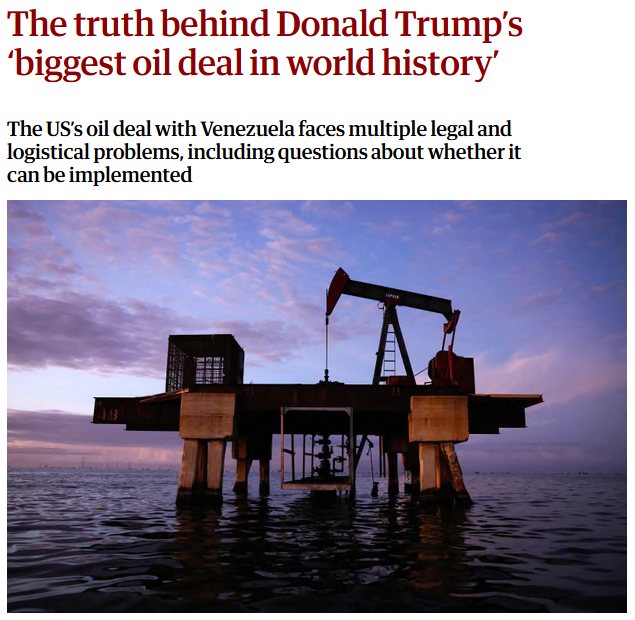
    Guardian: The truth behind Donald Trump’s ‘biggest oil deal in world history’

    Guardian (9/26/26): “Donald Trump has long coveted the oilfields of other nations.” [26/9/26]

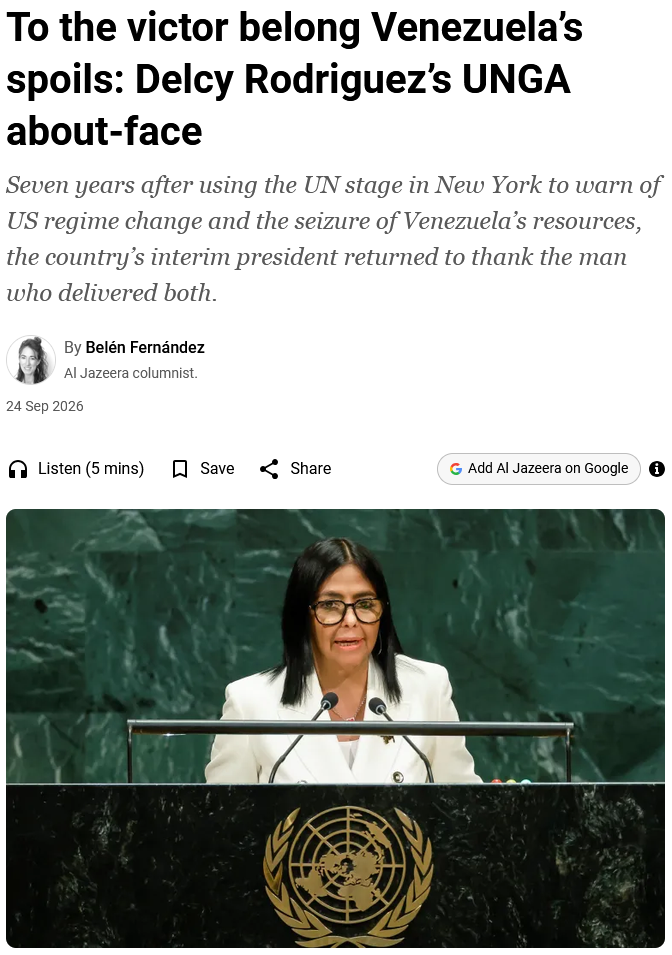
    Since the January 3, 2026, military strikes and kidnapping of President Nicolás Maduro, the Trump administration has imposed semi-colonial rule over Venezuela, forcing dramatic shifts in the country’s domestic and foreign policies.

    The capstone of the new tutelary regime is an oil deal announced in late August that Trump called “the biggest in history.” The agreement turns over 17 prime oilfields, holding over 20% of the country’s reserves, to a Pentagon-controlled corporation tasked with supplying cheap fuel to the US war machine for decades to come.

    After spending years manufacturing consent for US-sponsored regime change in Venezuela (e.g., FAIR.org, 6/4/21, 1/11/23, 2/12/25), having a government in Caracas subservient to Washington represented a new scenario for the corporate media. The novel conditions have raised few significant qualms for Western outlets. Tactical objections notwithstanding, there is no fundamental disagreement with the US running the affairs of a Global South country.

    Not ‘stealing Venezuela’s oil’

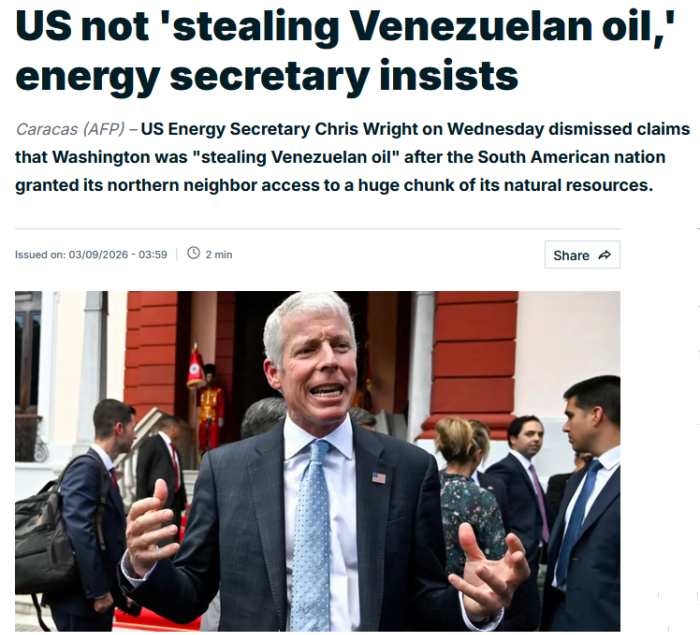
    France 24: US not 'stealing Venezuelan oil,' energy secretary insists

    Energy Secretary Chris Wright (France 24, 3/9/26): “I’ve seen those headlines. ‘We’re Stealing Venezuelan Oil.’ Of course, that’s not true at all.”

    Working hand in glove with the Trump administration, the acting Delcy Rodríguez government has overhauled Venezuela’s hydrocarbon legislation (Venezuelanalysis, 7/13/26) to offer what oil experts consider a business environment more favorable to foreign capital than at any point in the country’s history. The new oil agreement with the White House manages to go even further.

    The 17 oilfields in question will be taken over by North American Blue Energy Partners (NABEP), a private company in which the Pentagon’s Office of Strategic Capital (OSC) will get a 35% stake while investing nothing—and wielding veto power over its board.

    Furthermore, according to the White House, the US State Department will secure 20% of NABEP’s output at cost, and have a right of first refusal over the remaining 80%. On top of this, Venezuelan officials have already suggested Washington would be given an additional “sales discount”  (Venezuelanalysis, 9/9/26).

    In summary, Trump is looking to secure cheap crude supplies at a time when his disastrous Iran debacle has thrown global energy markets into upheaval. The agreement is so blatantly skewed that US Energy Secretary Chris Wright felt he needed to clarify that Washington was not “stealing Venezuela’s oil” (AFP, 9/3/26).

    Nevertheless, Western media outlets were largely unfazed by such an obvious oil grab, euphemistically referring to the deal as “highly unusual” (New York Times, 8/29/26) or “remarkable” (BBC, 9/1/26), at most as “contentious” (Guardian, 9/1/26).

    Corporate journalists did raise objections over the central role played by NABEP owner Alejandro Betancourt, a shady Venezuelan businessman who faced multiple money-laundering probes before the Trump administration intervened, and pressured judicial authorities at home and abroad to drop the investigations (BBC, 9/2/26; CNN, 9/4/26; New York Times, 9/4/26).

    But media seemed satisfied with Trump’s state and energy secretaries Marco Rubio and Chris Wright pledging that US oversight will keep proceedings honest (Reuters, 9/2/26; New York Times, 9/4/26), despite the fact that billions in Venezuelan oil revenues, controlled by the US Treasury Department since January, are unaccounted for (Council on Foreign Relations, 6/3/26; Financial Times, 7/22/26).

    Procedurally transparent plunder

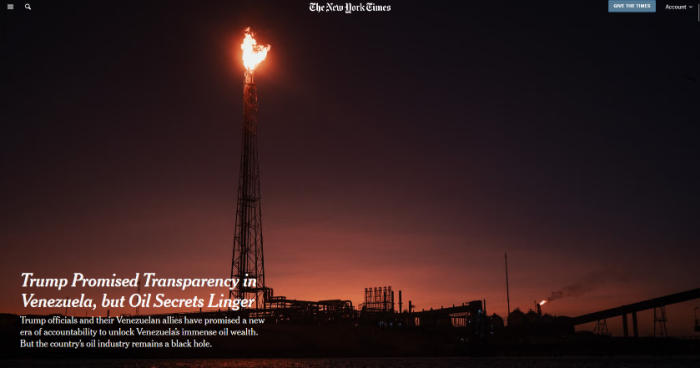
    NYT: Trump Promised Transparency in Venezuela, but Oil Secrets Linger

    The New York Times (5/5/26) wrote positively of “a new era of accountability” in which “the United States would control Venezuelan oil sales” and “Venezuela would submit monthly budgets to the White House.”

    Objections to the Venezuela/NABEP/Pentagon venture were mostly procedural and out of concern for appearances, not driven by any principled opposition to US imperialist predation. Faced with outright colonial plunder of Venezuela, the political and media establishment only demands “accountability” and “transparency” (New York Times, 5/5/26; Financial Times, 9/18/26).

    For months, the White House has controlled Venezuelan oil export revenues, with Trump officials openly calling them “one of the largest assets ever to go on the US balance sheet,” and a source of “leverage” over Caracas. Yet Trump’s Democratic opponents have found no issue with seizing another country’s income, raising only questions about the allocation of the funds in reference to alleged corruption on the part of Caracas and Trump insiders (The Hill, 9/30/26; Washington Post, 9/17/26). This despite the fact that the Venezuelan government has to submit a “monthly budget” to access its own funds (New York Times, 1/28/26) and is subjected to US-imposed auditors (Reuters, 4/27/26).

    The other source of disappointment with Trump stomping all over Venezuelan sovereignty, but prioritizing oil over regime change, is impatience for the restoration/recovery/return of “democracy” to Venezuela (Politico, 9/2/26; Guardian, 8/30/26; CBC, 9/3/26). Despite  widely acknowledgement that Trump is eroding democracy at home (New York Times, 8/20/26, 10/14/26; Guardian, 10/8/26), somehow pundits expected him to prioritize it in an oil-rich foreign country.

    In the establishment’s consensus, “democracy” does not mean a political system that meaningfully reflects the Venezuelan people’s collective will, but simply one that empowers opposition figures that have been groomed for years, like far-right María Corina Machado, their undemocratic credentials notwithstanding (FAIR.org, 10/23/25).

    Eager to stay in power, Rodríguez has over-complied with every US demand, going as far as adopting language about Venezuela undergoing a “democratic transformation.” Her pliancy has earned her favorable corporate media profiles that completely contrast with the demonization of Maduro.

    After securing an exclusive interview, Time (7/30/26) described the acting leader as a “disciplined operator” who “advocate[s] for greater economic openness,” in contrast to the “authoritarian” Maduro, who oversaw “economic collapse.” Along the same lines, the Guardian (9/12/26) presented Rodríguez as a “a pragmatic, witty and intelligent workaholic,” unlike her “authoritarian” and “incompetent” predecessor in the presidential palace.

    Nevertheless, given the broad Beltway consensus for comprehensive regime change, it is unlikely that the Rodríguez administration’s subservience to Trump will secure any leeway in determining its political path forward, free from outside meddling—especially if, as is anticipated, the GOP lawmakers most likely to be impressed by such obsequiousness lose power in the US’s upcoming midterm elections (Axios, 9/23/26; Financial Times, 10/9/26).

    Please think of the corporations!

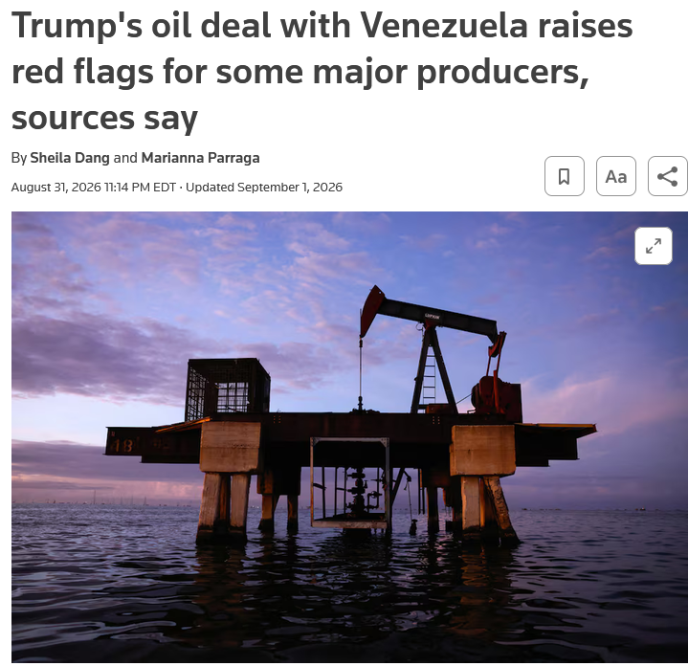
    Reuters: Trump's oil deal with Venezuela raises red flags for some major producers, sources say

    Reuters (9/1/26): ExxonMobil and ConocoPhillips “have repeatedly said that their requirements of legal certainty and contract sanctity ‌have not ⁠yet been met.”

    Alongside their exceptionalist expectations about “democracy,” legacy outlets also focus on those they consider the true victims of Trump’s neocolonial offensive in Venezuela: multinational oil corporations.

    According to Reuters (9/1/26), the recent oil deal “raises red flags for major producers,” who fear having their reputation sullied by being “seated at the same table with Betancourt,” as well as the prospect of the US government becoming a “competitor.”

    Bloomberg (8/30/26) raised concerns that the agreement “reprises [the] neocolonial past” of Venezuela’s oil industry. The warning stems not from apprehension that the Venezuelan people’s future is being determined by a foreign nation, but from fear that the US’s “out-sized power” might lead to “popular unrest.” This could create conditions for what the business mouthpiece views as a catastrophic outcome: the nationalization of foreign-owned oil assets.

    “The troubled history of Venezuela’s oil offers a cautionary tale,” Bloomberg’s Kevin Crowley and Patricia Garip wrote:

    The country was once dominated by US and European operators and was among the world’s largest producers. But assets owned by ExxonMobil Holdings Corps. and ConocoPhillips were seized and nationalized during political upheaval in the 2000s.

    Corporate media present companies that made massive profits in Venezuela for decades as victims, because the Chávez government wanted them to comply with new laws and accept minority stakes in joint ventures.

    The New York Times (9/1/26) complains that the two corporations “have spent years trying to get the country to repay them for their seized assets, with little success.” The statement conceals the fact that the Venezuelan government, when it enacted the 2007 decree imposing state majority in all Orinoco Oil Belt projects, offered to compensate ExxonMobil and ConocoPhillips for their transition to minority partners, or to buy out their assets altogether. However, both corporations rejected the offers in order to pursue international arbitration. The former has already recouped most of what it was granted, while the latter will eventually collect on a significant award.

    Despite the fact that Chevron, BP, Shell and other energy giants have signed deals in recent months taking advantage of the reformed hydrocarbon law (Venezuelanalysis, 9/3/26), pundits complain that ExxonMobil and ConocoPhillips remain “hesitant” (CBS, 8/31/26) and need to be “lured” (Reuters, 9/1/26). Still, the Western corporations are likely to return to the country with favorable deals (Reuters, 9/16/26).

    The victor and his spoils

    Al Jazeera: To the victor belong Venezuela’s spoils: Delcy Rodriguez’s UNGA about-face

    Belén Fernández (Al Jazeera, 9/24/26): “You’re not technically supposed to admit that you attacked a country just to get its oil.”

    Faced with strategic defeat in West Asia, Trump has clung to his Venezuela success, stating on multiple occasions that “to the victor belong the spoils,” in reference to the US hijacking the Venezuelan oil industry following the January 3 attacks and presidential kidnapping (Al Jazeera, 9/24/26; Guardian, 9/26/26).

    Furthermore, Trump has not been shy in boasting about the US winning a “war” against Venezuela (Financial Times, 9/18/26; New York Times, 6/26/26). Corporate journalists have rarely pointed out that this stance directly contradicts the administration’s official position that the kidnapping of Maduro and Flores was a “law enforcement” operation (New York Times, 1/6/26; PBS, 1/8/26) in order to justify bypassing congressional approval.

    The US president has likewise claimed to have recovered the costs of the military operation “many times over” (Al Jazeera, 3/3/26; Guardian, 6/28/26), a fact confirmed by Luigi Pisella, a business sector spokesperson with close ties to the acting Rodríguez administration (Venezuelanalysis, 8/10/26). Pisella stated that the US has retained $4.7 billion from the Venezuelan export revenues it controls to cover the costs of its military operation.

    In spite of their ostensible hostility to Trump, corporate outlets have historically been complicit with his Venezuela policies, from whitewashing a deadly sanctions program (FAIR.org, 6/13/22) to endorsing a military buildup over debunked “narcoterrorism” accusations (FAIR.org, 11/19/25). The New York Times and Washington Post went as far as to withhold information in order to not jeopardize the January 3 operation (FAIR.org, 1/13/26).

    Now, with a semi-colonial regime in place, the only concerns are about procedural transparency, democratic appearances and the well-being of multinational corporations. The Venezuelan people always get the short end of the stick.

    FAIR’s work is sustained by our generous contributors, who allow us to remain independent. Donate today to be a part of this important mission.

    Article by Ricardo Vaz republished from FAIR under a Creative Commons Attribution-NonCommercial-NoDerivs 3.0 Unported License.

    Climate science denier Donald Trump confirms that he knows nothing about democracy and that more liquid gold is being secured according to his policy of global privateering.
    Climate science denier Donald Trump confirms that he knows nothing about democracy and that more liquid gold is being secured according to his policy of global privateering.

  • AI Was Supposed to Cut Emissions. Instead, Fossil Fuel Companies Are Using It to Find More Oil and Gas.

    Spread the love

    Article by Sarah Hofmann republished from DeSmog.

    Credit: Sarah Hofmann/arbyreed via Flickr (CC-BY-NC-2.0)

    A new study found AI-driven fossil fuel productivity could increase emissions. Here are examples of companies already using AI to boost production.

    When United Nations Secretary-General António Guterres warned world leaders last week in his UN address about the unchecked power of both Big Oil and artificial intelligence, he treated them as two of the defining challenges facing governments.

    The fossil fuel industry is turning to AI to map seabeds, identify new oil reservoirs, assess oil wells’ “abandonment risks”, inspect facilities, and streamline regulatory processes, potentially adding to the emissions of an industry that Guterres said governments must move away from. 

    At the same time, the technology companies providing these AI tools are not generally held accountable for the additional fossil fuel production and emissions their products may enable.

    “The danger is not technology,” Guterres told the UN General Assembly. “The danger is technology without accountability.”

    A DeSmog review of company announcements, industry presentations, and other publicly available information found that, across major fossil fuel companies — Aramco, Chevron, Equinor, ExxonMobil, Shell, TotalEnergies and others — AI is increasingly being integrated into fossil fuel operations, from seismic exploration and drilling to equipment monitoring and field development.

    The examples provide a real-world look at the mechanism behind a recent study published in Nature: that AI can increase emissions not only because of the electricity required to run data centers, but because it can make fossil fuel production more productive and profitable.

    The study found that AI-driven productivity gains in fossil fuel production accounted for most of the modeled increase in global energy-related carbon dioxide emissions. It estimated that AI could increase global energy-related carbon dioxide emissions by between 1.2 and 4.8 percent, with productivity gains in fossil fuel production accounting for most of that increase. 

    In one example of AI gains, Norwegian energy company Equinor re-scanned the Norwegian continental shelf with “new seismic technology and AI,” resulting in 27 new discoveries of oil, Hege Skryseth, the company’s executive vice president, chief technology officer, said during a June presentation for Equinor’s Capital Market Day.

    “By reprocessing the data, the seismic image became much sharper, leading to the discoveries,” Skryseth said. “AI was key here, from automated data interpretation to efficient well planning.”

    AI saved Equinor $130 million last year, according to a January 2026 press release.

    Chevron is also using AI to produce oil that was “previously considered unreachable.” 

    In the oil company’s recently launched podcast — in which racing driver Tanner Foust and Chevron Chief Technology and Engineering Officer Ryder Booth chat from a pickup truck tailgate — Booth said that breakthroughs at Anchor, an oil and gas development, represented the “first time unlocking kind of a new horizon around the world.”

    “AI, it’s attracted to big data and big opportunities, and the oil and gas industry has big data,” Booth said. Last year, Chevron said it had improved drilling and fracking efficiency in the Permian Basin by over 30 percent.

    The value of these productivity gains is significant. A recent McKinsey & Co. report estimated that, for the upstream oil and gas sector, AI can generate $65 billion in profits annually in the short term, which could increase to $230 billion when the technology is deployed at its “full potential.”

    AI-driven efficiency gains have already reduced operational costs by up to 18 percent; and industry executives attribute about 5 percent of their current revenue to “AI-driven initiatives,” according to a 2025 report from IBM, which has multiple partnerships with oil and gas companies.

    ‘Done in seconds and live-streamed’

    At Equinor’s enormous Johan Sverdrup oil field in the North Sea, “data flows up from the ground faster than the oil,” the company’s site states, at the rate of “10,000 Netflix movies a second.”

    The company is also using AI to optimize the placement of subsea equipment and wells.

    “What used to take 2-3 weeks and involved flying hard disks to shore with helicopter for analysis can now be done in seconds and live-streamed,” Equinor said.

    ExxonMobil is also embracing enormous datasets. In 2019, ExxonMobil partnered with Microsoft to use AI in its Permian Basin operations, a move Exxon said would “generate billions of dollars in value” and produce up to an additional “50,000 oil-equivalent barrels a day by 2025.”

    The oil giant also said that gains in efficiency from advanced technologies, including AI, “is a first step” towards letting systems respond to events without human intervention.

    Holly Alpine, a coauthor of the Nature study, said the significance of such partnerships is easy to miss when attention focuses on the emissions produced by powering AI systems.

    “For some reason, tech companies are exempt from accountability for the tech they are creating,” she told DeSmog.

    Alpine and her husband, Will Alpine, another author of the Nature study, previously worked for Microsoft, but left after coming to the conclusion that the company hid how its products were harming the climate. The couple then founded the Enabled Emissions Campaign, a nonprofit that calls attention to tech’s role in fossil fuel production and advocates for better regulations.

    She said that now, oil companies like Exxon pumping 50,000 barrels a day is “actually quite a small deal.” 

    “The deals have only grown in size, and we realized that that was not part of Microsoft’s accountability whatsoever, even though they are the company creating the technology that is making this happen.”

    A recent Reuters article about Exxon’s use of automated drilling in the Permian Basin, which said the company plans to increase production in the region to 2.5 million barrels a day, didn’t mention if Microsoft was still involved with the project; on Exxon’s website, references to Microsoft partnerships still link to the announcement from 2019.

    Microsoft did not confirm whether it’s still partnering with Exxon on those operations, but the tech company is the leading cloud provider for the oil and gas industry, according to Kimberlite Research, followed by Amazon and Google. 

    Data Centers Are Intertwined with AI

    Just two years ago, fossil fuels’ share of the world’s energy supply was projected to decline in coming years. Then, AI data centers began expanding rapidly, and with them, the argument that fossil fuels must scale up, too, for the U.S. to win the “AI arms race.”

    At the same time, the fossil fuel and technology industries are becoming increasingly intertwined. AI data centers require enormous amounts of electricity, and natural gas supplies more than 40 percent of the power used by U.S. data centers, according to the International Energy Agency (IEA).

    “AI’s advance will depend not only on the design labs of Silicon Valley, but also on the gas fields of the Permian Basin,” Mike Wirth, Chevron’s chairman and CEO, said in 2024.

    In the face of power grid constraints, some data centers are turning to natural-gas power plants built onsite, a setup known as “behind-the-meter” generation, like Chevron’s Kilby project with Microsoft. U.S. data centers’ investments in new gas turbines recently surpassed the total investments of every country except the U.S., according to an IEA report. 

    Meanwhile, the oil and gas companies are benefiting both from using AI to increase efficiency, and from supplying the additional energy that its data centers demand.

    AI and Net Zero Aims

    Online, Microsoft promotes AI tools as a way to “accelerate the energy transition,” “reduce emissions,” and “accelerate climate innovation.”

    Instead, AI may be having the opposite effect, prolonging our reliance on fossil fuels and delaying a broader transition to cleaner energy.

    “In the absence of continuous reinvestment, oil and gas production would fall by approximately 8 percent annually,” the Nature paper says, quoting IEA reports, and “technological progress has repeatedly delayed ‘peak oil’ forecasts by unlocking resources previously considered un-viable.”

    Equinor’s website recognizes the growing scarcity of oil reserves, noting that undersea oil and gas discoveries have dramatically declined in recent decades. “Even with planned projects, the (production) trend is downward,” it states. “Gently at first, but more noticeably if we don’t act fast to create new resource opportunities. This will affect value creation across Norway.”

    Chevron’s Booth, meanwhile, says there’s still enough oil, “and technology and innovation will unlock that,” though he also admitted we would need all forms of energy to meet the world’s demand.

    In spite of concerns about future scarcity, wartime windfalls and beneficial policies have recently brought record profits for major oil and gas companies, news reports show.

    After the August Nature article showing that AI helps the fossil fuel industry create more pollution, Johanna Fornberg, a Greenpeace senior research specialist, said in a statement that, while Big Tech continues to promise that AI technologies will benefit humanity and offer climate solutions, “what is hidden from that story is the aggressive support tech companies provide to fossil fuel companies to continue producing oil and gas that harms communities and the climate.”

    Microsoft says it plans to “become carbon negative by 2030,” though the company’s emissions increased by 25 percent last year, driven in part by expanding data centers, according to its 2026 Environmental Sustainability Report.

    Microsoft’s 2025 Responsible AI Transparency Report also said that its enterprise contracts “incorporate our AI Services Code of Conduct, which requires our customers to implement responsible practices (such as human oversight and access controls) and prohibits using our AI services in ways that inflict harm on individuals, organizations, or society, or affects individuals in any way that is otherwise prohibited by law.”

    Alpine said very little action is being taken to regulate the use of AI’s climate impacts. Microsoft announced in 2022 that it would only work in certain capacities with companies with net zero targets, she said, but “they don’t follow any standards for net zero.”

    That principle, which is listed on Microsoft’s website, says the company may provide “technical or engineering resources to develop or co-develop specialized subsurface exploration and extraction services” or provide products at no cost to energy customers with goals to reach net zero Scope 1 and 2 carbon emissions by 2050.

    Exxon and Chevron have both walked back their plans to reach net zero by 2050, saying that necessary advancements in technology and policy that are beyond their control haven’t materialized. Exxon now says it’s on track to achieve net zero across its Permian Basin operations by 2035, while Chevron “continues to have the aspiration” to achieve net zero, but without a timeline.

    Microsoft did not respond to a question about whether the changes to Exxon’s and Chevron’s net zero goals has affected the companies’ agreements. Chevron, Equinor, and Exxon also did not respond to requests for comment.

    Equinor says it intends to become net zero by 2050 “as part of its commitment to do zero harm to people, the environment, and material assets.”

    Article by Sarah Hofmann republished from DeSmog.

    UK Prime Minister Andy Burnham says ignore facts and reality and be a climate science denier like him. He says that he's delayed the go-ahead for Jackdaw and Rosebank North Sea oil and gas extraction until after the Holborn and St. Pancras by-election - don't want democracy interfering with Capitalism.
    UK Prime Minister Andy Burnham says ignore facts and reality and be a climate science denier like him. He says that he’s delayed the go-ahead for Jackdaw and Rosebank North Sea oil and gas extraction until after the Holborn and St. Pancras by-election – don’t want democracy interfering with Capitalism.
    Donald Trump urges you to ignore facts and reality and be a Climate Science denier like him. He says that he makes millions and millions for destroying the planet, Burn, Baby, Burn and Flood, Baby, Flood.
    Donald Trump urges you to ignore facts and reality and be a Climate Science denier like him. He says that he makes millions and millions for destroying the planet, Burn, Baby, Burn and Flood, Baby, Flood.
    Nigel Farage urges you to ignore facts and reality and be a climate science denier like him and his Deputy Richard Tice. He says that Reform UK has received £Millions and £Millions from the fossil fuel industry to promote climate denial and destroy the planet.
    Nigel Farage urges you to ignore facts and reality and be a climate science denier like him and his Deputy Richard Tice. He says that Reform UK has received £Millions and £Millions from the fossil fuel industry to promote climate denial and destroy the planet.
  • North Sea oil and gas plans ‘won’t take a penny off our bills,’ campaigners warn as public consultation begins

    Spread the love

    https://morningstaronline.co.uk/article/north-sea-oil-and-gas-plans-wont-take-penny-our-bills-campaigners-warn-public-consultation

     Climate activists from Greenpeace and Uplift during a demonstration outside the Scottish Court of Session, Edinburgh, on the first day of the Rosebank and Jackdaw judicial review hearing, November 12, 2024

    CONTROVERSIAL North Sea oil and gas plans “won’t take a penny off our bills” and instead increase “profits of a few,” campaigners warned as a public consultation opened into projects today.

    Fossil fuel firm Adura claimed the Rosebank oil field and Jackdaw development would “deliver the greatest benefit for the UK.”

    But campaigners and researchers with Uplift, which won the legal case against Rosebank in 2025, warned Brits not to fall for the plans which only serve to increase profits for energy firms.

    Its executive director Tessa Khan said: “Rosebank won’t take a penny off our bills or meaningfully boost UK energy supplies — it’s overwhelmingly oil for export.

    “But burning its oil would produce emissions equal to 70 per cent of the UK’s annual total, making it utterly incompatible with safe climate limits.

    “Rosebank has nothing to do with the UK’s energy security and everything to do with increasing the profits of a few, already obscenely wealthy, oil companies.”

    …

    Article continues at https://morningstaronline.co.uk/article/north-sea-oil-and-gas-plans-wont-take-penny-our-bills-campaigners-warn-public-consultation