Trump returns: nine things to expect for the climate

Spread the love

Below the Sky/Shutterstock

Jack Marley, The Conversation

Climate scientists are probably among those most aggrieved by Donald Trump’s return as US president.

Trump has scoffed at the increasingly dire warnings of these scientists and declared his enthusiasm for digging up and burning the coal, oil and gas that is overheating Earth. His empowerment of the far right dims prospects for collective solutions to collective problems, but what is he likely to change about US climate policy?


This roundup of The Conversation’s climate coverage comes from our award-winning weekly climate action newsletter. Every Wednesday, The Conversation’s environment editor writes Imagine, a short email that goes a little deeper into just one climate issue. Join the 40,000+ readers who’ve subscribed.


Trump has not published a climate agenda. To discern his impact on domestic and international policy, we have to sift through statements, appointments to political positions and the record of his first term.

Here, our academics glean grim portents for the years ahead – and some continuities with supposedly pro-climate presidents of the past.

1. It’s still ‘drill, baby, drill’

Trump’s three-word campaign slogan, “drill, baby, drill”, is intended to sum up his plans for the US oil and gas industry. It’s also an apt summary of existing US energy policy.

Since 2008, when Democrat Barack Obama was elected, oil production has soared from a 50-year low of 6.8 billion barrels a day to 19.4 billion in 2023.

A dry landscape littered with oil derricks.
Not starved of investment: an oil field in California. Alizada Studios/Shutterstock

“The United States is already producing more crude oil than any country ever,” says Gautam Jain, an energy and finance expert at Columbia University.

“Oil and gas companies are buying back stocks and paying dividends to shareholders at a record pace, which they wouldn’t do if they saw better investment opportunities.”

2. We won’t always have Paris (or even Rio)

Trump withdrew the US from the 2015 Paris agreement on the first day of his second term (it took him six months to do it last time).

Jain frets that he may go further and exit international negotiations entirely, by rescinding his country’s membership of the UN Framework Convention on Climate Change, which was adopted in Rio de Janeiro in 1992.

Rejoining would be “nearly impossible”, Jain says, as a future president would need the consent of two-thirds of the Senate.

The US risks dropping the mantle of climate leadership on China, he adds. A recent analysis by Oxford economists Matthew Carl Ives and Natalie Sum Yue Chung suggests that that ship may have sailed years ago.

“China already processes most of the clean energy supply materials and has an advanced manufacturing base that is more capable of scaling up production to meet the rising demand,” they say.

3. The bucks stop here?

A US retreat from international climate diplomacy would afflict people who are particularly vulnerable to the mounting crisis in Earth’s atmosphere. Jain highlights how Trump’s predecessor Joe Biden donated several billions of dollars more towards renewable energy and adaptation in the developing world, compared with Trump in his first term.

However, a 2023 study that estimated each country’s “fair share” of this climate finance pot according to income, population size and historical emissions, issued this withering assessment while Biden was president:

“Based on these metrics, we found that the US is overwhelmingly responsible for the climate finance shortfall,” says environmental economist Sarah Colenbrander (University of Oxford).

“The world’s largest economy should be providing US$43.5 billion of climate finance a year. In 2021, it gave just US$9.3 billion – a meagre 21% of its fair share.”

4. Biden’s green tax credits may endure…

Trump could keep some Biden-era investments in clean energy (tax breaks for investors in renewables, for example) as the benefits are accruing in Republican states, Jain says.

He may still cut tax credits for people buying electric vehicles, though. This would slow the transition from combustion-engine transport by making it harder for people to afford an EV. (Biden’s 100% tariff on Chinese-made EVs hasn’t help either).

5. … but his methane tax probably won’t

Jain predicts that the greatest damage inflicted by Trump will be to the regulation of fossil fuels and emissions. In his crosshairs is a federal charge for the release of methane from oil and gas wells and pipelines.

Biden identified cutting methane emissions as a potential brake on the accelerating pace of global heating. That’s because methane is a greenhouse gas that lingers in our atmosphere for decades instead of centuries like CO₂ and is far more potent in trapping heat during that time.

Reducing methane emissions could reduce climate change quickly – a climate action lifeline we will be sorry to see thrown away.

6. The nuclear option

Trump seems to have a soft spot for one low-carbon energy source: nuclear power. Perhaps because civil nuclear maintains the skills and supply chains needed for its military applications?

7. Up is down, left is right

Democrats may regret making “trust the science” their dividing line against Trump.

Eric Nast, an environmental governance expert at the University of Guelph, tracked how the first Trump administration altered language on US government websites.

He expects Trump to disguise his regulation bonfire as “strengthening transparency” (blocking air pollution standards that rely on private health data) and championing “citizen science” (dismissing academics from advisory boards for private citizens rich in time and money, who might benefit from scrapping rules and limiting scrutiny).

8. Fighting fire with money

Tesla’s Elon Musk, Amazon’s Jeff Bezos and Meta’s Mark Zuckerberg attended Trump’s second inauguration. Their presence – plus a pointed farewell speech by Biden – has provoked murmurs of “oligarchy”: rule by people whose immense wealth and influence has utterly captured ostensibly democratic societies.

At the still-raging LA fires, an oligarch-friendly response to climate change has presented itself: firefighters-for-hire.

“As public firefighters struggle to cope, affluent residents and businesses have turned to private firefighting services to protect their properties,” says Doug Specht, a University of Westminster geographer.

9. Arctic relations

What explains Trump’s sudden interest in the Arctic? Oil, gas and critical minerals newly liberated by thawing ice in a region warming four times faster than the global average says engineer Tricia Stadnyk at the University of Calgary.

“The second Trump administration is aware of both the new opportunities and risks as global temperatures shatter new records and thresholds, and an ice-free Arctic becomes a possibility,” she says.

Jack Marley, Environment + Energy Editor, The Conversation

This article is republished from The Conversation under a Creative Commons license. Read the original article.

Orcas comment on killer apes destroying the planet by continuing to burn fossil fuels.
Continue ReadingTrump returns: nine things to expect for the climate

Sanders Lays Out Plan to Fight Oligarchy as Wealth of Top Billionaires Passes $10 Trillion

Spread the love

Original article by Jake Johnson republished from Common Dreams under Creative Commons (CC BY-NC-ND 3.0). 

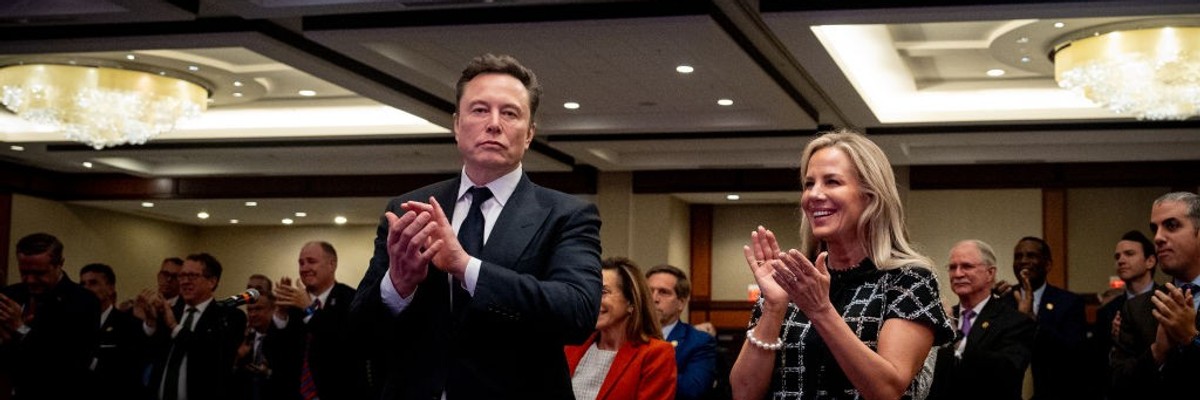
Elon Musk and the wife of House Speaker Mike Johnson (R-La.) applaud during a House Republican Conference meeting on November 13, 2024 in Washington, D.C. (Photo: Andrew Harnik/Getty Images)

“If there was ever a moment when progressives needed to communicate our vision to the people of our country, this is that time,” wrote Sen. Bernie Sanders. “Despair is not an option.”

Bloomberg analysis of billionaire wealth published Tuesday found that the combined fortunes of the 500 richest people on the planet surpassed $10 trillion this year, a finding that came shortly after U.S. Sen. Bernie Sanders issued an urgent call to action to prevent the emergence of “an oligarchic and authoritarian society.”

The new analysis notes that the world’s top 500 billionaires “got vastly richer” this year with the help of “an indomitable rally in U.S. technology stocks.”

Just eight billionaires—Elon Musk, Mark Zuckerberg, Jensen Huang, Larry Ellison, Jeff Bezos, Michael Dell, Larry Page, and Sergey Brin—added more than $600 billion to their collective wealth in 2024 and accounted for 43% of the $1.5 trillion increase in net worth among the world’s 500 richest people, according to Bloomberg.

“But it was Musk—the so-called ‘first buddy’ of President-elect Donald Trump after unprecedented support for his reelection campaign—who dominated the world’s wealthiest in 2024,” Bloomberg observed, adding that Trump himself also saw his fortune surge to a record high this year, “boosted by the performance of his majority stake in Trump Media & Technology Group Corp.”

Musk’s use of his enormous fortune to influence the U.S. political system—including via his purchase of one of the world’s largest social media platforms and donations to Trump’s 2024 campaign—amplified existing concerns about the corrosive impact of massive wealth concentration on democracy.

And wealth inequality in the U.S. could soon get worse, with Trump and the incoming Republican-controlled Congress set to pursue another round of tax cuts for the ultra-rich and large corporations.

“They do not believe in democracy—the right of ordinary people to control their own futures. They firmly believe that the rich and powerful should determine the future.”

In an email to supporters on Monday, Sanders (I-Vt.) called the rapid shift toward oligarchy in the U.S. “the defining issue of our time,” warning that billionaires have come to increasingly dominate not only “our economic life, but the information we consume and our politics as well.”

“A manifestation of the current moment is the rise of Elon Musk, and all that he stands for,” Sanders wrote, pointing to Musk’s outsize influence on the 2024 election and his key role in shaping Trump’s billionaire-dominated Cabinet.

“But it’s not just Musk. Billionaire owners of two major newspapers overrode their editorial boards’ decisions to endorse Kamala Harris, while many others are kissing Trump’s ring by making large donations to his inauguration committee slush fund,” the senator continued. “They do not believe in democracy—the right of ordinary people to control their own futures. They firmly believe that the rich and powerful should determine the future.”

Progressives, Sanders wrote, have a “radically different vision,” one that prioritizes “an economic system based on the principles of justice,” “a vibrant democracy based on one person, one vote,” and making “healthcare a human right.”

“Even though we are not going to succeed in achieving that vision in the immediate future with Trump as president and Republicans controlling Congress, it is important that vision be maintained and we continue to fight for it,” wrote Sanders.

Since Trump’s victory in the 2024 election, Sanders has focused heavily on the need to organize the working class to combat the threat posed by Musk and other far-right billionaires who have amassed obscene wealth and political power.

In his email on Monday, the senator said he intends to “travel, organize, hold events, and create content that reaches people where they are” in the coming weeks as part of the “struggle to determine where we go from here.”

“Will this effort be easy?” asked Sanders. “No, of course it will not. Can it be done? We have no choice. If there was ever a moment when progressives needed to communicate our vision to the people of our country, this is that time. Despair is not an option. We are fighting not only for ourselves. We are fighting for our kids and future generations, and for the well-being of the planet.”

Original article by Jake Johnson republished from Common Dreams under Creative Commons (CC BY-NC-ND 3.0). 

Continue ReadingSanders Lays Out Plan to Fight Oligarchy as Wealth of Top Billionaires Passes $10 Trillion

Trump Is Turning the White House Into a Billionaire Time-Share

Spread the love

Original article by Bob Burnett republished from Common Dreams under Creative Commons (CC BY-NC-ND 3.0). 

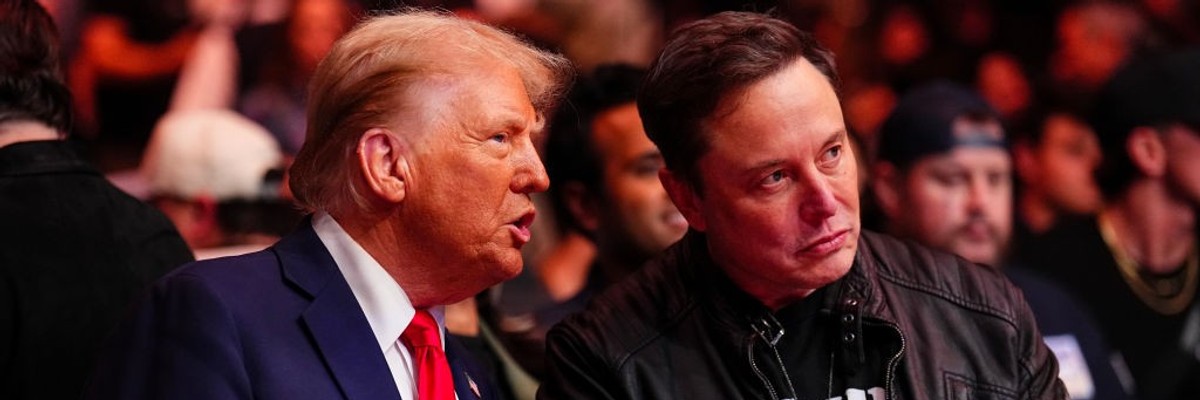
President-elect Donald Trump and Elon Musk talk ringside during the UFC 309 event at Madison Square Garden on November 16, 2024 in New York City. (Photo: Chris Unger/Zuffa LLC)

It appears that Trump has entered into a power-sharing agreement with Musk and several other wealthy individuals including Vivek Ramaswamy, Robert F. Kennedy Jr., and David Sacks.

Democracy decays into oligarchy when a few individuals accumulate most of the political power.

The reelection of Donald Trump has accelerated the decline of the United States into oligarchy. Trump has had billionaire donors for each of his presidential campaigns, but in 2024 the role of these wealthy donors expanded. Donors such as Elon Musk made gigantic contributions to Trump’s campaign; in return for this they are taking an active role in the Trump White House. Perhaps, this time around, Trump turned the oval office into a time-share.

On December 19, Elon Musk led the call for House Republicans to repudiate a continuing resolution they had just negotiated to keep the federal government running through the end of the year. Perhaps Musk’s charter includes coordination with Congress.

When Elon Musk and Vivek Ramaswamy speak of increasing government efficiency, they usually start with services for the unfortunate.

It appears that Trump has entered into a power-sharing agreement with Musk and several other wealthy individuals including Vivek Ramaswamy, Robert F. Kennedy Jr., and David Sacks. However this arrangement works, it’s likely that the Trump administration will cater to billionaires—Sen. Bernie Sanders (I-Vt.) observed that the 13 billionaires chosen by Trump to serve in his administration have a combined wealth of at least $383 billion.

What do these billionaires want? The oligarchs and billionaires want lower taxes and reduced government regulations. Of course, each billionaire has a particular set of interests; for example, David Sacks, Trump’s “AI and crypto czar,” is a venture capitalist with heavy investment in AI and crypto. Sadly. most of the oligarchs are climate-change deniers.

The oligarchs want more wealth. Robert Reich observes:

Since [1980], the median wage of the bottom 90% has stagnated. The share of the nation’s wealth owned by the richest 400 Americans has quadrupled (from less than 1% to 3.5%) while the share owned by the entire bottom half of America has dropped to 1.3%… The richest 1% of Americans now has more wealth than the bottom 90% combined.

The oligarchs share a fiscally conservative agenda. They intend to shrink the size of the federal government. The particulars vary but the oligarchs are not concerned with the size of the defense budget; their cost-cutting focus is on programs that service the poor and disadvantaged—such as Medicaid. When Elon Musk and Vivek Ramaswamy speak of increasing government efficiency, they usually start with services for the unfortunate.

What are the practical consequences of this shift to oligarchy? It’s unsettling to be in a political situation where we do not understand who is in charge at the White House. We don’t know how power-sharing will work. The relationship between Trump and Congress has been fraught. The shift to oligarchy will make this relationship even more difficult.

Will the oligarchs fix the economy? Trump was elected because he promised to fix the economy. Most Americans believed he would drive down inflation; they thought Trump would reduce the cost of food, housing, and household and medical expenses. Since November 5, Trump has given no indication of how he plans to do this. Perhaps he has lost interest.

During the presidential campaign, Trump said his inflation-fighting agenda would rely upon tariffs, but it’s likely that the oligarchs will influence how Trump’s tariff strategy plays out. Musk has huge business interests in China, and it’s unlikely that he would support a tariff policy that would hurt his relationships with the country.

Trump has appointed a “czar” for immigration (Tom Homan), energy (Doug Burgum), and AI & Crypto (Sacks). Trump has not appointed a czar for inflation. With much fanfare, Trump has appointed a commission on “government efficiency;” they’ve already started meeting. Trump has not appointed to a commission to curb inflation.

After January 20, Trump will own inflation and the economy. Trump’s immigration “purge” will drive up the cost of food. Trump’s tariffs will drive up the cost of household expenses.

Trump’s trying to ignore inflation. Or turn it over to an oligarch co-president. Stay tuned.

Original article by Bob Burnett republished from Common Dreams under Creative Commons (CC BY-NC-ND 3.0). 

Continue ReadingTrump Is Turning the White House Into a Billionaire Time-Share

Bernie Sanders Says Defeating Oligarchy Now Most Urgent Issue

Spread the love

Original article by Jon Queally republished from Common Dreams under Creative Commons (CC BY-NC-ND 3.0). 

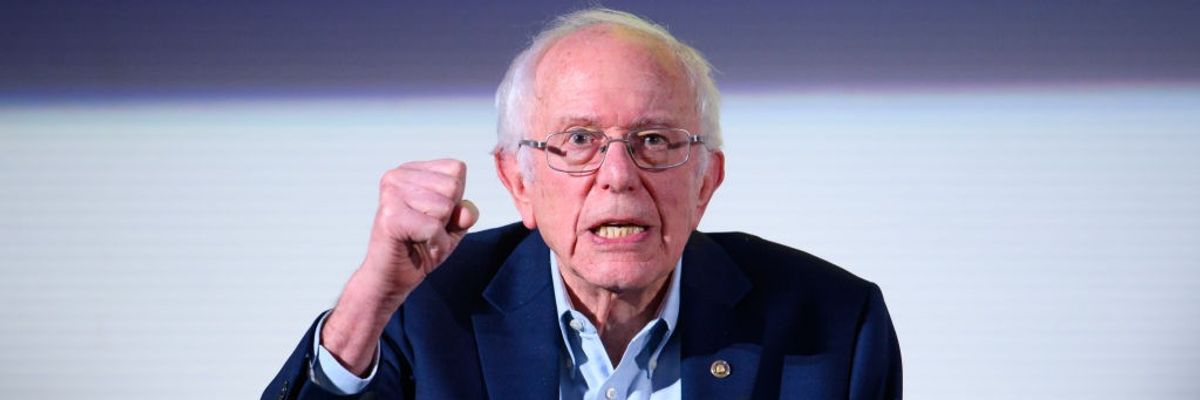
Bernie Sanders attends during “Bernie Sanders: It’s OK To Be Angry About Capitalism” at Royal Geographical Society on February 22, 2024 in London, England. (Photo by Joe Maher/Getty Images For Fane)

“My friends, you don’t have to be a PhD in political science to understand that this is not democracy. This is not one person, one vote. This is not all of us coming together to decide our future. This is oligarchy.”

Sen. Bernie Sanders of Vermont is escalating his fight against the U.S. oligarchy with a new campaign directed at the nation’s wealthiest individuals—including Elon Musk, Jeff Bezos, and Mark Zuckerberg—who he says are key culprits in a global race to the bottom that is stripping people worldwide of political agency while impoverishing billions so that the rich can amass increasingly obscene levels of wealth.

Announcing a new series that will detail how “billionaire oligarchs” in the U.S. “manipulate the global economy, purchase our elections, avoid paying taxes, and increasingly control our government,” Sanders said in a Friday night video address that it makes him laugh when mainstream pundits talk openly about the nefarious oligarchic structures in other places, but refuse to acknowledge the issue in domestic terms.

“Strangely enough, the term ‘oligarchy’ is very rarely used to describe what’s happening in the United States or in fact, what’s happening around the world,” said Sanders. “But guess what? Oligarchy is a global phenomenon, and it is headquartered right here in the United States.”

While rarely discussed in the corporate press or by most elected officials, argues Sanders, the reality is that a “small number of incredibly wealthy billionaires own and control much of the global economy. Period. End of discussion. And increasingly they own and control our government through a corrupt campaign finance system.”

Since the the victory of President-elect Donald Trump in November, Sanders has been increasingly outspoken about his frustrations over the failure of the Democratic Party to adequately confront the contradictions presented by a party that purports to represent the interests of the working class yet remains so beholden to corporate interests and the wealthy that lavish it with campaign contributions.

In a missive to supporters last month, Sanders bemoaned how “just 150 billionaire families spent nearly $2 billion to get their candidates elected” in this year’s elections, which included giving to both major political parties. Such a reality, he said, must be challenged.

As part of his new effort announced Friday, Sanders’ office said the two-time Democratic presidential candidate would be hosting a series of discussions with the leading experts on various topics related to the form and function of U.S. oligarchy and expose the incoming Trump administration’s “ties to the billionaire class,” including their efforts to further erode democracy, gut regulations, enrich themselves, and undermine the common good.

“In my view,” said Sanders, “this issue of oligarchy is the most important issue facing our country and world because it touches on everything else.” He said the climate crisis, healthcare, worker protections, and the fight against poverty are all adversely effected by the power of the wealthy elites who control the economy and the political sphere.

“My friends, you don’t have to be a PhD in political science to understand that this is not democracy,” he said. “This is not one person, one vote. This is not all of us coming together to decide our future. This is oligarchy.”

Original article by Jon Queally republished from Common Dreams under Creative Commons (CC BY-NC-ND 3.0). 

Continue ReadingBernie Sanders Says Defeating Oligarchy Now Most Urgent Issue