Cabinet Office minister Michael Gove referred Tory donor firms to Covid ‘VIP lane’
Exclusive: Judge slams “most unsatisfactory” Cabinet Office and orders release of names of ‘VIP’ firms to Democracy for Sale reporter – after *four year* wait.
The government has lost a long-running legal battle to block the release of information on companies referred to the lucrative ‘VIP lane’ for Covid contracts.
Firms linked to Conservative donors and party figures received over a billion pounds in PPE contracts during the pandemic after referrals from Tory ministers, MPs, and officials.
Companies in the VIP lane were ten times more likely to be given contracts, yet over half of the PPE they supplied was unusable.
In February 2021, Democracy for Sale reporter Jenna Corderoy filed a Freedom of Information (FOI) request seeking the names of all companies referred to the VIP lane and those who recommended them, including MPs and members of the House of Lords.
Months later, a court ruled the VIP lane was “unlawful,” and the government released the names of companies that secured contracts.
However, the identities of unsuccessful bidders and their political referrers remained secret, keeping the public in the dark about how politicians had helped politically-connected VIPs to seek public contracts.
For four years, the government resisted full disclosure, arguing it should not have to reveal how the VIP lane operated.
Corderoy took the case all the way to an information tribunal, where Judge Foss has now ruled that the government has 35 days to give Democracy for Sale the names of all unsuccessful companies.
You probably missed it, but a few months ago a report was published that inspected how the UK government prepared for major emergencies. What it found has profound implications for the whole country.
The report was written by the UK’s public inquiry into the COVID-19 pandemic and explained how the pandemic was an example of what’s called a “non-malicious threat”. These are major threats to our collective security that arise not from hostile intent – like terrorism or war – but as a result of human error, structural failure, or natural disasters. In this instance it was a novel virus that jumped from animals to humans and then rapidly spread.
The pandemic affected everything. Its impact was so severe that it created what the government calls a “whole-system civil emergency”, a rapidly escalating crisis that significantly affected multiple dimensions of the UK’s security, from the health system, through economic stability, to public trust. This was the UK’s greatest security crisis since the second world war. Yet it had nothing to do with armed conflict.
The inquiry found that successive governments grossly underestimated pandemic threats. They were not given the same priority as security threats coming from hostile action, like Russian aggression or terrorism. The subsequent tragedy proved how much of a mistake this was. When it came to planning and responding to whole-system civil emergencies, the UK government “failed their citizens”, the inquiry said, before concluding that “fundamental reform” was needed.
We have worked on a new report that finds worrying similarities to another, even greater “non-malicious threat” to security: climate change.
Compounding climate risks
Two weeks ago Hurricane Helene crashed into Florida and proceeded to cut a chaotic swathe north. By the time it dissipated over Tennessee two days later, over 200 people were dead and losses amounted to tens of billions of dollars.
Now Florida has been battered by Hurricane Milton too, which may prove to be more destructive in part because it came in the wake of Helene. Much of the region’s road, rail, and power infrastructure was still damaged. Many of the buildings still standing had been seriously weakened. Piles of debris from the clean up quickly became dangerous projectiles in Milton’s powerful winds. Hurricanes such as Helene and Milton are now twice as likely given climate change.
From hurricanes to deadly heatwaves, crippling droughts to crop failures – the consequences of climate change are potentially catastrophic. And while we have improved our resilience to individual extreme weather events, increasing climate change makes it more likely that impacts will pile up with the sum of loss and damages being much higher than the parts. It is these cascading and compounding impacts that not only threaten local communities, but add up to destabilise the security of entire countries and the globalised systems that connect them.
Yet many governments do not routinely consider extreme climate scenarios in their security plans, and instead continue to assume that climate risks will gradually evolve over the long term.
This approach is proving to be grossly insufficient. Take food security for example. Cascading climate effects are estimated to have caused a third of UK food price inflation in recent years, an impact compounded by rising energy prices. Spiking energy prices were the result of our reliance on fossil fuels, which became far more expensive after Russia invaded Ukraine.
These episodes show us how the causes and consequences of climate change supercharge the world’s security problems.
Tipping towards catastrophe
These climate risks create the potential for further “whole-system civil emergencies”. One example is tipping points. For instance, one of the Earth’s key ocean current systems is the Atlantic meridional overturning circulation (Amoc), which transports vast amounts of heat from the tropics to the northern hemisphere. Yet climate change is weakening the Amoc, a process that could lead it to pass a tipping point and collapse at some point this century, though there is still much debate among climate scientists over exact dates and probabilities.
Collapse would effectively wipe out crop growing in the UK, and devastate food production over much of Europe and North America, while disrupting key weather patterns across the globe. This would be a planetary-scale cataclysm with unmanageable security outcomes. A collapse this century cannot be ruled out without urgent international action to reduce emissions.
Meanwhile, the collapse of a northern section of the Amoc – in the North Atlantic subpolar gyre – could happen much sooner. While less severe, a collapse would upend weather in the UK, destabilising food production, public health, and infrastructure. Evidence suggests that the likelihood of this collapse is alarmingly high – up to a 45% chance of occurring this century – and that it could happen as early as 2040, if not before.
Inadequate assessment
Yet these risks do not appear in the UK government’s national register of security threats. In fact, there isn’t even a dedicated security risk assessment of climate change. The government’s existing climate change risk assessment is not set up to assess broader security threats in the round and is not intended for high level security decision-makers.
There are also important analytical flaws, such as inadequate consideration of cascading and interacting risks like successive hurricanes or a flood that also spreads diseases or disrupts food supplies months later. Individually, these risks might be bearable; together, they could prove unbearable.
Meanwhile, responsibility for climate risks is currently siloed away in non-security departments, marginalising climate change from the top table of decision-making on security.
Thankfully, the new UK government is undertaking a review of its national resilience and security policies. Climate change should be at the heart of its plans. The pandemic inquiry’s findings could represent a warning from a future in which the threat posed by climate change is still not taken seriously in key parts of government.
We face a choice. We can wait until climate impacts spiral out of control, and panicked governments resort to false solutions like more border walls and militarisation. Worryingly, the chances of this are growing as governments continue to effectively fly blind into an increasingly dangerous future. Alternatively, the institutions of government that are intended to protect us against major emergencies can finally act and begin to turn us away from the gathering storm.
Jeff Bezos and his fiancée Lauren Sánchez arrive at an event in Milan, Italy on January 13, 2024. (Photo: Jacopo Raule/Getty Images)
It’s been a rough few years for most people around the world—but not these folks.
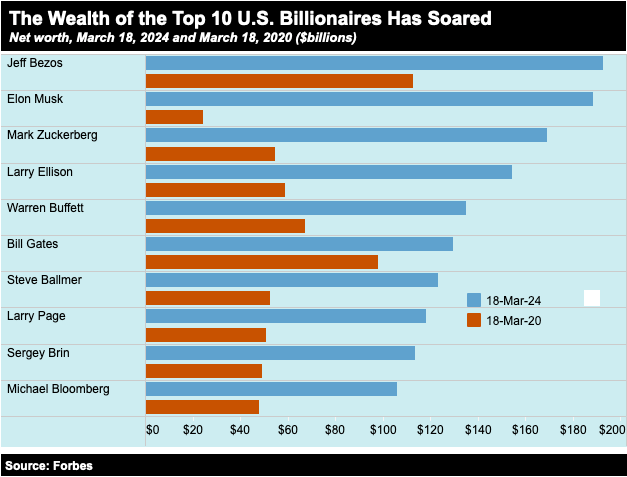
Four years ago, the United States entered the Covid-19 pandemic. Forbes published its 34th annual billionaire survey shortly after with data keyed to March 18, 2020. On that day, the United States had 614 billionaires who owned a combined wealth of $2.947 trillion.
Four years later, on March 18, 2024, the country has 737 billionaires with a combined wealth of $5.529 trillion, an 87.6 percent increase of $2.58 trillion, according to Institute for Policy Studies calculations of Forbes Real Time Billionaire Data. (Thank you, Forbes!)
The last four years have been great for particular billionaires:
On March 18, 2020, Tesla CEO Elon Musk had wealth valued just under $25 billion. By May 2022, his wealth had surged to $255 billion. As of March 18, 2024, Musk is at $188.5 billion, more than a seven-fold increase in four years.
Over four years, Amazon founder Jeff Bezos has seen his wealth increase from $113 billion to 192.8 billion, even after paying out tens of billions in a divorce settlement and donating tens of billions to charity.
Three Walton family members — Jim, Alice, and Rob — are the principal heirs to the Walmart fortune. They saw their combined assets rise from $161.1 billion to $229.6 billion.
In 2020, only one billionaire — Jeff Bezos — had $100 billion or more. Today, the entire top ten are centi-billionaires, bringing their collective wealth to a staggering $1.4 trillion.
The only billionaire on the 2020 top 15 wealthiest Americans list to see their wealth decline in four years was MacKenzie Scott. Four years ago, on March 18, 2020, the ex-wife of Jeff Bezos had a net worth of $36 billion. It has declined to $35.4 billion due to her aggressive giving to charity.
For more details on how America’s billionaires have fared since the onset of the pandemic, check out our updates page.