Palestine Action dismantle Elbit equipment, 6 August 2024. (Photo: Handout)
My understanding is that I am unable to mention many issues contained in this article due to secret court orders: UK judge Gags Palestine Action Defendants to Secure ‘Terror’ Stitch-Up so I won’t do that. What I will say is that the UK government and state has gone to considerable lengths to restrict the rights of Palestine Action defendants and supporters of Palestine Action persecuted for holding signs.
Palestine Action joke that appeared in the UK satirical magazine ‘Private Eye’.Keir Starmer objects to criticism of the IDF. He asks how could anyone object to them starving people to death, forced marches like the Nazis did, bombing Gaza’s hospitals and universities, mass-murdering journalists, healthworkers and starving people queuing for food, killing and raping prisoners and murdering children. He calls for people to stop obstructing his genocide for Israel.Keir Starmer explains that UK is actively supporting Israel’s genocidal expansion and repeats his previous quotation that he supports Zionism “without qualification”. Keir Starmer said “I said it loud and clear – and meant it – that I support Zionism without qualification.” here: https://www.jewishnews.co.uk/keir-starmer-interview-i-will-work-to-eradicate-antisemitism-from-day-one/
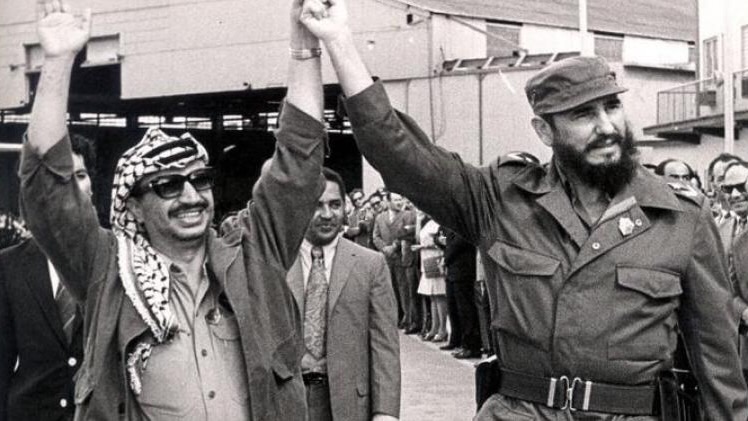
Palestinian leader Yasser Arafat and Cuban President Fidel Castro. Photo: Cuba Sí
On the 99th anniversary of Fidel Castro’s birth, we remember the revolutionary government’s support for Palestine, especially its condemnation of the genocide of the Palestinian people.
In a famous speech, Fidel Castro, the supreme leader of the Cuban Revolution, stated that medical, civil, and military support for the Angolan people was provided without expectation of any material reward. He pointed out that this way of thinking exposes an imperialist ideology, according to which one country supports another, always expecting to benefit materially in some way. “Revolutionaries expect nothing, which means that revolutionaries must devote themselves totally to a cause, to their ideas, to their noble goals, without expecting anything in return.”
This was the same principle that Fidel applied in supporting the Palestinian people’s struggle almost from the beginning of the revolutionary process he led since 1959. It is no coincidence that one of the most renowned Palestinian leaders, Yasser Arafat, visited the Caribbean Island eight times, on the personal invitation of Castro.
On October 12, 1979, at the United Nations Assembly, Fidel denounced before the world Israel’s process of territorial expansion, supported by the United States, at the expense of Palestinian territory. “The basis for a just peace in the region begins with Israel’s total and unconditional withdrawal from all occupied Arab territories and for the Palestinian people, the return of all their occupied territories and the restoration of their inalienable national rights, including the right of return to their homeland, self-determination, and the establishment of an independent state in Palestine, following General Assembly Resolution 3236,” Fidel said.
Castro acknowledged that this expansion was achieved through the killing of Palestinians, thus becoming one of the first world leaders to speak of “genocide” against the Palestinian people: “We repudiate with all our strength the ruthless persecution and genocide that Nazism unleashed against the Jewish people in its time. But I can think of nothing more similar in our contemporary history than the eviction, persecution, and genocide that imperialism and Zionism are carrying out today against the Palestinian people. Stripped of their lands, expelled from their homeland, scattered throughout the world, persecuted and murdered, the heroic Palestinians are an impressive example of self-sacrifice and patriotism, and they are the living symbol of the greatest crime of our time.”
Fidel also recognized that there are geopolitical interests that do not want peace to be established in the Middle East: “Can anyone be surprised that the Conference (of the Non-Aligned Movement) was forced, for reasons that do not stem from any political prejudice but from an objective analysis of the facts, to point out that US policy plays a fundamental role in preventing the establishment of a just and comprehensive peace in the region, by aligning itself with Israel, supporting it, and working to obtain partial solutions favorable to Zionist objectives and guaranteeing the fruits of Israeli aggression at the expense of the Arab people of Palestine and the entire Arab nation?”
“More than just rhetorical support, it was tangible support”
As historians point out, Fidel’s support for Palestine was not purely rhetorical, but also diplomatic. In 1974, Arafat arrived in Cuba and was received with the honors of a head of state, even though Palestine was not yet “officially” recognized as a state. Fidel’s message was clear: Palestine should be recognized by the international community as a state, and Arafat as its leader. In addition, Arafat was awarded the Playa Girón National Order, Cuba’s highest recognition for citizens “who have excelled in the struggle against imperialism, colonialism, and neo-colonialism, or who have done great deeds for peace and progress of mankind”.
The relationship between Cuban revolutionaries and the Palestine Liberation Organization (PLO) dates to the beginning of the Cuban Revolution. In 1959, Raúl Castro and Ernesto “Che” Guevara traveled to the Gaza Strip, disobeying the doctrine of hemispheric alignment whereby all Latin American countries, except for Cuba, supported Israel.
Thus, in 1964, thanks to Che Guevara’s tremendous efforts, Cuba recognized the PLO as soon as it was founded, becoming one of the first countries to do so. But its support went beyond official documents, according to Mansour Tahboub, former acting director of the Arafat Foundation: “Cuba has always been a strong supporter of Palestinians in all realms: political, military, vocational training. The Cubans trained Palestinian cadres, and Fidel himself was a staunch advocate of the Palestinian quest for freedom and independence.”
The truth is that one of the core principles of Castro’s administration was to support anti-imperialist and anti-colonialist struggles, wherever they took place. In a 1977 interview with French Weekly, Fidel stated: “The Palestinian movements have shown their ability to resist imperialist … aggression … [The Palestinian cause] will prevail sooner or later despite the betrayal by Arab reactionaries, imperialist maneuvers and Israeli aggression.”
That is why Cuba, along with Nicaragua, were the only two Latin American countries to condemn Israel’s actions after the Six-Day War. In 1973, Cuba severed diplomatic relations with Israel following the Non-Aligned Movement meeting in Algeria.
According to Abdel Majeed Sweilim, professor of political science at Al Quds University, the PLO also benefited from the relationship between Cubans and Palestinians, thanks to the political training of Palestinians on Cuban soil.
Today, despite the economic blockade imposed by the United States, which causes a perpetual economic crisis on the Caribbean Island, the Cuban government has reserved funding in the form of academic scholarships so that each year, 150 Palestinians can study medicine, engineering, and other professions at Cuban universities.
In his final years, Fidel continued to support the Palestinian cause. Thus, after resigning from his political posts, Castro signed an international manifesto in support of Palestine in 2014, which demanded Israel’s withdrawal from the Gaza Strip, the West Bank, and East Jerusalem, as well as respect for the resolutions passed by the United Nations regarding the conflict.
Arafat’s recognition of Cuban support
These and other measures have led countless Palestinians to see the revolutionary government of Cuba as an unwavering ally. Arafat himself acknowledged this when he stated: “I consider, Your Excellency President Fidel Castro, this demonstration of firmness and unwavering friendship that has taken place in Havana, as a strong and effective message from a beloved world leader who enjoys great international prestige among all the peoples and countries of the world, to mobilize them quickly to put an end to the suffering of the Palestinian people as a result of the Israeli occupation of their homeland, and the intensification of military, economic, and financial actions and blockades against our cities, villages, towns, farms, and water wells, and the closure of international border crossings by land, air, and water.”
In addition, the historic leader of the PLO said: “Every Palestinian today holds in their heart and conscience this glorious image of Your Excellency with the Palestinian hatta on your shoulders, which is irrefutable evidence of the justice of our cause and the magnitude of the injustice committed by the Israeli aggressors against our people. Have full confidence, Your Excellency President Castro, so beloved by our people and by all peoples, that our people, as resilient as the Palestinian mountains, take from your position and example, which makes us proud, more courage and determination to continue the struggle, the resistance, and the Intifada to remove the Israeli occupiers from our country, Palestine.”
In this way, Cuba continues to unreservedly support the demands for sovereignty, self-determination, and peace made by the Palestinian people in the face of the previous and most recent attacks by the Israeli government on their territory. This support, since 1959, is not given with the expectation of anything in return, but because of the anti-imperialist and anti-colonialist principles that guide the Cuban Revolution and that Fidel helped to establish as principles of the Cuban state itself.
Genocide denier and Current UK Prime Minister Keir Starmer is quoted that he supports Zionism without qualification. He also confirms that UK air force support has been essential in Israel’s mass-murdering genocide. Includes URLs https://www.declassifieduk.org/keir-starmers-100-spy-flights-over-gaza-in-support-of-israel/ and https://youtu.be/O74hZCKKdpAKeir Starmer objects to criticism of the IDF. He asks how could anyone object to them starving people to death, forced marches like the Nazis did, bombing Gaza’s hospitals and universities,mass-murdering journalists, healthworkers and starving people queuing for food, killing and raping prisoners and murdering children. He calls for people to stop obstructing his genocide for Israel.
Journalist Richard Medhurst addresses supporters of jailed WikiLeaks founder Julian Assange outside 10 Downing Street following the second day of his final extradition appeal on February 21, 2024 in London. (Photo: Mark Kerrison/In Pictures via Getty Images)
“I criticized the Terrorism Act before getting on the plane, then got arrested under the Terrorism Act upon landing.”
Richard Medhurst, a Syrian-British independent journalist who defends Palestinians’ right to resist Israeli apartheid, occupation, and other crimes, said this week that he was recently arrested at London’s Heathrow Airport and held for nearly 24 hours for allegedly running afoul of a highly controversial anti-terrorism law critics say is used to silence legitimate dissent.
Medhurst—who is known for his work opposing U.S., British, and Israeli war crimes in the Middle East and for his advocacy for formerly imprisoned WikiLeaks founder Julian Assange—said on social media Tuesday: “I criticized the Terrorism Act before getting on the plane, then got arrested under the Terrorism Act upon landing. Can’t make this up.”
In a nearly nine-minute video posted Monday night on X, the social network formerly known as Twitter, Medhurst said that “on Thursday, as I landed in London Heathrow Airport, I was immediately escorted off the plane by six police officers who were waiting for me at the entrance of the aircraft.”
“They arrested me—not detained—they arrested me under Section 12 of the Terrorism Act of 2000 and accused me of allegedly ‘expressing an opinion or belief that is supportive of a prescribed organization,’ but wouldn’t explain what this meant,” he continued.
If you thought Britain's draconian terrorism laws were intended simply to stop terrorism, think again.
They're also there to stop us learning about how our own government spreads terror.
Independent journalist Richard Medhurst gives shocking details about his arrest under the… https://t.co/A0SDKn20UI
The controversial law criminalizes anyone who “invites support for a proscribed organization” or “expresses an opinion or belief that is supportive” of such a group. Violators can be punished with up to 14 years’ imprisonment and a fine.
As Laura Tiernan explained Tuesday at World Socialist Web Site:
Introduced by [former U.K. Prime Minister] Tony Blair’s Labour government, the act is a legal dragnet. In Medhurst’s case, it appears that commentary defending the right of Palestinians under international law to resist foreign military occupation and genocide is being defined as support for terrorism.
Hamas is among the organizations proscribed as terrorist by the U.K. government. While its military wing was proscribed in 2001, Hamas was banned in its entirety in 2021, aimed at criminalizing support for the Palestinian people. The political wing of Hamas won elections held in Gaza in 2006 and the organization also oversees charitable work.
Medhurst said: “I categorically and utterly reject all the accusations by the police. I am not a terrorist. I have no criminal record. Prior to this incident, I’d never been detained in my entire life.”
“I’m a product of the diplomatic community, and I’m raised to be anti-war,” he explained. “Both of my parents won Nobel Peace Prizes for their work as United Nations peacekeepers. They had a tremendous effect on my worldview and outlook and instilled in me the importance of diplomacy, international law, and peace.”
Medhurst said he was searched, handcuffed, and taken in a police van to a station where he was searched again, fingerprinted, photographed, and placed in solitary confinement. His phone and work equipment were seized. When he questioned why he’d been arrested, “the police would say something like: ‘Well, we’re just the arresting officers. We don’t really know.’”
“No one in the world knew what had happened to me or where I was,” he said. “I had to ask like four or five different guards for several hours until I finally received a call. In total, I spent almost 24 hours in detention. At no point whatsoever was I allowed to speak to a family member or a friend. After waiting 15 hours, I was finally interviewed by two detectives.”
I am being politically persecuted by my own government, so unfortunately I am unable to speak freely or do my job as a journalist it seems.
I thought I'd seen it all in court with Julian's case, but this is really something.
“I felt that the whole process was designed to humiliate, intimidate, and dehumanize me and treat me like a criminal, even though they must’ve been aware of my background and that I’m a journalist,” Medhurst alleged. He contended that his arrest was “done on purpose to try and rattle me psychologically,” and noted that “many people have been detained in Britain because of their connection to journalism.”
He named Assange—who was freed in June following a plea deal with the U.S. government—as well as Scottish author Craig Murray, Grayzone correspondent Kit Clarenberg, and Glenn Greenwald’s late partner, Brazilian politician David Miranda, as people who have been targeted for their political beliefs and expression.
“Freedom of the press, freedom of speech really are under attack,” Medhurst warned in the video. “The state is cracking down and escalating to try and stop people from speaking out against our government’s complicity in genocide.”
Israel is currently on trial for genocide at the International Court of Justice over its 320-day assault on Gaza, which has killed more than 40,000 Palestinians, wounded at least 93,000 others, starved hundreds of thousands more, and obliterated the coastal enclave.
“We cannot call ourselves a democracy as long as reporters are dragged off of planes and detained and treated like murderers,” Medhurst concluded. “I am disgusted that I am being politically persecuted in my own country.”