‘Downright Orwellian’: In Midst of Planetary Emergency, Trump Admin Takes Down Website Hosting Influential US Climate Report

Spread the love

Original article by Eloise Goldsmith republished from Common Dreams under Creative Commons (CC BY-NC-ND 3.0). 
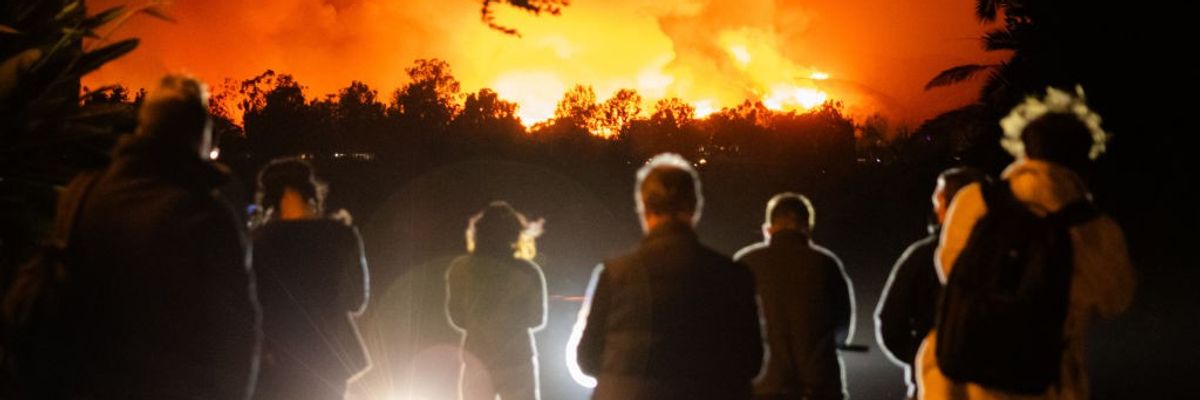
People watch the smoke and flames from the Palisades Fire in the Pacific Palisades neighborhood on January 7, 2025 in Los Angeles, California. 
(Photo: Tiffany Rose/Getty Images)

“This is the modern version of book burning,” said one scientist.

Amidst an ever-worsening climate emergency, the Trump administration this week took down the website hosting the U.S. government’s preeminent climate assessment, sparking outcry from experts who have worked previous versions of the report.

Considered the definitive body of research about how planetary warming is transforming the nation, the National Climate Assessment—which is required by Congress to be published every few years—gives a rundown of how global warming is impacting different sectors of the economy, ecosystems, and communities.

The five assessments that have been published so far were previously available through the website globalchange.gov, but the address stopped working Monday afternoon, according to The New York Times. As of Wednesday morning the website was still down.

However, it is still possible to access some of the climate research. The fifth assessment is available through the National Oceanic and Atmospheric Administration. An archived version of the fifth assessment is also available via Internet Archive’s Wayback Machine. According to a NASA spokesperson who spoke to NPR, all five editions of the assessment will also be available on NASA’s website, though it’s not clear when.

“It’s critical for decision-makers across the country to know what the science in the National Climate Assessment is. That is the most reliable and well-reviewed source of information about climate that exists for the United States,” Kathy Jacobs, a University of Arizona climate scientist who coordinated the 2014 version of the assessment, toldThe Associated Press.

“This is evidence of serious tampering with the facts and with people’s access to information, and it actually may increase the risk of people being harmed by climate-related impacts,” she added.

“They’re public documents. It’s scientific censorship at its worst,” said Peter Gleick, a California water and climate scientist who worked on the version of the assessment published in 2000, toldThe Los Angeles Times. “This is the modern version of book burning.”

Howard Crystal, legal director of the Center for Biological Diversity’s energy justice program, said in a statement on Tuesday that “it’s downright Orwellian for the Trump administration to take the nation’s premier climate reports and just yank them offline.”

“Hiding these congressionally mandated reports won’t make climate change go away, but it will leave Americans uninformed and unprepared,” he said.

Earlier in April, the Trump administration enacted cuts to the U.S. Global Change Research Program, which oversees the production of the National Climate Assessment, and later that month dismissed hundreds of scientists and experts working on the next version of the report, the 6th National Climate Assessment.

Meanwhile, a new budget document outlining fiscal year 2026 spending for the National Oceanic and Atmospheric Administration (NOAA) details deep cuts to climate research at the agency, including the elimination of the Office of Oceanic and Atmospheric Research, though some of its activities would be transferred to the National Ocean Service and the National Weather Service.

The budget proposal “eliminates all funding for climate, weather, and ocean Laboratories and Cooperative Institutes. It also does not fund Regional Climate Data and Information, Climate Competitive Research, the National Sea Grant College Program, Sea Grant Aquaculture Research, or the National Oceanographic Partnership Program,” according to the document.

With the termination of Climate Competitive Research, which funds academic institutions to do climate-related research, “NOAA will no longer support climate research grants,” the document also states.

“That’s it—with that statement, the administration signals its intent to have NOAA, arguably the world’s leading oceanic and atmospheric governmental organization, completely abandon climate science,” wrote Alan Gerard, a meteorologist who previously worked for NOAA.

Original article by Eloise Goldsmith republished from Common Dreams under Creative Commons (CC BY-NC-ND 3.0). 

Neo-Fascist Climate Science Denier Donald Trump says Burn, Baby, Burn.
Elon Musk urges you to be a Fascist like him, says that you can ignore facts and reality then.
Continue Reading‘Downright Orwellian’: In Midst of Planetary Emergency, Trump Admin Takes Down Website Hosting Influential US Climate Report

Pacific Islands Summit Highlights Disproportionate Climate Impacts

Spread the love

Original article by Brett Wilkins republished from Common Dreams under a CC licence.

Leaders of Pacific island nations gather in Nuku’alofa, Tonga on August 26, 2024 for the 53rd Pacific Islands Forum Leaders Meeting (PIFLM53).
 (Photo: Pacific Islands Climate Action Network/X)

U.N. Secretary-General António Guterres stressed that “the region urgently needs substantial finance, capacities, and technology to speed up the transition and to invest in adaptation and resilience.”

As more than 1,500 delegates from over 40 nations gathered in Tonga for the 53rd Pacific Islands Forum Leaders Meeting, climate defenders on Monday urged the world’s biggest polluters to do much more to phase out the fossil fuels that are driving a planetary emergency disproportionately affecting low-lying island countries, which are among the world’s lowest greenhouse gas emitters.

“Tonga’s vision for the 53rd Pacific Islands Forum Leaders Meeting (PIFLM53) is for the Pacific to move beyond policy deliberation to implementation—to achieve transformation by building better now,” summit organizers said in a statement affirming the event’s mission to “develop collective responses to regional issues and deliver on their vision for a resilient Pacific region of peace, harmony, security, social inclusion, and prosperity.”

“We may be small island countries but we are a force to be reckoned with.”

Addressing attendees at the summit’s opening ceremony in the Tongan capital of Nuku’alofa, Pacific Islands Forum (PIF) Secretary-General Baron Waqa of Nauru called for regional unity to tackle common challenges.

“We may be small island countries but we are a force to be reckoned with,” he said. “We are at the center of geostrategic interest, we are at the forefront of a battle against climate change and its impacts.”

Speaking at Monday’s opening session, United Nations Secretary-General António Guterres lamented that “humanity is treating the sea like a sewer. Plastic pollution is choking sea life. Greenhouse gases are causing ocean heating, acidification, and a dramatic and accelerating rise in sea levels.”

Guterres—who warned in Samoa last week that low-lying island nations face the threat of climate “annihilation”—said that “Pacific islands are showing the way to protect our climate, our planet, and our ocean: By declaring a climate emergency and pushing for action, and with your declarations on sea-level rise, and aspirations for a just transition to a fossil fuel-free Pacific. But, the region urgently needs substantial finance, capacities, and technology to speed up the transition and to invest in adaptation and resilience.”

“The young people of the Pacific have taken the climate crisis all the way to the International Court of Justice,” Guterres added. “You have also rightly recognized that this is a security crisis—and taken steps to manage those risks together.”

Mahoney Mori, who chairs the Pacific Youth Council and is the PIFLM53 youth representative from the Federated States of Micronesia, called out the international community’s failure to adequately fund climate mitigation initiatives like the loss and damage fund—which developing nations say will require an annual investment of at least $400 billion, or nearly 10 times the amount pledged at last year’s United Nations Climate Change Conference in Dubai.

“Despite the commendable pledges from the United Nations and world leaders such as the Paris agreement, the existing global finance mechanisms still hindered community-based and youth organizations from accessing critical support,” Mori said. “The Pacific’s grassroots organizations struggle to meet global standards amidst this crisis and time is running out.”

As leaders met for PIFLM53 amid torrential rains, a 6.9-magnitude earthquake rocked Tonga’s main island of Tongatapu. While there was no damage reported and no tsunami warning issued, summit attendees said the temblor underscored vulnerabilities faced by low-lying island nations.

Leaders and activists from Pacific island nations took aim at regional giant Australia—which has been perennially ranked as one of the world’s worst climate-wreckers in U.N.-backed Sustainable Development reports—for insufficient climate action.

“We recognize Australia’s desire to present itself as a climate leader and co-host the COP alongside the Pacific,” Pacific Islands Climate Action Network regional director Rufino Varea said in a statement, referring to Australia’s bid to help lead the 2026 United Nations Climate Change Conference, or COP31.

“However, true leadership must not merely be aspirational; it must be actionable,” Varea continued. “To date, Australia has expanded gas production instead of aligning its practices with the urgent needs of the Pacific. This does not reflect the leadership we need.”

“If Australia is to demonstrate genuine commitment, it must align its domestic and international climate policies with our goals and advocate earnestly for a fossil fuel-free Pacific,” he stressed. “It must also commit to ambitious climate actions, ensure effective climate finance is delivered to Pacific island countries, and contribute substantially to the loss and damage fund.”

“If these steps are not taken, we risk witnessing a COP that concedes failure—declaring that critical targets were missed, and that Pacific communities continue to be exploited as mere labor resources for the enrichment of others,” Varea added.

Original article by Brett Wilkins republished from Common Dreams under a CC licence.

Continue ReadingPacific Islands Summit Highlights Disproportionate Climate Impacts

‘Our Leaders Are Not Leading’: Groups Decry Yet Another G7 Climate Failure

Spread the love

Original article by BRETT WILKINS republished from Common Dreams under Creative Commons (CC BY-NC-ND 3.0). 

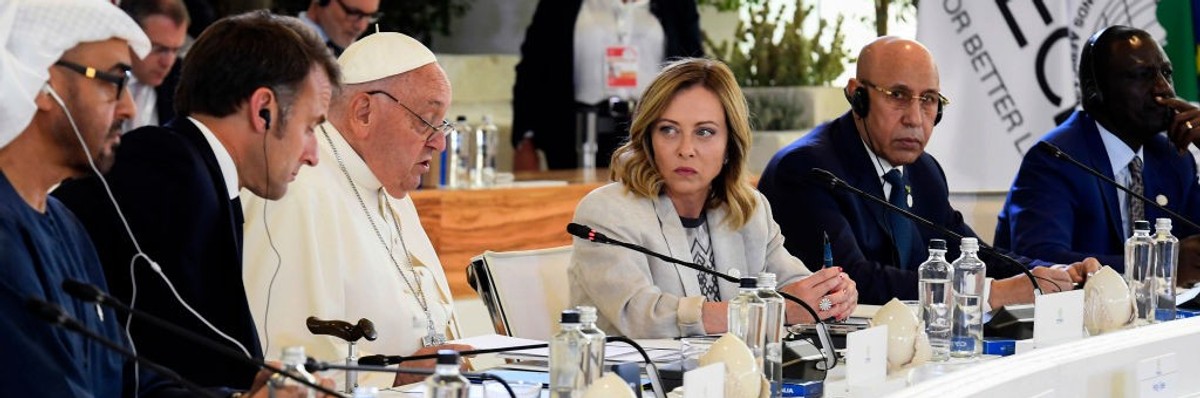
Italian Prime Minister Giorgia Meloni (center) looks toward Pope Francis as he speaks during the G7 Leaders Summit in Fasano, Italy on June 14, 2024. 
(Photo: Vatican Media via Vatican Pool/Getty Images)

“If these embattled leaders want to leave a lasting legacy, they need to heed the will of voters demanding a safe environment and climate,” one campaigner asserted.

As the Group of Seven summit wrapped up Friday in Italy, climate defenders condemned G7 leaders for their continued failure to take meaningful action to combat the worsening planetary emergency.

Taking aim at what critics called the G7 leaders’ largely empty pledge to undertake “concrete steps to address the triple crisis of climate change, pollution, and biodiversity loss,” 350.org U.S. campaigns manager Candice Fortin lamented that “yet another meeting ends without real commitments to revert the situation rich countries like the U.S. put us in.”

“As COP29 approaches and the world deals with worsening climate impacts, we can’t afford to waste more time,” Fortin said, referring to the United Nations Climate Change Conference scheduled to take place in Baku, the capital of Azerbaijan—a major fossil fuel-producing nation—in November. COP29 is set to be chaired by a former oil executive.

“If the U.S. wants to pride itself on being a ‘world leader,’ it needs to show how it will pay its climate debt to climate-vulnerable countries that bear the most significant climate impacts without the necessary funds for adaptation,” Fortin added.

While G7 governments hailed their recent agreement to phase out existing unabated coal power generation in energy systems during the first half of the 2030s, critics took issue with the policy’s timeline and banks’ continued financing of fossil fuels.

“Our leaders are not leading. In the hottest 12 consecutive months of recorded human history, our leaders are failing us,” argued Bronwen Tucker, Oil Change International’s public finance lead. “G7 countries are adopting an inadequate coal phaseout date and endorsing increased fossil gas production, sending a terrible signal at a time when countries should be focusing on accelerating the phaseout, not delaying it.”

Tucker continued:

G7 leaders can’t say they’re committed to a livable climate while expanding and bankrolling the fossil fuel industry at home and abroad. At the same time, these rich countries should not be congratulating themselves for delivering $100 billion for climate finance two years too late. Trillions are needed to cover climate damages and the G7’s finance was largely provided as loans which only worsens unjust debts.

“The G7 must end the billions of dollars in taxpayer finance still flowing to fossil fuel projects abroad and fund the buildout of affordable renewable energy on fair terms,” Tucker asserted. “If their oil and gas expansion plans are allowed to proceed, it will lock in climate chaos and an unlivable future.”

Greenpeace International climate politics expert Tracy Carty said in a statement that “if these embattled leaders want to leave a lasting legacy, they need to heed the will of voters demanding a safe environment and climate.”

“Taxing the billions of dollars in profits of the fossil fuel industry to fund climate action at home and abroad could be their stake in history and a win for people and planet,” Carty continued. “G7 leaders need to seize the moment ahead of the U.N. climate talks in Baku and show they will lead the transition away from fossil fuels and build trust they will significantly increase climate finance support to developing countries.”

Original article by BRETT WILKINS republished from Common Dreams under Creative Commons (CC BY-NC-ND 3.0). 

Continue Reading‘Our Leaders Are Not Leading’: Groups Decry Yet Another G7 Climate Failure