Pope Francis calls Israel’s bombing of Gaza children a “great cruelty”

Spread the love

Original article by Aseel Saleh republished from peoples dispatch under a Creative Commons Attribution-ShareAlike 4.0 (CC BY-SA) license.
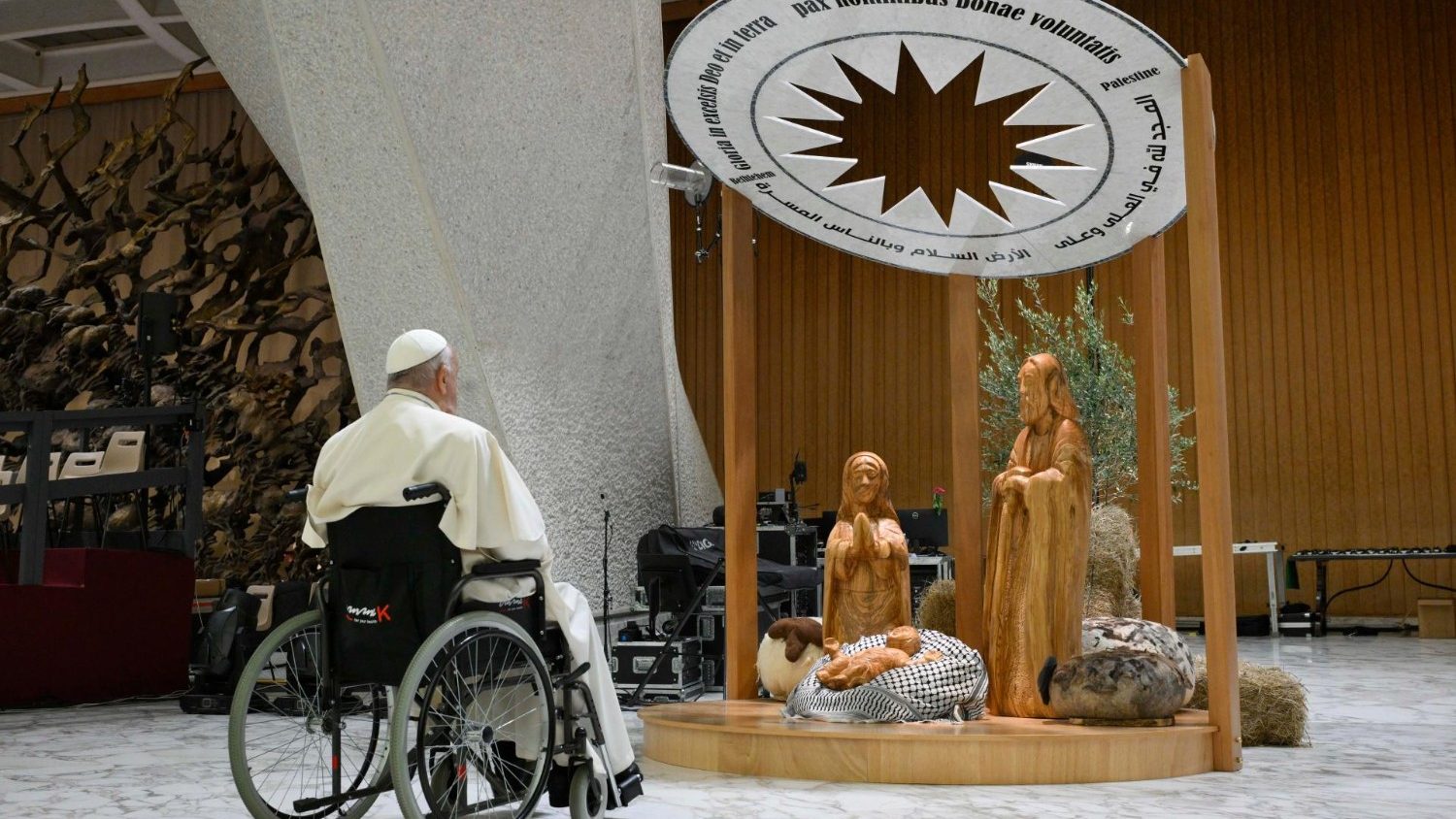
Pope Francis before the “Nativity of Bethlehem 2024” in the Paul VI Hall. Photo: Vatican News

Israel continues to commit massacres in Gaza, and has launched attacks on Pope Francis for speaking up in defense of the Palestinian people.

Pope Francis issued a sharp condemnation of the ongoing Israeli genocidal aggression on the Gaza strip this past weekend, just ahead of Christmas. His statements came after the Gaza Civil Defense rescue agency reported the killing of 12 people from the same family, including seven children, in an Israeli airstrike on Gaza’s northern city of Jabalia on Friday, December 20.

The Pontiff lamented the bombing of children in Gaza with deep sorrow during his traditional address to the cardinals, bishops, priests and lay people of the Roman Curia at the Vatican on Saturday, December 21.

“This is cruelty. This is not war. I want to say this because it touches the heart,” Pope Francis said. He also pointed out that the airstrikes had prevented the highest representative of the Catholic church in the Holy Land, Cardinal Pierbattista Pizzaballa, from entering Gaza the previous day.

Following Pope Francis’s Saturday address, the Israeli authorities allowed Pizzaballa to enter Gaza on Sunday, December 22, where he celebrated mass in the small Christian community of the Holy Family parish in Gaza City.

During a midday Angelus on Sunday, December 22, Pope Francis reiterated his repudiation of Israel’s continuous massacring of children in Gaza. “With sorrow I think of Gaza, of so much cruelty; of the children machine-gunned, the bombing of schools and hospitals…So much cruelty!”, the head of the Catholic Church and sovereign of the Vatican City State said.

On December 8, Pope Francis had issued an appeal addressing political leaders and the international community to reach a ceasefire on “all war fronts” by Christmas. “I appeal to Governments and the International Community that a ceasefire may be reached on all war fronts by the Christmas celebrations,” the appeal reads.

One day earlier, Pope Francis unveiled the annual nativity scene at the Vatican featuring baby Jesus draped in a Palestinian keffiyeh, which highlighted the Holy Family’s connection to the occupied Palestinian city of Bethlehem and served as a poignant nod to the Palestinian struggle.

Last November, Pope Francis urged that allegations of a genocide in Gaza should be “carefully investigated”. “According to some experts…what is happening in Gaza has the characteristics of a genocide,” the Pontiff writes in a forthcoming book. “It should be carefully investigated to determine whether it fits into the technical definition formulated by jurists and international bodies,” he writes.

Pope Francis also calls the leader of the Catholic Church in Gaza every night to check on them and hear news of how they are surviving which inevitably gives him an intimate look into the immense suffering and difficulties faced by the Palestinian people in Gaza.

The nativity scene and Pope Francis’s call for an investigation into the Israeli genocide in Gaza were slammed by Israel’s Diaspora Affairs and “Combating Antisemitism” Minister Amichai Chikli, who accused the Catholic leader of “deliberately adopting the Palestinian narrative.”

“Two weeks ago, you took part in a display that echoes the Palestinian narrative, portraying Jesus as a Palestinian Arab,” Chikli wrote in a strongly-worded letter sent to Pope Francis on Thursday, December 19. “Had this been a one-time matter, I would not have written. However, in a more severe expression, you recently insinuated that the State of Israel ‘might be’ committing genocide in Gaza,” the Israeli minister added. Chikli even went further by saying: “It is a well-known fact that Jesus was born to a Jewish mother, lived as a Jew and died as a Jew.”

Chikli’s statements once again reveal the paradox of the Israeli rhetoric, as people of the Christian community were among the first civilians to be crushed by the Israeli war machine in Gaza. In October 2023, St. Porphyrius Greek Orthodox Church in Gaza City, which is believed to be the third oldest church in the world, was bombed by Israeli warplanes while providing shelter for an estimated 500 Palestinians, most of whom were Christians. 16 Palestinian Christians were killed and dozens others injured in the assault, according to the Palestinian Health Ministry in the Gaza Strip.

In May 2024, the Palestinian State Minister of Foreign Affairs Varsen Aghabekian Shahin revealed during her meeting with a delegation from Churches for Middle East Peace (CMEP) that 3% of Gaza’s Christians were killed in the Israeli genocidal aggression on Gaza since October 7, 2023.

“The Israeli war has resulted in the death of 3% of Gaza’s Christians and the destruction of churches amid restrictions (on Christians) in the West Bank,” Shahin stated. Meanwhile, Gaza’s government media office estimated that at least three churches were destroyed in Israeli attacks in Gaza during the ongoing genocide.

Israel’s targeting of Christians and their holy sites is yet another evidence of its systematic ethnic cleansing of the Indigenous Palestinian people regardless of their faith.

For the second year, Palestinians are canceling Christmas celebrations to show solidarity with Gaza. “We chose to restrict Christmas celebrations to prayers as a stand against the oppression faced by Gaza and all of Palestine”, Bethlehem Mayor Anton Salman said a couple of days prior to the Christmas eve.


Original article by Aseel Saleh republished from peoples dispatch under a Creative Commons Attribution-ShareAlike 4.0 (CC BY-SA) license.

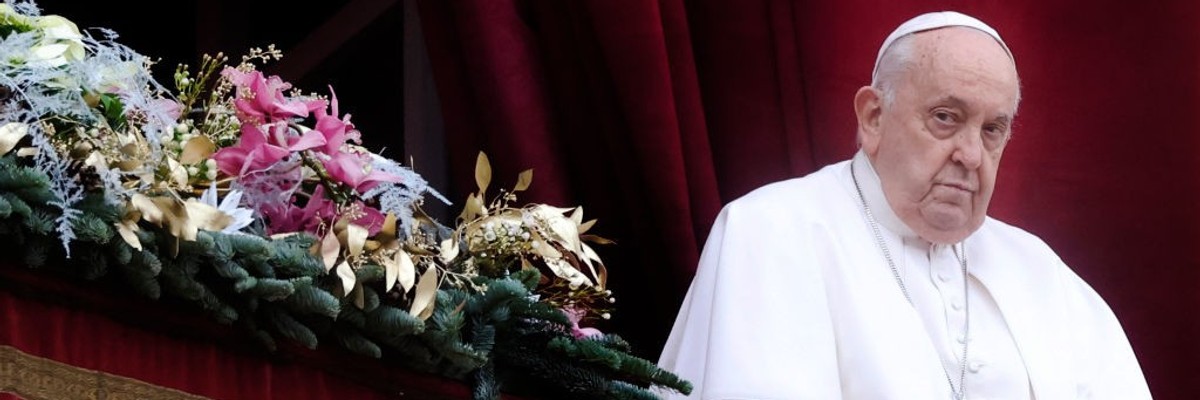
Continue ReadingPope Francis calls Israel’s bombing of Gaza children a “great cruelty”

Pope Francis condemns Israeli ‘cruelty’ in Gaza

Spread the love

https://www.middleeastmonitor.com/20241221-pope-francis-condemns-israeli-cruelty-in-gaza

Pope Francis attends his weekly general audience in the Paul VI hall at the Vatican, on August 07, 2024 [Riccardo De Luca/Anadolu Agency]

Pope Francis on Saturday condemned the recent Israeli air strikes on Gaza, expressing sorrow over the bombing of children in the Gaza Strip the previous day, Anadolu reports.

“Yesterday, children were bombed. This is not war. This is cruelty. I want to say this because it touches my heart,” he told members of the Roman Curia, the Vatican’s central administration.

He also lamented that Israeli air strikes had prevented Cardinal Pierbattista Pizzaballa, the highest representative of the Catholic Church in the Holy Land, from entering Gaza.

Israel has killed more than 45,000 people, most of them women and children, in Gaza since the Oct. 7, 2023 Hamas attacks, and reduced the territory to rubble.

On Nov. 21, the International Criminal Court issued arrest warrants for Israeli Prime Minister Benjamin Netanyahu and former Defense Minister Yoav Gallant for war crimes and crimes against humanity in Gaza.

Israel also faces a genocide case at the International Court of Justice for its military campaign in the enclave.

The pontiff has also called for an investigation to determine if Israel’s attacks in Gaza constitute genocide, according to excerpts from an upcoming new book.

READ: Israel leaves Palestinian bodies for stray dogs: Gaza Civil Defense

This work by Middle East Monitor is licensed under a Creative Commons Attribution-NonCommercial-ShareAlike 4.0 International License.

Continue ReadingPope Francis condemns Israeli ‘cruelty’ in Gaza

Pope Francis Urges Genocide Probe of Israel’s War on Gaza

Spread the love

Original article by Brett Wilkins republished from Common Dreams under Creative Commons (CC BY-NC-ND 3.0).

Pope Francis speaks on December 25, 2023 in the Vatican City.(Photo: Alessandra Benedetti/Corbis via Getty Images)

The pontiff’s call comes as the International Court of Justice is reviewing evidence in a South Africa-led genocide case against Israel.

In a new book set to be released this week, Pope Francis I endorsed a genocide investigation into Israel’s war on Gaza—which has killed or maimed more than 150,000 Palestinians and forcibly displaced, starved, or sickened millions more over the past 13 months.

“In the Middle East, where the open doors of nations like Jordan or Lebanon continue to be a salvation for millions of people fleeing conflicts in the region: I am thinking above all of those who leave Gaza in the midst of the famine that has struck their Palestinian brothers and sisters given the difficulty of getting food and aid into their territory,” the pontiff wrote in his latest book, which goes on sale in some countries on November 19.

“According to some experts, what is happening in Gaza has the characteristics of a genocide,” the Pope added. “It should be carefully investigated to determine whether it fits into the technical definition formulated by jurists and international bodies.”

https://twitter.com/VaticanNews/status/1858112095260131496?ref_src=twsrc%5Etfw%7Ctwcamp%5Etweetembed%7Ctwterm%5E1858112095260131496%7Ctwgr%5Eb6e2c072f49b719695cfba9fd09043a86ba065ff%7Ctwcon%5Es1_c10&ref_url=https%3A%2F%2Fwww.commondreams.org%2Fnews%2Fpope-gaza-genocide

Sorry, this content could not be embedded.
X

The Pope’s words echo last week’s finding by a United Nations expert panel that Israel’s annihilation of Gaza is “consistent with the characteristics of genocide.”

The International Court of Justice—a U.N. organ—is currently weighing a South Africa-led genocide case against Israel backed by more than 30 nations and regional blocs as well as hundreds of groups and experts around the world.

Meanwhile, the prosecutor of the International Criminal Court is seeking arrest warrants for Israeli Prime Minister Benjamin Netanyahu and former Israel Defense Minister Yoav Gallant, as well as three former Hamas leaders assassinated by Israel, for alleged war crimes and crimes against humanity, including extermination.

Many juristsscholars, and other expertsincluding some of Israel’s leading Holocaust historians—have called Israel’s policies and actions in Gaza genocide. Early in the war, Raz Segal—an Israeli historian and professor of Holocaust and genocide studies at Stockton University in New Jersey—called Israel’s Gaza onslaught “a textbook case of genocide.”

Numerous world leaders and other international officialsartistsentertainers, and others—including half of Democratic voters in the United States surveyed in May—also agree that Israel is committing genocide in Gaza.

Many Palestinian Christians have been killed, injured, or otherwise harmed by Israeli forces during the bombardment, invasion, and siege of Gaza. With just 800 to 1,000 people believed remaining in Gaza, members of the world’s oldest Christian community warned early in the war that they were “under threat of extinction.”

In their most infamous attack on Gaza Christians, Israeli forces bombed the 12th century Saint Porphyrius Greek Orthodox Church, Gaza’s oldest, in October 2023, killing 18 Palestinians including numerous children. Among the victims were two women and an infant related to former Republican U.S. Congressman Justin Amash of Michigan.

After an Israeli sniper fatally shot an elderly woman and her daughter on the grounds of a Catholic church in Gaza City last December, Pope Francis condemned what he called an act of “terrorism.”

Amid the death and destruction wrought by Israel’s assault on Gaza, last December’s Christmas celebrations were canceled in Bethlehem, the purported birthplace of Jesus Christ.

“How can we celebrate when we feel this war—this genocide—that is taking place could resume at any moment?” asked Palestinian Lutheran pastor Munther Isaac at the time.

Original article by Brett Wilkins republished from Common Dreams under Creative Commons (CC BY-NC-ND 3.0).

Biden’s Faith and Support for Genocide in Gaza

Continue ReadingPope Francis Urges Genocide Probe of Israel’s War on Gaza

World Leaders Failed Us, But We Have the Power to End the Era of Fossil Fuels

Spread the love

Original article by RABBI JACOB SIEGEL republished from Common Dreams under Creative Commons (CC BY-NC-ND 3.0). 

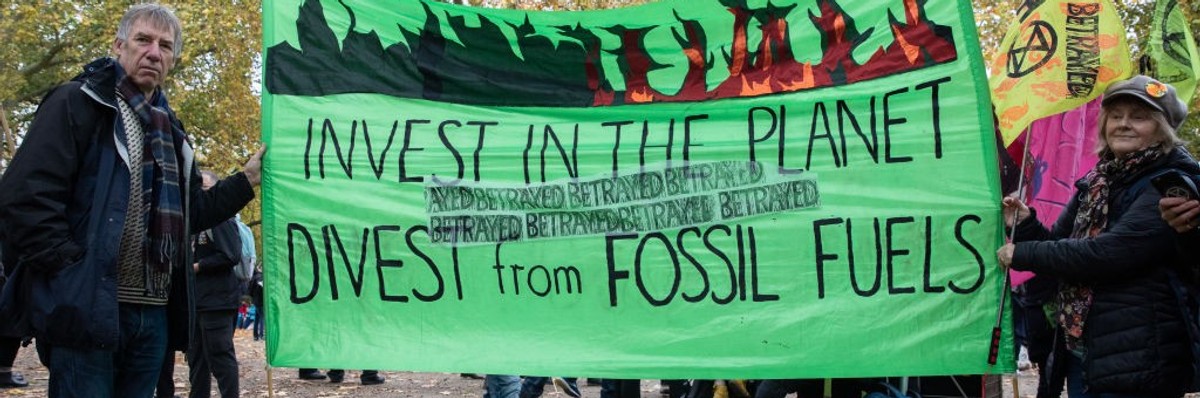
Extinction Rebellion climate activists hold a banner in Lincoln’s Inn Fields before a march on November 13, 2021 in London, United Kingdom.  (Photo by Mark Kerrison/In Pictures via Getty Images)

Over 1,600 institutions, including hundreds of faith-based organizations, have now joined the fight to move money away from polluting fossil fuels and toward clean energy solutions—yours should be next.

Last month saw an historic, albeit altogether insufficient, step forward to avoid climate catastrophe.

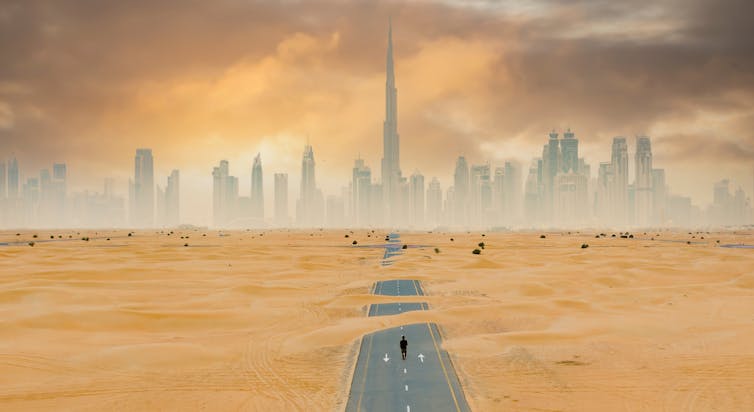
At the annual global UN-backed climate change conference in Dubai, known as COP28, countries for the first time unanimously acknowledged the necessity of “transitioning away from fossil fuels”: coal, oil, and gas. While short of an endorsement of a full fossil fuel phaseout—what scientists tell us is needed to avert the worst impacts of the climate crisis—it is a milestone, decades in the making.

Yet even this tepid sign of progress faced pushback from fossil fuel executives and the politicians who do their bidding.

The story of COP28 is one of the power and perniciousness of the fossil fuel industry. The CEO of the United Arab Emirates’ oil company (the 12th largest in the world) served as conference chair, and industry lobbyists outnumbered delegates from nearly every country. The final text is full of industry-friendly loopholes, giving fossil fuel corporations leeway to continue to profit off dirty energy.

Trying to address the climate crisis while expanding drilling, mining, and fracking operations is like offering chemotherapy to a lung cancer patient while handing them pack after pack of Marlboro Reds.

It’s clear we are at the end of the fossil fuel era. Solar and wind energy are the cheapest forms of energy to build.

Like tobacco companies before them, fossil fuel corporations have known for years (with shocking accuracy) about the science: their products, when used as directed, would harm the health of the planet and cause widespread devastation. But the industry has time and again blocked significant action or sought to delay it through false promises. They did so again at COP28.

As the future is at stake, it falls to the rest of us to take urgent action. Indeed, civil society institutions are not waiting. Last week marked a major achievement: 1600 institutions across the world representing more than $40 trillion (with a “T”) have now pledged to move money away from fossil fuels and toward clean energy.

Finance represents a critical lever for climate action. Fossil fuel corporations rely on an open spigot of funds – project finance through underwriting and loans from major banks, plus investment capital and approval for continued fossil fuel expansion from investors, including the world’s largest firms, BlackRock and Vanguard.

When investors move their money en masse, fossil fuel corporations face reputational and brand risk that can have knock-on effects, including lower credit ratings and challenges with securing financing for projects and operations. Crucially, doing so also erodes fossil fuel corporations’ social license to expand their operations.

The 1600 institutions that have committed to move their money include groups like the National Academy of Medicine, because profiting from burning fossil fuels violates the medical ethic of “first, do no harm.” They include universities like Brandeis, rooted in Jewish history, experience, and values, whose students and administration recognize the climate crisis as an existential threat to their future.

It’s clear we are at the end of the fossil fuel era. Solar and wind energy are the cheapest forms of energy to build. The market itself is acting on this imperative. Fossil fuels as a sector have performed worse financially over the past decade than the rest of the market. Over the last 30 years, they have shrunk from a quarter of the market to around 5%. According to a recent report, six public pensions could be $21 billion richer if they had ditched investments in coal, oil, and gas a decade ago.

As the future is at stake, it falls to the rest of us to take urgent action.

Faith-based institutions, representing more than a third of the commitments, are at the forefront of this movement for change. As Pope Francis has encouraged, we “must listen to science and institute a rapid and equitable transition to end the era of fossil fuel.”

One year ago, my organization, Dayenu: A Jewish Call to Climate Action, released a report about the investment capital of major Jewish institutions. The report found that these institutions had a substantial opportunity to move more than $3 billion in capital out of fossil fuels and into clean energy, and offered a roadmap to achieve this goal. Since last year, the climate crisis has grown more urgent, and so has the power of our faith and moral voice.

Faith groups are leading. They are making prudent, long-term decisions that will protect their communities. Join us before it is too late.

Original article by RABBI JACOB SIEGEL republished from Common Dreams under Creative Commons (CC BY-NC-ND 3.0). 

Continue ReadingWorld Leaders Failed Us, But We Have the Power to End the Era of Fossil Fuels

As disasters and heat intensify, can the world meet the urgency of the moment at the COP28 climate talks?

Spread the love

Shutterstock

Brendan Mackey, Griffith University

Eight years ago, the world agreed to an ambitious target in the Paris Agreement: hold warming to 1.5°C to limit further dangerous levels of climate change.

Since then, greenhouse gas emissions have kept increasing – and climate disasters have become front page news, from mega-bushfires to unprecedented floods.

In 2023, the world is at 1.2°C of warming over pre-industrial levels. Heatwaves of increasing intensity and duration are arriving around the world. We now have less than 10 years before we reach 1.5°C of warming.

This week, the COP28 climate talks will begin against a backdrop of evermore strident warnings from climate scientists and world leaders. United Nations chief António Guterres has warned climate action is “dwarfed by the scale of the challenge” and that we have “opened the gates of hell”. In his latest climate letter, Pope Francis quotes bishops from Africa who dub the climate crisis a “tragic and striking example of structural sin”.

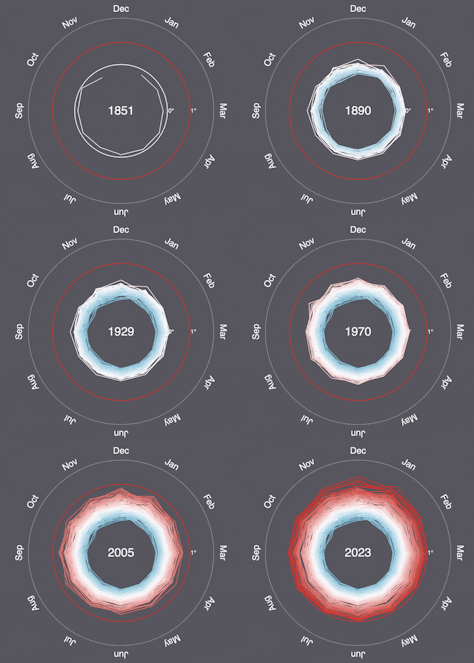
Global monthly land and ocean anomalies from 1850, relative to the 1901-2000 average
Global monthly land and ocean anomalies from 1850, relative to the 1901-2000 average.
NOAA, CC BY-SA

In the United Arab Emirates, the 198 nations in the UN’s climate framework will gather for COP28. Can we expect to see real progress – or half-measures?

Watch for these three key issues facing negotiators.

1. Taking stock of progress on climate action

This year, a critical issue will be the global stocktake, the key mechanism designed to ratchet up climate ambition under the 2015 Paris Agreement. This is the first time each nation’s emission cut targets and benefits from climate adaptation or economic diversification plans have been assessed.

The stocktake reveals what track we are on. Do the combined emission cut promises from all countries mean we can limit warming to 1.5°C? If not, what is the “emissions gap” – and how much more ambitious do nation’s emission reductions need to be?

There’s been progress, but not nearly enough. If all national emissions pledges became a reality, global warming would peak between 2.1-2.8°C.

That leaves an emissions gap of around 22.9 gigatonnes of carbon dioxide equivalent over the period to 2030.

It is very good that the worst-case scenarios – unchecked warming and 4+ degrees of global heating by 2100 are now looking unlikely. But a 2°C world would bring unacceptable harm and irreversible damage.

We’ll need much more ambitious targets and support to cut global greenhouse gas emissions 43% by 2030 and 60% by 2035 compared with 2019 levels if we are to reach net zero CO₂ emissions by 2050 globally. A major measure of COP28’s success will be whether the major emitting nations agree on more ambitious emission reduction actions.

2. Who pays for climate loss and damage?

For decades, nations have wrestled over the fraught question of who should pay for loss and damage resulting from climate change.

Now we’re close to finalising arrangements for the new Loss and Damage Fund. This will be the second major issue for negotiators at COP28.

So far, governments have drawn up a blueprint for the new fund. Expect to see debate over who will manage the fund – the World Bank? A UN agency? – and whether emerging economies such as China will provide funds. To date, there’s no target for how much money the fund will hold and disburse. The blueprint must be formally adopted at COP28 before it can begin operating.

Why a new fund? Other climate finance commitments are aimed at cutting emissions or helping societies adapt to climate impacts. This fund deals specifically with the loss and damage from the unavoidable impacts of climate change, like rising sea levels, prolonged heatwaves, desertification, the acidification of the sea, extreme weather and crop failures.

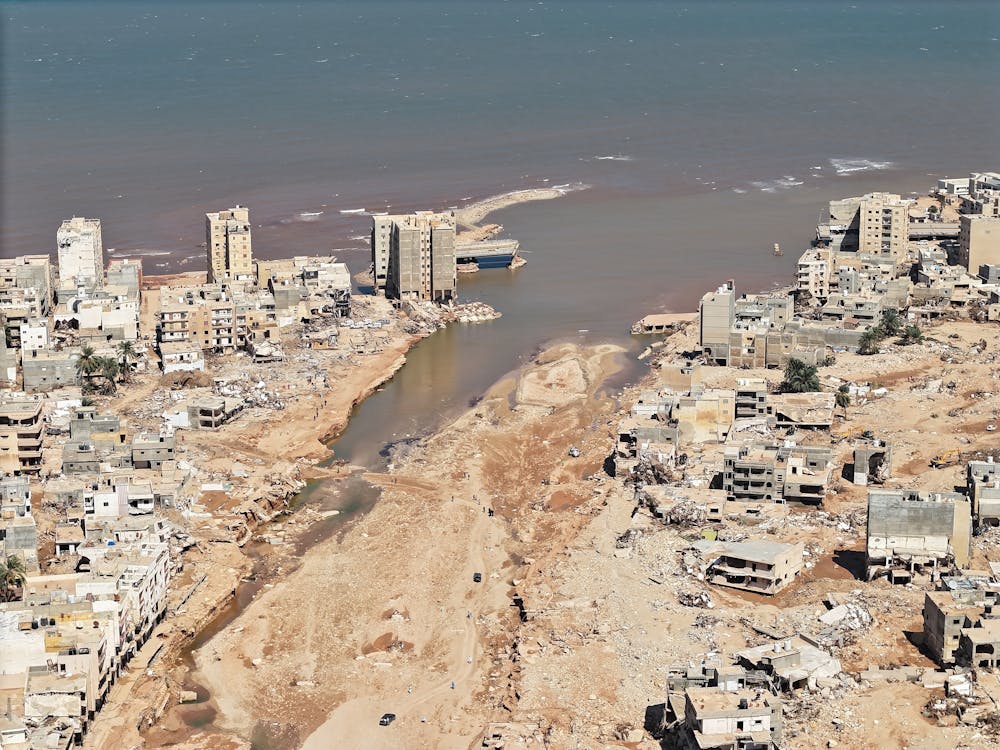
Think of the damage from the unprecedented floods in Pakistan or Libya, for instance.

libya flood, image of destroyed city with floodwater from air
Libya’s devastating floods in September killed thousands.
Shutterstock

3. Where’s the climate finance?

A major issue in climate negotiations is how countries can transform their economies so they are “climate ready”, with lower emissions and boosted resilience. For developing countries, this requires massive levels of investment and new technologies to let them “leapfrog” fossil fuel dependency.

This is likely to be a critical sticking point. To date, climate finance has flowed too slowly. Under the Paris Agreement, rich countries promised to provide funds of A$150 billion a year every year. This has been slow in coming, though it is nudging closer, with $130 billion flowing in 2021.

Unless we see significant progress on climate finance – including making the Loss and Damage Fund a reality and meeting the existing commitments – we’re unlikely to see progress on other key issues such as ratcheting up emission cuts under the stocktake mechanism, phasing out fossil fuels and work on preserving biodiversity.

How do you build a 198-government consensus?

One reason climate negotiations advance slowly is the need for consensus.

All 198 governments must agree on each decision. This means any one nation or group of countries can block a proposal or force the wording to be changed in order for it to be approved.

The votes of less wealthy countries – including small island nations and least developed countries – therefore carry as much weight as the G20 nations, who account for about 85% of global GDP. This has in the past worked to increase the level of climate action, including the focus on 1.5°C as the global warming target.

The COP28 President is Sultan Ahmed al-Jaber, who has attracted controversy due to the fact he heads the Abu Dhabi National Oil Company. Expect to see considerable debate over wording. Will governments agree to the “phasing down of fossil fuels” or just the “phasing down of unabated fossil fuels”?

It might sound like quibbling but it’s not – the second option, for instance, implies the heavy use of yet-to-be-proven carbon capture and storage technologies and offsets.

Sultan al-Jaber has, to his credit, promoted some progressive agenda items including a focus on the conservation, restoration, and sustainable management of nature to help achieve the goals of the Paris Agreement.

Here, there are welcome commonalities with the major global biodiversity pact struck late last year, the Global Biodiversity Framework, aimed at stemming the extinction of species and degradation of ecosystems. Healthy ecosystems store carbon and help people adapt to the climate change already here.

As nations prepare for a fortnight of intense negotiation, the stakes are higher than they have ever been. Now the question is – can the world community seize the moment? The Conversation

Brendan Mackey, Director, Griffith Climate Action Beacon, Griffith University

This article is republished from The Conversation under a Creative Commons license. Read the original article.

Continue ReadingAs disasters and heat intensify, can the world meet the urgency of the moment at the COP28 climate talks?