‘Our Leaders Are Not Leading’: Groups Decry Yet Another G7 Climate Failure

Spread the love

Original article by BRETT WILKINS republished from Common Dreams under Creative Commons (CC BY-NC-ND 3.0). 
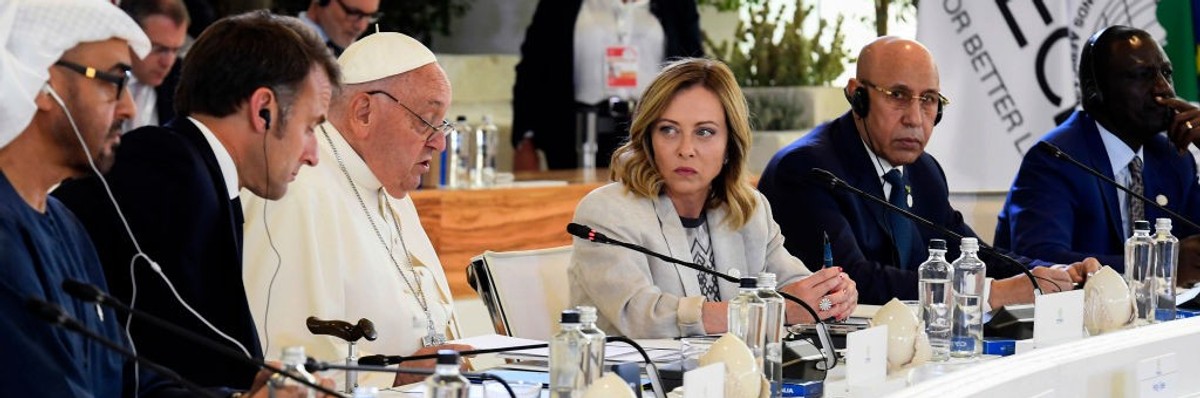
Italian Prime Minister Giorgia Meloni (center) looks toward Pope Francis as he speaks during the G7 Leaders Summit in Fasano, Italy on June 14, 2024. 
(Photo: Vatican Media via Vatican Pool/Getty Images)

“If these embattled leaders want to leave a lasting legacy, they need to heed the will of voters demanding a safe environment and climate,” one campaigner asserted.

As the Group of Seven summit wrapped up Friday in Italy, climate defenders condemned G7 leaders for their continued failure to take meaningful action to combat the worsening planetary emergency.

Taking aim at what critics called the G7 leaders’ largely empty pledge to undertake “concrete steps to address the triple crisis of climate change, pollution, and biodiversity loss,” 350.org U.S. campaigns manager Candice Fortin lamented that “yet another meeting ends without real commitments to revert the situation rich countries like the U.S. put us in.”

“As COP29 approaches and the world deals with worsening climate impacts, we can’t afford to waste more time,” Fortin said, referring to the United Nations Climate Change Conference scheduled to take place in Baku, the capital of Azerbaijan—a major fossil fuel-producing nation—in November. COP29 is set to be chaired by a former oil executive.

“If the U.S. wants to pride itself on being a ‘world leader,’ it needs to show how it will pay its climate debt to climate-vulnerable countries that bear the most significant climate impacts without the necessary funds for adaptation,” Fortin added.

While G7 governments hailed their recent agreement to phase out existing unabated coal power generation in energy systems during the first half of the 2030s, critics took issue with the policy’s timeline and banks’ continued financing of fossil fuels.

“Our leaders are not leading. In the hottest 12 consecutive months of recorded human history, our leaders are failing us,” argued Bronwen Tucker, Oil Change International’s public finance lead. “G7 countries are adopting an inadequate coal phaseout date and endorsing increased fossil gas production, sending a terrible signal at a time when countries should be focusing on accelerating the phaseout, not delaying it.”

Tucker continued:

G7 leaders can’t say they’re committed to a livable climate while expanding and bankrolling the fossil fuel industry at home and abroad. At the same time, these rich countries should not be congratulating themselves for delivering $100 billion for climate finance two years too late. Trillions are needed to cover climate damages and the G7’s finance was largely provided as loans which only worsens unjust debts.

“The G7 must end the billions of dollars in taxpayer finance still flowing to fossil fuel projects abroad and fund the buildout of affordable renewable energy on fair terms,” Tucker asserted. “If their oil and gas expansion plans are allowed to proceed, it will lock in climate chaos and an unlivable future.”

Greenpeace International climate politics expert Tracy Carty said in a statement that “if these embattled leaders want to leave a lasting legacy, they need to heed the will of voters demanding a safe environment and climate.”

“Taxing the billions of dollars in profits of the fossil fuel industry to fund climate action at home and abroad could be their stake in history and a win for people and planet,” Carty continued. “G7 leaders need to seize the moment ahead of the U.N. climate talks in Baku and show they will lead the transition away from fossil fuels and build trust they will significantly increase climate finance support to developing countries.”

Original article by BRETT WILKINS republished from Common Dreams under Creative Commons (CC BY-NC-ND 3.0). 
Continue Reading‘Our Leaders Are Not Leading’: Groups Decry Yet Another G7 Climate Failure

Pope Francis Urges Climate Action as World Nears ‘Breaking Point’

Spread the love

Original article by OLIVIA ROSANE republished from Common Dreams under Creative Commons (CC BY-NC-ND 3.0). 

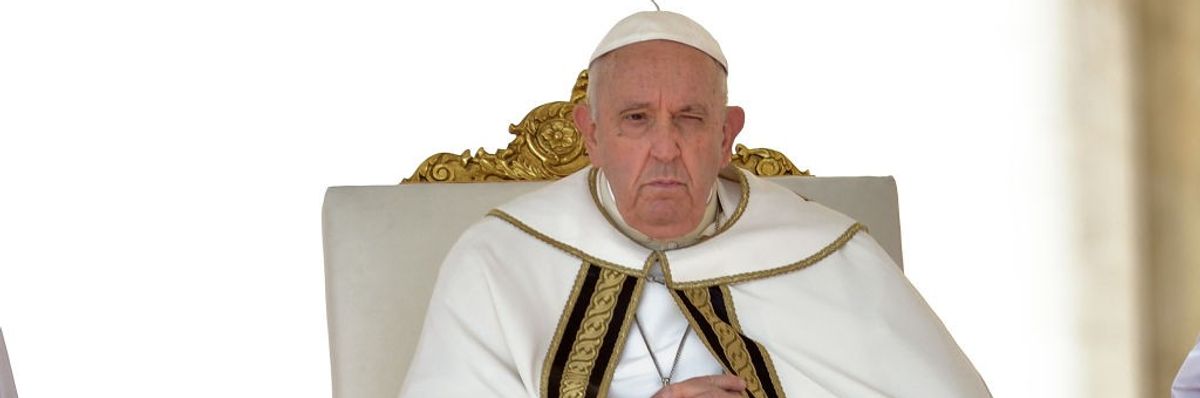
Pope Francis during the act of appointment of cardinals in the Vatican Basilica of St. Peter, on September 30, 2023, in Rome, Italy.
 (Photo: Stefano Spaziani/Europa Press via Getty Images)

“The necessary transition towards clean energy sources such as wind and solar energy, and the abandonment of fossil fuels, is not progressing at the necessary speed,” he said.

In his second major address on the climate crisis, Pope Francis called for urgent global action ahead of the COP28 United Nations climate conference.

The pontiff’s remarks came in a papal exhortation published Wednesday morning titled “Laudate Deum” or “praise God.”

“We must move beyond the mentality of appearing to be concerned but not having the courage needed to produce substantial changes,” Francis said.

The pope made waves in 2015 when he published an encyclical on climate and the environment titled Laudato Si, shortly before world leaders negotiated the Paris agreement. An exhortation is a shorter, less prestigious document, according to The Washington Post. In Wednesday’s document, the first he has published on the climate crisis in eight years, Francis reflected on how far the world hadn’t come.

“With the passage of time, I have realized that our responses have not been adequate, while the world in which we live is collapsing and may be nearing the breaking point,” he said.

As the world prepares for COP28, he said that international agreements had not so far led to effective action.

“The necessary transition towards clean energy sources such as wind and solar energy, and the abandonment of fossil fuels, is not progressing at the necessary speed,” he said. “Consequently, whatever is being done risks being seen only as a ploy to distract attention.”

“In conferences on the climate, the actions of groups negatively portrayed as ‘radicalized’ tend to attract attention. But in reality they are filling a space left empty by society as a whole.”

He also addressed concerns about the conference being hosted in a major oil-producing country, though he acknowledged that the United Arab Emirates had made significant investments in renewable energy.

“Meanwhile, gas and oil companies are planning new projects there, with the aim of further increasing their production,” he said.

The pope warned about the consequences of inaction:

We know that at this pace in just a few years we will surpass the maximum recommended limit of 1.5° C and shortly thereafter even reach 3° C, with a high risk of arriving at a critical point. Even if we do not reach this point of no return, it is certain that the consequences would be disastrous and precipitous measures would have to be taken, at enormous cost and with grave and intolerable economic and social effects. Although the measures that we can take now are costly, the cost will be all the more burdensome the longer we wait.

Yet he also counseled against abandoning hope, saying it “would be suicidal, for it would mean exposing all humanity, especially the poorest, to the worst impacts of climate change.”

Instead, he argued that hope should be found in structural changes rather than relying entirely on technological fixes like carbon capture.

“We risk remaining trapped in the mindset of pasting and papering over cracks, while beneath the surface there is a continuing deterioration to which we continue to contribute,” he wrote. “To suppose that all problems in the future will be able to be solved by new technical interventions is a form of homicidal pragmatism, like pushing a snowball down a hill.”

Throughout the text, he emphasized climate justice, pointing out that the wealthy world had contributed more to the crisis, while the Global South suffered disproportionately from its impacts. In particular, he called on the United States to alter its energy-intensive lifestyle.

“If we consider that emissions per individual in the United States are about two times greater than those of individuals living in China, and about seven times greater than the average of the poorest countries, we can state that a broad change in the irresponsible lifestyle connected with the Western model would have a significant long-term impact,” he said.

“Global leaders meeting in Dubai for COP28 must heed the pope’s call to agree to a just and equitable phaseout of all fossil fuels and a transition to renewable energy, with adequate financial support for impacted countries.”

He also defended climate activists who have been criticized for disruptive tactics.

“In conferences on the climate, the actions of groups negatively portrayed as ‘radicalized’ tend to attract attention,” he said. “But in reality they are filling a space left empty by society as a whole, which ought to exercise a healthy ‘pressure,’ since every family ought to realize that the future of their children is at stake.”

Several long-time climate advocates welcomed Pope Francis’ remarks.

“The pope’s intervention ahead of the Dubai climate talks is welcome and adds to an increasingly loud chorus of voices demanding that countries tackle the root cause of the climate crisis: fossil fuels,” Mariam Kemple Hardy, global campaigns manager at Oil Change International, said in a statement. “The pope is right to point out the growing gap between the urgent need to phase out all fossil fuels and the fact that countries and the oil and gas industry are doubling down on new production that is incompatible with a livable climate.”

Hardy also echoed the pope’s emphasis climate justice, calling out wealthy nations for continuing to exploit fossil fuels.

“Global leaders meeting in Dubai for COP28 must heed the pope’s call to agree to a just and equitable phaseout of all fossil fuels and a transition to renewable energy, with adequate financial support for impacted countries. Unless it does so, COP28 will be a failure,” Hardy said.

350.org and Third Act co-founder Bill McKibben hoped that the pope’s message might succeed where others had failed.

“The work of spiritual leaders around the world may be our best chance of getting hold of things,” McKibben toldThe Guardian. “Yes, the engineers have done their job. Yes, the scientists have done their job. But it’s high time for the human heart to do its job. That’s what we need this leadership for.”

Original article by OLIVIA ROSANE republished from Common Dreams under Creative Commons (CC BY-NC-ND 3.0). 

Continue ReadingPope Francis Urges Climate Action as World Nears ‘Breaking Point’

Commentary and analysis of recent political events

Spread the love

Mandela’s funeral dominates the news today.

Prime Minister David Cameron has rejected the advice of his advisor Nadhim Zahawi that child benefit is only paid for the first two children. Why mention it then?

Pope says that he is not a Marxist but does not consider it an insult.

Illiberal benefits cuts increase evictions of poor families.

MPs to be given honesty training. MPs are apparently the most mistrusted profession – ahead of bankers, journalists, estate agents and second-hand car salesmen!


Continue ReadingCommentary and analysis of recent political events