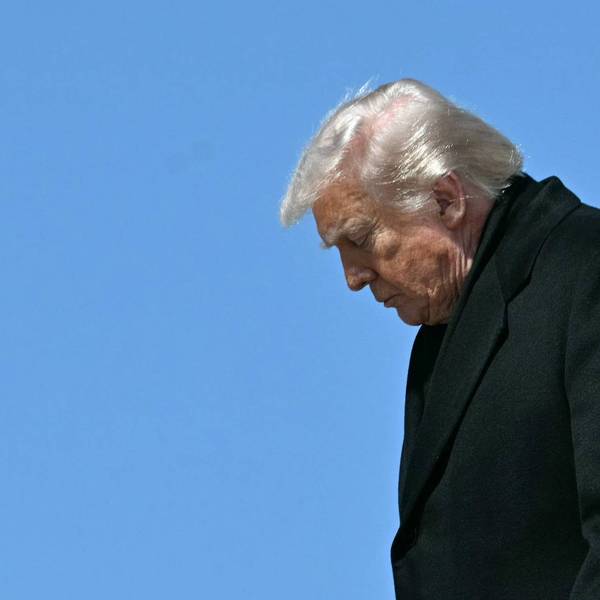
Protesters march during a rally calling for the removal of US Immigration and Customs Enforcement from Minnesota on December 20, 2025.(Photo by Kerem Yucel/AFP via Getty Images)
“I love my Somali friends and neighbors,” said one former Democratic official in the state. “If Trump tries to come for them, he needs to come through all of us.”
Fear is running high in Minnesota after President Donald Trump went on yet another racist tirade against the state’s Somali community on Thursday—this time verging into what was widely interpreted as a call for vigilante violence.
“The once Great State of Minnesota is being taken over by Somali Immigrants,” Trump wrote Thursday afternoon on Truth Social. “There is Violence, Murder, and Mayhem all over the State. The people of Minnesota must fight back.”
Trump raged against Democratic Gov. Tim Walz, whom he described as an “incompetent thief who doesn’t want to get involved,” and seemed to suggest that if ordinary Minnesotans took matters into their own hands, they’d have the blessing of the federal government.
“The Somalians [sic] should not be allowed to get away with what they are doing,” Trump said. “They view you as weak and stupid people. Fight back, Minnesota, fight back! If you need, the Federal Government will come to your rescue.”
Trump is trying to start a race war in Minnesota: "The once Great State of Minnesota is being taken over by Somali Immigrants. There is Violence, Murder, and Mayhem all over the State. The people of Minnesota must fight back. You have been robbed, and abandoned by your State… pic.twitter.com/YbNmJDBMFg
It’s hardly the first time Trump has slurred Somali immigrants. He’s previously referred to them as “garbage,” “very low-IQ people,” and “pirates,” and said they should all be deported from the country.
But Trump’s comments on Thursday went a step further than that, leaving community members on edge about the possibility that they could instigate violent attacks by his supporters.
“President Trump is placing a target on the backs of Somali Americans,” said Jaylani Hussein, the executive director of the Council on American-Islamic Relations in Minnesota, in a statement. “His words are not simply political rhetoric. They are a dangerous invitation to hatred and potentially violence.”
“Minnesota has led the nation in attacks on mosques, including fire-bombings,” he said. “We know firsthand what happens when hateful rhetoric turns into violence.”
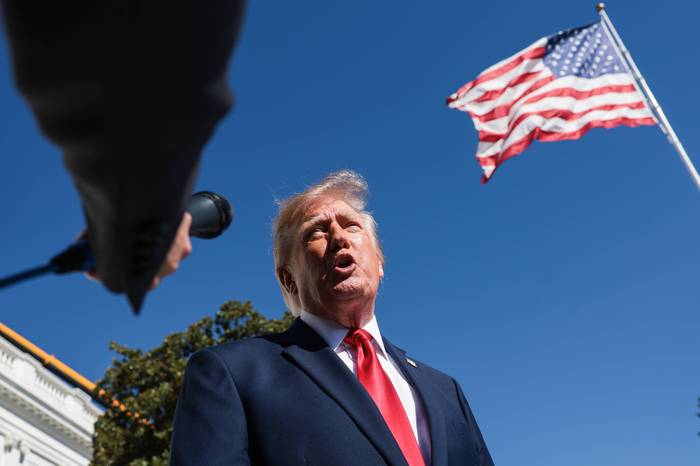
President Donald Trump speaks to reporters before boarding Marine One on the South Lawn of the White House on October 7, 2026 in Washington, DC. (Photo by Anna Moneymaker/Getty Images)
Faisa Ahmed, a Somali American political organizer and senior adviser to the reelection campaign of Minnesota Attorney General Keith Ellison, said unease ran deep in her home city of Minneapolis on Thursday night.
“Every Somali I know is walking through our own neighborhoods scared tonight,” she said.
“The president just told Minnesotans to ‘fight back’ against Somalis by name,” she added. “This is incitement, and everyone should call it that.”
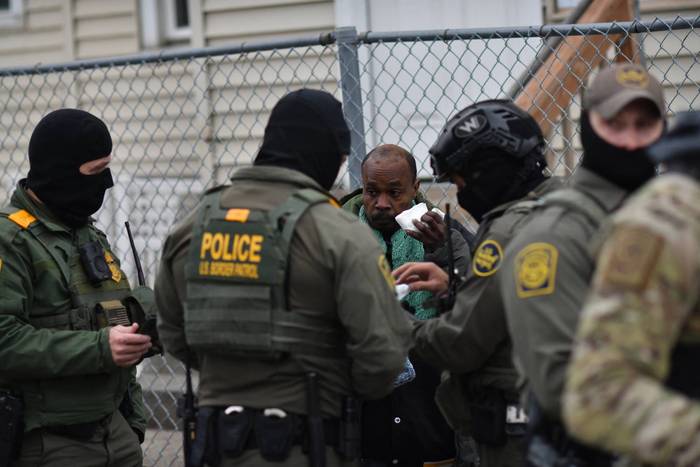
Though most of them are US citizens, Somalis were aggressively targeted when thousands of immigration agents descended on Minnesota during Trump’s Operation Metro Surge earlier this year.
US Border Patrol agents detain an unidentified man of Somali descent in Minneapolis, Minnesota, on January 8, 2026. (Photo by Octavio Jones/AFP via Getty Images)
Ellison, who has sued the administration for civil rights violations and pushed for agents to be investigated under state law, said he would not let this happen again.
“We’ve seen what Trump’s government coming to the ‘rescue’ looks like,” he wrote on social media Thursday. “It ended with two Minnesotans shot dead by federal agents, racial profiling, assaults, and the violation of our rights.”
“Never again. If Trump tries, I’ll drag him back to court,” he said. “Somali Minnesotans are our neighbors. They are part of Minnesota. And the Minnesota I know and love is so much better than this bigotry.”
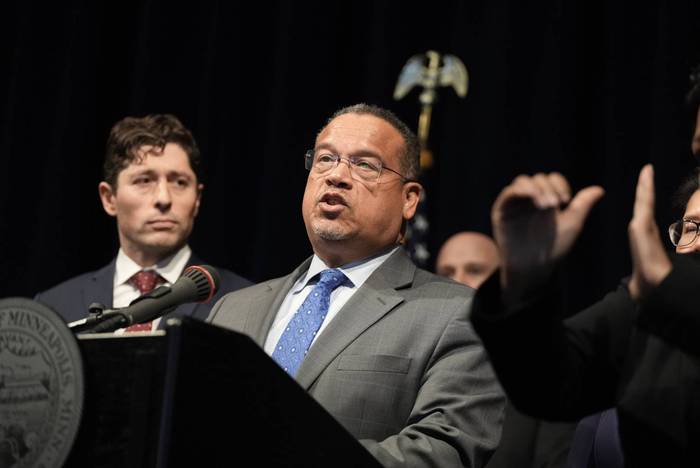
Minnesota Attorney General Keith Ellison, along with Minneapolis Mayor Jacob Frey, announced a lawsuit against the Trump administration’s deployment of ICE agents to the Twin Cities during a press conference at Minneapolis City Hall on Monday, January 12, 2026. (Photo by Richard Tsong-Taatarii/The Minnesota Star Tribune via Getty Images)
With less than a month to go before the midterm elections, Minnesota Republicans have sought to harness bigotry against Somalis to rally support.
Democratic candidate Doug Chapin, who is trying to unseat Republican House Majority Whip Tom Emmer in Minnesota’s 6th district, put it plainly during an event on Thursday night.
“I’ll call it what it is,” Chapin said. “The president is trying to foment a race war here in Minnesota.”
Minnesota CD6 Congressional candidate Doug Chapin says “the president is trying to foment a race war here in Minnesota.”
Doug says @tomemmer’s statement that “Somali Americans should be treated as enemy combatants and jailed” is beyond the pale and we deserve better in Congress. pic.twitter.com/gymFUEyTOy
But as the violent rhetoric has ramped back up, so have expressions of solidarity from community members who have called it out as a cynical political tactic.
“This is KGB-style fear-mongering before an election. Trump’s terrified he’s going to lose the House and Senate and get impeached,” said Mike Norton, the former vice chair of the Democratic Farmer-Labor Party in Minneapolis.
“I love my Somali friends and neighbors. They make Minnesota a better place,” Norton said. “If Trump tries to come for them, he needs to come through all of us.”
Elon Musk urges you to be a Fascist like him, says that you can ignore facts and reality then.Orcas discuss Donald Trump and the killer apes’ concept of democracy. Front Orca warns that Trump is crashing his country’s economy and that everything he does he does for the fantastically wealthy.
This work by Middle East Monitor is licensed under a Creative Commons Attribution-NonCommercial-ShareAlike 4.0 International License.
New York Police Department (NYPD) officers and U.S. Secret Service (USSS) personnel maintain a heavy security presence around the United Nations Headquarters as New York hosts nearly 200 heads of state and government, ministers, diplomats, civil society representatives and journalists attending the 81st session of the United Nations General Assembly (UNGA), in New York, United States, on September 23, 2026. [Mehmet Ali Özcan – Anadolu Agency]
The mass departure of 77 delegations from the UN General Assembly hall shortly before Israeli Prime Minister Benjamin Netanyahu’s speech sparked widespread reaction on social media, with users describing the scene as a major blow to Israel and a sign of its growing international isolation.
Footage showed most delegations leaving the hall before Netanyahu began speaking, while the prime minister appeared visibly uncomfortable as only a limited number of people remained and protesters chanted slogans.
According to Israeli reports, representatives of 77 countries were absent during Netanyahu’s speech, with several delegations leaving shortly before it began, while representatives of other countries had not been in their seats from the outset.
The departure drew significant attention in the Israeli media. Channel 14 described it as “a spit in Israel’s face”, while Yedioth Ahronoth called it “the dramatic protest”.
Haaretz, meanwhile, described Netanyahu’s speech as repetitive and dull, saying it was mainly aimed at his right-wing base and US President Donald Trump, amid what it described as growing international isolation for the Israeli prime minister.
The Guardian reported that Netanyahu pledged to “finish the job” in Gaza while delegations left the hall in protest.
The Washington Post described the walkout as part of a “fierce global backlash” against Israeli policies, while Britain’s Independent said Netanyahu was speaking to a single audience anyway.
At the same time as Netanyahu was speaking at the UN headquarters, a protest was held near Times Square in New York, where demonstrators raised slogans calling for an end to Israel’s war on the Gaza Strip.
The scene came amid the continuing Israeli war on the Gaza Strip, which has resulted in large numbers of civilian casualties, as international criticism of Israel’s policies towards Gaza and the Palestinian territories continues to grow.
It’s been an eventful year since Washington Post owner Jeff Bezos tapped Adam O’Neal for the prestigious job of Post Opinions editor. O’Neal was an unusual hire, a 33-year-old with little by way of managerial experience. But O’Neal had a redeeming quality: He was ready to shill for Bezos, and the man Bezos has been desperately wooing, President Donald Trump.
It’s remarkable how far Bezos has come since 2013, when he said he purchased the Post from the Graham family out of a sense of civic duty.
Bezos was still singing a similar tune nearly midway through Trump’s first term, telling Axel Springer CEO Mathias Döpfner (4/28/18), “I would be humiliated to interfere” with the Post’s coverage. “I would be so embarrassed. I would turn bright red…. It would feel icky; it would feel gross.”
But days before the 2024 election, with Trump looking like he might return to the White House, Bezos apparently got over his queasiness and personally spiked the Post’s endorsement of Kamala Harris (FAIR.org, 10/30/24). “Trump was thrilled, advisers said, and later thanked Bezos,” the Wall Street Journal (7/2/26) reported.
Bezos followed up by declaring that Post Opinions would now promote “personal liberties and free markets,” while “viewpoints opposing those pillars will be left to be published by others.” Coming a month into Trump’s second term, this came across as another gift to the president (FAIR.org, 2/28/25).
‘Unapologetically patriotic’
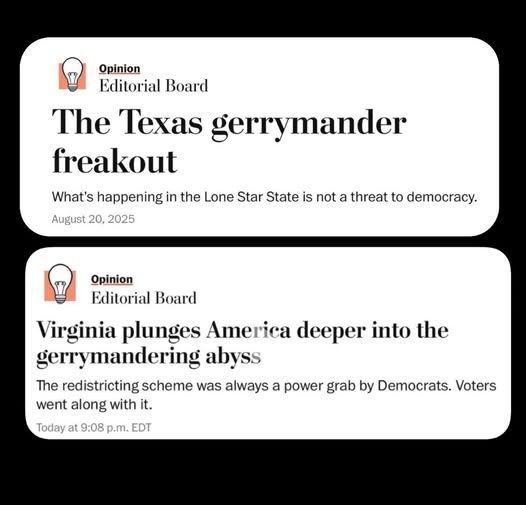
When Texas did a mid-census gerrymander in 2025, the Washington Post (8/20/25) urged Democrats to “hold the apocalyptic warnings about the end of democracy.” When Virginia followed suit in 2026, the Post‘s message (4/21/26) to Democrats was ” spare us the false sanctimony about democratic norms.”
To lead the newly oriented Opinions page, Bezos tapped O’Neal, who had been a correspondent for the Economist, editorial writer for the Wall Street Journal and executive editor at the conservative Dispatch for just one year.
In that last role—apparently O’Neal’s only newsroom managerial experience—he quickly alienated the Dispatch staff. “He was a competent editor who had no idea how to talk to another human being,” a former associate of O’Neal’s told Status (7/18/25):
He was tough on reporters, sure, but that’s common in newsrooms. He just couldn’t express even the most minor thing without being abrasive, hostile or raising his voice.
After being named to his post in June 2025, O’Neal declared that Post Opinions would be “unapologetically patriotic” and “communicate with optimism about this country.” This echoed Bezos, who declared a month into Trump’s second term, “I am of America and for America, and proud to be so.” Bezos was, of course, echoing Trump’s “America first” rhetoric.
O’Neal has demonstrated his patriotism by overseeing an editorial page that has backed Trump in destroying the East Wing of the White House (10/25/25), kidnapping the Venezuelan president (“one of the boldest moves a president has made in years”—1/3/26), militarily taking over DC (8/11/25; FAIR.org, 8/14/25), and unprecedented gerrymandering (8/20/25). (When Democrats responded in kind, the Post decried the “power grab”—4/21/26).
The Post’s pro-Trump boosterism under O’Neal has been so over the top, wrote Chris Lehmann (TheNation, 2/4/26), it’d “be a stretch for Pravda to pull off.”
“I try to avoid reading what the opinions section publishes,” a current Post staffer told Status (5/10/26). “I can’t tell if some of these arguments are being made in good faith or not. Sometimes it just seems like rage bait.”
‘Being reconciled is not enough’
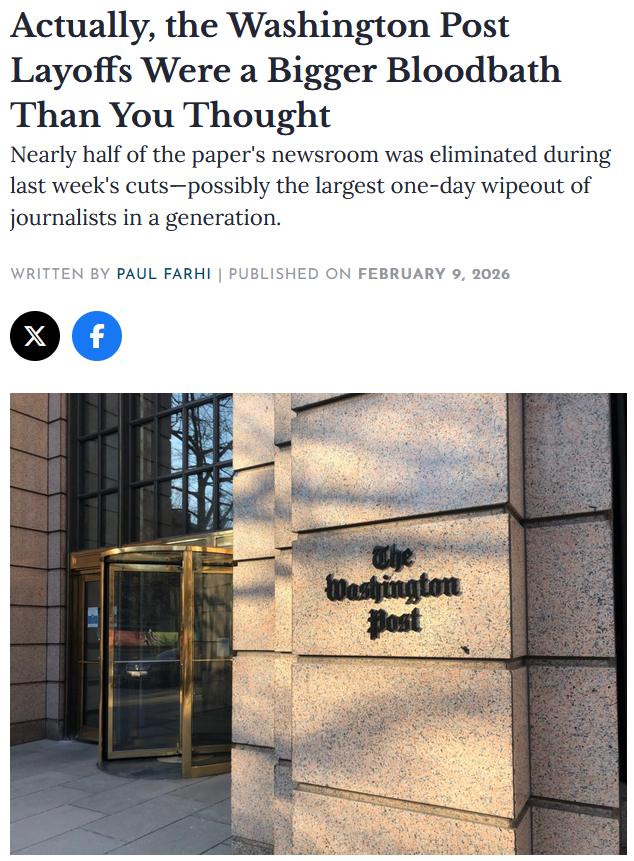
Former Washington Post media writer Paul Farhi (Washingtonian, 2/9/26) described Bezos’ layoffs as “disfiguring…with whole sections and departments—sports, books, staff photography—wiped away, and devastating cuts inflicted on its Metro section and foreign bureaus.”
While O’Neal’s predecessor, David Shipley, did everything Bezos could have asked for—spiking the Post’s Harris endorsement and a cartoon depicting Bezos and other tech moguls as Trump supplicants (FAIR.org, 1/7/25)—he did it without zeal, which Bezos found intolerable. “I suggested to him that if the answer wasn’t ‘hell yes,’ then it had to be ‘no,’” Bezos wrote, in explaining Shipley’s February 2025 resignation.
Shipley had voiced concern over the direction Bezos was taking the Post, warning the billionaire that spiking the Harris endorsement days before the election and yanking Opinions rightward could turn off subscribers. “I don’t care,” Bezos replied (New York Times, 3/14/26). (Shipley proved correct; Bezos’ interventions led to over 375,000 Post readers canceling their subscriptions—NPR, 1/30/26.)
Replacing Shipley, O’Neal wasted little time in transforming Opinions’ editorial outlook, and its personnel. In his first email to the Opinions desk, O’Neal encouraged his colleagues to get with the program or quit, mimicking Bezos’ message to Shipley. “Simply being reconciled to these changes is not enough,” O’Neal wrote. “We want those who stick with us to be genuinely enthusiastic about the new direction and focus.”
The paper’s last full-time Black Opinions columnist, Karen Attiah, was fired in September 2025 (Golden Hour, 9/15/25; FAIR.org, 9/23/25). (Theodore R. Johnson of New America writes roughly once a week as a contributing columnist, but is not on staff.)
Jeff Bezos (CNBC, 5/20/26): “The [Washington] Post needs to be a profitable enterprise that stands on its own two feet.” Bezos could cover the Post‘s annual losses by spending 0.04% of his wealth—the equivalent of a typical US household spending $77 a year to maintain a fishtank. Bezos hollowed the Post out further in February when he laid off nearly half of the newsroom, in what “may have been the biggest one-day wipeout of journalists in a generation” (Washingtonian, 2/9/26).
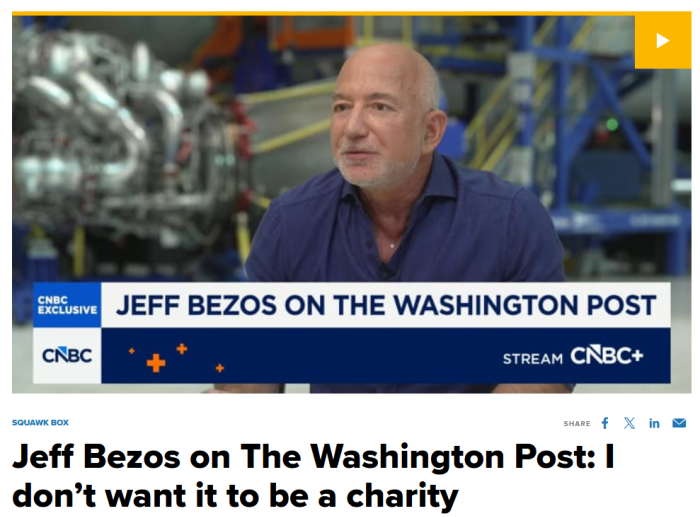
Publicly, Bezos claimed he was doing this for the long-term viability of the paper. To be relevant, the Post has to be a “profitable enterprise that stands on its own two feet,” Bezos told Andrew Ross Sorkin (CNBC, 5/20/26). Otherwise, “it would be like poetry without rhyming.”
Privately, however, Bezos told Trump that Post employees “are terrible…. They don’t listen. My other companies, they listen,” according to New York Times reporters Maggie Haberman and Jonathan Swan’s new book Regime Change.
To make the Post more like his other companies, Bezos needed “hell yes” management, like Adam O’Neal (and former publisher Will Lewis).
O’Neal, in turn, needed fellow travelers, and seems to have hired exclusively MAGA-friendly columnists. According to media critic Adam Johnson (Real News Network, 5/22/26), the Post
purged its opinion page of its actually popular writers and replaced them with charmless Economist and Wall Street Journal also-rans so they can spew libertarian cliches [and] tedious anti-woke screeds.
‘A whole bunch of incredible miracles’
Jeff Bezos (Financial Times, 6/11/26): “Six thousand years ago, somebody invented the plow, and we all got wealthier.” Actually, the invention of agriculture impoverished most people, resulting in humans losing 5–6 inches of height due to malnutrition (Discover, 5/87).
O’Neal’s fealty to Bezos is most blatant in Opinions’ approach to artificial intelligence.
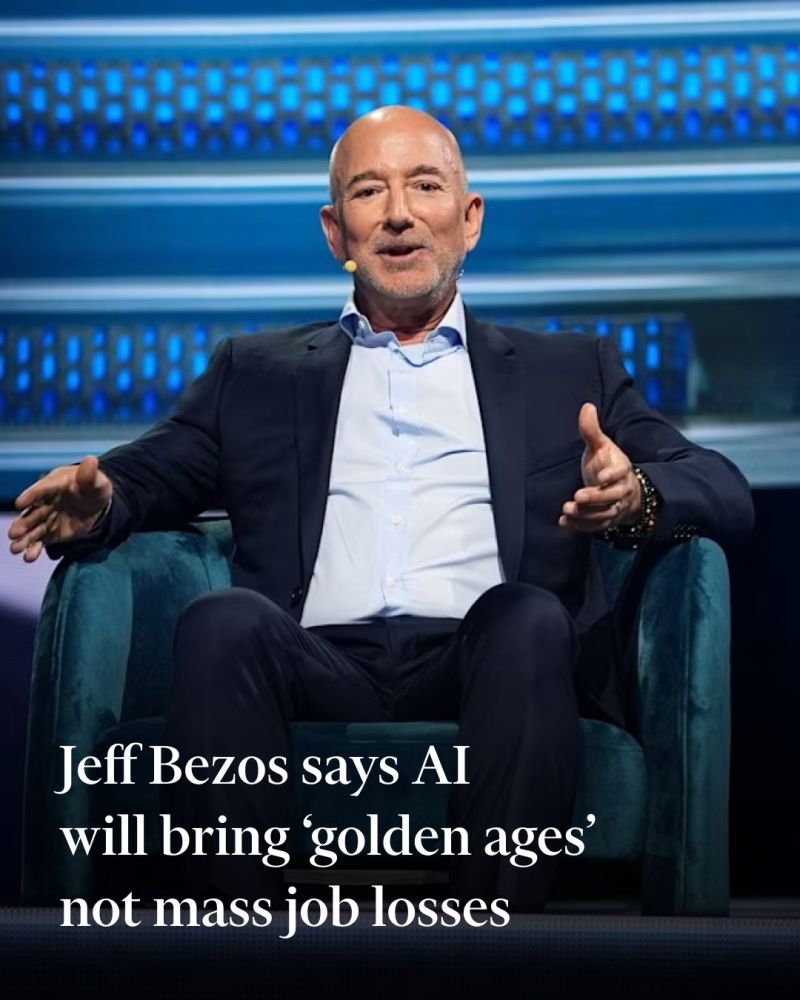
“All of the things that I work on today have something to do with AI,” Bezos told the Financial Times (6/11/26). “We’re in the middle of multiple golden ages right now, certainly with AI,” he continued, sounding every bit the snake oil salesman. “I think you’re going to see a whole bunch of incredible miracles unfold here in the next decade.”
And Bezos is banking on these miracles to expand his empire on earth and in space. Despite being worth a quarter-trillion dollars, Bezos is presently scouring the globe to raise $100 billion for a new fund that plans to buy companies in industrial sectors and improve them using AI (Forbes, 3/19/26). Bezos’ latest effort aligns neatly with his new role as co-CEO of Project Prometheus, a low-profile AI company that’s raised $18 billion in funding (Morning Brew, 6/12/26).
Meanwhile, Amazon—the company Bezos founded, where he remains the largest shareholder and executive chair—“recently placed a series of staggeringly expensive bets on artificial intelligence, audacious even by the standards of Silicon Valley’s ongoing trillion-dollar AI bacchanalia,” Bloomberg reported (5/14/26).
With so much on the line, Bezos has little patience for doomsayers who fear AI will cause mass job loss—the very thing Wall Street is salivating over. Sure, AI will be “shrinking the number of people needed by 10x,” Bezos told the Wall Street Journal (6/11/26). But the technology will in fact create “more than 10x” as many jobs, he said. The suggestion seems to be that more than 90% of us will soon be in hitherto unimagined job categories made possible by artificial intelligence. (Bezos’ fellow tech titans recently started following his lead and saying similar things about AI job losses.)
Despite Bezos’ rosy outlook, “the public isn’t so reassured,” the Journal reported (6/13/26) two days later, citing a Pew Research Center survey from March. “Only 17% of Americans say AI will have an overall positive effect on the US over the next 20 years.”
And the data centers needed to power AI fare little better. “Americans have changed their minds about data centers. Decisively,” reported the outlet Heatmap (6/2/26), which conducted a recent poll. “At least seven in 10 Americans would now oppose a data center being built near their home…a record low.”
Opposition to data centers—and their insatiable demand for power and water—has become “The Most Bipartisan Issue Since Beer,” according to a New York Times headline (5/1/26).
‘Data centers don’t deserve so much hate’
Billionaire-owned paper warns that blocking data centers will only benefit billionaires. (Original headline: “Halting Data Center Construction Will Entrench Inequality”—Washington Post, 3/24/26.)
With the American people on one side of the AI divide, and Bezos and his fellow tech oligarchs on the other, O’Neal has rushed to his boss’s rescue (FAIR.org, 11/20/25). Here are some recent Opinions headlines (a couple have been subsequently altered):
“Halting Data Center Construction Will Entrench Inequality” (3/24/26)
“High Energy Bills? Blame the Trial Lawyers” (4/24/26)
“Blocking the Construction of Data Centers Is a National Security Risk” (5/28/26)
“AI Backlash Threatens to Hold Kids Back” (6/21/22)
“AI Is Sparking a Boom in Blue-Collar Jobs…” (6/22/26)
Beyond the dutiful headlines themselves, the editorials also fail to disclose Bezos’ AI ties—which is not unusual. “What the Post’s data-center cheerleading only intermittently mentions is its owner’s vested interest in the topic,” noted Paul Farhi (Washingtonian, 6/23/26), the Post’s former media reporter. “I was unable to find a single editorial or opinion column opposing [AI data centers’] construction over the past six months.”
One of O’Neal’s top deputies, James Hohmann, took things a step further (while also failing to note Bezos’ ties to AI). Hosting an episode (5/26/26) of Opinions’ new flagship podcast, Make It Make Sense—headlined “Why Data Centers Don’t Deserve So Much Hate”—Hohmann “described climate activists as a ‘cult’ and argued that the media is ‘guilty’ of fueling ‘hysteria’ over climate change,” Status (6/7/26) summarized. It’s a jarring listen; like the keys to a once-storied newspaper have been turned over to the manosphere.
Even as Bezos hollows out the rest of the Post, money is flowing to Make It Make Sense, which has a well-appointed new studio. So far, however, “the investment has produced an astonishingly small audience,” Status reported (5/11/26). “It does feel like this is just for an audience of one,” a former Post staffer told the outlet.
Bernie Sanders, ‘leading Luddite’
The Washington Post (3/25/26) calls Sen. Bernie Sanders “part of the lunatic fringe” because he wants “safeguards” on a technology whose developers routinely warn “could end humanity” (Nature, 4/21/26).
As grassroots fights against AI data centers spring up from coast to coast, opposition in the Senate is led by Sen. Bernie Sanders, who introduced a bill to place a two-year moratorium on the construction of new data centers.
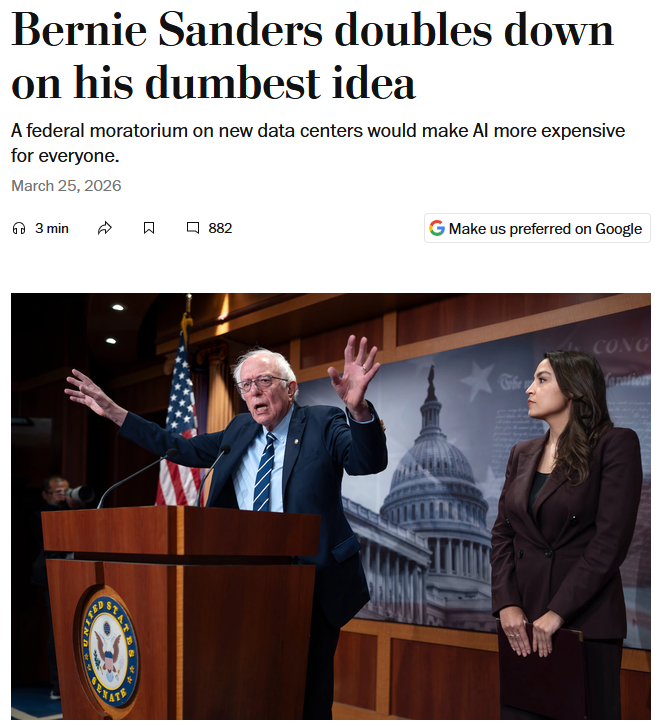
Already a bête noire of the Post (FAIR.org, 3/8/16), Sanders’s critique of data centers has led to a renewed thrashing. In a March editorial (3/25/26) headlined “Bernie Sanders Doubles Down on His Dumbest Idea,” the Post placed Sanders at “the lunatic fringe” of society for “throwing sand into the gears of progress.” The editorial also called Sanders “the leading Luddite of the 2020s.”
Two weeks later, the Post (4/8/26) returned to the “L” word, this time in an editorial that didn’t mention Sanders, but did associate opposition to data centers with domestic terrorism:
The mob-like movement against data centers that’s been gaining traction across the country took a dark turn this week. Indianapolis Councilor Ron Gibson (D), who supports a project to build such a facility in his district, woke up early Monday to the sound of 13 gunshots fired at his home. The gunman left a note on the lawmaker’s doorstep: “NO DATA CENTERS.”
No one was injured, but the incident illustrates how opposition to artificial intelligence can metastasize into an irrational frenzy. It wouldn’t be the first time in history that deranged Luddites turn to violence to fight the advancement of frontier technology.
Later that month, the Post’s editorial page was back to attacking Sanders. Under a scowling picture of the senator, a Post editorial (4/30/26) charged that Sanders
is as naive now as he was during the Cold War. Rarely, if ever, has the socialist met an enemy of the United States who he doesn’t think he can partner with to advance his agenda. The same impulse that led Sanders to cozy up to the Soviets, the Sandinistas and Fidel Castro in the 1980s was on display again Wednesday night at the Capitol as he invited two Chinese academics to urge Americans to slow-roll our pursuit of artificial intelligence.
“Of course that’s what Beijing wants Washington to do,” the Post continued, in a brazen attempt to paint skepticism of AI data centers—a view held by most Americans—as anti-American.
The Post’s inflammatory editorial mentioned neither Bezos or Amazon, per usual.
The billionaire project
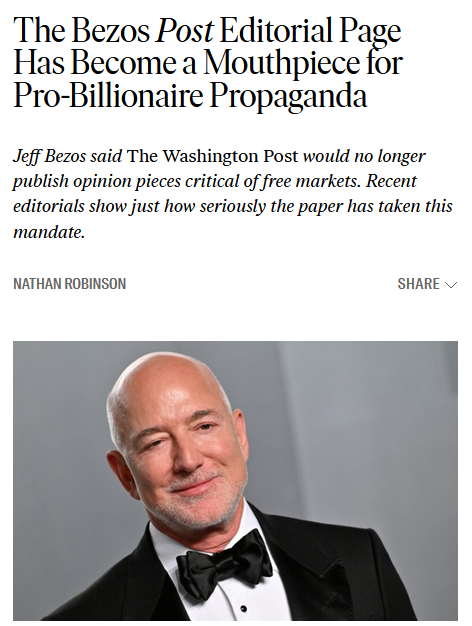
“It’s remarkable how brazen the paper is about shilling for the financial interests of its owner,” writes Nathan Robinson (The Nation, 4/21/26) . “Some of these headlines might as well read ‘Don’t Tax Jeff Bezos More,’ ‘Don’t Let Unions Threaten Jeff Bezos’ Control Over His Workers,’ ‘Don’t Stop Jeff Bezos From Building Data Centers in Your Town.’”
It’s not just Bezos’ financial interests that are advanced by O’Neal’s Opinions page, but also Bezos’ and his fellow billionaires’ broader ideological project (Real News Network, 5/22/26).
Under O’Neal’s watch, no tax on the wealthy seems to go uncensured. “The Post has weighed in on tax policy everywhere from Switzerland to Seattle, lambasting every attempt to reduce the grotesque inequality of our times,” Nathan Robinson wrote in a detailed review of the Post Opinions page for The Nation (4/21/26):
Almost no tax on the rich around the world escapes the paper’s notice—one might wonder why capital gains taxes in the Netherlands are a priority for a DC paper.
And no social program appears too small to earn O’Neal’s ire, not even diapers. In providing 400 free diapers to new parents, “California’s nanny state is taking infantilization to a new level,” decried a Post editorial (5/12/26).
But when government largesse flows to the rich, the Post is more open minded. The Trump administration’s request for another $200 billion for the Iran War, as well as a $1.5 trillion Pentagon budget for next year, both received the Post’s blessing (3/21/26, 5/12/26). “Peace doesn’t come cheap,” the Post wrote.
Left unmentioned in the editorials is that Bezos’ empire—via his space company Blue Origin and Amazon’s cloud computing arm, AWS—holds billions of dollars worth of Pentagon contracts.
FAIR’s work is sustained by our generous contributors, who allow us to remain independent. Donate today to be a part of this important mission.
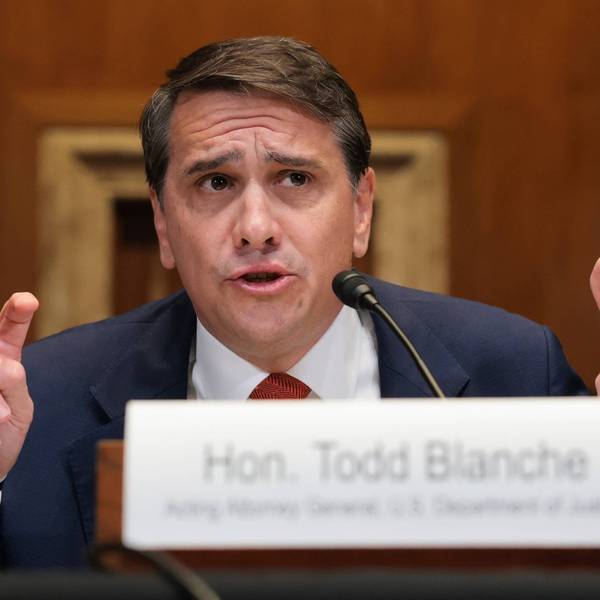
Acting US Attorney General Todd Blanche testifies before a House Committee on Appropriations Subcommittee on Commerce, Justice, Science, and Related Agencies hearing at the Rayburn House Office Building in Washington, DC on June 2, 2026. (Photo by Nathan Posner/Anadolu via Getty Images)
“If the administration and its allies in Congress are truly walking away from the $1.8 billion criminal enrichment fund, they should have no problem joining us in banning it outright,” the Maryland Democrat said.
Though acting US Attorney General Todd Blanche has said President Donald Trump’s $1.8 billion “weaponization” slush fund is now “dead,” Democratic Rep. Jamie Raskin on Thursday unveiled draft legislation that would eliminate what he describes as a “super pardon” buried in the Department of Justice settlement reached last month.
While Blanche—whom Trump said he plans to nominate for a full term as attorney general—has backed off the fund that would allow the DOJ to disburse taxpayer money to Trump allies and January 6 insurrectionists amid bipartisan backlash, a news release from Raskin’s (D-Md.) office on Thursday said the acting AG has done nothing to rescind “the mother of all sweetheart deals he tucked into his unprecedented settlement with Trump.”
The settlement, created in exchange for Trump dropping a $10 billion lawsuit against the Internal Revenue Service (IRS) for improperly leaking his tax returns, gives Trump, his entire family, and all their business ventures total and permanent immunity for “any matters currently pending or that could be pending” not only before the IRS, which Trump sued in the case that led to the settlement, but also before “other agencies or departments.”
The Maryland Democrat also said that despite retreating on the “weaponization” fund, the DOJ is still using its Judgment Fund to improperly reward the president’s allies.
According to the Washington Post, as of April, the DOJ had already paid $8.5 million to prominent Trump allies who claimed to have been wrongly targeted by the Biden administration, even though no court formally determined that they had been.
"It would be phenomenal if Todd Blanche had pulled this off, working openly and publicly, formally, as Donald Trump's lawyer, but he was working for our lawyer against Donald Trump, at least theoretically. He should have stopped this at every level…" @RepRaskinpic.twitter.com/sT2ZMx9MBo
“If the administration and its allies in Congress are truly walking away from the $1.8 billion criminal enrichment fund, they should have no problem joining us in banning it outright,” Raskin said. “But no one should be fooled by Trump and Blanche’s tactical pause: Nothing has been dismantled, and nothing has been renounced. Trump’s scheme to raid the Judgment Fund, bankroll political allies using taxpayer cash, and score a sweeping Super Pardon is alive and well and remains a clear and present threat to our constitutional order.”
Raskin, who is the ranking member of the House Judiciary Committee, introduced a new legislative package on Thursday, aiming to destroy the remaining vestiges of the DOJ deal and ensure that future presidents can never use federal settlements to reward themselves.
The Block Lawless Agreements and Nullify Corrupt Handouts and Emoluments (BLANCHE) Act, bars sitting presidents from entering settlements for money damages with the federal government and requires independent judicial oversight of any such agreements, including ones that grant the president “super pardons” like the one granted to Trump by the DOJ.
“My legislative package would end the slush fund, outlaw collusive settlements, and make clear that no president can use taxpayer dollars to cut partisan loyalty reward checks,” Raskin said.
He also introduced the Constitutional Rights Defense Act, which would allow individuals to file suits against the federal government when their rights are violated by agents of the state.
In contrast with the January 6 Capitol riot participants who have been claiming compensation under the fund, Raskin said his bill “ensures that all people who have actually had their constitutional rights violated by the government will have access to justice.”
Raskin has previously introduced legislation that would block the use of federal funds to finance the Trump IRS settlement and prohibit payouts to January 6 Capitol riot participants and other Trump allies, including family members.
“Congress must act with urgency to shut down this presidential plunder once and for all,” Raskin said.
Donald Fuhrump says that Amerikkka doesn’t bother with crimes or charges anymore, not being 100% Amerikkkan and opposing his real estate intentions is enough.Donald Trump urges you to be a Climate Science denier like him. He says that he makes millions and millions for destroying the planet, Burn, Baby, Burn and Flood, Baby, Flood.Orcas discuss rotting brain, front Orca says Sundown Syndrome is a dead givaway and he wishes someone would Lock Him Up
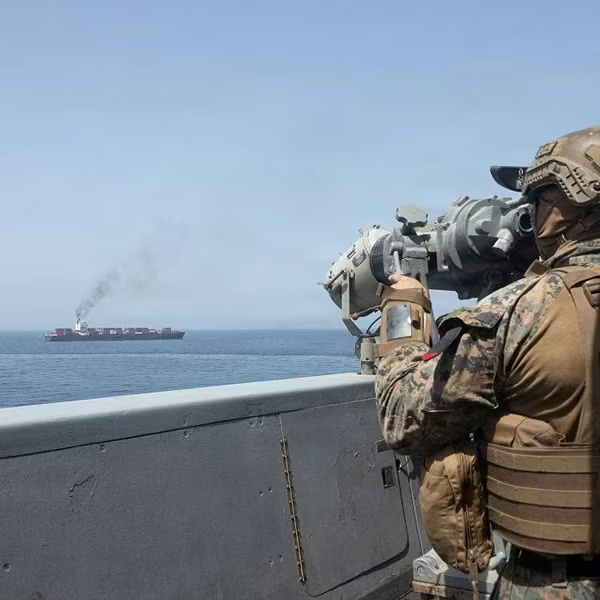
A cargo boat navigates the sea behind a mural depicting the shoreline on April 28, 2026 on Qeshm Island, Iran. (Photo by Asghar Besharati/Getty Images)
“Any American interference in the new maritime regime of the Strait of Hormuz will be considered a violation of the ceasefire,” said a member of the Iranian Parliament.
Iranian officials warned Sunday that US President Donald Trump’s newly announced plan to help “guide” stranded ships out of the Strait of Hormuz is an attempted provocation aimed at justifying additional military action against the Middle Eastern country.
An unnamed senior Iranian official toldDrop Site that Trump’s plan, announced on Truth Social and confirmed by the US military, “is primarily intended to provoke Iran into taking an initial step toward confrontation, thereby creating a pretext for escalation and enabling him to justify further military action in response to an Iranian initiative.”
The official added that “our definitive position is that any commercial vessel attempting to transit through designated restricted routes without prior coordination will be promptly intercepted by Iranian forces.”
“Should US military vessels respond, such actions would be met with an immediate and corresponding response from Iran,” the official continued. “The US military vessels are far from the corridor area. If commercial vessels attempt to move, they would be engaged well before reaching any American ships,” the official added. “Trump has effectively turned them into bargaining tools in his political game.”
Ebrahim Azizi, who heads the national security commission of the Iranian Parliament, warned in response to Trump’s plan that “any American interference in the new maritime regime of the Strait of Hormuz will be considered a violation of the ceasefire” that took effect in early April.
“The Strait of Hormuz and the Persian Gulf would not be managed by Trump’s delusional posts,” Azizi added.
Trump wrote on his social media platform on Sunday that his administration has told countries with vessels stranded in the vital strait that “we will guide their Ships safely out of these restricted Waterways, so that they can freely and ably get on with their business.” Iran closed the strait—through which around 25% of the world’s seaborne oiltrade and a third of global fertilizer trade flows each year—in response to the US-Israeli war as well as the Trump administration’s naval blockade against Iran.
The US president characterized his plan, which is titled Project Freedom and set to take effect on Monday, as a “humanitarian gesture on behalf of the United States,” but provided few details on how it would work.
US Central Command (CENTCOM) said in a statement on Sunday that military support for Project Freedom would “include guided-missile destroyers, over 100 land and sea-based aircraft, multi-domain unmanned platforms, and 15,000 servicemembers.”
“Last week, the U.S. Department of State announced a new initiative, in partnership with the Department of War, to enhance coordination and information sharing among international partners in support of maritime security in the strait,” CENTCOM said. “The Maritime Freedom Construct aims to combine diplomatic action with military coordination, which will be critical during Project Freedom.”
Brian Finucane, senior adviser to the US Program at the International Crisis Group, wrote that CENTCOM’s statement makes the president’s plan “sound like information-sharing backed by a vague threat of military action.”
The president’s scheme drew immediate support from one of the most vocal boosters of the Iran war, US Sen. Lindsey Graham (R-SC), who said he “totally” agrees with Trump’s decision to launch Project Freedom.
“I hope this conflict can end diplomatically,” said Graham, “but it is now time to regain freedom of navigation and forcefully respond to Iran if they insist on terrorizing the world.”