27 journalists killed in Israeli attacks in Lebanon, press union says

Spread the love

This work by Middle East Monitor is licensed under a Creative Commons Attribution-NonCommercial-ShareAlike 4.0 International License.

People attend funeral ceremony for journalist Amal Khalil, who was killed in an Israeli military strike targeting the village of Tayri, in Nabatieh, Lebanon on April 23, 2026. [Elif Öztürk – Anadolu Agency]

At least 27 journalists have been killed in Israeli attacks in Lebanon since March 2, along with many others wounded, the Lebanese Press Syndicate Editors said Thursday.

In a statement, the syndicate condemned Israel’s targeting of a group of journalists in the southern town of Tayri on Wednesday, in which reporter Amal Khalil was killed and her colleague Zeinab Faraj was wounded.

The syndicate said Khalil had previously received death threats from the Israeli army.

“With her killing, the number of journalists and media workers killed has risen to 27, in addition to a large number of injured,” the statement said.

The syndicate called on the Federation of Arab Journalists to work with international and Arab press unions to support Lebanese journalists amid deliberate Israeli attacks.

READ: Lebanese journalist Amal Khalil killed in Israeli strike in southern Lebanon

It also urged journalists working in the field in Lebanon to exercise caution, avoid high-risk areas and coordinate with the Lebanese army and other official security forces in areas exposed to Israeli attacks, including UNIFIL, the Lebanese Red Cross and local relief teams, “to avoid any unexpected fatal risk.”

The syndicate said Israel’s actions against Lebanese civilians, particularly journalists, “have exceeded all limits,” calling on the Lebanese government to take urgent action at international bodies and file a legal case against Israel.

During Wednesday’s attack, Israeli forces prevented the Red Cross and Lebanese army forces from reaching the two journalists and targeted a road linking Tayri and Haddatha to block rescue teams, according to the state news agency NNA.

Since March 2, Israeli attacks on Lebanon have killed 2,475 people, wounded 7,696 and displaced more than 1.6 million, according to official figures.

A 10-day ceasefire announced by the US on April 16 is set to expire Sunday and has been violated daily by Israel.

READ: Palestinian journalist killed by Israeli fire in Gaza, death toll rises to 262

Keir Starmer explains that UK is actively supporting Israel's genocidal expansion and repeats his previous quotation that he supports Zionism "without qualification". Keir Starmer said “I said it loud and clear – and meant it – that I support Zionism without qualification.” here: https://www.jewishnews.co.uk/keir-starmer-interview-i-will-work-to-eradicate-antisemitism-from-day-one/
Keir Starmer explains that UK is actively supporting Israel’s genocidal expansion and repeats his previous quotation that he supports Zionism “without qualification”. Keir Starmer said “I said it loud and clear – and meant it – that I support Zionism without qualification.” here: https://www.jewishnews.co.uk/keir-starmer-interview-i-will-work-to-eradicate-antisemitism-from-day-one/
Keir Starmer objects to criticism of the IDF. He asks how could anyone object to them starving people to death, forced marches like the Nazis did, bombing Gaza's hospitals and universities, mass-murdering journalists, healthworkers and starving people queuing for food, killing and raping prisoners and murdering children. He calls for people to stop obstructing his genocide for Israel.
Keir Starmer objects to criticism of the IDF. He asks how could anyone object to them starving people to death, forced marches like the Nazis did, bombing Gaza’s hospitals and universities, mass-murdering journalists, healthworkers and starving people queuing for food, killing and raping prisoners and murdering children. He calls for people to stop obstructing his genocide for Israel.
Continue Reading27 journalists killed in Israeli attacks in Lebanon, press union says

Israel kills five journalists in a clearly marked press van in Gaza

Spread the love

Original article by Aseel Saleh republished from peoples dispatch under a Creative Commons Attribution-ShareAlike 4.0 (CC BY-SA) license.

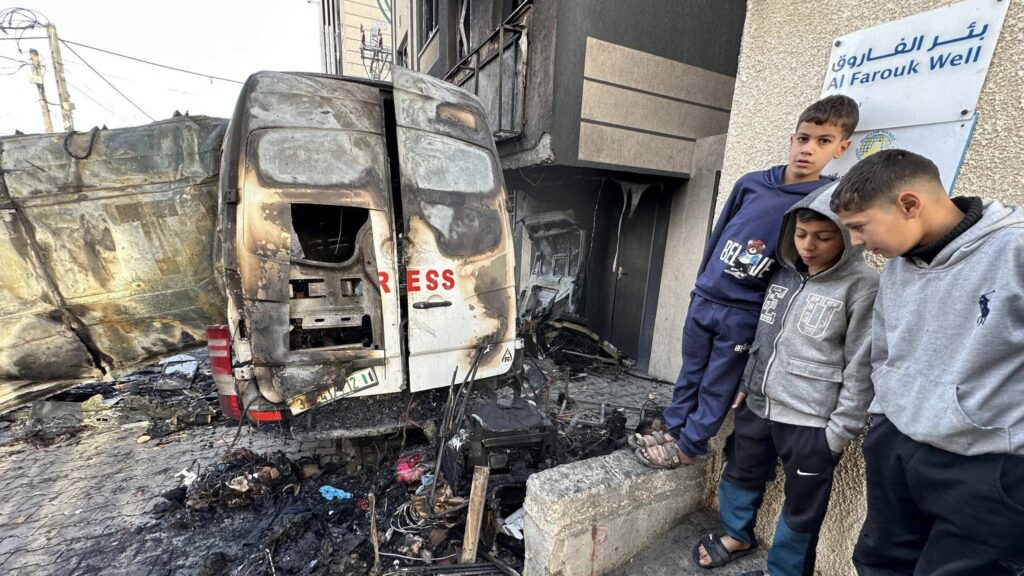
5 journalists were killed in an Israeli air strike on their vehicle near Al-Awda Hospital in Nuseirat, central Gaza Strip, on December 26, 2024. Photo: Mohammed Asad/Middle East Monitor.

Instead of condemning the massacre of the Palestinian journalists, western media outlets have attempted to whitewash Israel’s flagrant crime by adopting its narrative.

Five Palestinian journalists from Al-Quds Today TV channel were killed in an Israeli airstrike that hit their broadcasting van as they were covering events near Al-Awda Hospital, in Al-Nuseirat refugee camp in the central Gaza strip on Thursday, December 26.

The slain journalists were identified as Faisal Abu al-Qumsan, Ayman al-Jadi, Ibrahim al-Sheikh Ali, Mohammad al-Ladah, and Fadi Hassouna.

Just hours before their van, which was marked with the word “Press” in large red letters, was hit, Ayman al-Jadi recorded a video with his slain colleagues. The video showed Ayman celebrating with them as he was awaiting the birth of his first child, who was born around the same time as he was killed in the airstrike.

Press van that was hit with an Israeli airstrike. Photo: Mohammed Asad/Middle East Monitor

Ayman’s brother Omar al-Jadi recorded and later shared a video of the moment Ayman and his colleagues were killed. In the video, a grief-stricken Omar sobs as the van carrying his brother is set ablaze.

The Palestinian Journalists Syndicate (PJS) condemned the Israeli massacre of the five journalists on Thursday, pointing out that the deadly attack took the death toll of Palestinian journalists and media workers killed by Israel since the beginning of the Israeli genocidal aggression in Gaza to more than 190.

PJS called the murder of the journalists “an attempt to obscure the truth and stifle freedom of expression,” adding that it reflects the extent of the systematic targeting of Palestinian journalists. The syndicate also urged the international community and all human rights organizations to provide urgent protection for Palestinian journalists and take practical steps to stop the crimes committed by the Israeli Occupation Forces (IOF) against them.

For its part, the Committee to Protect Journalists (CPJ) denounced the crime on Thursday. CPJ’s program director in New York, Carlos Martinez de la Serna, clarified in a statement that with the assassination of Al-Quds Today journalists “nine Gazan journalists have been killed in less than two weeks”, urging the international community to act immediately “to protect Palestinian journalists in Gaza and end Israel’s impunity for these killings.”

On December 11, Palestinian broadcaster of local Al-Aqsa Radio Eman al-Shanti was killed alongside her three children and husband in an Israeli airstrike that targeted a residential building in Sheikh Radwan neighborhood, in Gaza City. Four days later, Al-Mashhad News correspondent Mohammad Baalousha was killed after an Israeli quadcopter dropped a bomb on a street within the same neighborhood.

On the same day, Palestinian journalist and editor at a local news agency, Mohammad al-Qrinawi, his wife and children were killed in an Israeli aerial attack that struck their home in Al-Bureij refugee camp in the central Gaza Strip.

One day after Baalousha and al-Qrinawi were murdered, Al Jazeera cameraman Ahmad Baker al-Louh was killed in an Israeli airstrike, which targeted a Palestinian Civil Defense post in Al-Nuseirat refugee camp in the central Gaza Strip.

While the Israeli Occupation Forces (IOF) have been systematically targeting Palestinian journalists and media workers in a bid to cover Israel’s war crimes in Gaza, it has also blocked foreign media outlets from entering the besieged enclave.

According to a report published by Reporters Without Borders (RSF) last October, Israel has implemented diverse methods to orchestrate a media blackout in Gaza. In addition to the targeted killing of journalists, and prohibiting foreign journalists from accessing Gaza, IOF sought to destroy newsrooms and cut off internet and electricity, annihilating the Palestinian media infrastructure.

Meanwhile, western media has continued to whitewash Israel’s war crimes and the slaughtering of journalists by adopting the IOF’s narrative. Echoing Israeli media, The New York Times reported on Thursday, that the five murdered journalists from Al-Quds Today were associated with a militant group.

Original article by Aseel Saleh republished from peoples dispatch under a Creative Commons Attribution-ShareAlike 4.0 (CC BY-SA) license.

Continue ReadingIsrael kills five journalists in a clearly marked press van in Gaza

US Urged to Condemn Israel’s ‘Summary Execution’ of Two Journalists

Spread the love

Original article by EDWARD CARVER republished from Common Dreams under Creative Commons (CC BY-NC-ND 3.0). 

Palestinian Al Jazeera journalist Ismail al-Ghoul and cameraman Rami al-Rifee were killed by Israeli forces on July 31, 2024. (Photo: Dawoud Abo Alkas/Anadolu via Getty Images)

International outcry and a reporter’s pointed questions weren’t enough to get the State Department to denounce the killings of Al Jazeera journalists.

A Palestinian journalist on Thursday pressed a U.S. State Department spokesperson to characterize the killings of two Al Jazeera journalists by Israeli forces as summary execution.

The heated press briefing followed an airstrike on Wednesday that killed Al Jazeera reporter Ismail al-Ghoul and cameraman Rami al-Rifee, and sparked global outrage. Israel’s military acknowledged targeting al-Ghoul, saying he was “eliminated” because he was a Hamas “terrorist,” an allegation the Qatar-based network said was “baseless.”

The death toll of Palestinian journalists and media workers now stands at least 108, including several intentionally targeted by Israel forces, according to the Committee to Protect Journalists (CPJ).

Said Arikat, the Washington bureau chief of Al-Quds, an Arabic-language newspaper based in Jerusalem, called the strike a “premeditated crime to kill a journalist for doing their job” and a “summary execution” in the press briefing, but State Department spokesperson Vedant Patel declined to affirm the characterizations or condemn the airstrike.

Al-Ghoul and al-Rifee were killed in northern Gaza after reporting from near the home of Ismail Haniyeh, the Hamas political leader who was assassinated in Tehran earlier on Wednesday. They wore press vests and had signs on their vehicle identifying them as journalists; they had last contacted their news desk just 15 minutes before the strike, Al Jazeera reported.

The Israel Defense Forces (IDF) presented no evidence in a social media post claiming that al-Ghoul was a terrorist and Hamas operative. In March, al-Ghoul reported being stripped, handcuffed, and blindfolded during the course of a 12-hour detainment by Israeli forces; he had been covering an Israeli attack on al-Shifa hospital in Gaza City. Witnesses said Israeli forces severely beat al-Ghoul at the hospital before arresting him.

Anas al-Sharif, another Al Jazeera reporter in Gaza, was on site at a different hospital on Wednesday when his colleagues’ bodies were brought in, and he spoke about the role al-Ghoul had played in the outlet’s war coverage.

“Ismail was conveying the suffering of the displaced Palestinians and the suffering of the wounded and the massacres committed by the [Israeli] occupation against the innocent people in Gaza,” he told his own news outlet.

“The feeling—no words can describe what happened,” he added.

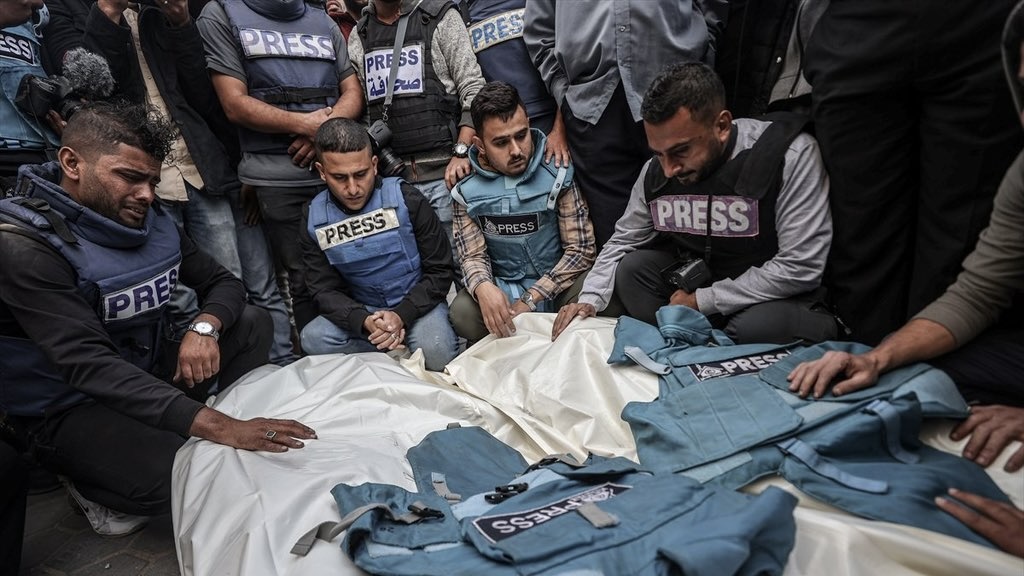
In protest of the killings, Palestinian journalists gathered to throw off their press vests and vowed to continue showing the suffering of Gazans through their work, despite the dangers they faced.

Condemnation of the killings of the two Al Jazeera journalists came not just from Gaza but all over the world.

CPJ CEO Jodie Ginsberg said in a statement that she was “dismayed” by the killings and that journalists are civilians who should never be targeted.

Defending Rights & Dissent, a U.S.-based civil liberties nonprofit, also condemned the killing of al-Ghoul and said the reasons for it were clear.

“When you ‘eliminate’ journalists, it’s much easier to hide war crimes, it’s easier to spread lies, it’s easier to commit genocide,” Sue Udry, the group’s executive director, said in a statement.

In response to the killing, the International Committee of the Red Cross (ICRC) said that journalists “must be protected, and we decry attacks against them.”

William Schomburg, head of the ICRC’s sub-delegation in Gaza, said in a statement that his team had just met with al-Ghoul the previous week to get an update on the humanitarian situation in Gaza. “Journalists in all wars play a central role in highlighting the plight of civilians and in speaking for the voiceless,” Schomburg said.

Reporters Without Borders (RSF, in French), a Paris-based nonprofit, wrote in unequivocal terms about the need for Israel to stop killing journalists.

“RSF is deeply disturbed to see the Israel Defense Forces using social media to justify their targeted killing of Al Jazeera journalist Ismail al-Ghoul,” the organization wrote on social media. “Journalists are not terrorists. This campaign of violence against media in Gaza must stop now.”

The Freedom of the Press Foundation also responded forcefully to the IDF’s claim about al-Ghoul.

“Documenting a war isn’t terrorism, it’s journalism,” the group wrote on social media. “If the IDF can prove al-Ghoul was working for Hamas’ military, it should do so immediately. If not, this looks like a flimsy excuse for intentionally murdering a journalist from an outlet Israel dislikes.”

Israeli forces have killed at seven journalists or media workers affiliated with Al Jazeera during the war, and Israel shut down the network’s local operations in May, citing a security threat, though critics said it was a case of censorship—an attempt to hide the brutality of the assault on Gaza.

In total, 113 journalists and media workers have died since the war began, including two Israelis and three Lebanese, according to CPJ, which says this has been the deadliest period for journalists anywhere in the world since it began collecting data in 1992.

The international outcry over all of the killings has ramped up pressure on the U.S.—which has backed the Israeli assault with weapons and diplomatic support— to condemn them, and Wednesday’s strike on al-Ghoul and al-Rifee has only increased that pressure. Still, Patel, the spokesperson, wouldn’t issue any such condemnation on Thursday.

Arikat also pressed Patel to call for the release of Palestinian journalists being held in Israeli detention centers without charges, but Patel didn’t do so.

Original article by EDWARD CARVER republished from Common Dreams under Creative Commons (CC BY-NC-ND 3.0). 

Continue ReadingUS Urged to Condemn Israel’s ‘Summary Execution’ of Two Journalists

Group Files New ICC Complaint Over Journalists Killed by Israel in Gaza

Spread the love

Original article by BRETT WILKINS republished from Common Dreams under Creative Commons (CC BY-NC-ND 3.0). 

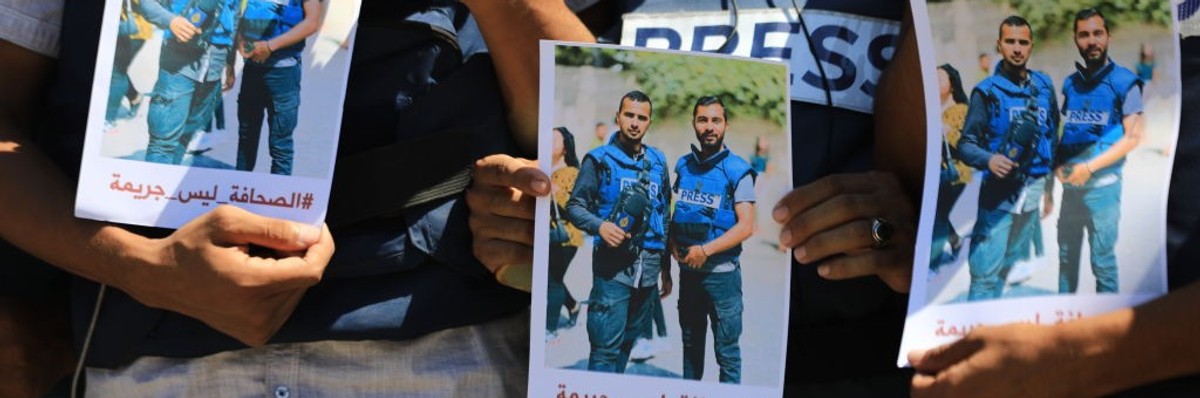
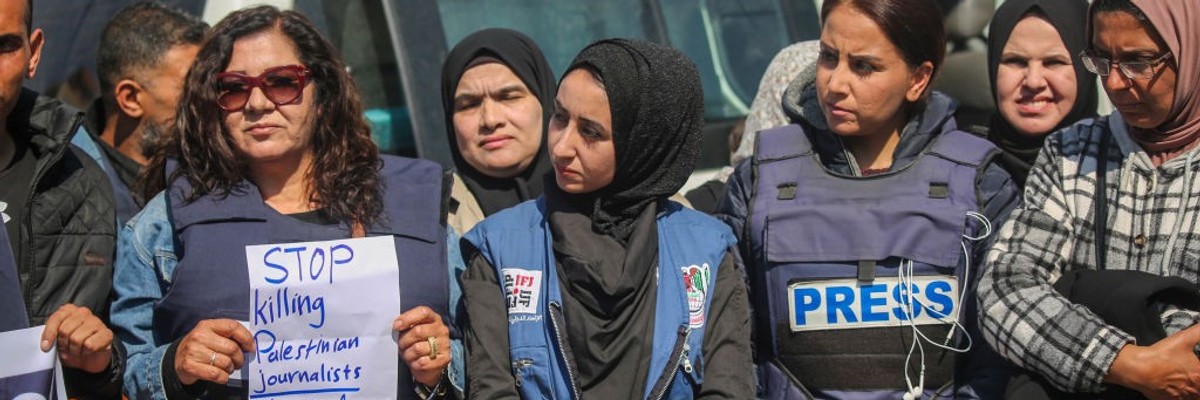
Palestinian journalists stage a protest to draw attention to Palestinian press killed while covering the war in the Gaza Strip on February 26, 2024 in Rafah.
 (Photo: Ahmad Hasaballah/Getty Images)

Reporters Without Borders says it has “reasonable grounds for thinking that some of these journalists were deliberately killed and that the others were the victims of deliberate IDF attacks against civilians.”

The press freedom group Reporters Without Borders announced Monday that it has filed a third complaint at the International Criminal Court alleging “war crimes against journalists in Gaza,” where over 100 media professionals have been killed by Israeli forces since October 7.

Paris-based Reporters Without Borders (RSF) is asking the ICC to investigate the Israel Defense Forces’ (IDF) killing of eight Palestinian journalists and wounding of another between December 15 and May 20 and, more broadly, the over 100 media workers slain during the course of Israel’s 234-day assault on Gaza.

RSF said it “has reasonable grounds for thinking that some of these journalists were deliberately killed and that the others were the victims of deliberate IDF attacks against civilians” and accused Israel of “an eradication of the Palestinian media.”

“Impunity endangers journalists not only in Palestine but also throughout the world,” RSF advocacy and assistance director Antoine Bernard said in a statement. “Those who kill journalists are attacking the public’s right to information, which is even more essential in times of conflict. They must be held accountable, and RSF will continue to work to this end, in solidarity with Gaza’s reporters.”

Journalists in RSF’s latest complaint include Mustapha Thuraya and Hamza al-Dahdouh, freelancers working for Al Jazeera in Rafah when they were killed by a targeted Israeli drone strike on their vehicle on January 7, and Hazem Rajab, who was injured in the strike.

According to RSF:

The complaint also cites the cases of Hadaf News website reporter Ahmed Badir, who was killed by an airstrike at the entrance to Shuhada al-Aqsa Hospital in Deir al-Balah on 10 January; Kan’an News Agency correspondent Yasser Mamdouh, who was killed near Al-Nasser Hospital in Khan Yunis on 11 February; Ayat Khadoura, an independent video blogger killed by an Israeli strike on his home on 20 November shortly after posting a video; Yazan Emad Al-Zwaidi, a cameraman with the Egyptian satellite TV news channel Al Ghad, who was killed on 14 January when an Israeli strike hit the group of civilians he was with in Beit Hanoun; Ahmed Fatima, a journalist with the Al Qahera News TV channel, who was killed during a bombardment in Khan Yunis on 13 November; and Rami Bdeir, a reporter for the Palestinian New Press media outlet, who was killed during an Israeli bombardment in Khan Yunis on 15 December.

Another advocacy group, the Committee to Protect Journalists, previously condemned what it called an “apparent pattern of targeting journalists and their families,” noting cases in which media workers were killed while wearing press insignia and after being threatened by Israeli officials.

Monday marked the ninth anniversary of United Nations Security Council Resolution 2222, which concerns the protection of journalists in conflict zones and “emphasizes the responsibility of states to comply with the relevant obligations under international law to end impunity and to prosecute those responsible for serious violations of international humanitarian law.”

Last month, Francesca Albanese, the U.N. special rapporteur on the occupied Palestinian territories, said: “Killing journalists is a war crime that undermines the most basic human rights. Justice starts with the cessation of injustice.”

Original article by BRETT WILKINS republished from Common Dreams under Creative Commons (CC BY-NC-ND 3.0). 

Continue ReadingGroup Files New ICC Complaint Over Journalists Killed by Israel in Gaza

Israel is assassinating journalists in Gaza

Spread the love

Original article by Amanda Yee republished from peoples dispatch under a Creative Commons Attribution-ShareAlike 4.0 (CC BY-SA) license.

As part of its genocidal onslaught on Gaza, Israel is killing media workers at an unprecedented rate, seemingly to prevent the world from seeing the unspeakable atrocities it carries out.

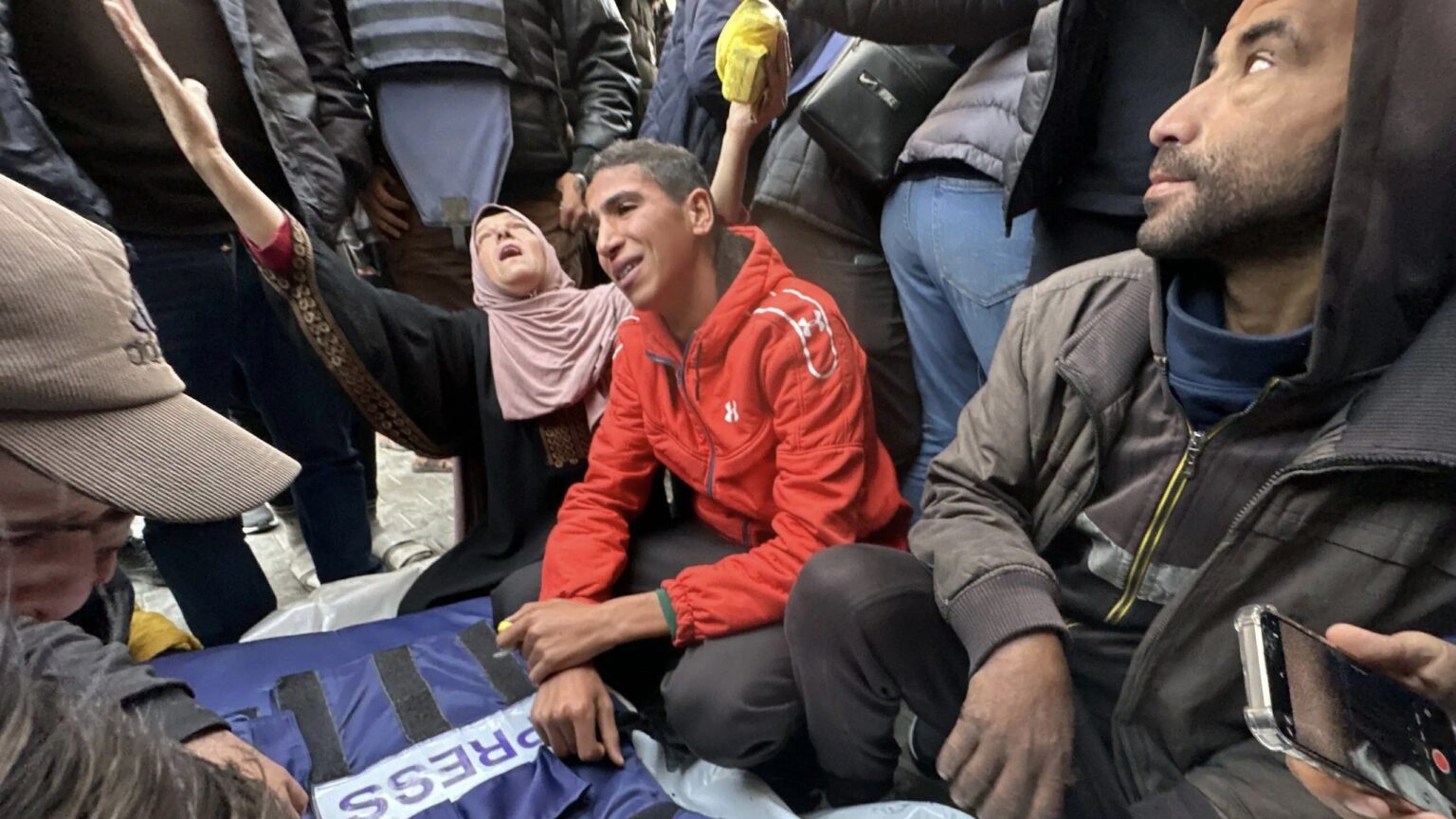
Relatives, colleagues and loved ones of Palestinian journalists Sari Mansour and Hasona Saliem, who were killed while working, mourn during funeral ceremony in Deir al-Balah, Gaza on November 19, 2023. Photo: Anadolu Ajansı / Ali Jadallah

Israel is intentionally assassinating journalists in Gaza. As it wages its genocidal onslaught on the enclave, having murdered at least 13,000 Palestinians so far, Israel is simultaneously killing media workers in order to prevent the world from seeing the unspeakable atrocities it carries out.

The situation at hand is as dire as it is unprecedented. Since October 7, the Israeli military has killed 60 media workers, according to the Gaza Government Media Office. The Committee to Protect Journalists has stated this is the deadliest month for attacks on journalists since it started keeping record in 1992. Additionally, many other Palestinian reporters outside of Gaza face intimidation and harassment by Israeli forces.

“We have never experienced anything like this and we are overwhelmed,” admitted Nasser Abu Bakr, head of the Palestinian Journalists’ Syndicate, a Ramallah-based trade union representing Palestinian media workers. “We are losing colleagues and friends every day as a result of the ongoing Israeli genocide against the Palestinian people and the policy of targeted killing against journalists.”

“We can’t keep up with the number of attacks against our journalists,” Abu Bakr continued. “We are receiving more calls and information about … incidents than we can process. Our journalists have always been a target for the Israeli military, but Israel moved from killing [an average of] one Palestinian journalist a year before October 7 to killing [over] one a day.”

And it’s not just Palestinian reporters the Israel Defense Forces (IDF)  is attacking—any journalist who may potentially disseminate information critical of Israel is a potential target.

Among the long list of reporter casualties is Reuters photojournalist Issam Abdallah, who was killed by an October 13 Israeli strike on the Lebanese border while covering clashes between Hezbollah and the IDF. According to an independent investigation by Reporters Without Borders (RWB), Abdallah was explicitly targeted by Israeli forces—he was clearly identified as a journalist through his press helmet and vest, and he was standing next to a vehicle marked “press” on its roof. Immediately before the attack, other journalists in the area had witnessed an Israeli helicopter flying overhead, so the military was able to clearly see that Abdallah was a non-combatant. According to ballistic analysis done by RWB, the missiles were launched from the side of the Israeli border and “two strikes in the same place in such a short space of time (just over 30 seconds), from the same direction, clearly indicate precise targeting.”

Not even the families of journalists are safe from Israeli retaliation. After learning on air that an Israeli air raid had killed his wife, son, daughter, and grandson, Gaza Al Jazeera bureau chief Wael Al-Dahdouh rushed to the hospital, followed by press cameras. Upon finding his son there, he knelt over his lifeless body and lamented, “They take revenge on us with our children.”

On November 7, Mohammad Abu Hasira, a correspondent for Palestinian news agency Wafa, was killed by an Israeli air raid, along with 42 members of his family. And just days before that, an Israeli strike killed Palestine TV reporter Mohammad Abu Hattab and 11 members of his family in south Gaza, including his wife, son, and brother.

Israel invents lies to justify war crimes

Just as it has claimed that Hamas was hiding in Gaza hospitals, near schools, and in ambulance convoys in order to justify its bombing and killing of civilians, Israel has peddled the same predictable excuses for these targeted assassinations of journalists. In a chilling November 2 article that effectively doubles as a hit list, the Jerusalem Post spotlighted several independent Palestinian journalists who had been reporting from Gaza and smeared them as part of “Hamas’s propaganda team.”

Then, pro-Israel media watchdog group HonestReporting released a report on November 8 claiming—with little evidence—that the Associated Press, CNN, The New York Times, and Reuters freelance photographers in Gaza knew in advance of the October 7 Palestinian Resistance counter-offensive and even collaborated with Hamas in order be on location to get their shots during the operation.

Israeli officials quickly jumped on the story to vindicate their assassination campaign against Palestinian reporters.

In response to the report, former Minister of Defense and current member of Israel’s war cabinet Benny Gantz said, “Journalists found to have known about the massacre, and [who] still chose to stand as idle bystanders while children were slaughtered, are no different than terrorists and should be treated as such.”

Danny Danon, Israel’s representative to the United Nations, went so far as to declare that these reporters would be put on a hit list, stating on X, “Israel’s internal security agency announced that they will eliminate all participants of the October 7 massacre. The ‘photojournalists’ who took part in recording the assault will be added to that list.”

Gil Hoffman, executive director of HonestReporting, later admitted that he had no evidence to substantiate the claims made, but was just “raising questions.” According to Hoffman, he and HonestReporting “don’t claim to be a news organization.”

Accusations that Palestinian reporters are embedded within and acting in coordination with Hamas lay the propaganda groundwork to depict journalists as legitimate military targets.

Israel restricting information coming out of Gaza

Not only is the IDF killing Palestinian journalists on the ground, but the Israeli government is actively denying access to foreign press into Gaza. The only reporters allowed into the strip are those embedded within the IDF, and media outlets such as NBC and CNN have confirmed that in exchange for access, they must submit all materials to the Israeli military prior to broadcast for review and approval.

Additionally, the Palestinian Journalists’ Syndicate reported that as many as 50 media outlets in Gaza have been partially or entirely destroyed by Israeli air strikes since October 7. If Israel is not outright bombing news outlets, then they are actively trying to repress the flow of information coming out. In late October, the Israeli government approved regulations that would allow it to shut down any foreign news channel if it believed the outlet posed a threat to national security. This regulation was then used to block the programming and website of Lebanese outlet Al Mayadeen, because of its “wartime efforts to harm [Israel’s] security interests and to serve the enemy’s goals,” according to a statement released by the Israeli security cabinet.

In the absence of foreign press bearing witness to Israel’s atrocities in Gaza, Palestinian civilians have taken to documenting the horrors themselves and sharing them on social media sites such as X and TikTok for the outside world to see.

The Israeli government has responded by repeatedly shutting down internet and communications systems across Gaza, even further restricting the flow of information coming out.

History of Israel targeting journalists

Even before its current war on Gaza began on October 7, Israel had a long history of targeting reporters and news networks. During its 2021 military incursion on Gaza, Israel was accused of “silencing” journalists by press freedom advocates after it bombed the offices of Al Jazeera and the Associated Press. This occurred just days after it had bombed another building that housed a number of other news outlets, including Al Araby TV, Al Kofiya TV, and Watania News Agency, among others.

According to the Palestinian Journalists’ Syndicate, Israel killed 55 journalists from 2000 to 2022, either by live fire or bombardment. This figure includes Shireen Abu Akleh, the beloved Palestinian-American journalist and longtime Al Jazeera correspondent who was shot by Israeli forces while reporting on IDF raids in Jenin, as well as Yaser Murtaja, a cameraman for Palestinian network Ain Media, who was shot and killed by the IDF while covering the 2018 Great March of Return.

Like so many other Palestinian journalists Israel murdered on the job, Abu Akleh and Murtaja were both wearing their press vests at the time of their killings. Immediately after his death, Israel predictably—with no evidence—rushed to accuse Murtaja of being a Hamas fighter in order to cover its tracks.

The day after Murtaja’s killing, Israel’s then-Defense Minister Avigdor Lieberman bluntly stated, “In the march of terror, there were no innocent civilians. They were all Hamas.”

Israel is losing the information war

Israel relies on its advanced military weaponry and billions of dollars in funding from the US to carry out its genocidal violence against the Palestinian people across Gaza, Jerusalem, and the West Bank. Its Hasbara and “Brand Israel” campaigns work around the clock to justify its war crimes through outright lies and disinformation.

However, Israel has suffered significant losses in the information war as reports and images of the atrocities have reached millions across the world, many of whom have joined the mass mobilizations in support of the Palestinian cause. On the international stage, Israel is further politically isolated, with more and more countries cutting ties or recalling their diplomatic staff.

This battle of ideas cannot be won through sheer force and US-backed military superiority. Israel cannot prevent information about its atrocities from leaking out, especially in an age of social media in which ordinary Palestinians are emboldened to act as citizen journalists, documenting what they are living through in Gaza for the world to see. As Israel escalates its assassination campaign against media workers, support for the Palestinian Resistance continues to grow.

Grim as the current situation may seem, it speaks to the reality at hand: The people of the world are waking up to the atrocities carried out by the Zionist state and refusing to allow it to continue.

And that speaks to another reality: Israel is living on borrowed time, and that time is running out.

Amanda Yee is a journalist and organizer based out of Brooklyn. She is the managing editor of Liberation News, and her writing has appeared in Monthly Review Online, The Real News Network, CounterPunch, and Peoples Dispatch. Follow her on X @catcontentonly.

This article was produced by Globetrotter.

Original article by Amanda Yee republished from peoples dispatch under a Creative Commons Attribution-ShareAlike 4.0 (CC BY-SA) license.

Continue ReadingIsrael is assassinating journalists in Gaza