Tag: privilege

  • From aristocracy to ‘assetocracy’ – how wealth has transformed the House of Lords

    Spread the love
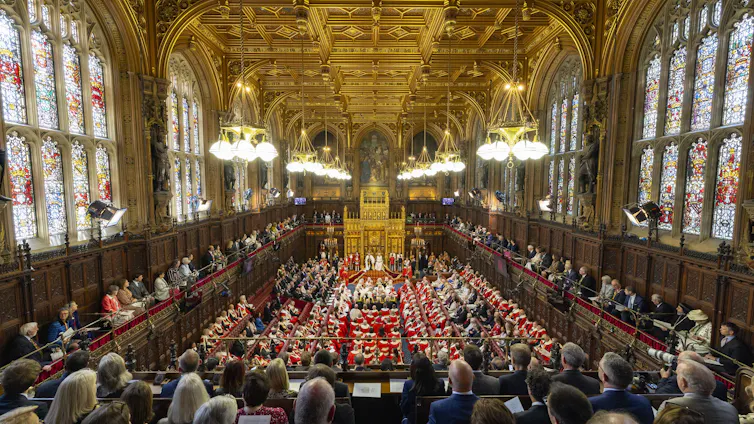
    peers in ermine in the house of lords chamber for the state opening of parliament 2026 with the king and queen.
    The State Opening of Parliament 2026. House of Lords / Roger Harris, CC BY-NC-ND

    Huw Macartney, University of Birmingham

    On April 29, 2026, the remaining hereditary peers left the House of Lords. These 92 individuals were the last vestiges of an era in which the landed aristocracy dominated the UK’s second chamber. In the recent past, as many as 800 aristocrats filled the red benches. Now though, a new financial elite appears to have taken their place.

    Gradually, the dominance of the aristocrats gave way to a more meritocratic order of life peers. In 1999, Tony Blair’s government removed most of the hereditary peers; in 2026, Keir Starmer’s government finished the job. But did removing them really make the House of Lords any less elitist?

    These were some of the issues I sought to explore with a team of graduate researchers at the University of Birmingham. We set about gathering what is, to the best of our knowledge, the largest-ever repository of the financial and political activities of the Lords. Over 18 months, we collected details of all the shareholdings, company directorships, landholdings, rental properties, education, attendance and speeches in the second chamber, as well as voting records for all Lords. These are presented in my new book, The Assetocracy.

    What we uncovered was staggering. More than 260 peers hold multiple, individual shareholdings – stakes in listed companies – worth more than £100,000 apiece. In fact, some Lords held more than 200 individual holdings, each valued in excess of £100,000. Even assuming each asset was only worth £100,000, that would put the combined value of those shareholdings alone at more than £22 million.

    Put simply, this reflects a level of wealth far beyond that of all but the richest people in Britain. In fact, 14 Lords appear in The Sunday Times Rich List of the UK’s wealthiest people, with a combined net worth of £27.8 billion.

    Moreover, half of the House are landlords with rental income. And 250 peers hold one or more paid company directorship. In short, this is an extraordinary concentration of wealth at the heart of Britain’s second chamber.

    The social profile of the Lords is equally revealing. Nearly half of peers were privately educated, compared with just 7% of the wider population. Around one third went to Oxford or Cambridge, compared with just 1% nationally. And 11% attended some of Britain’s most elite schools, where annual fees can now top £60,000.

    Our conclusion? The Lords is not merely wealthy, it is an institution steeped in economic, educational and social privilege. Yet remarkably little is known about the extent of this wealth. Disclosure requirements remain limited, leaving many of the peers’ financial interests hidden from public view.

    And that matters. Membership of the Lords can sit alongside extremely lucrative private-sector careers. Several peers, for example, declared earning between £100,000 and £300,000 a year from company directorships and advisory positions – on top of their parliamentary roles and Lords allowances (a £371 daily rate).

    Aristocrats have gone – but privilege has not

    This is the paradox at the heart of the modern House of Lords. The old aristocracy may be disappearing from the red benches, but wealth and privilege have not disappeared with it. The aristocracy has increasingly given way to what we termed an “assetocracy” – members of the new financial elite whose power rests on property, finance and accumulated asset-based wealth.

    Reforming the second chamber has previously been tied to either removing the aristocratic hereditary peers or (ostensibly) increasing the scope for non-elite appointments. This is primarily done through the House of Lords Appointments Commission and the introduction of crossbenchers, whose appointment does not depend on prime ministerial patronage or political donations.

    Yet while these efforts appeared to be producing a diverse collection of Lords through the early 2000s, the trend was reversed with the arrival of the Conservative governments of the 2010s. Since then, my research shows that the second chamber has seen a striking influx of the new “assetocratic” elite.

    Appointments of peers with shareholdings over £100,000 (by political party)

    My research also reveals a small but clear relationship between wealth and participation in the Lords. Previous accounts have shown that some political donors appear to treat a peerage as a status symbol, playing little part in the day-to-day work of the House. My findings suggest however, that the pattern extends beyond political donors. On average, the wealthiest peers tend to attend less, speak less and contribute less to the work of the House.

    One of the book’s central conclusions is that the rise of the assetocrats in the Lords coincided with a wider transformation of British society. It was a period when wealth inequality grew and asset ownership became an increasingly important source of economic advantage.

    The Lords did not create these changes, nor are its members the only or primary beneficiaries. But my research shows how peers have often sought to narrow the terms of political debate around wealth and redistribution. They have defended a system that privileges asset ownership and particular forms of wealth accumulation.

    For example, Lord Leigh of Hurley, a Conservative peer and businessman, told the House in 2025 that “we need to teach kids that so-called ‘earned income’ is paid, weekly or monthly, without any risk whatever, while ‘unearned income’ is typically generated from an investment, which involves risk to capital and, therefore, deserves greater reward”.

    The research points to three conclusions. The first may seem paradoxical, but the more I researched the Lords, the more convinced I became that – certainly on issues beyond wealth and inequality – it is a remarkable source of expertise that often improves and strengthens legislation. That is why abolishing the Lords would throw away an institution that still performs an important democratic function.

    Second, reform is nonetheless overdue. Prime ministerial patronage should be curtailed; minimum expectations for attendance and participation introduced; transparency over financial affairs should be increased; and outside employment more tightly regulated where it creates conflicts of interest.

    But there is a bigger issue. The transformation of the Lords reflects a much more profound transformation of society. Over the past five decades, the UK has become an economy in which owning property, shares and other assets is an increasingly important route to extraordinary wealth. Removing the last vestiges of the old aristocracy from the Lords will not solve the problem. The deeper challenge is confronting the structural forces that have allowed a new asset-owning elite to take its place.

    This article features references to books that have been included for editorial reasons, and may contain links to bookshop.org. If you click on one of the links and go on to buy something from bookshop.org The Conversation UK may earn a commission.

    Huw Macartney, Associate professor in Political Economy, University of Birmingham

    This article is republished from The Conversation under a Creative Commons license. Read the original article.

    Orcas discuss Donald Trump and the killer apes' concept of democracy. Front Orca warns that Trump is crashing his country's economy and that everything he does he does for the fantastically wealthy.
    Orcas discuss Donald Trump and the killer apes’ concept of democracy. Front Orca warns that Trump is crashing his country’s economy and that everything he does he does for the fantastically wealthy.

  • Green Party plans 55mph motorway speed limit as Tories slam ‘war on drivers’

    Spread the love

    https://www.lbc.co.uk/article/green-party-55mph-motorway-speed-limit-5HjdXKh_2

    Fuel taxes would rise, whilst parking spaces would be steadily reduced and frequent driving tests mandated in accordance with the plans.

    New plans from the Green Party show measures to significantly reduce motorway speed limits from 70mph down to just 55mph.

    The move has sparked criticism from the Conservatives, who said Green leader Zack Polanski is waging a “war on drivers”.

    Other Green Party measures proposed for motorists would see taxes on driving “increased incrementally”, whilst parking spaces would be “steadily reduced” to discourage their use.

    According to reports, drivers would also be expected to re-take their driving test every five years, with driving considered “not a right, but a privilege”.

    The reported plans would see speed limits on motorways and dual carriageways reduced to 55mph, down from their current 70mph. Picture: Alamy

    The official Green Party transport policy reads: “On major roads outside built up areas, the maximum speed limit allowed would be 55mph, to maximise the efficiency of fuel use as well as improving safety.”

    They add that the speed limits on motorways and dual carriageways would be dropped by 15mph, and 20mph limits would be imposed on all built up areas.

    …

    https://www.lbc.co.uk/article/green-party-55mph-motorway-speed-limit-5HjdXKh_2

    dizzy: Encountering some problems posting again …

  • Expanding Heathrow is incompatible with net zero – here’s the evidence

    Spread the love

    Plane Photography / shutterstock

    Richard Sulley, University of Sheffield

    The UK government is set to back plans for a third runway at Heathrow, the country’s busiest airport, and to expand two other airports near London: Gatwick and Luton. The move is designed to support the government’s “mission” to grow the economy.

    Air transport is notoriously hard to decarbonise. Unlike the energy system, or even road transport, there is no renewable alternative to switch to immediately. If electric or hydrogen planes become reality, it won’t be for many years yet. Therefore it’s not clear this airport expansion can fit within the UK’s legal and arguably moral requirement to cut emissions and remain within its carbon budget.

    It certainly goes against what the government’s official advisory body the Committee on Climate Change (CCC) recommends. The CCC’s 2023 report to parliament stated that: “No airport expansions should proceed until a UK-wide capacity management framework is in place to annually assess and, if required, control sector GHG [greenhouse gas] emissions and non-CO₂ effects.”

    Those non-CO₂ effects of aviation include water vapour, soot and other gases like nitrous oxides and sulfur dioxide, all released directly into the high atmosphere where they help form heat-trapping clouds. Estimates suggest they could triple the greenhouse impact of aviation.

    In 2019, the last year of available data pre-COVID, domestic and international aviation accounted for around 8% of the UK’s total emissions. The non-CO₂ effects makes aviation a larger contributor to climate change than that number suggests.

    The sector itself struggles to build a coherent decarbonisation roadmap based solely on “supply-side” improvements to things like fuel efficiency or, in a recent example from EasyJet, thinner paint. The demand side – taking fewer flights, frequent flyer levies, or restrictions on domestic flights as have been introduced in France – is rarely mentioned.

    Unfortunately aviation is a prime example of the Jevons effect where any improvement in efficiency has been wiped out by increased demand. With a growing global middle class pursuing a higher consumption lifestyle, aviation emissions continue to grow even while other sectors have shows some efforts to reduce their own.

    '3rd runway plane stupid'
    A third runway at Heathrow was first proposed back in the 2000s. This photo is from a 2016 protest. Dinendra Haria / shutterstock

    The UK has mandated that synthetic aviation fuel (SAF), a more sustainable alternative to regular jet fuel, must make up 10% of aviation fuel by 2030. But only 1.2% of aviation fuel is currently SAF and the industry has not published any plans to show it can scale up in time. Indeed, the sector’s own plans for growth will outstrip efforts to decarbonise through synthetic fuel, delivering a neutral effect at best.

    The consumer-facing airport sector has also been accused of greenwash. For instance, Luton Airport recently published adverts making the claim that its own expansion would be stopped if it did not meet stringent environmental targets. However, the Advertising Standards Authority found that consumers would naturally believe that would include air traffic and not just terminal operations (a terminal’s heating or lighting is, of course, largely irrelevant when its core business is as emissions-intensive as flying).

    The difficulty of decarbonising aviation while the sector still grows is exemplified by the government’s recently launched consultation on adopting the Corsia carbon offsetting scheme for international flights and how it might work with existing cap and trade schemes. All of which encourage or excuse excess emissions through a charging mechanism.

    Growing pains

    “Kickstarting economy growth” and “Make Britain a clean energy superpower” are two of the UK government’s six “missions”. However, by expanding airports in support of the former, it risks failing the latter.

    A new report by thinktank the New Economics Foundation shows that airport expansion could balance out all of the emissions saved by the government’s clean power plans by 2050.

    There is evidence that airport expansion can bring some of the economic benefit that government needs. However, another New Economics Foundation report has found that air travel is no longer a catalyst for productivity growth. So the economic benefits of a new runway are really confined to the airport operation itself – projects for engineers and builders, service jobs for people living near Heathrow, and so on.

    Aviation is the privilege of the richer part of society, both globally and within the UK. Figures from Our World in Data shows the richest 50% of the global population produces 90% of the aviation emissions.

    While many more UK residents have experienced flying than in the past, most flights are still taken by a small, wealthy subset of the population, which will typically capture the largest share of any new capacity. Each year, around half of British residents do not fly at all.

    The focus on London airports for the largest scale expansions will shift the balance of the economy further towards south-east England, and increase inequality within the UK economy. And while these plans might bring some of the GDP gains the government is desperate to deliver, all the evidence shows they will be at the expense of its environmental targets.


    Don’t have time to read about climate change as much as you’d like?
    Get a weekly roundup in your inbox instead. Every Wednesday, The Conversation’s environment editor writes Imagine, a short email that goes a little deeper into just one climate issue. Join the 40,000+ readers who’ve subscribed so far.


    Richard Sulley, Senior Research Fellow, Sustainability Policy, University of Sheffield

    This article is republished from The Conversation under a Creative Commons license. Read the original article.

    Orcas comment on killer apes destroying the planet by continuing to burn fossil fuels.
    Orcas comment on killer apes destroying the planet by continuing to burn fossil fuels.
  • Climate activists fill golf course holes with cement in France

    Spread the love

    https://www.independent.co.uk/climate-change/news/climate-activist-france-water-ban-b2144729.html

    French climate activists have filled golf course holes with cement in protest against a water ban exemption on greens across the country during a severe drought.

    The group, part of the Extinction Rebellion organisation, targeted courses near the city of Toulouse, calling golf the “leisure of the most privileged.”

    …

    In a petition, the local activists said the exemption showed that “economic madness takes precedence over ecological reason”.

    “At a time when the greatest drought ever observed in France since the beginning of meteorological readings is raging, while the drying up of rivers is accelerating in our regions, at a time when 93 departments out of 96 are placed under water use restrictions, resulting in total bans on irrigation for certain market gardeners and for agriculture; a sector concerning a tiny fraction of the population seems to enjoy a privilege worthy of another world in these times of crisis; golf,” the group said in its online petition.

    …