Lloyd’s of London has committed to leading the market to a net zero underwriting position, yet it does not mandate or restrict the underwriting policies of its 85 members. Image: Dmitry Tonkonog, CC BY-SA 3.0 https://creativecommons.org/licenses/by-sa/3.0, via Wikimedia Commons
Lloyd’s of London, Zurich and Swiss Re among top 10 insurers of largest US coalmines, study finds
Lloyd’s of London and other big European insurers are underwriting almost a third of US coal production despite their net zero pledges, according to research, with the Lloyd’s insurance market emerging as the second-biggest player.
A report from the Insure Our Future campaign group found that Lloyd’s, Zurich and Swiss Re are among the top 10 insurers of the 25 biggest US coalmines, which produced more than 60% of the country’s output last year. They underwrite 13 mines producing 30.7% of US coal.
Coal is the largest contributor of carbon dioxide emissions, and the US is the fourth largest producer of coal worldwide, last year mining 595m short tons – a measure commonly used in the US equal to 2,000 pounds (907.18 kg).
Even though 45 big global insurers have adopted policies limiting coal underwriting in recent years, the report found that some are exploiting loopholes or violating their own policies to continue insuring coalmines.
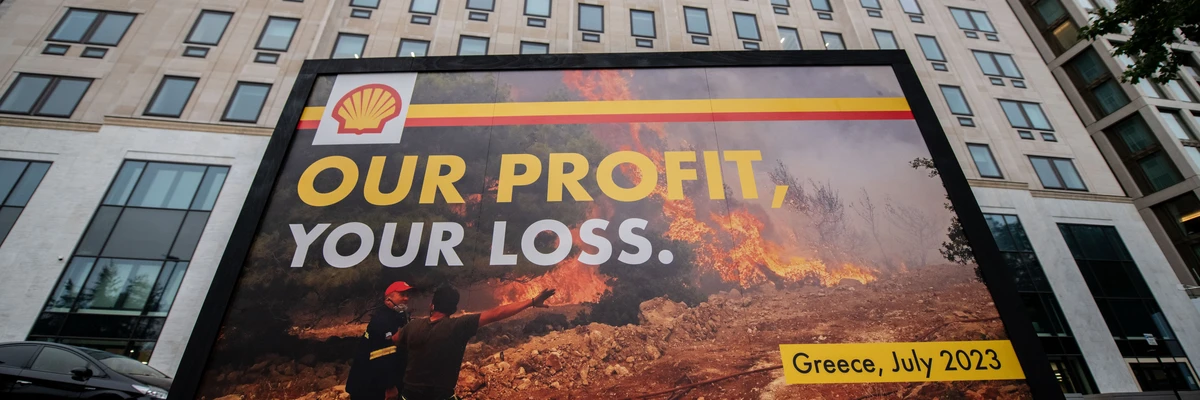
Greenpeace activists display a billboard during a protest outside Shell headquarters on July 27, 2023 in London. (Photo: Handout/Chris J. Ratcliffe for Greenpeace via Getty Images)
“Every house burnt to the ground, every town forced to evacuate, every ecosystem lost to a wildfire is a necessary consequence of a business model like Shell’s.”
With much of the world reeling from record-shattering heat and devastating wildfires, the London-based oil giant Shell is poised to ramp up its investments in planet-warming fossil fuels after ditching its plan to cut oil production.
An analysis released Thursday by the rights group Global Witness estimates that Shell’s investments in oil and gas projects are set to surge to around $14.5 billion this year, a 10% increase over 2022. The company is expected to spend far less on what it defines as “renewables and energy solutions.”
“Fossil fuels are the number one cause of climate breakdown, which is stoking extreme heatwaves, forest fires, and drought,” said Jonathan Noronha-Gant, a senior campaigner at Global Witness. “Every house burnt to the ground, every town forced to evacuate, every ecosystem lost to a wildfire is a necessary consequence of a business model like Shell’s, which prioritizes short-term cash grabs over the safety and survivability of our societies.”
The new analysis came as Shell reported $5.1 billion in second-quarter profits, a major decline compared to the company’s record-setting $11.5 billion in profits during the same period last year. Despite the profit dip, which Shell blamed on falling oil and gas prices, the company announced a 15% quarterly dividend increase and $3 billion in stock buybacks.
“CEO Wael Sawan’s fossil fuel direction continues to be solely aimed at profit for shareholders,” Nine de Pater, a campaigner with Friends of the Earth Netherlands, said in a statement. “This is immoral and completely irresponsible. We are seeing the impact of the climate crisis around the world this summer: the wildfires in Greece and heat records in southern Europe, Algeria, and India, among others, and the floods in Italy and Afghanistan.”
“Shell’s profits clearly show that the company chooses profits over human lives,” she added.
Shell, which has known about the climate impacts of burning fossil fuels since the 1970s, announced last month that it intends to boost gas production in the coming years while abandoning its plan to reduce oil production by up to 2% per year.
In an interview weeks after the announcement, Sawan claimed it would be “dangerous and irresponsible” to curb oil and gas production even as scientists say that’s exactly what’s needed to avert catastrophic warming.
Global Witness recently estimated that Shell’s reversal on oil production could generate an average of “29 million tonnes of extra carbon per year, almost as much as Denmark emits annually.”
“By 2030,” the group added, “Shell’s extra estimated emissions would be as much as Spain—one of Europe’s largest polluters—produces in one year.”
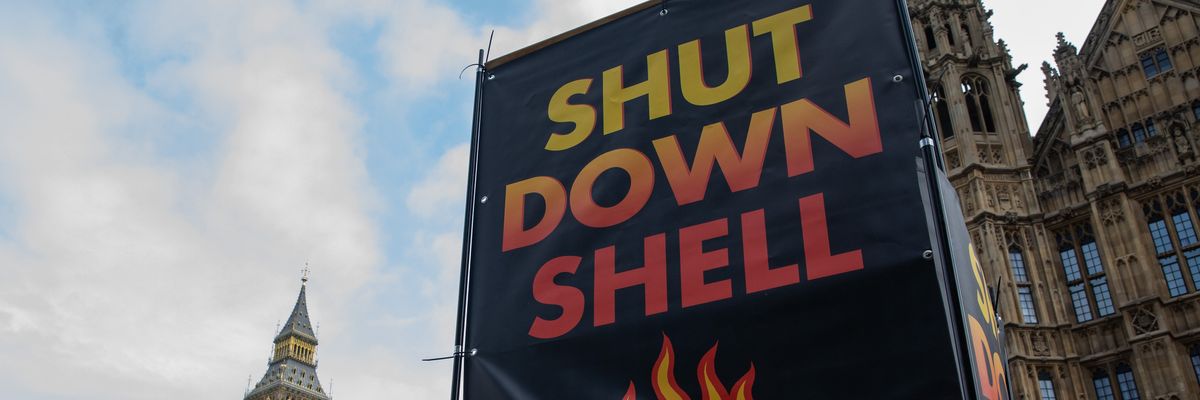
A large display from the environmental group Fossil Free London is seen during a climate protest in London on April 24, 2023. (Photo: Mark Kerrison/In Pictures via Getty Images)
“The only ‘danger’ Shell would see in cutting production is to their eye-watering profits,” said one campaigner.
Two days after scientists recorded the hottest day on record and warned that the milestone is the latest clear sign that all fossil fuel production must be urgently phased out, the CEO of multinational oil and gas giant Shell claimed that transitioning to renewable energy sources is what would endanger the world and expressed what campaigners called “cynical” concerns for the well-being of the Global South.
Wael Sawan, who took over the U.K.-based company last year, told the BBC Thursday that the world’s energy system “continues to desperately need oil and gas,” contrary to evidence put forward by the International Energy Agency, the Intergovernmental Panel on Climate Change, United Nations Secretary-General António Guterres, and other experts.
“I think what would be dangerous and irresponsible is actually cutting out the oil and gas production so that the cost of living—as we saw just last year—starts to shoot up again,” said Sawan.
Cost-of-living increases have raised alarm in communities around the world following the coronavirus pandemic and Russia’s invasion of Ukraine—but numerous analyses have pointed to corporate greed and price-gouging, not the decreasing supply of oil and gas, as primary drivers of financial hardship for working people.
Shell reported record-breaking profits of nearly $40 billion last year, doubling its total for 2021.
“The only ‘danger’ Shell would see in cutting production is to their eye-watering profits,” Alice Harrison of the international human rights group Global Witness told The Guardian Thursday. “Whether blinded by the pound signs or simply willfully ignorant, Shell’s CEO is wrong. Ending our dependence on fossil fuels and transitioning to green energy will serve both the planet and provide energy security for all. Shell [has] once again made their loyalties clear—profit over people and planet.”
Guterres is among the critics who have warned that companies that continue to invest in fossil fuels will not continue to see enormous profits forever, and as Common Dreams reported last week, research from the University of Waterloo in Canada found that public pensions in the United States have lost tens of billions of dollars due to their refusal to pull out of the oil, gas, and coal sectors.
“Investing in new fossil fuels infrastructure is moral and economic madness,” Guterres said earlier this year. “Such investments will soon be stranded assets—a blot on the landscape and a blight on investment portfolios.”
In his comments to the BBC, Sawan suggested his concern is not with his own company’s future, but that of the Global South—where people are suffering disproportionately from the effects of the climate crisis and planetary heating, despite causing a tiny fraction of the fossil fuel pollution that originates in wealthier countries.
He said the distribution of benefits from the use of renewable energy must be “globally responsible” so the Global North doesn’t hoard energy sources such as solar and wind power.
“Let’s be clear, companies like Shell are fueling both the climate crisis and the soaring cost of energy,” Jamie Peters of Friends of the EarthtoldThe Guardian. “They are profiting from the misery of ordinary people while destroying the planet, and they’re making a cynical case to continue locking us into the volatile fossil fuel markets that are the root cause of the energy crisis.”
As environmental journalist Harry Cockburn noted on social media, for all Sawan’s claims of concern for people in the Global South, he made clear that Shell’s profits are his top priority as the interview concluded.
Quite amazing interview with Shell boss Wael Sawan here, in which he argues global fossil fuel production must be maintained, or children will be working by candle light, before adding: "Ultimately, I am in the service of shareholder value". https://t.co/JPnI5EgHLM
“Cutting production is only dangerous in the kind of upside-down world where profit rules over everything,” said the grassroots coalition Stop Cambo, which pressured Shell to pull out of the Cambo oil field off the coast of Scotland in 2021. “Even as the planet burns and people are forced to choose between heating and eating.”
Lindsey German on … [Keith Starmer] , the establishment’s friend …
The fate of Thames Water should be the end of the privatisation model pioneered by Thatcher in the 1980s. The major utilities and public companies were sold off at undervalued prices, their shares rapidly snapped up by big corporations and investors, prices for consumers rose rapidly, and profits went to shareholders, not to investment. That’s why today the common refrain about most parts of public life in Britain is that nothing works. And it is epitomised by Thames Water drowning in debt and likely to be taken back into public ownership temporarily.
But any form of nationalisation is going to be resisted to the bitter end, not just by the greedy privatised companies themselves, but by the Tories and the increasingly right-wing Labour Party under Keir Starmer. The cheek of the privatised companies was illustrated when the head of another, Severn Trent, convened a meeting of all the water firms to explicitly discuss ways of resisting nationalisation. And it’s no use going to the supposed regulators for help. As the Observer reported, ‘27 former Ofwat directors, managers and consultants [are] working in the industry they helped to regulate, with about half in senior posts.’ So a number of those regulating the industry have moved over to take lucrative positions in…. the privatised water companies.
While investors take the money and run, working class people are left with dire and expensive services that fail frequently because there is no investment. The water companies are publicly disgraced because of their dumping of sewage in rivers and seas, rather than invest in new treatment plants. But in London (and no doubt elsewhere) there have been several burst water mains, risking lives as they cause disruption sometimes for months, because of lack of investment. In the southeast of England, drinking water supplies have failed ‘because of the hot weather’, in what must be the lamest excuse from a company supposed to provide just that.
The answer from government and industry alike is that future investment will have to be paid for by us, through much higher bills and higher taxes. Already gas and electricity is beyond affordable for millions. But the energy companies will set the benchmark for other industries as profits are protected. No wonder nearly 13 million adults struggle to pay bills.
dizzy: Under Capitalism failing companies would normally go bankrupt so that the companies’ debts would be transferred to it’s creditors. This is not the case with the banks in the banking crisis of 2008, the energy companies failures ofrecent yearsand it looks like failing water companies now. Instead of the companies creditors shouldering the debt as part of the normal process, the poor public is instead burdened with it. This is great for the banks of course because it means that they can borrow without any risk of default, knowing that they will profiteer from the public regardless.
England’s private water firms are under fire once again today, after reports that they could be set to raise bills by as much as 40%. The touted rise comes as the water industry faces significant pressure to tackle the scandal of sewage being pumped into waterways.
Private companies currently operate thousands of sewer overflows which are used to discharge raw sewage into Britain’s rivers and seas. Last year, private water companies released raw sewage into rivers and seas in England for more than 1.75 million hours, with an average of 825 sewage spills per day.
Critics of the water companies argue that they have prioritised providing returns for shareholders, rather than investment in infrastructure that would have tackled the sewage crisis. Since privatisation in 1989, water companies have paid out more than £70 billion to shareholders.
Anti-privatisation campaign group We Own It has branded reports of major bill rises ‘outrageous’, and has called for water to be taken into public ownership. The group’s director Cat Hobbs told Left Foot Forward: “It’s outrageous. We’ve seen decades of underinvestment in our water system, and now we’re expected to foot the bill for infrastructure improvements.
“What have private companies been doing with their enormous profits for the last 34 years? They’ve paid out £72bn in dividends to shareholders. That’s money that could have been reinvested into our infrastructure to prevent the mess we’re in now. Publicly-owned Scottish water spends £72 more per household per year on tackling infrastructure problems.