GREENPEACE has said that a legal case launched by Shell intended to intimidate it and drain its resources has instead had the opposite effect, with members of the public donating over £1 million to support the NGO.
The group launched the fundraiser last November after Shell announced that it was suing over a peaceful climate protest in the North Sea, in which activists occupied a moving oil platform to protest against the damage caused by the oil giant.
Although Shell, which reported a record £22.3 billion in profits last year, acknowledges no damage was caused to its equipment, it is still demanding extensive damages.
Donations are being used to fight the case and to campaign for oil giants to “stop drilling and start paying” for the environmental damage they have caused.
Almost 25,000 donations were received in just nine months, and the funds raised now exceed the amount Shell is seeking in damages ($1m, or £789,000), although it is likely legal costs will run into the millions.
Greenpeace UK campaigner Philip Evans said: “Shell’s attempt to intimidate us is only making us stronger.
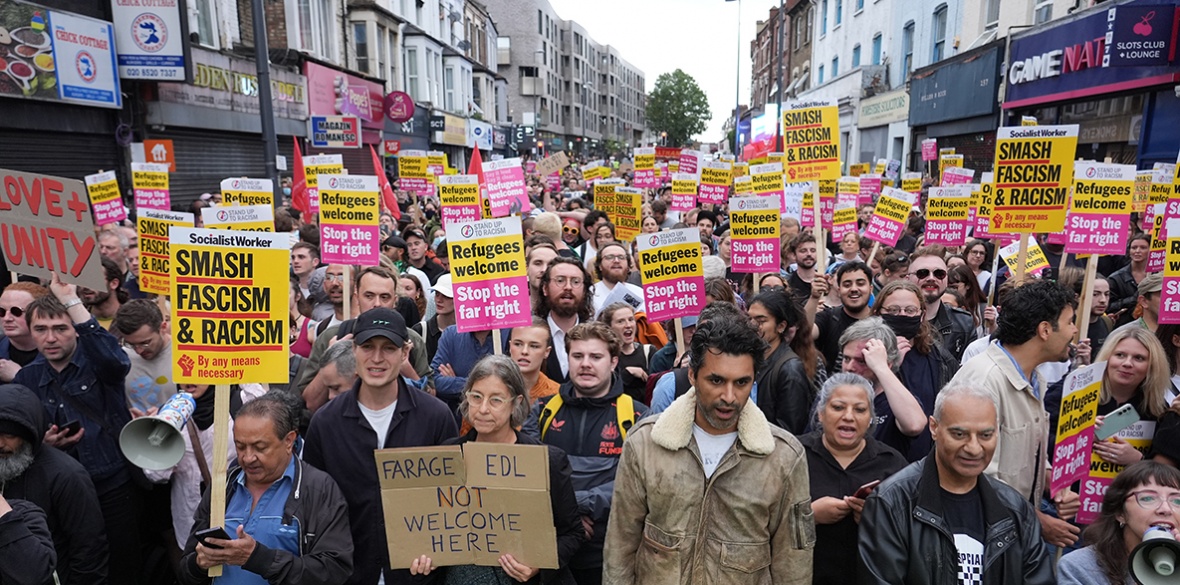
Counter protesters at head of an anti-immigration protest in Walthamstow, London, August 7, 2024
PEOPLE power has changed the narrative. The threat of fascist riots is not over, but they look far more isolated than they did before Wednesday night.
Even those who are not usually friends to street demonstrations have saluted the spirit that brought hundreds of thousands out in Bristol, Newcastle, Walthamstow and many other places.
Metropolitan Police Commissioner Mark Rowley acknowledges the role the counter-protests played in preventing far-right violence. “Frankly the show of unity from communities together defeated the challenges that we’ve seen… the fears of extreme right disorder were abated.”
Even more surprising was approbation on the front pages of right-wing papers. The Times, the Mail, the Express are associated with hatred of the left: the latter two, particularly, with migrant-bashing. Yet all ran glowing tributes to anti-racist popular rallies on their front pages.
There is hypocrisy here. But that only underlines the significance of a movement that forces them to take this line. They have read the mood of the country and realised it is not with the racists.
This explodes the logic of anti-socialist fanatic Lord Walney, whose bid to call out “Russia and Iran” for whipping up disorder was an attempt to associate the arson, assault and vandalism of the fascists with peaceful marches in solidarity with Palestine.
It will be harder for authoritarians in government to use the riots as an excuse for a sweeping crackdown on public demonstrations now that the country’s biggest police force and most of its major newspapers are on record praising street demos mobilised by the activist left, most prominently Stand Up to Racism.
25,000 counter-protesters take to the streets in show of clear resistance
…
Weyman Bennett, co-convener of Stand Up to Racism which has helped organise rallies around the country, said: “In city after city, people came together to unite against racism and the far-right threat.
“We need more of that. They’re not going to go away.
“We’re building a movement across Britain to stop the far right — and it’s a movement built on solidarity and unity.”
…
Prime Minister Sir Keir Stamer chaired another Cobra meeting as the country braced for another 20 potential gatherings this evening before the Morning Star went to print.
Ahead of the meeting, he said that violence was prevented on Wednesday thanks to the police deployment, ignoring the crucial role of tens of thousands of counter-protesters who had mobilised to defend their communities nationwide.
He said the decision to speed up prosecutions of those involved in riots “sent a very powerful message.”
Many newspapers took a rare break from peddling racist hate to feature the large counter-demos on their front pages.
…
The surge of racist violence came after the fatal stabbing of three young girls in Southport last week.
Far-right agitators exploited the tragedy and spread lies online claiming that the attacker, who was born in Britain to a Christian family, was Muslim and a migrant.
Wind turbines at Loftsome Bridge, East Yorkshire, with Drax Power station in the distance
ACTIVISTS slammed the police today for diverting resources away from tackling racist riots and targeting peaceful climate protesters instead.
Protesters opposing Drax power station, Britain’s largest carbon emitter, were due to set up a protest camp today.
But police pre-emptively arrested 22 activists under public order offences, including conspiracy to interfere with key national infrastructure.
Police seized tents, toilets, a track for wheelchairs and other equipment to make the peaceful protest safe and accessible, organisers Reclaim the Power said.
The Silver Commander for the police operation, Supt Ed Haywood-Noble, admitted that police resources were “stretched nationally,” but still thought it was “essential” that the operation go ahead.
He claimed: “Policing is not anti-protest, we are anti-crime, and we are here to protect the public.”
The protest organisers hit back at the force for making the “unfathomable decision” to divert resources away from communities under attack in the racist violence sweeping Britain.
They accused the police of prioritising the arrest of peaceful protesters over “locating and arresting people who are actually organising far-right riots with bricks, knives and other weapons.”
I’m wondering why the police are seizing “tents, toilets, a track for wheelchairs and other equipment to make the peaceful protest safe and accessible”. Is that part of their job too?
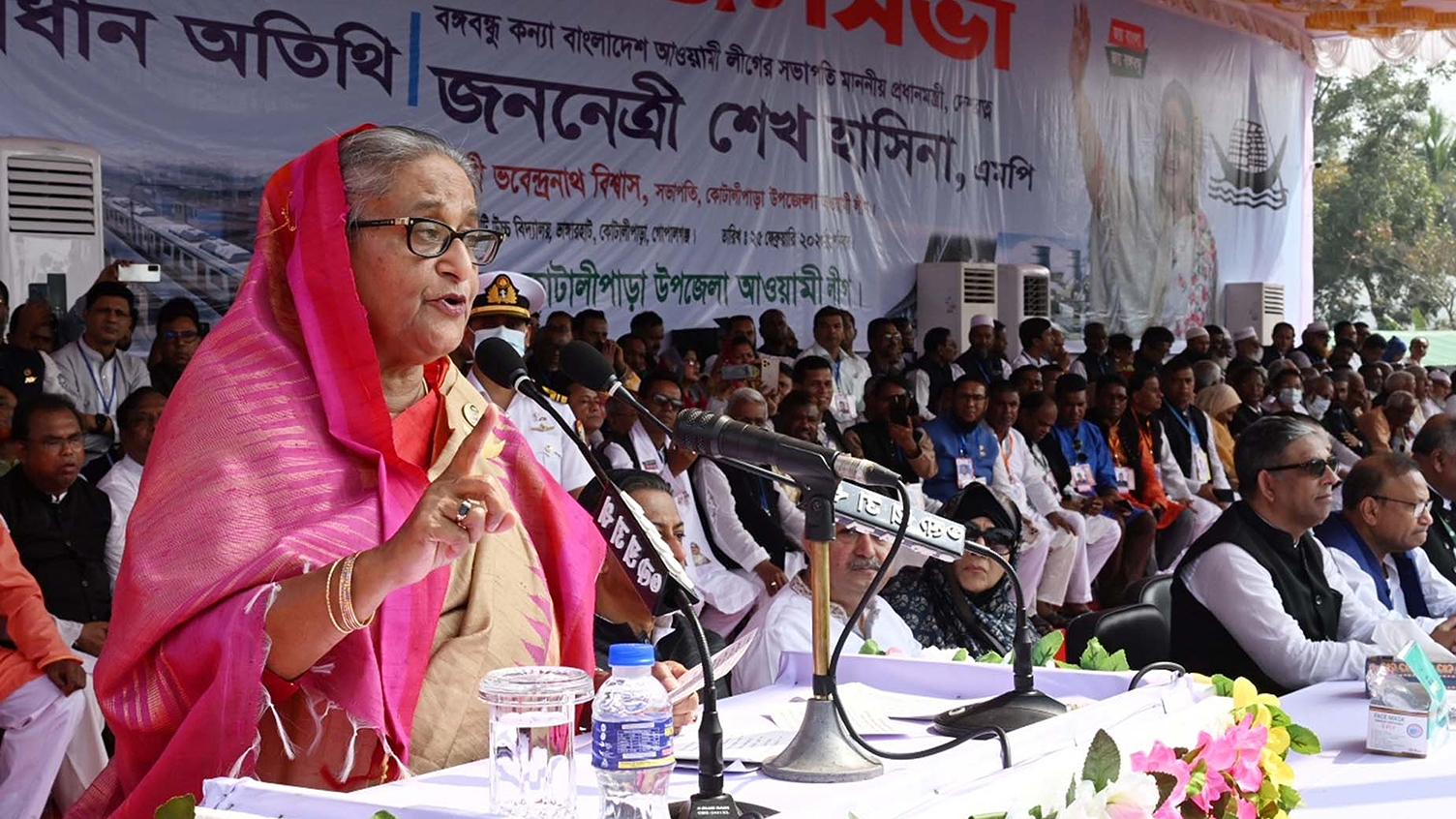
Sheikh Hasina addresses party rally last year (Photo: Delwar Hossain/ Wikimedia Commons)
The protests, initially led by students demanding reforms in the quota system in government jobs, took a violent turn in the last weeks of July
Prime Minister of Bangladesh Sheikh Hasina resigned and left the country, army chief General Waker-Uz-Zaman announced during an address to the nation in the afternoon of Monday, August 5.
The Army chief also claimed to have taken full responsibility over the government, promising that an interim government would be formed soon after consulting all the opposition parties. He also appealed to the protesters to end their demonstrations with a hope that the violence would stop.
Waker-Uz-Zaman promised that he will make sure that all persons responsible for the killing of protesters are held accountable for their acts.
Despite the announcement of Hasina leaving the country, demonstrations continued throughout the day in Bangladesh. There were reports of Hasina’s former official residence being stormed and Dhaka’s international airport being shut down in the afternoon.
Protesters reportedly blocked roads at different places in the country, vandalized the statue of Sheikh Mujibur Rahman, considered the founder of the nation, as well as the offices of Hasina’s Awami League. Attacks were also carried out against the offices of various other parties, and continued into the evening.
Over 300 people, including security personnel, have been killed and thousands of others have been injured in the protests so far.
The protests in the country have been ongoing for over a month now. The first weeks of the protests saw university students demand reforms in the quota system in the recruitment in government jobs, and were largely peaceful. Protests turned violent after they were allegedly attacked by members of the ruling Awami League Party under the cover of security in the third week of July.
Amid the intensification of the protests, the Hasina government called for all universities to be shut down, imposed a curfew and a communication blockade. A shoot on sight order was also issued to the army deployed to control the violence.
Over 200 people were killed and thousands were injured in clashes between the security forces and protesters in the following week of July.
On July 21, the country’s Supreme Court scrapped most of the quota, fulfilling the central demand of the protesters. Yet, the protests continued with growing demands for action against the perpetrators of the violence and against the government itself.
The second round of protests erupted on Sunday, August 3, with thousands gathered in different major cities in the country calling for Hasina to resign. Chittagong, one of the major centers of quota reform protests witnessed the hundred of thousands of people flooding the streets, waving national flags and shouting slogans against Hasina.
Over 100 people, including over a dozen security personnel, have been killed in Sunday’s protests.
Hasina’s government and her Awami League party had alleged that the violent protests were initiated as a part of a conspiracy against the elected government. Hasina had accused the opposition Bangladesh Nationalist Party (BNP) of collaborating with Jamaat-e-Islami, an extremist group, to provoke violence across the country in order to bring regime change in the country as they could not win popular elections.
According to a source on the ground, the violence during the quota reform movement was used by the imperialist powers led by the US to orchestrate regime change in the country. They also claimed that the new regime would be used to undo the secular and progressive reforms initiated by the Hasina government during her four terms.
In January’s national elections in Bangladesh, Sheikh Hasina had won her fourth straight term as prime minister since 2009. This was her fifth term as prime minister in total. She was first elected as prime minister in 1996. The US had questioned the legitimacy of the last elections in January.