Rachel Reeves Promised Oil Industry ‘Quid Pro Quo’ Over Windfall Tax in Private Meeting
Original article by Sam Bright republished from DeSmog.
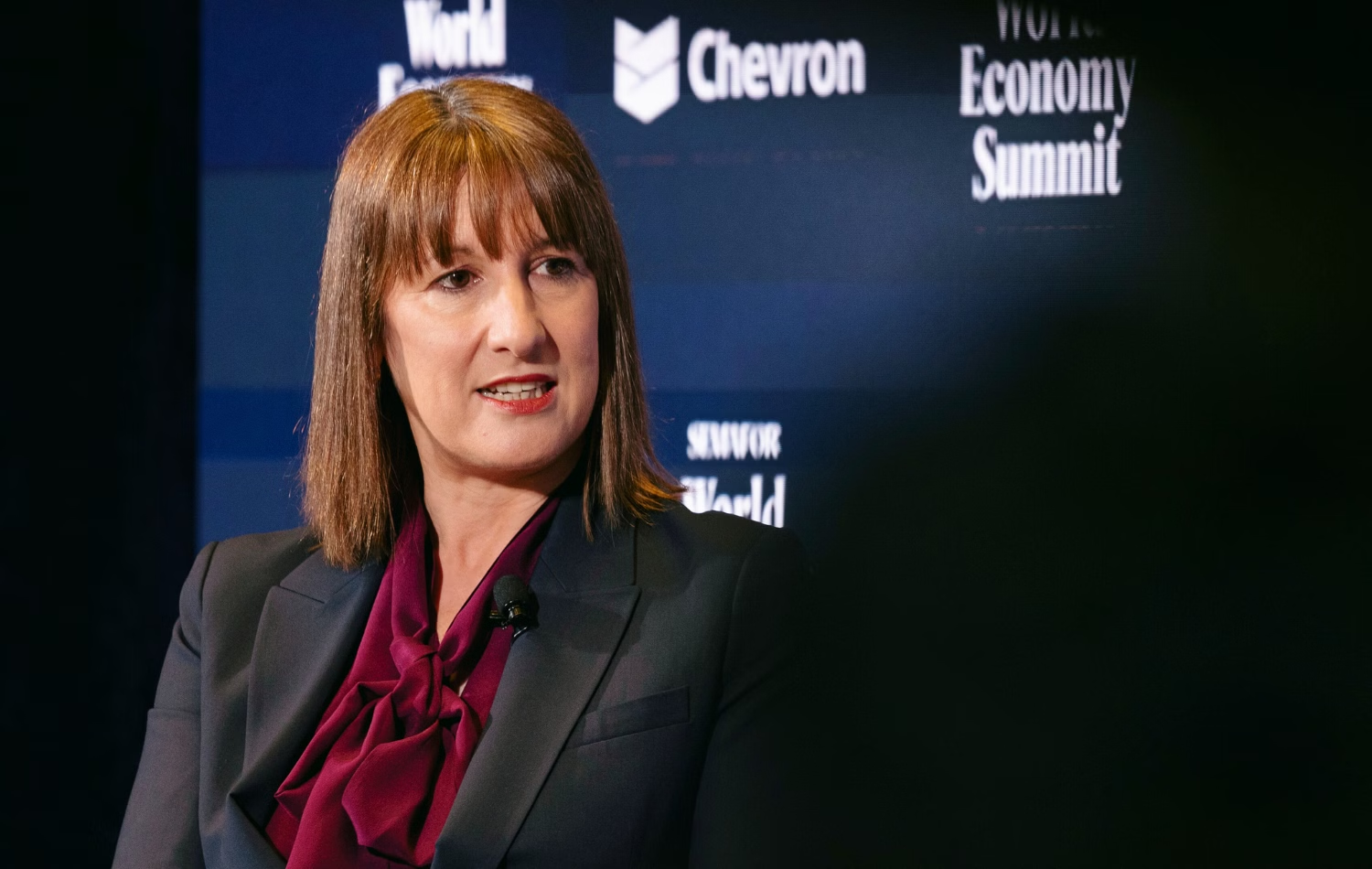
The government has been accused of making a “secret exchange deal” with fossil fuel firms to compensate for the tax hike.
Chancellor Rachel Reeves told a fossil fuel giant that the industry would receive a “quid pro quo” in return for higher taxes on its windfall profits, DeSmog can reveal.
In a meeting with the Norwegian state energy company Equinor on 27 August last year, Reeves suggested that the government’s carbon capture, utilisation and storage (CCUS) subsidies were a payoff for oil firms being hit with a higher tax rate.
Minutes of the meeting obtained by DeSmog state that Equinor CEO Anders Opedal raised concerns over the Energy Profits Levy – also known as the “windfall tax” – and “its impact on the value” of Equinor’s UK portfolio.
In response, Reeves said that raising the windfall tax from 35 percent to 38 percent was a “manifesto commitment”, but stated that “Equinor should recognise the quid pro quo – the funds raised enable government investment in CCUS etc.”.
This article was co-published with The Guardian.
CCUS is the controversial practice of trapping the emissions produced by fossil fuel plants before they enter the atmosphere.
The technology is accused of being a favourite climate “solution” of the fossil fuel industry since it allows for the continued extraction of oil and gas. Experts have also suggested that the technology is not economically viable at scale.
The Labour government announced in October that it would provide £22 billion in subsidies to CCUS projects over 25 years following a surge in lobbying by the fossil fuel industry, as revealed by DeSmog.
Green Party co-leader Carla Denyer MP claimed that Reeves and the Labour government had been “caught out making promises in a secret exchange deal which goes against the interests of the British people”.
Denyer added: “In public they claim to be taxing fossil fuel giants more fairly by raising the windfall tax, but behind closed doors they are giving back with dodgy deals to allow the fossil fuel corporates to continue with business as usual under the guise of CCUS – an expensive distraction and largely unproven technology.”
An Equinor spokesperson said: “Government regularly meets with companies like Equinor. This is standard and necessary practice. As with any official meeting, minutes were taken of the conversation between the chancellor and Equinor CEO as a public record of what was said and readily available via a Freedom of Information request.”
Equinor is one of the principal firms investing in the UK’s CCUS sector. In December, the government signed deals with Equinor, BP, and TotalEnergies to develop carbon capture facilities in Teesside. This will involve the development of the Net Zero Teesside Power plant, which will be 25 percent owned by Equinor and aims to be the world’s first gas-fired power station featuring CCUS.
Earlier this year, following a DeSmog investigation, Equinor retracted the claim that it stores 1 million tonnes of carbon dioxide annually at its flagship carbon capture project in the North Sea. Equinor has not captured 1 million tonnes of CO2 per year at the site since 2001, and only captured a tenth of that figure in 2023.
The firm made an $28.7 billion (£21.2 billion) post-tax profit in 2022 after Russia’s invasion of Ukraine triggered higher oil and gas prices – a figure that stood at $8.8 billion (£6.6 billion) in 2024.
Tessa Khan, executive director of the campaign group Uplift, said: “Oil companies, like Equinor, have held sway over successive UK governments, for years shaping policies to benefit their bottom line and slowing down climate action. This Labour government must stand up to them and put our needs – for affordable clean energy and a safe climate that we can pass on to our children – ahead of their insatiable need to profit.”
The House of Commons’ Public Accounts Committee (PAC) – which scrutinises government spending decisions – released a report in February describing the UK’s CCUS subsidies as “risky”.
The report noted that the government has downgraded its ambitions for CCUS storage, scrapping its previous commitment of storing 20 to 30 million tonnes annually by 2030. It also highlighted that the UK’s new CCUS projects don’t allow the government to share any potential profits or for local consumers to benefit from lower energy bills.
The committee also reported that producing liquid natural gas, which will be used in the UK’s CCUS projects, leaks more greenhouse gases into the atmosphere than previously thought.
“This could undermine the rationale for pursuing certain schemes,” the report said.
After being sued by environmental consultant Andrew Boswell over the Net Zero Teesside scheme, the previous Conservative government admitted that it had not taken into account the plant’s full potential emissions, which Boswell estimated could reach more than 20.3 million tonnes during its lifetime.
In summer 2024, a judge rejected Boswell’s case, which argued that officials did not fully explore the environmental impacts of the scheme before approving it. The government also won the appeal in May.
Boswell, who leads the Scrap Carbon Capture campaign, called Reeves’ Equinor meeting “an outrageous spectacle”.
“She begs Norway’s oil colossus to tax its huge profits, and then gifts it with far more in return – many billions over decades for climate-wrecking CCUS.”
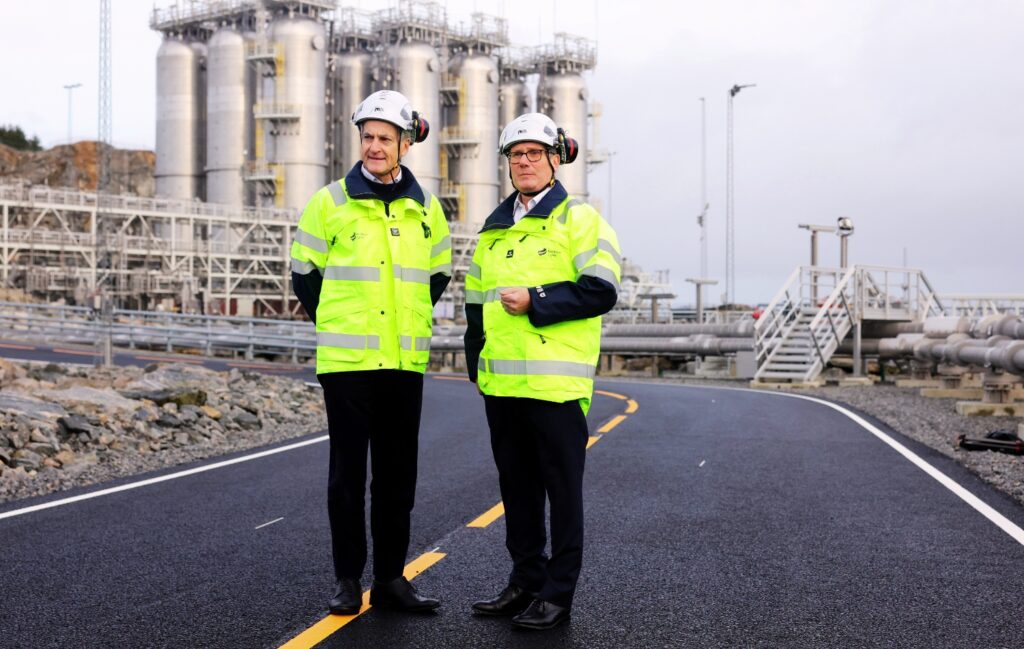
Equinor and Shell have formed a joint venture to become the UK’s largest North Sea fossil fuel producer. In November, the government admitted that it had unlawfully approved the development of the country’s largest untapped oilfield, Rosebank, which is operated by Equinor, by not taking into account the climate effects of burning the oil and gas extracted from the field. Equinor intends to re-apply for approval to develop the project.
The Labour government has been steadfast in its support for the UK achieving net zero emissions by 2050, with Prime Minister Keir Starmer stating that “home grown clean energy” is “in the DNA” of his administration.
The Climate Change Committee stated in its 2025 appraisal of the government’s net zero policies that the UK needs to scale up its CCUS capacity to 73 million tonnes a-year by 2050 to help meet its climate commitments.
“Investment in carbon capture and storage is a gamble on unproven technology,” said Lily-Rose Ellis, campaigner at Greenpeace UK. “All it does is give oil and gas giants carte blanche to continue causing planet destroying emissions in the hopes that one day they might be able to capture the carbon and store it for all of eternity. Public money should be spent on renewables which guarantee to lower emissions, bring bills down, and boost the economy with new jobs.”
“Equinor has been a reliable energy partner to the UK for over 40 years,” a company spokesperson said, “providing a stable supply of oil and gas, developing the UK’s offshore wind industry, and pioneering solutions to decarbonise the UK economy, including carbon capture and storage.
“Using our experience of decarbonising energy production in Norway, including safely storing carbon emissions under the North Sea for over 25 years, we are supporting the UK to develop its own home grown energy transition.”
A government spokesperson said: “We are delivering first of a kind carbon capture projects in the UK, supporting thousands of jobs across the country, reigniting industrial heartlands and tackling the climate crisis.
“Money raised from changes to the Energy Profits Levy made at the Autumn Budget last year support the transition to clean energy, enhance energy security and independence, provide sustainable jobs for the future, and help protect electricity bills against future price shocks”.
This article was co-published with The Guardian.
Original article by Sam Bright republished from DeSmog.