This work by Middle East Monitor is licensed under a Creative Commons Attribution-NonCommercial-ShareAlike 4.0 International License.
Pictures of slain al-Jazeera journalist Shireen Abu Akleh hang on the facade of the building housing the television station’s office in Ramallah in the occupied West Bank, after Israel issued a 45-day closure order on September 22, 2024. [ JAAFAR ASHTIYEH/AFP via Getty Images]
Israeli occupation forces raided the closed Al Jazeera office in central Ramallah, in the occupied West Bank, shortly after midnight.
The troops extended the closure order for an additional 60 days and posted a new military order on the office entrance, according to the network.
In September last year, Israeli forces stormed the Al Jazeera office in Ramallah under a military order, handed its staff a closure notice, confiscated all equipment and documents, and barred employees from using their vehicles.
Al Jazeera had previously condemned the raid and shutdown, saying such repressive actions are aimed at preventing the world from seeing the true situation in the occupied Palestinian territories and the ongoing war on Gaza. Widespread reactions have since condemned the move.
In a statement, the network described the raid as a “criminal act” and said the ongoing Israeli crackdown on free media seeks to conceal its actions in Gaza and the occupied West Bank.
The statement rejected the Israeli authorities’ claims used to justify what it called an unlawful raid. It held the government of Benjamin Netanyahu fully responsible for the safety of its journalists and vowed to pursue legal steps to defend its rights and those of its staff.
Al Jazeera also affirmed its commitment to continue reporting the truth with professionalism and impartiality, despite Israeli measures aimed at silencing it.
Palestinian Prime Minister Mohammad Mustafa speaks during the first meeting with the new cabinet at the Prime Minister’s Office in Ramallah, West Bank on April 02, 2024 [Issam Rimawi – Anadolu Agency]
“While we are waiting for the ceasefire, it is important to stress that it won’t be acceptable for any other entity to govern the Gaza Strip but the legitimate Palestinian leadership and the government of the state of Palestine,” the Palestinian Authority’s Prime Minister, Mohammad Mustafa, stated during a meeting of the Global Alliance for the Implementation of the Two-State Solution.
The PA is not a legitimate leadership. In 2006, Hamas won the Palestinian legislative elections, disturbing the Western world’s preferred outcome. Democracy, according to the West, can only conform with Western expectations; therefore Palestinians got a taste of what the US does when democracy crashes imperialist expectations. Instead of respecting the electoral result, the US and Fatah embarked upon a series of destabilisation and coercion tactics, aimed at marginalising Hamas further and ultimately destroying the legitimate representation of Palestinians according to the 2006 electoral result.
While Hamas was shunned and its diplomatic efforts rebuffed, even though it combined resistance and political pragmatism, the PA intensified its efforts at forcing Hamas to relinquish power, enforcing sanctions on an enclave repeatedly bombarded by Israel. When Palestinians in the Occupied West Bank protested against such authoritarianism and cruelty, the PA unleashed its security services on civilians, and continues to do so. As the US and the EU continued funnelling funds to enhance the PA’s brutality under the guise of state-building, and the PA continued harming Palestinians in the name of security, to the point of detaining, torturing and, at times, killing their critics.
All this was orchestrated because the international community sided with an illegitimate political representation under the auspices of democracy. Are we to assume that legitimacy and democracy change meaning according to colonial and imperialist interests? What of the importance of language, which is of equal importance in the anti-colonial struggle against Israel and the PA?
Back to the present. Since Israel started its genocide in Gaza, the PA has consistently sought to navigate the corridors of power by presenting itself as an alternative to Hamas. Yet, in doing so, it completely neglected the fact that its silence on the genocide is tantamount to tacit support. The PA merely reiterated the importance of the two-state paradigm as it has for decades, with no acknowledgement of the fact that not even the hypothesis can sustain itself, let alone implementation. Meanwhile, to garner favour with Israel and the international community, and possibly prove how relevant it is to post-genocide Gaza governance, the PA started its own attack against the Palestinian Resistance.
The question is, since legitimacy does not hold the same meaning for the PA and its accomplices, what does legitimacy mean in the context of its Prime Minister citing legitimacy as the reason why the PA should return to Gaza? There is no other acceptable entity, according to the PA – based on what parameters? Just as genocide became synonymous with human rights in the Israeli and international narrative, is the PA’s illegitimate rule becoming synonymous with democracy? Why hasn’t the PA suggested elections and why has the international community not voiced any concern over Ramallah wanting to extend its power to Gaza?
The PA’s attempts to prove itself purportedly worthy of governing Gaza are precisely the reason why it should not. The PA’s only foundations are foreign funding and Israeli colonialism. Having sold itself to the two highest bidders (not forgetting the tangible illegitimacy since 2006), what Palestinian leadership and legitimacy is the PA really talking about?
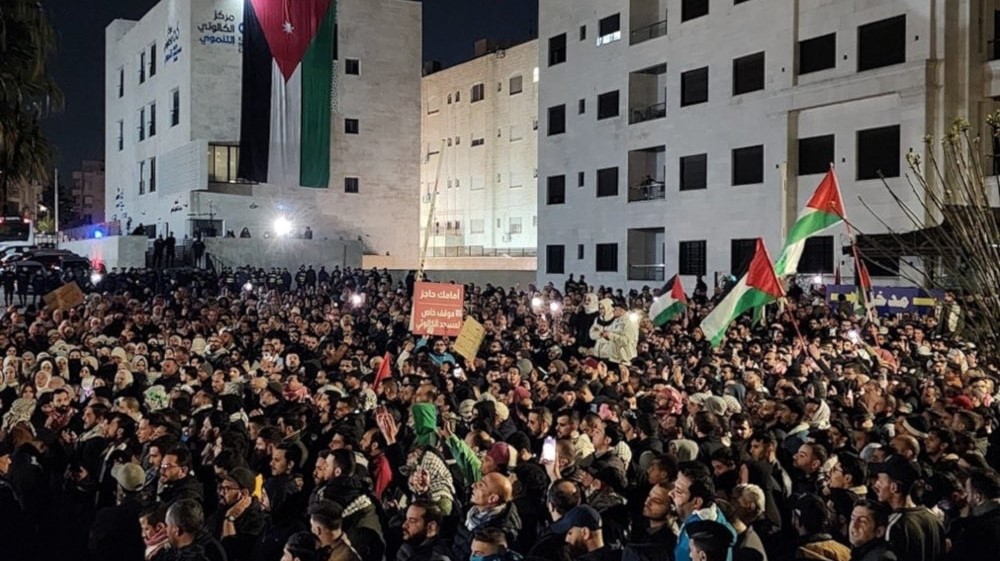
Protesters gather in Amman in Jordan demanding an immediate ceasefire in Gaza. Photo: Al Mayadeen
People took to the streets in a number of countries across West Asia and North Africa after the UN Security Council resolution calling for a ceasefire. However, Israel refused to heed the call and continued its attacks on Gaza on Tuesday
Large-scale protests broke out in different parts of West Asia and North Africa on Monday, March 25 in support of Palestine with people chanting slogans against the Israeli war in Gaza and demanding an immediate ceasefire. People took to the streets in a number of countries in the aftermath of the UN Security Council resolution that called for a ceasefire.
Jordanian security forces fired tear gas shells to disperse protesters who tried to storm the Israeli embassy in Amman. Thousands of these protestors chanted slogans in solidarity with the people in Gaza and in support of the Al-Aqsa mosque. Many of them carried Palestinian flags which they hoisted in nearby buildings.
Similar protests took place in other parts of the country. A day before, Jordanian forces had prevented a large group of people from marching to the Israeli embassy.
Protests were also organized in the Iraqi capital Baghdad and Cairo in Egypt as well on Monday where hundreds gathered to chant slogans in support of Palestine and demand an immediate ceasefire.
"El-Sisi is the enemy of God."
Iraqi women chant slogans decrying Egyptian President Abdel Fattah El-Sisi in front of the Egyptian Consulate in Baghdad in protest of the continued siege of Gaza and the closure of the crossings with Gaza, including the Rafah border crossing with… pic.twitter.com/yzfhi6C0Kw
Hundreds also gathered in Tangiers in Morocco to demonstrate against the continued Israeli genocide of Palestinians in Gaza.
Tens of thousands of Moroccos demonstrated last night in the city of Tangiers in Morocco in solidarity with the Palestinian people amid the ongoing Israeli genocide. pic.twitter.com/NbJXnNCb7u
Protests were also organized in the Nur Shams refugee camp in Tulkarem and in Ramallah in the occupied West Bank on Tuesday. Hundreds of Palestinians, defying Israeli dictates and ongoing attacks, took to the streets in the morning to call for a ceasefire.
The protests followed the UNSC resolution demanding an immediate ceasefire. The resolution was adopted after the US, which had blocked three similar previous resolutions, decided to abstain. All the other members of the Security Council supported the resolution.
The resolution called for an immediate ceasefire during the month of Ramadan and for working towards a permanent cessation of hostilities and the release of all hostages. It was welcomed by the Palestinian resistance group Hamas and most of the countries in the region.
Hamas reiterated its demand for a permanent ceasefire that would lead to the complete withdrawal of all Israeli forces from Gaza and the return of all Palestinians displaced due to the war over five months.
Nearly the entire population of Gaza, around 2.3 million, has been displaced due to the Israeli war which has killed more than 32,000 and wounded close to 74,000 Palestinians.
The Iranian foreign ministry welcomed the UNSC resolution, calling it a positive step and demanded its immediate implementation. It also demanded the lifting of all blockades on the supply of aid to Gaza and the opening of all border crossings to the besieged territory and immediate resumption of reconstruction.
Israel has however rejected the resolution. It carried out fresh attacks on Gaza on Tuesday, killing dozens of Palestinians.
The resolution accepted by the Security Council is binding on all members of the UN. However, only a fresh vote in the Security Council can decide the future course of action in case one particular party chooses not to implement it.
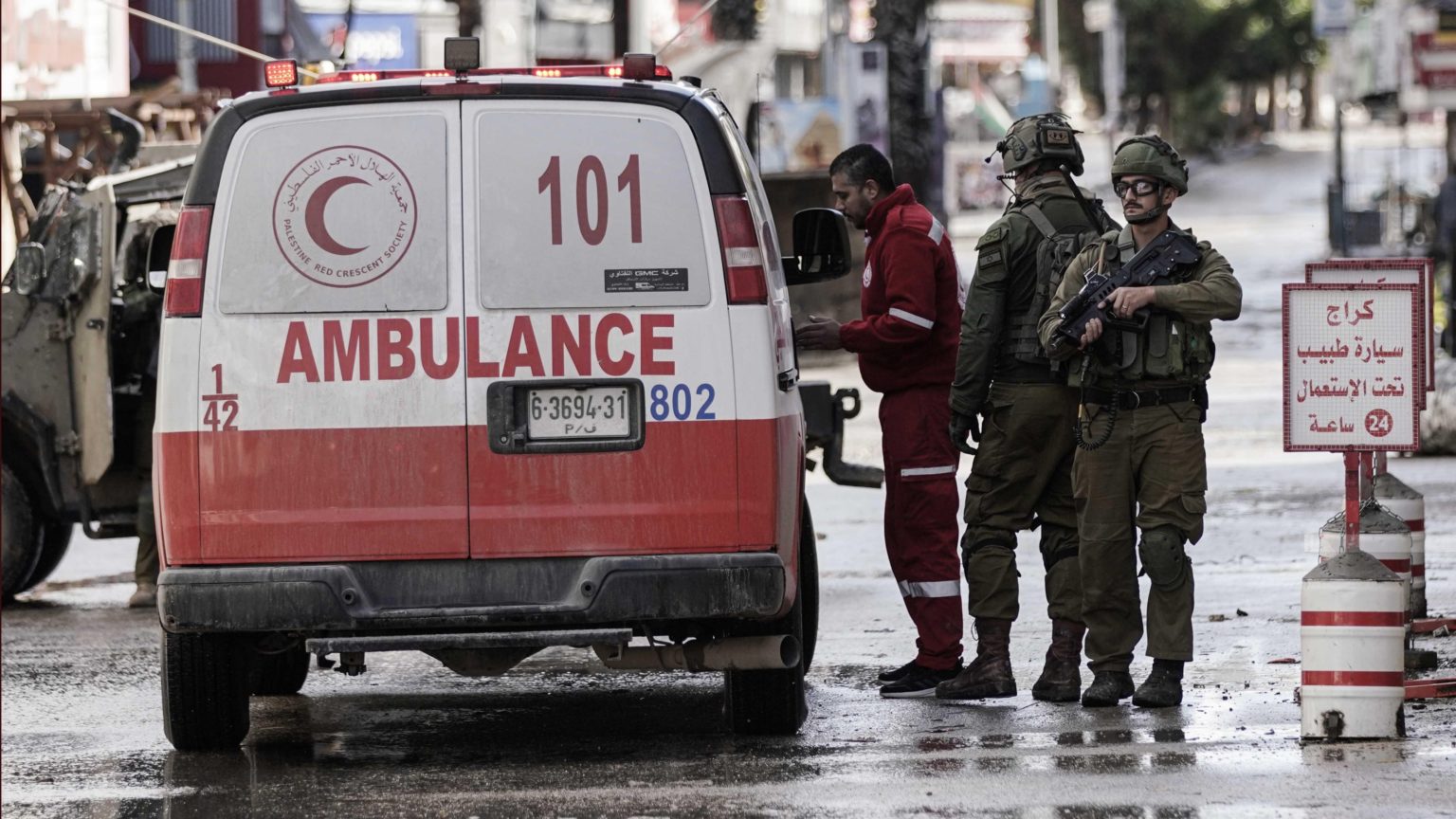
Israeli occupation forces obstructing the work of ambulances in Jenin. (Photo: Mohammad Mansour/WAFA)
Over 500 Palestinians were killed in the West Bank in 2023. Under its undeclared policy of collective punishment, Israel also destroyed a significant amount of civilian infrastructure such as roads, residential buildings, and hospitals in West Bank since October 7
Israel’s war on Gaza has entered its fourth month. It has killed over 23,000 Palestinians in the besieged enclave and injured around 60,000. Nearly 80% of all Gazans have been displaced due to the constant bombings. The amount of destruction and killing in Gaza is horrendous. The offensive has also extended to the West Bank where Palestinians have been facing a form of undeclared collective punishment both before and since the war in Gaza.
Though the West Bank has always faced violent attacks from Israeli occupation, those attacks have increased manifold since the beginning of the war in Gaza. Despite the fact that Hamas does not rule the territory, Israel used the excuse of Operation Al-Aqsa Flood to justify its unprecedented attacks on civilians and their infrastructure there.
Between October 7 and December 31, last year more than 340 Palestinians, including a large number of children, were killed in attacks carried out by both the Israeli forces and illegal settlers.
The Israeli attacks targeted Palestinian civilians, including artists from the famous Freedom Theater, while homes were demolished, hospitals and medical facilities targeted, and roads and other civilian infrastructure uprooted.
At least three Palestinian men were shot and killed by the occupying Israeli forces during the intervening period of Monday evening and Tuesday night in Tulkarm. Video footage of these attacks showed Israeli forces first shooting and killing the men and then running over the bodies of one of them with their military vehicle.
A terrifying scene of an Israeli Jeep running over a young man after shooting him along with two other young men in Tulkarm in the West Bank.
Israeli soldiers prevented paramedics from reaching the young men leaving them to bleed until they died. pic.twitter.com/Udm539Ho0D
Israeli forces reportedly conducted similar night raids in Qalqilya, Nablus, Ramallah, and Bethlehem, among several other places on Tuesday night, arresting scores of people and destroying civic infrastructure.
Israeli occupation is targeting the Palestinians in the West Bank economically as well by refusing to transfer millions of dollars in tax revenue to the Palestinian Authority, leaving it with no money to pay the salaries to its over 140,000 employees. It has also refused to allow around 150,000 workers from the territory to return to their jobs in Israel since October 7.
Deadliest Year since 2005
Israeli forces similarly attacked the Jenin refugee camp a couple of days ago and killed at least 7 Palestinians. They have targeted the camp repeatedly since October 7, killing over 60 Palestinians there and deliberately destroying most of the roads and other civil infrastructure. According to Al-Jazeera, Tulkarm too has been a center of Israeli attacks with at least 60 Palestinians killed since October 7.
In August, the UN had already declared 2023 to be the deadliest year for the West Bank as the number of Palestinians killed in Israeli attacks had crossed 200, more than the previous high of 167 in 2022.
According to the latest data, the total number of Palestinians killed in 2023 has crossed 500 with over 13,000 more injured in the attacks carried out by both illegal settlers as well as Israeli soldiers.
More than 70 of the Palestinians killed in Israeli attacks were children. This is the highest number of the Palestinian children ever killed in the occupied West Bank in a year. Some sources say the death toll among children is even higher.
Settler Violence
According to Israeli human rights organization Yesh Din, 2023 was also the most violent year for the Palestinians in the occupied West Bank in terms of the number of attacks carried out by the illegal settlers. According to it, at least 10 Palestinians were killed in 2023 just in those attacks.
According to the UN Office for the Coordination of Humanitarian Affairs (OCHA), at least 1,225 cases of settler violence were recorded in 2023.
The figure presented by the Palestinian officials for the same is almost double at 2,410. It also claims that the number of Palestinians killed in settler violence in 2023 was 22.
There are around 500,000 Israeli settlers living illegally inside the occupied West Bank. Most of these illegal settlers participate in attacks on nearby Palestinian villages under security cover provided by the Israeli occupation forces.
The settlers attack the villages, burn Palestinian houses, their farms and other properties, and attack people trying to prevent those attacks with the objective of terrorizing people to leave their villages and farms.
Record number of Palestinians detained
More than 11,000 Palestinians were also arrested or detained by Israel in the last year in the occupied West Bank alone, which is almost three times higher than the total number of Palestinians inside Israeli prisons before the beginning of the year.
Some of them were later released after a brief period of detention. Some others were released as part of the prisoner exchange deal between Hamas and Israel. Still the number of Palestinian prisoners inside Israeli jails has jumped from around 4,500 before the beginning of the year to over 7,000 at the end of it.
A joint statement issued by Detainees and Ex-Detainees Affairs Commission, the Palestinian Prisoners Society, Addameer, and others stated that 1,085 of those detained by the Israeli occupation forces from the West Bank in 2023 were children.
As per reports, scores of Palestinian prisoners have been killed inside Israeli jails with large number of them reporting torture and abuse by the prisoner authorities.