The Trump administration is a serious threat to democracy. They’re also laughably incompetent. But the result is no laughing matter.
…
Clown-show fascism describes a regime marked simultaneously by hubristic and defiant assaults on the democratic and constitutional order on the one hand and, on the other, a nearly laughable incompetence in just about every other area of the regime’s activity. The first characteristic certainly applies to the Trump administration, and it’s chilling and frightening and not at all funny. Just ask Mahmoud Khalil.
Yet at the same time, in other areas, the incompetence has been staggering. Trump’s constant about-faces and walk backs on tariffs have been an international embarrassment. Elon Musk’s DOGE has fired federal workers willy-nilly only to turn around and rehire many after the Musketeers realized they weren’t deep-state bloodsuckers and the work they did was kind of essential, after all—you know, like the people who tend the country’s nuclear weapons stockpile.
It can be hilarious to watch. But it carries two consequences that are no laughing matter.
First and more obviously, we have the prospect of the impact of Trump’s tariffs policy on real people. Will they cause inflation and a recession, as most experts now believe? As fate would have it, Trump will go to bed the night of his 100th day in office—Tuesday—and wake up the very next morning to the release of the first-quarter GDP number. Economists expect anemic results. The Atlanta Fed even predicts negative growth, around -2.5 percent. During Trump’s first week in office, its forecast nudged a gaudy 4 percent, but the president’s actions have liberated that figure ever downward.
Second and more insidiously: Even the gross incompetencies take us into treacherous territory because they contribute to making this all about one man, the man who must be in front of the cameras every day. He doesn’t have policies so much as he has urges, which he must announce to the world on a constant basis in a desperate plea that we keep him front of mind at all times. Some of those urges are cruel; some of them are a joke. What unites them is that they make the story entirely about him.
That is not how it’s supposed to work in democracies. Which we still are, for now, as we reach this 100-day mark. Only 1,361 to go.
Neo-Fascist Climate Science Denier Donald Trump says Burn, Baby, Burn.Elon Musk urges you to be a Fascist like him, says that you can ignore facts and reality then.
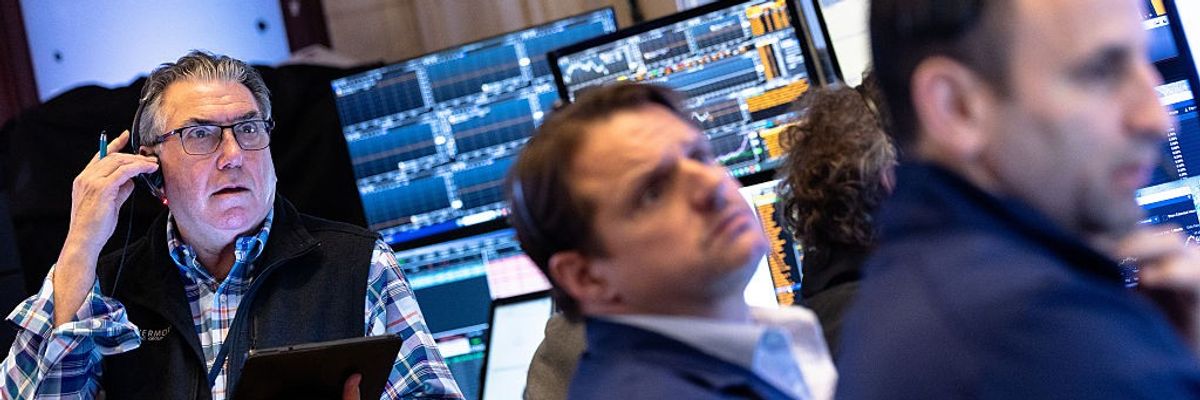
Traders work on the floor of the New York Stock Exchange during morning trading on April 3, 2025 in New York City. (Photo: Michael M. Santiago/Getty Images)
Instead of strategically imposing tariffs, Trump has chosen to “give the country the most massive tax increase in its history, possibly exceeding $1 trillion on an annual basis.”
As stocks “nosedived” on Thursday, economists, policymakers, and campaigners around the world continued to warn about the impacts of U.S. President Donald Trump’s trade war, which includes a 10% universal tariff for imports and steeper duties—that he claims are “reciprocal”—for dozens of countries, set to take effect over the next week.
“This is how you sabotage the world’s economic engine while claiming to supercharge it,” wrote Nigel Green, CEO of the international financial consultancy deVere Group. “Trump is blowing up the post-war system that made the U.S. and the world more prosperous, and he’s doing it with reckless confidence.”
As Bloomberg detailed after the president’s “Liberation Day” remarks from the White House Rose Garden:
China’s cumulative tariff rate of 54% includes both the 20% duty already charged earlier this year, added to the 34% levy calculated as part of Trump’s so-called reciprocal plan, according to people familiar with the matter. The European Union’s rate is 20% and Vietnam’s is 46%, White House documents showed. Other nations slapped with larger tariffs include Japan with 24%, South Korea with 25%, India with 26%, Cambodia with 49%, and Taiwan with 32%.
In Europe on Thursday, “the regional Stoxx 600 index provisionally ended down around 2.7%,” while “the U.K.’s FTSE 100 was down 1.6%, with France’s CAC 40 and Germany’s DAX posting deeper losses of 3.3% and 3.1%, respectively,” according to CNBC.
In the United States, CNBC reported, “the broad market index dropped 4%, putting it on track for its worst day since September 2022. The Dow Jones Industrial Average tumbled 1,200 points, or 3%, while the Nasdaq Composite fell 5%. The slide across equities was broad, with decliners at the New York Stock Exchange outnumbering advancers by 6-to-1.”
However, as Economic Policy Institute (EPI) chief economist Josh Bivens noted last week, “because most households depend overwhelmingly on wages from work as their primary source of income and not returns from wealth-holding, the stock market tells us nothing about these households’ economic situations.”
And Trump’s tariffs are expected to hit U.S. households hard, as the cost of his taxes on imports are passed on to consumers.
“Tariffs can be a legitimate and useful tool in industrial policy for well-defined strategic goals, but broad-based tariffs that significantly raise the average effective tariff rate in the United States are unwise,” Bivens and EPI senior economist Adam Hersh stressed in a Thursday statement—which also called out Trump for mischaracterizing one of the think tank’s 2022 analyses.
“Further, the second Trump administration’s rationale, parameters, and timeline for tariffs have been ever-shifting,” Bivens and Hersh continued. “As the original post cited by the administration argues, tariffs should not be a goal unto themselves, but a strategic tool to pair with other efforts to restore American competitiveness in narrowly targeted industrial sectors.”
Instead of strategically imposing tariffs, Trump has chosen to “give the country the most massive tax increase in its history, possibly exceeding $1 trillion on an annual basis, which comes to $7,000 per household,” warned Center for Economic and Policy Research co-founder and senior economist Dean Baker. “And this tax hike will primarily hit moderate and middle-income families. Trump’s taxes go easy on the rich, who spend a smaller share of their income on imported goods.”
Baker—like various other economists and journalists—also took aim at Trump’s claims that the tariffs are reciprocal, explaining:
Trump’s team calculated our trade deficit with each country and divided it by their exports to the United States. Trump decided that this figure was equal to that country’s tariff on goods imported from the U.S.
Trump’s method of calculating tariffs is comparable to the doctor who assesses your proper weight by dividing your height by your birthday. Any doctor who did this is clearly batshit crazy, and unfortunately so is our president. And apparently none of his economic advisers has the courage and integrity to set him straight or to resign.
However, outside Trump’s administration, the intense criticism continued to mount, including from groups focused on combating the fossil fuel-driven climate emergency, which also endangers the global economy.
Andreas Sieber, associate director of policy and Campaigns at 350.org, said Thursday that “Trump’s tariffs won’t slow the global energy transition—they’ll only hurt ordinary people, particularly Americans.”
“Despite his claims he ‘gets’ economic policy, his record tells a different story: Tariffs are tanking U.S. stocks and fueling inflation,” Sieber added. “The transition to renewables is unstoppable, with or without him. His latest move does little to impact the booming clean energy market but will isolate the U.S. and drive up costs for American consumers.”
Allie Rosenbluth, U.S. campaign manager at Oil Change International, similarly emphasized that “Trump’s tariffs will hurt working families first and foremost, raising costs for essentials we depend on and threatening to plunge the U.S. economy into a recession. Though Trump pretends to care about the cost of living for ordinary people, his real loyalties lie with his fossil fuel industry donors.”
“If he actually cared about energy affordability, he would stop bullying other countries into buying more U.S. liquefied natural gas (LNG), which boosts the fossil fuel industry’s profits, but results in increased prices for domestic consumers and pushes us further toward climate catastrophe,” she asserted. “The one step countries can take to hit Trump where it hurts most is wean off their dependency on fossil fuels from the United States.”
The impact of Trump’s new levies won’t be limited to working-class people in the United States. Nick Dearden, director of U.K.-based Global Justice Now, pointed out that “Trump has set light to the global economy and unleashed a world of pain, not least on a group of developing countries that will suffer tremendous impoverishment as a result of his punitive tariffs.”
“All those affected must come together and stand up to this bully by building a very different international economy that promotes the interests of ordinary people rather than the oligarchs standing behind Trump,” he argued. “For all its scraping and crawling, the U.K. got no special treatment here, and the government should learn this lesson fast: They need to stop giving away our rights and protections in a futile effort to appease Donald Trump.”
Leaders in the United States are also encouraging resistance to Trump. U.S. Sen. Chris Murphy (D-Conn.) said Wednesday that “this week you will read many confused economists and political pundits who won’t understand how the tariffs make economic sense. That’s because they don’t. They aren’t designed as economic policy. The tariffs are simply a new, super dangerous political tool.”
Murphy made the case that “the tariffs are DESIGNED to create economic hardship. Why? So that Trump has a straight face rationale for releasing them, business by business or industry by industry. As he adjusts or grants relief, it’s a win-win: the economy improves and dissent disappears.”
“But as long as we see this clearly, we can stop him. Public mobilization is working. Today, a few Republicans joined Democrats to vote against one set of tariffs,” he added, referring to a resolution that would undo levies on Canadian imports. “The people still have the power.”
Neo-Fascist Climate Science Denier Donald Trump says Burn, Baby, Burn.Elon Musk urges you to be a Fascist like him, says that you can ignore facts and reality then.Orcas discuss Donald Trump and the killer apes’ concept of democracy. Front Orca warns that Trump is crashing his country’s economy and that everything he does he does for the fantastically wealthy.
Chancellor of the Exchequer Rachel Reeves at the Confederation of British Industry (CBI) conference at the QEII Centre, London, November 25, 2024
…
Leading left MP and former shadow chancellor John McDonnell issued the warning to Rachel Reeves as the Chancellor returned from her China trip to confront the bond market crisis.
Mr McDonnell, presently suspended from the Labour whip for opposing the cruel two-child benefit cap, told BBC radio: “There is obviously a problem.
“There’s turbulence in the international markets, and we’ve just got to see those through.
“You don’t turn to cuts, certainly, because not only will that be politically suicidal, that would undermine the political support upon which Labour got elected.
“In addition to that, you would be taking demand out of the economy, and you would be looking at turning a crisis into a recession.
“So I think you just have to see through the turbulence in the markets.”
Mr McDonnell also reminded the government that voters matter more than markets.
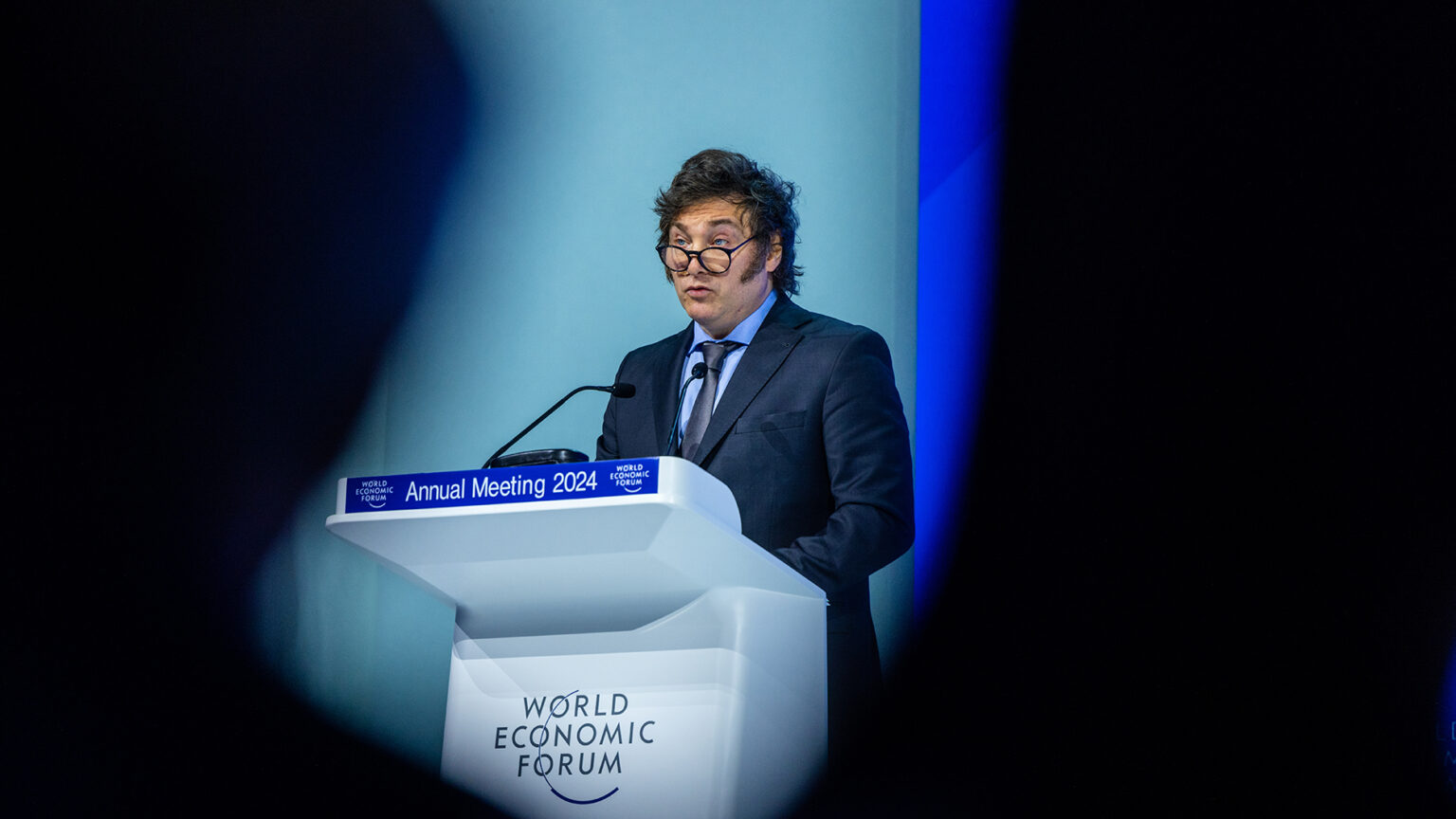
Javier Milei’s right-wing government promised to stop inflation in Argentina, and has thus far failed
The neoliberal economic measures of Javier Milei’s government are not improving the economic situation they promised to eradicate. During the election campaign, Milei made several promises that thus far he has been unable to keep. For example, he stated that the price of gas would not increase under his government, but from April to May rates rose by 450%. He also promised that public transportation fares would not increase, but the price of the subway went from 125 to 757 pesos.
The government has not been able to stimulate the growth of the Argentine economy either. According to the IMF itself, which bases a good part of its analysis and recommendations on neoliberal economic theory, the GDP of the Argentine economy will fall by 3.5% in 2024. In this sense, the recession the country is enduring does not seem to have a clear way out. Initially, the IMF thought that the economic contraction would be 2.8% of the GDP, but given the incontestable evidence, it had to adjust its forecast.
However, the IMF maintains that there will be a rebound effect, and that, therefore, in 2025 Argentina will grow by 5%. In addition, the agency praised the economic measures of the Milei government to curb the inflationary process, fiscal adjustment, and liberalization of the economy. Petya Koeva Brooks, deputy director of the Research Department, said that “looking ahead, even in the coming quarters, we expect growth to rebound because we see the effects of fiscal adjustment, the return of confidence and rising wages.”
However, several Argentine economists have stated that such expectations are not based on the reality of the national economy, as the problems caused by high inflation have worsened, as well as the evident decrease in employment in the country. According to data for the first half of 2024, Argentina has the highest cumulative inflation worldwide, 79.8%, and a peak year-on-year inflation of 271.5%.
Another unfulfilled promise of Milei was the increase of employment in the country thanks, according to the libertarian government, to the radical liberalization of the economy. However, despite the set of neoliberal economic measures, there has been a 7.7% increase in unemployment during the first quarter of 2024.
Milei’s administration celebrates the fact that the inflationary process decreased a little compared to previous years, claiming that this is thanks to certain public policies of his administration. This is even though Milei’s brutal fiscal adjustment, the contraction of the State, and the loss of thousands of jobs, which Milei stated would have a very positive impact on inflation, have not had the expected results. For example, food prices in Argentina have risen 260% (40 times more than Mexico), one of many figures which confirms that the neoliberal “shock” measures of Milei are not likely to benefit workers in the long run.
A budget totally out of step with what people want and need.
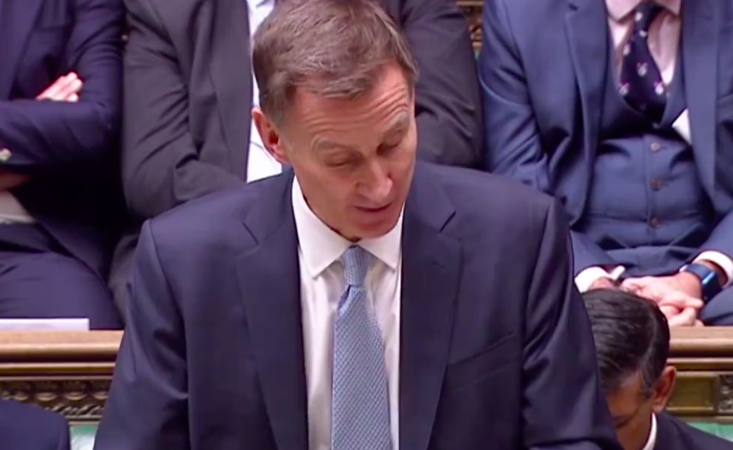
Today [yesterday] saw Chancellor Jeremy Hunt deliver his much-awaited Spring Budget. The stakes couldn’t be higher, with the economy in recession, millions struggling to make ends meet and a forthcoming general election.
In what is likely to be the last budget, and possibly the final fiscal event before the general election later this year, Hunt sought to present a rosy picture of the economy, one which is totally divorced from reality.
A budget totally out of step with what people want and need, opinion polls have repeatedly shown that the British public prefer investment in public services rather than tax cuts. There was no bold and radical plan to get the UK economy out of economic stagnation, to tackle poor productivity or to improve public services.