Count Binface: why Britain’s ‘joke’ election candidates deserve to be taken seriously

Spread the love
Aaron Chown/Alamy

Richard Toye, University of Exeter

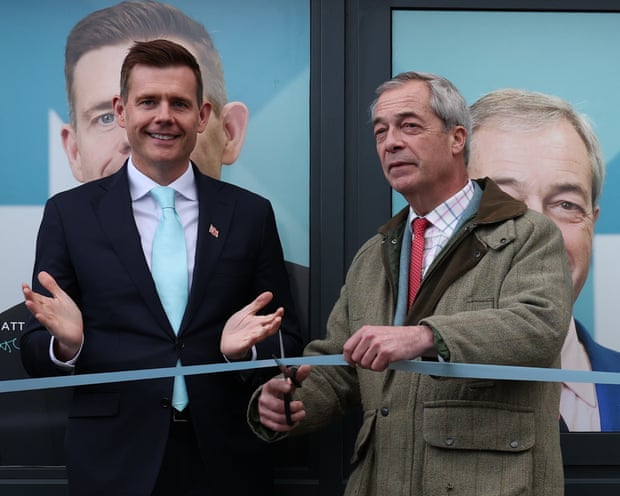
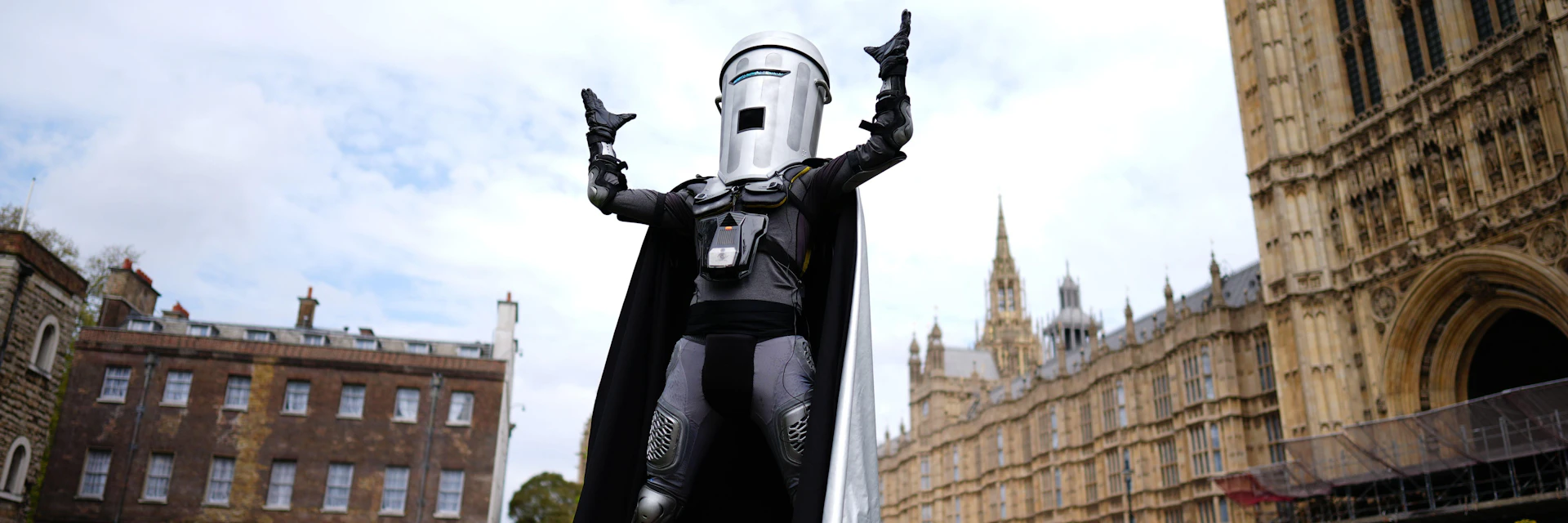
Reform UK leader Nigel Farage’s decision to resign his Clacton seat and force a by-election, amid scrutiny over his personal finances, has produced one of the odder spectacles in recent British politics. With every other major party declining to stand and despite a record 34 candidates running, his most prominent challenger is Count Binface, the silver-caped “intergalactic space warrior” with a bin for a helmet.

Danny Kruger, the Reform UK MP for East Wiltshire, told the House of Commons that politics is not a joke, criticising rivals for lining up behind a comedian in a dustbin costume. His reaction suggests that Reform UK is a party that senses its own vulnerability to ridicule, rather than one confident enough to shrug it off. But Kruger’s reaction also overlooks an important point: that “joke” candidates belong to a long and consequential tradition in Britain.

The template was set by David Sutch, who stood as Screaming Lord Sutch. A previously aspiring rock singer, he entered politics in 1963. He campaigned to lower the voting age from 21 to 18, stood against Labour prime minister Harold Wilson in 1966, and founded the Monster Raving Loony Party in 1983. He contested elections 39 times in total.
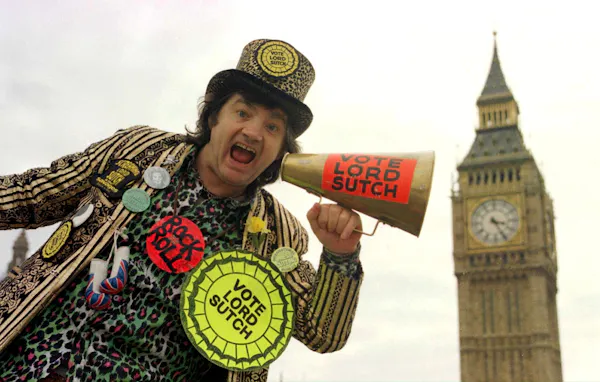
‘Screaming Lord Sutch’, former leader and founder of the Monster Raving Loony Party. Justin Williams/EPA

His slogan, “vote for insanity, you know it makes sense,” concealed real disenchantment. Sutch saw himself as speaking for people too alienated by politics to vote at all. Ironically, several of his “joke” policies – commercial radio, a lower voting age, all-day pub opening – were enacted later by various governments. In 1990, his party outpolled the collapsing Social Democrats in the Bootle by-election.

Sutch established the trope of comedy candidates standing alongside the country’s most powerful politicians. Count Binface – who challenged Theresa May in 2017 in his previous guise as Lord Buckethead – follows this well-beaten path.
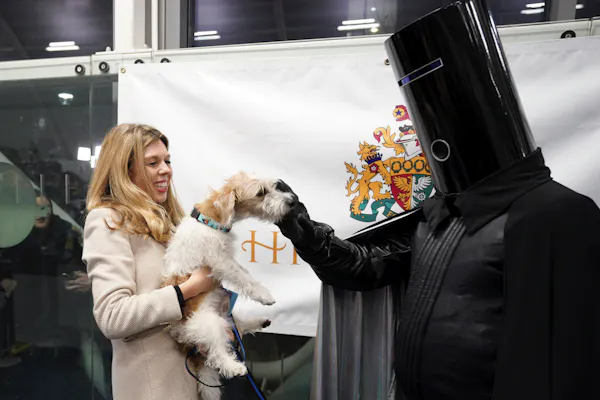
Count Binface (as Lord Buckethead) demonstrated reaching across the political divide by petting (wife of Boris Johnson) Carrie Symonds’ dog. Will Oliver/EPA

British election results are announced in a public hall, with the constituency’s candidates all lined up on one stage. This forces even a sitting prime minister to be pictured beside a rival in costume. The ritual of the count itself may help sustain this peculiar tradition by providing oddball candidates with a form of recognition, no matter how few votes they get.

In the Makerfield by-election, the fox took 18 votes against Burnham. What could be achieved in Clacton? Alamy

The line between joke and fringe candidates is more blurred than it seems. Sutch’s comedy hid serious protest; some overtly serious candidates, conversely, have been treated by the public as figures of fun. The road-safety campaigner William “Bill” Boaks, a naval veteran decorated at Dunkirk, spent decades sincerely contesting elections from a car painted as a zebra crossing. He eventually polled just five votes in Glasgow.

Similarly, the Natural Law Party (NLP) – whose candidates preached applying the principles of Transcendental Meditation to all levels of government and promoted “yogic flying” – never intended satire. It had serious policies such as an arms export ban. Its excruciating election broadcasts were nevertheless widely considered hilarious.

It should not be assumed that fringe candidacies are necessarily poorly resourced or powerless. Both the NLP and James Goldsmith’s Referendum Party, which fought the 1997 election on a single anti-European Union issue, drew on considerable private riches. The NLP was funded by ex-Beatle George Harrison; Goldsmith was a billionaire. The latter’s party used innovative but expensive messaging techniques such as the distribution of video cassettes to voters. Wealthy individuals could buy influence on the political process – something highlighted again recently by the donations received by Farage.
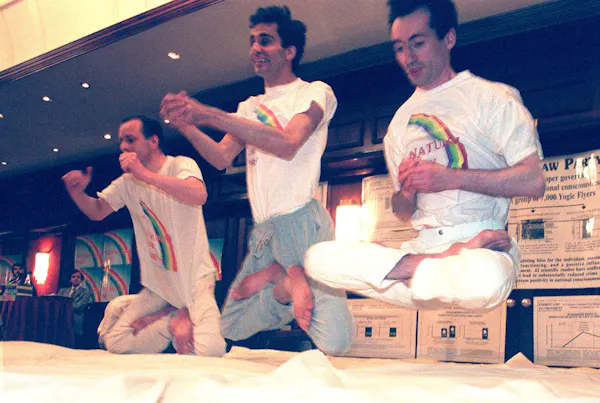
Members of the Natural Law Party demonstrate ‘yogic flying’ in 1997. David Cheskin/Alamy

The Referendum Party did shape the outcome of the 1997 general election. One statistical study found that, despite winning no seats and averaging under 3% of the vote, its intervention cut the Conservative vote by around 3.4 points – enough, is is estimated, to have cost the Conservatives 16 to 18 seats. A single-issue party built around one wealthy backer swung a significant number of individual contests even in total defeat.

The possibility of decisive impact without a single seat won is a useful corrective to the instinct to write off Binface’s Clacton campaign as empty theatre. His manifesto combines joke policies, such as nationalising Adele, with a few credible propositions, such as banning MPs who resign mid-parliament from standing in the resulting by-election. One survey already shows more voters nationwide would rather see him win than Farage, and local polling suggests that he might pick up a non-derisory 20% of the vote.
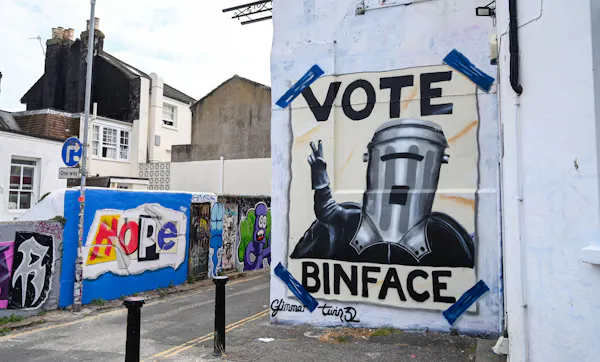
Some Clacton residents have demonstrated their support for Binface ahead of the by-election. Simon Dack News/Alamy

Whether or not Farage takes the Clacton seat, the number of voters who chose Binface instead may be used as ammunition by critics and comedians for the rest of his career. There is a further irony: what counts as “fringe” or “ridiculous” is constantly renegotiated. Farage himself spent years cast as a fringe obsessive before becoming one of the most consequential figures in current British politics. It’s a reminder that the boundary he polices against Binface is one he once crossed himself.

The history of British democracy is not only a history of winners. It is also the history of the losers, loners and long-shots whose campaigns reveal what voters find funny, what they find unacceptable, and what they are, in the end, prepared to take seriously. A man in a bin costume standing against the man who forced this election is a small but revealing window into the shifting boundaries of British politics.

Richard Toye, Professor of Modern History, University of Exeter

This article is republished from The Conversation under a Creative Commons license. Read the original article.
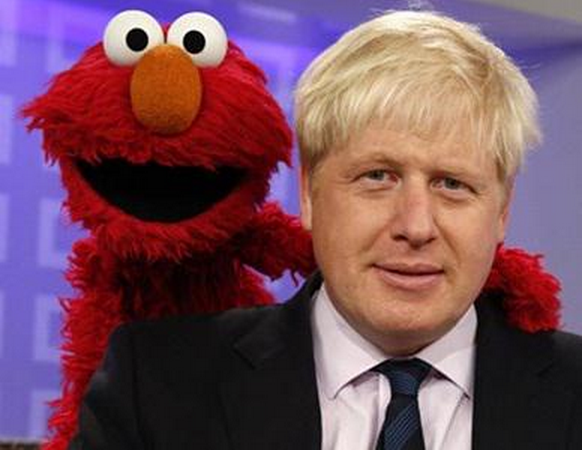
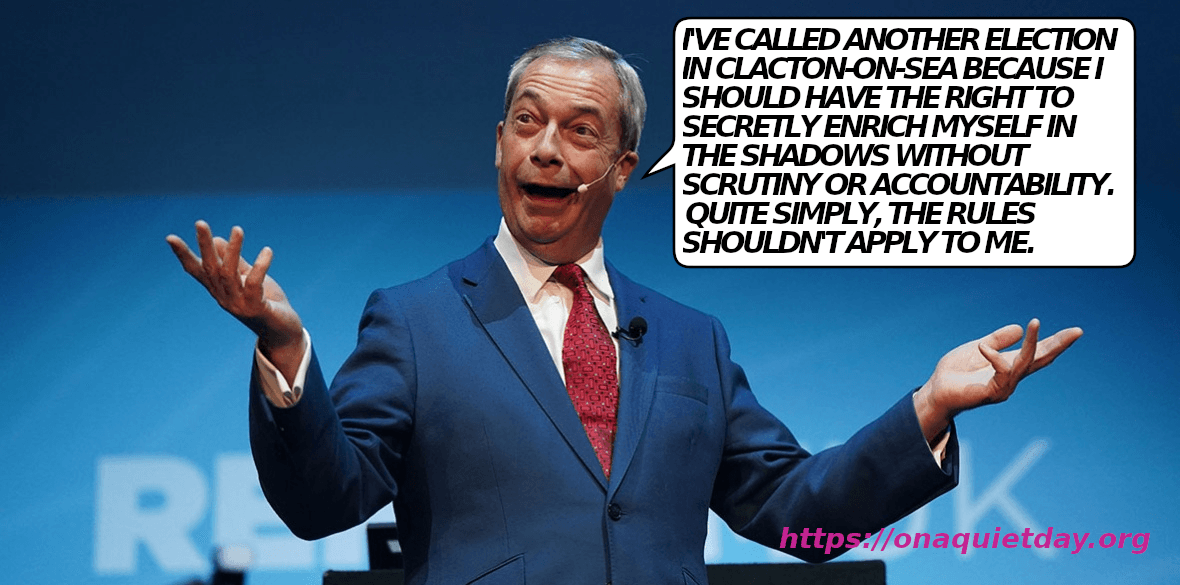
Image of Elmo and former Prime Minister Tory idiot Boris Johnson
Image of Elmo (left) and former Prime Minister Tory idiot Boris Johnson (right)
Nigel Farage explains that he's called another byelection in Clacton-on-Sea because he should be able to secretly enrich himself without scrutiny and accountabilty and that the rules shouldn't apply to him.
Nigel Farage explains that he’s called another byelection in Clacton-on-Sea because he should be able to secretly enrich himself without scrutiny and accountabilty and that the rules shouldn’t apply to him.
Orcas discuss how Trump was re-elected and him being an obviously insane, xenophobic Fascist.
Continue ReadingCount Binface: why Britain’s ‘joke’ election candidates deserve to be taken seriously

George Monbiot: How is Reform’s charmless candidate still a contender in Gorton and Denton? Ask Labour

Spread the love

https://www.theguardian.com/commentisfree/2026/feb/25/reform-matt-goodwin-labour-gorton-and-denton-byelection-greens

Reform UK’s Gorton and Denton byelection candidate, Matt Goodwin, attends a campaign event in Manchester with Nigel Farage, 5 February 2026. Photograph: Adam Vaughan/EPA

This byelection should have been a stroll for Keir Starmer’s party. Instead, all hope of defeating Matt Goodwin now seems to lie with the Greens

Every barb Labour has directed at the Greens can now be returned with interest. “It’s a wasted vote.” “Do you want to see Reform in power?” New polling ahead of the crucial Gorton and Denton byelection this week, while by no means decisive, puts the Greens first on 22%, followed by Reform UK (20%), then Labour (18%), with 31% undecided. But still Keir Starmer falsely claims that “only Labour can beat Reform”. Does he want to see Reform in power?

survey of 6,000 people by the group Persuasion UK found that by far the most effective message of five options was focused on corporate interests and went as follows: “Nigel Farage says he’s on people’s side – but when you take a closer look it’s pretty clear who he’s really fighting for, isn’t it? It’s the rich, the powerful, his mates in big business.” It explained that Reform UK has taken vast donations from fossil fuel investors and climate science deniers. This, Persuasion UK said, is why Farage wants to cut public services, workers’ rights and taxes for the richest. “He’s not smashing the system. He and his rich friends basically are the system.”

None of the other attack lines came anywhere near this for efficacy. So why doesn’t Labour use it? Because that might alienate the people Starmer seems keenest to appease: Labour’s own corporate backers and the billionaire proprietors of the rightwing press. The leadership’s key objective is not stopping Farage, but frightening people into voting Labour. Quite frankly, it has nothing else left.

One by one, it has destroyed the hopes that people vested in it, alienating potential voters on everything from Gaza to benefits to its self-destructive apeing of Reform’s rhetoric on immigration; from its vicious factional warfare against leftwingers in the party to its tearing up of environmental protections and attacks on wildlife, which, in a country of nature lovers, is utter, self-defeating madness. Disgust and disillusionment among former supporters is everywhere palpable.

See the original article at https://www.theguardian.com/commentisfree/2026/feb/25/reform-matt-goodwin-labour-gorton-and-denton-byelection-greens

Nigel Farage urges you to ignore facts and reality and be a climate science denier like him and his Deputy Richard Tice. He says that Reform UK has received £Millions and £Millions from the fossil fuel industry to promote climate denial and destroy the planet.
Keir Starmer refuses to be outcnuted by Nigel Farage's chasing the racist bigot vote.
Keir Starmer refuses to be outcnuted by Nigel Farage’s chasing the racist bigot vote.
Nigel Farage explains the politics of Reform UK: Racism, Fake anti-establishmentism, Deregulation, Corporatism, Climate Change Denial, Mysogyny and Transphobia.
Continue ReadingGeorge Monbiot: How is Reform’s charmless candidate still a contender in Gorton and Denton? Ask Labour

Greens say Labour are “plumbing new depths” with filmed immigration raids

Spread the love
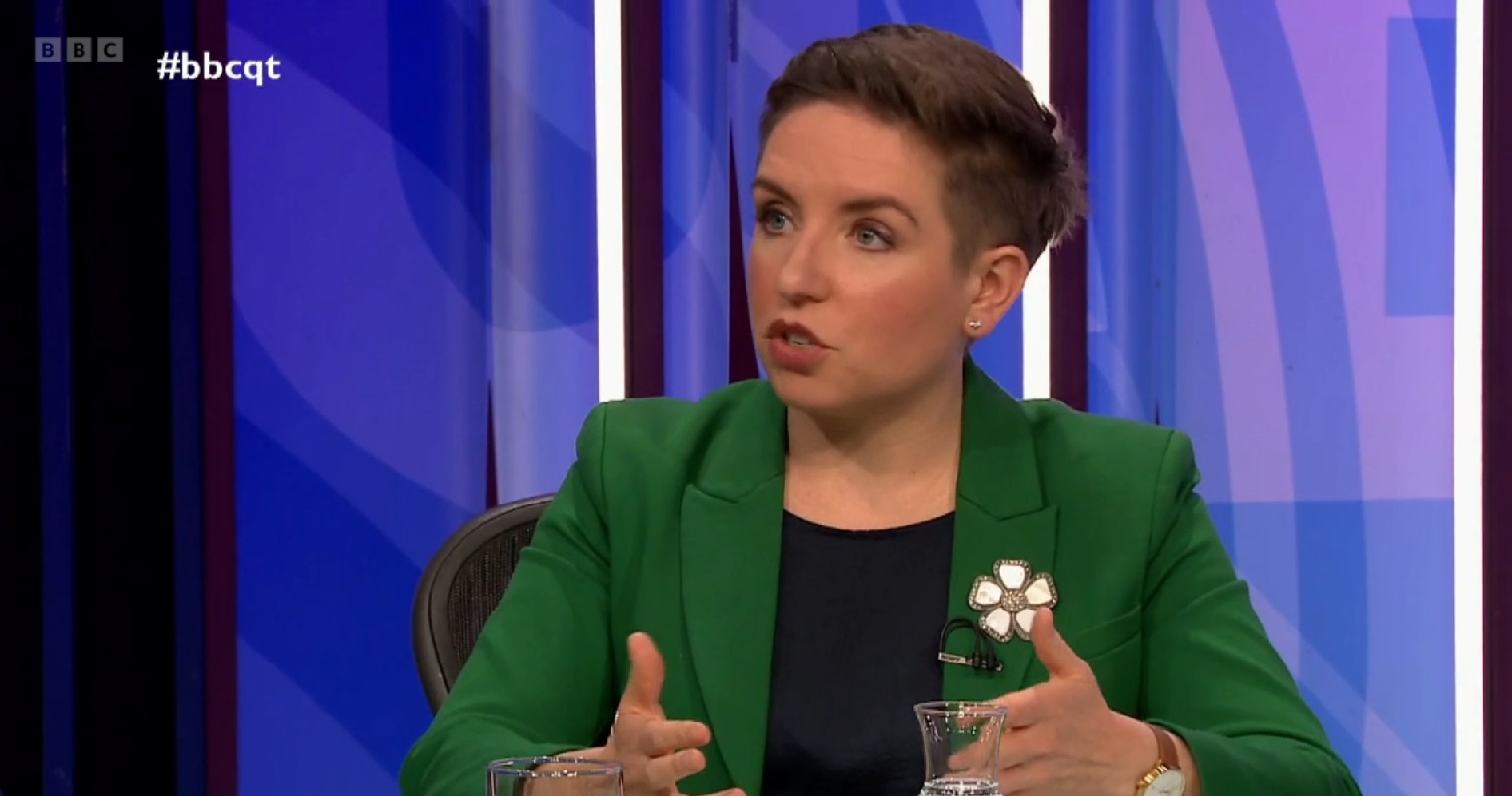
Image of the Green Party's Carla Denyer on BBC Question Time.
Image of the Green Party’s Carla Denyer on BBC Question Time.

Responding to the news that Labour are now publishing videos of police immigration raids, Green Party Co-Leader, Carla Denyer MP, said:

“This Labour government are plumbing new depths with their plan to broadcast footage of people being detained and deported. Those involved should be searching their consciences to ask if such breath-taking cruelty is really worth it all for the sake of aping the rhetoric of Reform. The bitter irony is that following Reform to the right on migration won’t win Labour any support – it will only lend legitimacy to Reform’s extreme views. It’s time this government showed a bit of backbone and told the truth – that migration is good for this country.”

Continue ReadingGreens say Labour are “plumbing new depths” with filmed immigration raids