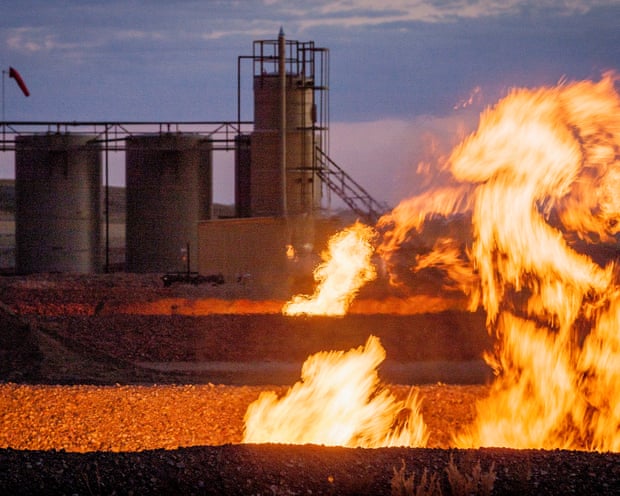
More than 160 governments are nominally signed up to the global methane pledge. Photograph: Orjan F Ellingvag/Corbis/Getty Images
Analysis published at Cop30 summit shows adhering to pledges offer world hope of avoiding climate breakdown
Sticking to three key climate promises – on renewables, energy efficiency and methane – would avoid nearly 1C of global heating and give the world hope of avoiding climate breakdown, analysis published at the Cop30 climate summit suggests.
Governments have already agreed to triple the amount of renewable energy generated by 2030, double global energy efficiency by then, and make substantial cuts to methane emissions.
If they follow through on these promises – still a big if, even though countries are meeting for climate crisis talks in Brazil this week – it would be a “gamechanger”, shaving 0.9C from projected temperature rises this century, according to the Climate Action Tracker coalition.
Achieving all of these measures, among G20 countries alone, would reduce global greenhouse gas emissions by 18bn tonnes in 2035 – enough to cut the rate of global heating by a third in the next decade, and halve it by 2040.
Bill Hare, chief executive of Climate Analytics, one of the organisations behind the report, said: “If [governments] achieve this by 2035, it would be a gamechanger, quickly slowing the rate of warming in the next decade and lowering global warming this century from 2.6C to about 1.7C.”
Orcas comment on killer apes destroying the planet by continuing to burn fossil fuels.Donald Trump urges you to be a Climate Science denier like him. He says that he makes millions and millions for destroying the planet, Burn, Baby, Burn and Flood, Baby, Flood.Nigel Farage urges you to ignore facts and reality and be a climate science denier like him and his Deputy Richard Tice. He says that Reform UK has received £Millions and £Millions from the fossil fuel industry to promote climate denial and destroy the planet.
Reform UK leader Nigel Farage speaking in Aberdeen. Credit: Reform UK / YouTube
Nigel Farage’s party was told by Offshore Energies UK to rethink its plan to thwart clean energy.
LIVERPOOL – The UK’s largest oil and gas trade body has criticised Reform UK’s plans to “turn off the tap” on renewable energy.
Nigel Farage’s party has tried to present itself as the oil and gas industry’s closest ally, vowing to “drill, baby, drill” in the North Sea and scrap the windfall tax on excess profits, while meeting with oil executives, and courting donations from the sector.
However, on a panel at the Labour Party’s annual conference in Liverpool on Monday (29 September), a spokesperson for Offshore Energies UK (OEUK) criticised Reform’s plans to end state support for clean energy.
Natalie Coupar, communications and marketing director at OEUK – members of which include fossil fuel giants BP, Shell, ExxonMobil, TotalEnergies, and Equinor – said the group is “apolitical” but gives “hard truths to all parties”.
She said: “One of the things we’ve been saying to Reform very much is, you know, if you’re going to turn on the taps for oil and gas, there’s almost really no point if you’re just going to turn off the taps to renewables.
“That doesn’t help. We need to keep both those streams open.”
According to the Confederation of British Industry (CBI), the UK’s net zero economy grew by 10 percent in 2024, employing almost a million people in full-time jobs.
Coupar also said it was essential to “hold the consensus on tackling climate change and growing our energy future”.
A panel at 2025 Labour Party conference sponsored by Offshore Energies UK (OEUK). Credit: DeSmog
Reform’s Oil Campaign
Reform has vowed to stop all government subsidies for renewable energy, and has pledged to block solar and onshore wind farms in the local authorities it controls.
In May, the party’s deputy leader Richard Ticesaid: “Whether it’s planning blockages, whether it’s judicial reviews, whether it’s lawsuits, whether it’s health and safety notices, we will use every available legal measure to an extreme way in order to frustrate these people.”
Tice – who has said “there’s no evidence that man-made CO2 is going to change the climate” – met with senior oil executives in May and promised to approve new drilling licences “on day one” of a Reform government.
Last month, he pledged to overturn the UK’s ban on fracking for shale gas, which he calls “treasure beneath our feet”, and told the industry to “get ready”.
In April, Reform party treasurer and a billionaire property developer Nick Candy said he was trying to secure donations from oil and gas executives, claiming to have raised £100,000 from one, though this has yet to appear on Reform’s donations register.
As DeSmog has reported, 92 percent of Reform’s funding between the 2019 and 2024 general elections came from climate science deniers or those with highly polluting interests – a total of £2.3 million.
Since his election as an MP last year, Farage has spoken at a string of events in the U.S. organised by radical groups backing U.S. President Donald Trump’s pro-fossil fuel agenda. Last December, Farage launched the UK-EU branch of the Heartland Institute, a U.S. climate denial think tank.
Speaking at the Alliance for Responsible Citizenship conference in London in February, Farage claimed it was “absolutely nuts” for CO2 to be considered to a pollutant. However, he added: “I’m not a scientist. I can’t tell you whether CO2 is leading to warming or not, but there are so many other massive factors.”
Climate scientists at the UN’s Intergovernmental Panel on Climate Change (IPCC), the world’s leading climate science body, have stressed that “it is a statement of fact, we cannot be any more certain; it is unequivocal and indisputable that humans are warming the planet”.
Nigel Farage urges you to ignore facts and reality and be a climate science denier like him and his Deputy Richard Tice. He says that Reform UK has received £Millions and £Millions from the fossil fuel industry to promote climate denial and destroy the planet.Elon Musk urges you to be a Fascist like him, says that you can ignore facts and reality then.Nigel Farage reminds you that he’s the man that brought you Brexit and asks what could possibly go wrong.
“The tax-payer will pick up nearly half of the estimated £38bn bill for Sizewell C but see not a single watt of electricity from it for at least a decade. Bill-payers will also have to stump up the cash for this plant through an increase in their energy bills by around £12 a year.
“New nuclear is a vastly more expensive way to produce electricity than renewables, with electricity from Sizewell C estimated to cost around £170 per megawatt hour compared to offshore wind at around £89/MWh. Hinkley C has also shown how the costs of developing nuclear power plants mushroom and are beset by endless delays.
“The billions of our money being squandered on this nuclear gamble would be far better spent on insulating and retrofitting millions of homes, which would bringing down energy bills and keep people warm in winter and cool in summer. We should also be investing in genuinely green power such as fitting millions of solar panels to roofs, and in innovative technologies like tidal power. All this would create many more jobs than nuclear ever will and deliver clean electricity much more quickly.”
Expected greenhouse gas emissions from US oil and gas fields has jumped under Trump, after previously dropping under Biden, forecasts show. Photograph: Bloomberg/Getty Images
Tariff chaos hampers Trump’s pledge to ‘drill, baby, drill’, but analysis still shows surge in planet-heating emissions
Donald Trump’s ambitions for the US to “drill, baby, drill” for more fossil fuels have ironically been hampered by the economic chaos unleashed by his own tariffs, but the US is still on track to increase oil and gas extraction, causing a surge in planet-heating emissions, a new analysis shows.
The US was already the world’s leading oil and gas power, producing more of the fossil fuels than any country in history during Joe Biden’s administration. But Trump has sought to escalate this further, declaring an “energy emergency” to open up more land and ocean for drilling and launching an unprecedented assault on environmental regulations in his first 100 days back in the White House.
This new political climate means that the expected amount of greenhouse gas emissions from active and planned projects in US oil and gas fields has jumped under Trump, after previously dropping under Biden, forecasts shared with the Guardian show.
Despite awarding more drilling leases than Trump in his first 100 days, Biden also pursued policies to combat the climate crisis that saw oil and gas companies revise down their production estimates. That situation has now reversed, threatening a pulse of new pollution that will further add to the fever of a planet already suffering from heatwaves, floods, droughts and other disasters accelerated by global heating.
“The uptick in embodied emissions from forecast US oil and gas production is worrying,” said Olivier Bois von Kursk, policy adviser at the International Institute for Sustainable Development, which tracks emissions projections from the lifetime of projects, based on data from research consultancy Rystad Energy. “The world can’t afford more climate chaos.”
…
The International Energy Agency, which has forecast that global oil and gas demand will peak by 2030, has said that no new major fossil fuel projects can occur if the world is to stay within agreed temperature limits and avoid catastrophic climate impacts. Last year was the hottest, worldwide, ever recorded and governments are collectively failing to meet targets to avert escalating disasters.
…
Tariffs on solar panels from Vietnam, Cambodia and Malaysia have been ratcheted up to as much as 3,521%. “We don’t want windmills in this country,” the president said shortly after his inauguration in January. “We don’t want windmills. You know what else people don’t like? Those massive solar fields.”
Neo-Fascist Climate Science Denier Donald Trump says Burn, Baby, Burn.Elon Musk urges you to be a Fascist like him, says that you can ignore facts and reality then.Orcas discuss Donald Trump and the killer apes’ concept of democracy. Front Orca warns that Trump is crashing his country’s economy and that everything he does he does for the fantastically wealthy.
The UK government is about to host a summit with the International Energy Agency (IEA) on the future of energy security. It does so as the world grapples with war, geopolitical realignments and trade barriers, against a backdrop of accelerating climate upheavals. One of the expected outcomes of this summit is a new, agreed definition of what constitutes energy security in the 21st century.
Common understandings of energy security have focused on making supplies reliable and affordable, with less attention paid to ensuring sources of energy are sustainable and less volatile over the medium- and long-term. This neglect compromises our collective security.
The IEA’s 31 member countries and 13 associates include most of the world’s most powerful states. Its influence means that this new definition of energy security will be used to inform government policies and investment decisions around the world. Given the cost of energy infrastructure, and the lengthy time it takes to build these projects, this definition is set to shape our future, economically and climatically.
But there is a very real risk that this definition will open the door to further investments into fossil fuel production under the guise of energy security.
International Energy Agency (IEA) member and ‘association member’ countries. IEA, CC BY-SA
After Russia invaded Ukraine, governments rushed to cut their reliance on Russian fossil fuels. This caused major disruptions as prices spiked and millions were pushed into energy poverty.
Europe alone spent an extra €517–€831 billion (£444–£713 billion) on energy in 2021 and 2022, even though some imports from Russia continued through so-called “shadow fleets”. Some argued that high fossil fuel prices only embolden leaders like Putin and help fund their conflicts.
Governments responded with “energy nativism”, as they sought to secure as much energy as possible for their citizens at whatever cost. This typically meant boosting renewables and bulk buying oil and gas. In the UK’s case, it also meant the previous government issuing hundreds of new licenses to drill for oil and gas to “increase energy security” – licenses the current government says it will honour).
Shipments of liquified natural gas (LNG) were also redirected from poorer countries like Pakistan and Bangladesh towards the highest bidders in Europe and Asia. This raises the question of who exactly is becoming more energy secure and at what cost.
Meanwhile, large fossil fuel exporters like Qatar, the US and Australia ramped up production. A US official even referred to its gas exports as “molecules of freedom”. Australia has exported so much natural gas it may have to buy its own gas back from Japan at market price.
The sheer volume of investment in new oil and gas infrastructure like offshore rigs or LNG terminals, combined with long build times, has locked in higher fossil fuel production and pushed emissions to record levels. This poses significant risks for both exporters and importers, especially as future demand is uncertain and energy markets remain volatile.
Fossil fuels remain dominant
More fundamentally, continued reliance on fossil fuels is making humanity less secure. The vast majority of emissions still come from burning coal, oil or gas. Preventing climate catastrophe therefore requires us to phase out fossil fuels as fast as possible – with wealthy nations leading the charge. In their place, we’ll have to generate energy from renewable sources that do not replicate the volatility of globally traded fossil fuels.
Yet despite some progressive policies, fossil fuels remain dominant across the global economy. Investment in oil and gas today is almost double the level it must fall below if the world is to reach net zero by 2050, according to the IEA’s own modelling.
The pursuit of energy security has boosted renewables, but adding additional clean energy isn’t enough – it must ultimately displace fossil fuels entirely. This will require a whole-economy shift. That means cutting production of fossil fuels while also reducing demand, stabilising prices and building out clean energy fast enough to support the electrification of transport, industry and heating.
But supply chains for batteries, solar panels and other key technologies are vulnerable. Delays and shortages could mean electricity prices spike, sparking social unrest. This is yet another risk of getting energy security wrong: if inflationary pressures drive the immiseration of the general public, governments and their energy plans will be short lived.
The definition of energy security that comes out of the IEA summit should reflect the fact we’re now in a world of constant crises. True energy security means charting a path towards a world that is more socially, economically and environmentally secure. This means developing a well-managed global plan to phase out fossil fuels.