Tag: reporting

  • Reports on Heat Waves and Flooding Usually Neglect to Explain Why They’re Happening: Study

    Spread the love

    Original article by OLIVIA RIGGIO republished from FAIR under a Creative Commons Attribution-NonCommercial-NoDerivs 3.0 Unported License.

    This month brought yet another record-breaking spate of flash floods and deadly heatwaves across the US. Yet, as a new study by Heated (6/27/24) reveals, despite ample reporting on these events, a majority of news outlets still did not link these events to their cause: climate change.

    Emily Atkin and Arielle Samuelson, writers for the climate-focused, Substack-based outlet, analyzed 133 digital breaking news articles from national, international and regional outlets reporting on this month’s extreme weather. Just 44% mentioned the climate crisis or global warming. Broken down by weather event: 52% of stories that covered heatwaves, and only 25% of stories that covered extreme rainfall, mentioned climate change.

    As Atkin and Samuelson write, by now we know that climate change is the main cause of both extreme heat and extreme flooding. And we know the biggest contributor of climate-disrupting greenhouse gasses: fossil fuels, which account for about 75% of global emissions annually.

    Still, the study’s authors found, only 11% of the articles they studied mentioned fossil fuels. Only one piece (BBC, 6/24/24) mentioned deforestation, which scientists say contributes about 20% of annual greenhouse gas emissions. None mentioned animal agriculture, which the FAO estimates contributes about 12% of global emissions.

    Stark omissions

    The omissions were laughably stark: A New York Post piece (6/21/24) ended with a New Yorker and former Marine who said he’d been in “way hotter conditions”—in Kuwait and Iraq. An AP article (6/4/24) quoted the “explanation” offered by a spokesperson for the Arizona Department of Forestry and Fire Management: “It does seem like Mother Nature is turning up the heat on us a little sooner than usual.”

    Heated recognized some outlets that consistently mentioned climate change in their breaking coverage of heat and floods this month. That list included NPR, Vox, Axios, BBC and Agence France-Presse (AFP).

    Then there were the outlets whose breaking coverage never mentioned it: ABC News, USA Today, The Hill, the New York Post and Fox Weather. When questioned, many of these outlets pointed the study’s authors to other climate coverage they had done, but this study’s focus on breaking news stories  was deliberate:

    Our analysis focused only on breaking stories because climate change is not a follow-up story; it is the story of the lethal and economically devastating extreme weather playing out across the country. To not mention climate change in a breaking news story about record heat in June 2024 is like not mentioning Covid-19 in a breaking news article about record hospitalizations in March 2020. It’s an abdication of journalistic responsibility to inform.

    Explaining isn’t hard

    A crucial takeaway for journalists and editors in this piece is that explaining the cause of these weather events isn’t hard. It’s often a matter of adding a sentence at most, Atkin and Samuelson write. They provide examples of stories that successfully made this connection, as with BBC (6/24/24):

    Scientists say extreme weather events are becoming more frequent and intense as a result of human-caused climate change, fueled by activities like burning fossil fuels and cutting down forests.

    Or the Guardian (6/23/24):

    Heatwaves are becoming more severe and prolonged due to the global climate crisis, caused primarily by the burning of fossil fuels.

    Notably, the Guardian piece was a reprint of an AP article that did not originally include that sentence; Heated confirmed that it was added by a Guardian editor.

    AP, however, was sometimes able to provide appropriate context, as in a June 21 piece:

    This month’s sizzling daytime temperatures were 35 times more likely and 2.5 degrees F hotter (1.4 degrees C) because of the warming from the burning of coal, oil and natural gas—in other words, human-caused climate change.

    More denial than acknowledgment

    During last summer’s apocalyptic orange haze on the East Coast, caused by record Canadian wildfires, I conducted a similar study (FAIR.org, 7/18/23) on US TV news’s coverage. Out of 115 segments, only 38% mentioned climate change’s role. Of those 115, 10 mentioned it in passing, 10 engaged in climate denial and 12 gave a brief explanation without alluding to the reality that climate change is human-caused. Only five segments acknowledged that climate change was human caused, and just seven fully fleshed out the fact that the  main cause of the climate crisis is fossil fuels.

    When there are more segments denying climate change than acknowledging fossil fuels’ role in it, you know there’s a problem.

    This year, I noticed coverage of worldwide coral bleaching that did make the appropriate connections (FAIR.org, 5/17/24). As Atkin and Samuelson emphasized, the difference between careless and responsible reporting on this issue is often just a few words.

    Original article by OLIVIA RIGGIO republished from FAIR under a Creative Commons Attribution-NonCommercial-NoDerivs 3.0 Unported License.
  • Israel Bans Al Jazeera in ‘Assault on Freedom of the Press’

    Spread the love

    Original article by BRETT WILKINS republished from Common Dreams under Creative Commons (CC BY-NC-ND 3.0). 

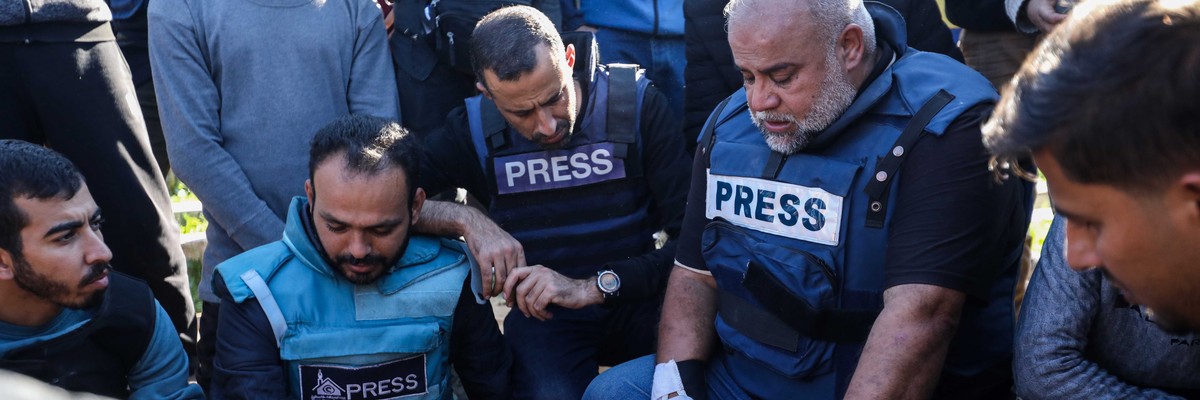
    Al Jazeera correspondent Wael Dahdouh mourns his son Al Jazeera correspondent Wael Dahdouh mourns his son and another journalist killed by an Israeli airstrike on January 7, 2024 in Rafah, Gaza. (Photo: Ahmad Hasaballah/Getty Images)

    “Rather than trying to silence reporting on its atrocities in Gaza, the Israeli government should stop committing them,” said one observer.

    The Jerusalem offices of Al Jazeera were raided Sunday after Israel’s far-right Cabinet banned the Qatar-based satellite news network—the sole international media outlet providing 24/7 live coverage from Gaza—from operating in the country.

    “If you’re watching this… then Al Jazeera has been banned in Israel,” correspondent Imran Khan said in a pre-recorded report from occupied East Jerusalem preempting the Israeli Cabinet’s unanimous vote to shutter the network.

    The order—which does not affect Al Jazeera’s ability to operate in Gaza or the illegally occupied Palestinian territories—is believed to be the first of its kind targeting a foreign media outlet operating in Israel. It comes after the Knesset, Israel’s parliament, recently voted 71-10 in favor of a law empowering the Israeli communications minister to ban foreign news organizations from working in Israel and to confiscate their equipment.

    “The time has come to eject Hamas’ mouthpiece from our country,” Israeli Prime Minister Benjamin Netanyahu said in a televised address.

    Ofir Gendelman, Netanyahu’s Arab media spokesperson, said Sunday that the closure would be “implemented immediately.”

    Gendelman said that the network’s “broadcast equipment will be confiscated, the channel’s correspondents will be prevented from working, the channel will be removed from cable and satellite television companies, and Al Jazeera‘s websites will be blocked on the internet.”

    In a statement, Al Jazeera vowed to “pursue all available legal channels through international legal institutions in its quest to protect both its rights and journalists, as well as the public’s right to information.”

    “Israel’s ongoing suppression of the free press, seen as an effort to conceal its actions in the Gaza Strip, stands in contravention of international and humanitarian law,” the network added. “Israel’s direct targeting and killing of journalists, arrests, intimidation, and threats will not deter Al Jazeera.”

    The New York-based Foreign Press Association issued a statement slamming the move and saying it “should be a cause for concern for all supporters of a free press.”

    “With this decision, Israel joins a dubious club of authoritarian governments to ban the station,” the group said. “This is a dark day for the media. This is a dark day for democracy.”

    Human Rights Watch Israel and Palestine director Omar Shakir called the order “an assault on freedom of the press.”

    “Rather than trying to silence reporting on its atrocities in Gaza, the Israeli government should stop committing them,” he added.

    Al Jazeera is the only international news network providing nonstop on-the-ground coverage of Israel’s war on Gaza, often being the first to report Israeli atrocities in what many experts worldwide say is a genocidal campaign in the besieged, starving strip.

    Its correspondents and other media professionals work under constant risk to life and limb. More than 100 journalists, the vast majority of them Palestinians, have been killed by Israeli forces since October 7 in what the Committee to Protect Journalists (CPJ) and others say are often intentional targetings of not only media workers but also their families.

    In December, Israeli forces killed Al Jazeera cameraman Samer Abudaqa as he reported on the war in southern Gaza, an attack that also wounded Al Jazeera Gaza bureau chief Wael Dahdouh—whose wife, son, daughter, and grandson were killed in a separate Israeli strike.

    Previous probes—like the investigation into Israeli troops’ 2022 killing of renowned Palestinian American Al Jazeera reporter Shireen Abu Akleh—have confirmed that Israel has deliberately targeted journalists.

    Last May, CPJ published Deadly Pattern, a report that found Israeli troops had killed at least 20 journalists over the past 22 years with utter impunity. While some of the slain journalists have been foreigners—including Italian Associated Press reporter Simone Camilli and British cameraman and filmmaker James Miller—the vast majority of victims have been Palestinian.

    Israeli forces have also attacked newsrooms in every major assault on Gaza, including in May 2021 when the 11-story al-Jalaa Tower, which housed offices of Al Jazeera, The Associated Press, and other media outlets, was completely destroyed in an airstrike.

    On Friday—World Press Freedom Day—Palestinian journalists covering the war on Gaza were awarded this year’s UNESCO/Guillermo Cano World Press Freedom Prize after being recommended by an international jury of media professionals.

    Original article by BRETT WILKINS republished from Common Dreams under Creative Commons (CC BY-NC-ND 3.0).