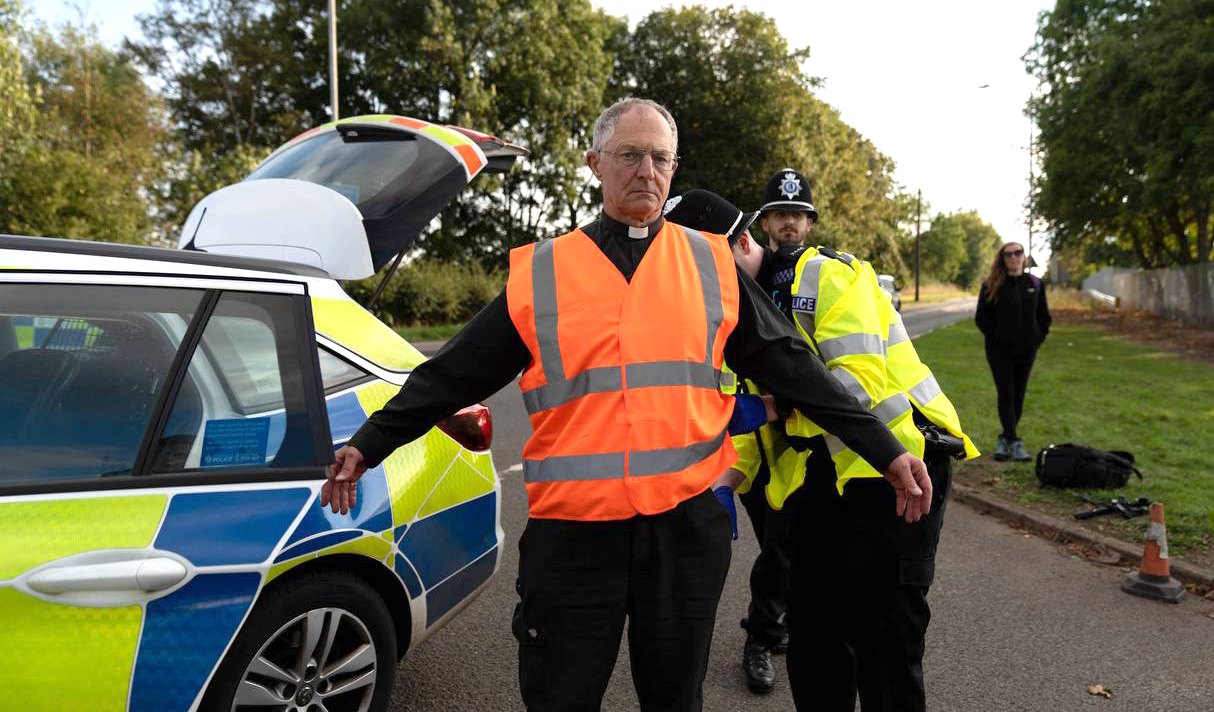
Chris Nineham – deputy leader of the Stop the War Coalition and Chief Steward for many of London’s demonstrations against the Israel Hamas War and the British government’s involvement (source) – was arrested for some reason at the Gaza protest in London yesterday. There’s also a video of him getting arrested.
This video is from 2 months ago. Among other things, he says
The police and the establishment in this country … are conducting a campaign of vilification and repression against the movement … it’s really a campaign against freedom of speech in general in this country and certainly on the issue of Palestine.
…
We should take no lectures from the Metropolitan Police or any other police force about hate crime and about intimidation …
Climate and environmental protest is being criminalised and repressed around the world. The criminalisation of such protest has received a lot of attention in certain countries, including the UK and Australia. But there have not been any attempts to capture the global trend – until now.
We recently published a report, with three University of Bristol colleagues, which shows this repression is indeed a global trend – and that it is becoming more difficult around the world to stand up for climate justice.
This criminalisation and repression spans the global north and south, and includes more and less democratic countries. It does, however, take different forms.
Our report distinguishes between climate and environmental protest. The latter are campaigns against specific environmentally destructive projects – most commonly oil and gas extraction and pipelines, deforestation, dam building and mining. They take place all around the world.
Climate protests are aimed at mitigating climate change by decreasing carbon emissions, and tend to make bigger policy or political demands (“cut global emissions now” rather than “don’t build this power plant”). They often take place in urban areas and are more common in the global north.
The intensifying criminalisation and repression is taking four main forms.
1. Anti-protest laws are introduced
Anti-protest laws may give the police more powers to stop protest, introduce new criminal offences, increase sentence lengths for existing offences, or give policy impunity when harming protesters. In the 14 countries we looked at, we found 22 such pieces of legislation introduced since 2019.
2. Protest is criminalised through prosecution and courts
This can mean using laws against climate and environmental activists that were designed to be used against terrorism or organised crime. In Germany, members of Letzte Generation (Last Generation), a direct action group in the mould of Just Stop Oil, were charged in May 2024 with “forming a criminal organisation”. This section of the law is typically used against mafia organisations and had never been applied to a non-violent group.
Criminalising protest can also mean lowering the threshold for prosecution, preventing climate activists from mentioning climate change in court, and changing other court processes to make guilty verdicts more likely. Another example is injunctions that can be taken out by corporations against activists who protest against them.
3. Harsher policing
This stretches from stopping and searching to surveillance, arrests, violence, infiltration and threatening activists. The policing of activists is carried out not just by state actors like police and armed forces, but also private actors including private security, organised crime and corporations.
In Germany, regional police have been accused of collaborating with an energy giant (and its private fire brigade) to evict coal mine protesters, while private security was used extensively in policing anti-mining activists in Peru.
4. Killings and disappearances
Lastly, in the most extreme cases, environmental activists are murdered. This is an extension of the trend for harsher policing, as it typically follows threats by the same range of actors. We used data from the NGO Global Witness to show this is increasingly common in countries including Brazil, Philippines, Peru and India. In Brazil, most murders are carried out by organised crime groups while in Peru, it is the police force.
Protests are increasing
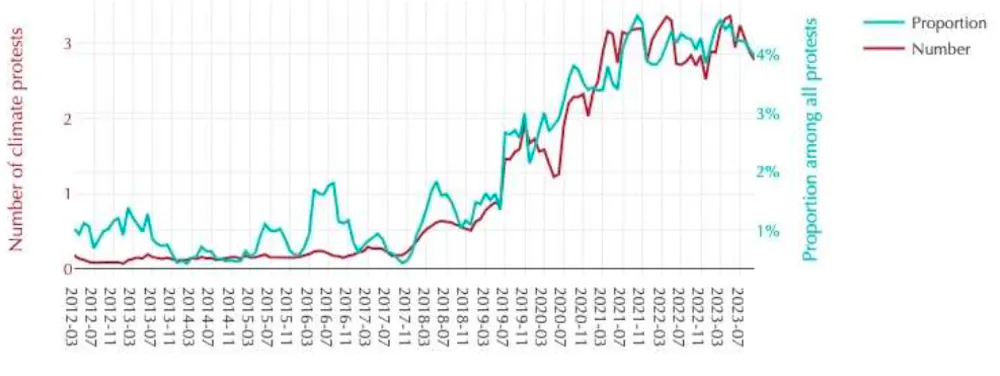
To look more closely at the global picture of climate and environmental protest – and the repression of it – we used the Armed Conflicts Location Event database. This showed us that climate protests increased dramatically in 2018-2019 and have not declined since. They make up on average about 4% of all protest in the 81 countries that had more than 1,000 protests recorded in the 2012-2023 period:
Climate protests increased sharply in the late 2010s in the 14 countries studied. (Data is smoothed over five months; number of protests is per country per month.) Berglund et al; Data: ACLED, CC BY-SA
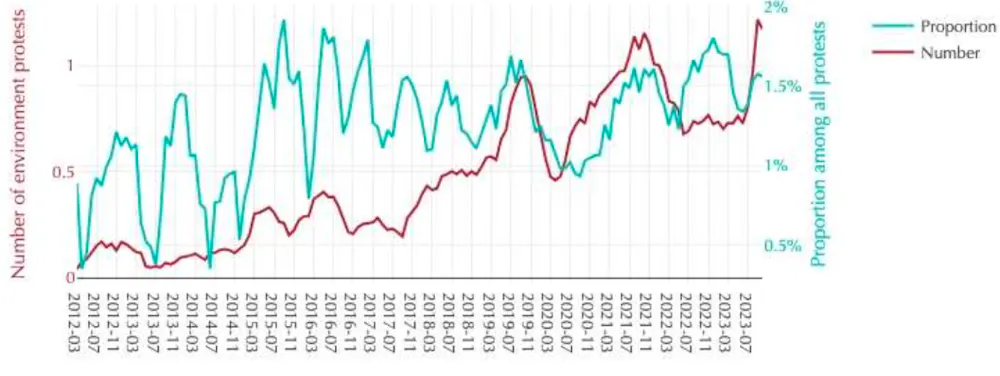
This second graph shows that environmental protest has increased more gradually:
Environmental protests in the same 14 countries. Data: ACLED, CC BY-SA
We used this data to see what kind of repression activists face. By looking for keywords in the reporting of protest events, we found that on average 3% of climate and environmental protests face police violence, and 6.3% involve arrests. But behind these averages are large differences in the nature of protest and its policing.
A combination of the presence of protest groups like Extinction Rebellion, who often actively seek arrests, and police forces that are more likely to make arrests, mean countries such as Australia and the UK have very high levels of arrest. Some 20% of Australian climate and environmental protests involve arrests, against 17% in the UK – with the highest in the world being Canada on 27%.
Meanwhile, police violence is high in countries such as Peru (6.5%) and Uganda (4.4%). France stands out as a European country with relatively high levels of police violence (3.2%) and low levels of arrests (also 3.2%).
In summary, while criminalisation and repression does not look the same across the world, there are remarkable similarities. It is increasing in a lot of countries, it involves both state and corporate actors, and it takes many forms.
This repression is taking place in a context where states are not taking adequate action on climate change. By criminalising activists, states depoliticise them. This conceals the fact these activists are ultimately right about the state of the climate and environment – and the lack of positive government action in these areas.
MetropolitanRepublic staff celebrating at the Silverback Awards, November 2023. (Credit: MetropolitanRepublic Uganda)
MetropolitanRepublic enlisted social media influencers to promote giant oil project as climate campaigners suffered beatings and arrests.
Last November, a beaming group of staff from MetropolitanRepublic collected their gorilla-shaped trophy at the Silverback Awards, Uganda’s top advertising and public relations gala.
The South African PR agency had won its prize for promoting the “sustainable development” of Uganda’s untapped oil reserves by French oil company TotalEnergies.
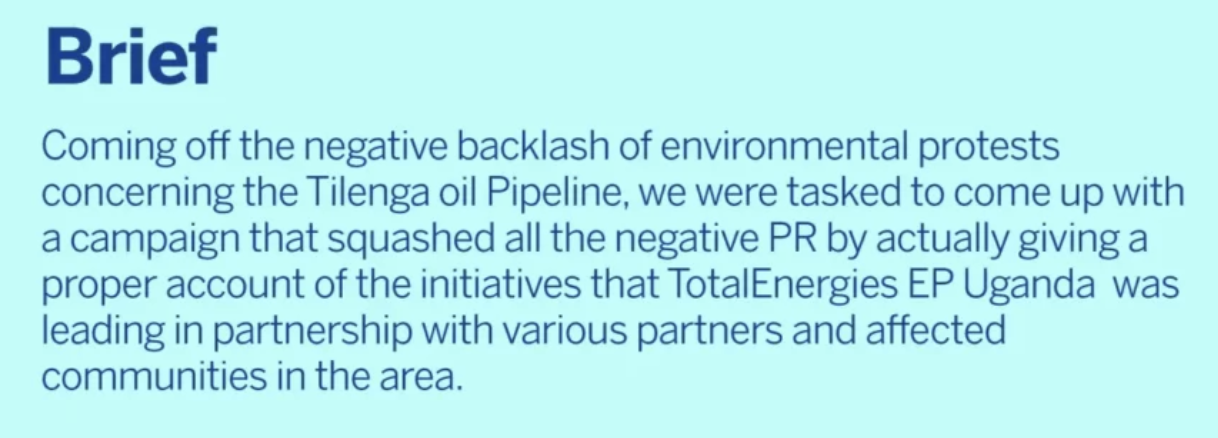
MetropolitanRepublic — which is part-owned by British communications giant WPP — described the brief for the award-winning “Action for Sustainability” campaign in its entry to the Silverback Awards: to devise an approach that “squashed all the negative PR” from protests against TotalEnergies’ plans for a 1,443-kilometre pipeline to export oil from Uganda’s Lake Albert via neighbouring Tanzania.
An accompanying video featured photographs of Ugandan anti-pipeline campaigners to illustrate this “backlash” and described them as “haters”.
“How do you launch a successful project off the back of this?” asks the narrator in the video. “Well, you develop a 360 PR campaign that retells your story the way it should be told.”
A screenshot from the award submission published on the Silverback Awards’ website. The Tilenga pipeline is a feeder pipeline under construction to carry oil from the Tilenga oilfields to the start of EACOP. (Credit: Silverback Awards)
Now, DeSmog can reveal that Ugandan police or military personnel have arrested, beaten, threatened, or harassed at least eight of the 15 campaigners pictured in MetropolitanRepublic’s award submission video.
These incidents — documented via video taken at protests, interviews with the campaigners, and police records — took place both before and after the video was published on the Silverback website in March.
There is no indication that MetropolitanRepublic’s campaign or the award submission led directly to any specific incidents affecting the activists. Nevertheless, DeSmog found that the agency engaged a network of social media influencers to post hundreds of times in support of TotalEnergies’ plans to mitigate the impact of the pipeline — even as protestors were being beaten and harassed.
“These PR firms are sponsoring our oppression,” said Hillary Innocent Taylor Seguya, one of the campaigners pictured in MetropolitanRepublic’s award submission video. “The more you push misinformation to the rest of the world, the more it means that you don’t care about our rights.”
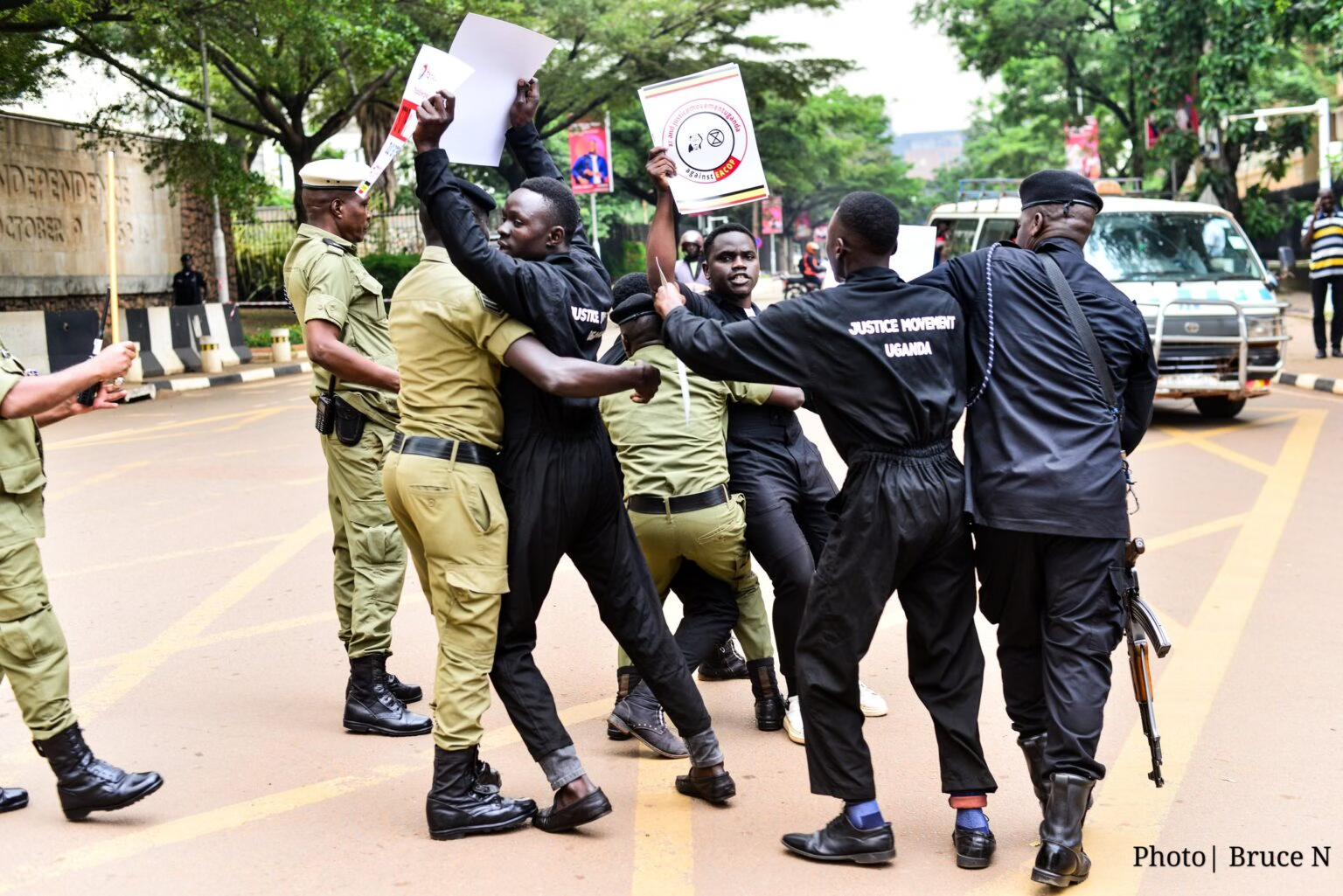
Protestors from student human rights group Justice Movement Uganda opposing the East Africa Crude Oil Pipeline. (Credit: Bruce Nahabwe)
Since the pipeline project was first announced in 2017, advocacy groups have highlighted concerns over the displacement of communities in Uganda and Tanzania, damage to ecosystems and wildlife, and the climate impact of burning Uganda’s oil. The outcry has prompted some banks, insurers, and the PR company Edelman — which has represented oil companies for decades — to shun the project, known as the East Africa Crude Oil Pipeline, or EACOP.
In June this year, UN Secretary-General Antonio Guterres urged communications agencies to stop working for fossil fuel companies, saying PR campaigns run by “Mad Men fuelling the madness” were making the climate crisis harder to address.
MetropolitanRepublic, however, defended its role in promoting the pipeline — a joint venture between TotalEnergies and state oil companies from Uganda, Tanzania, and China.
Commenting on the lengthy jail sentences imposed on climate activists for planning a peaceful protest, following a trial where the defendants were prevented from fully explaining the reasons for their actions, Greenpeace UK’s programme director Amy Cameron said:
“This is a dark day for the right to protest, a pillar of our democracy. Without it, we would have no votes for women, basic workers’ rights or an end to coal and commercial whaling. What sort of country locks people away for years for planning a peaceful demonstration, let alone for talking about it on a Zoom call? We’re giving a free hand to the polluting elite robbing us of a habitable planet while jailing those who’re trying to stop them – it makes no sense.
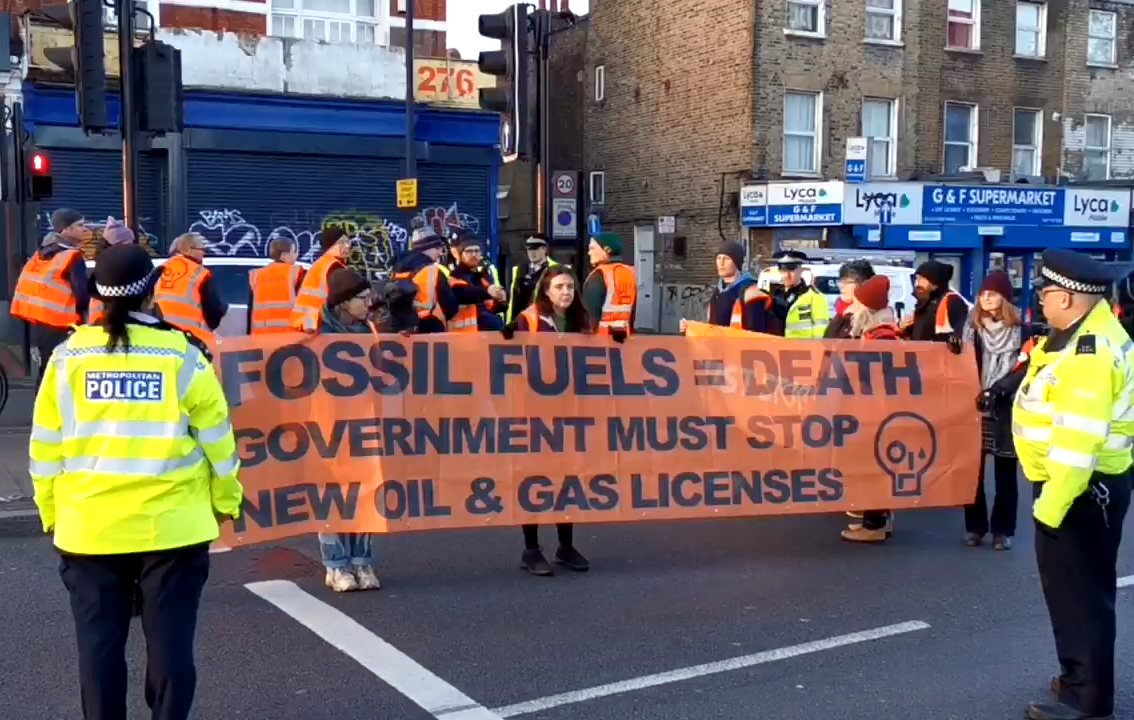
Just Stop Oil protesting in London 6 December 2022.
“These sentences are not a one-off anomaly, but the culmination of years of repressive legislation, overblown government rhetoric and a concerted assault on the right of juries to deliberate according to their conscience. This judicial crackdown on climate activists has gotten out of hand and is now a major international embarrassment. It’s part of the mess the Labour government has inherited from its predecessor and they must fix it by giving back to people the right to protest that’s been slowly being taken away from them.
“Starmer’s ministers should repeal the gagging laws brought in by the Conservatives and instruct the Attorney General to meet with campaigners and the UN rapporteur on environmental defenders to discuss a way forward.”
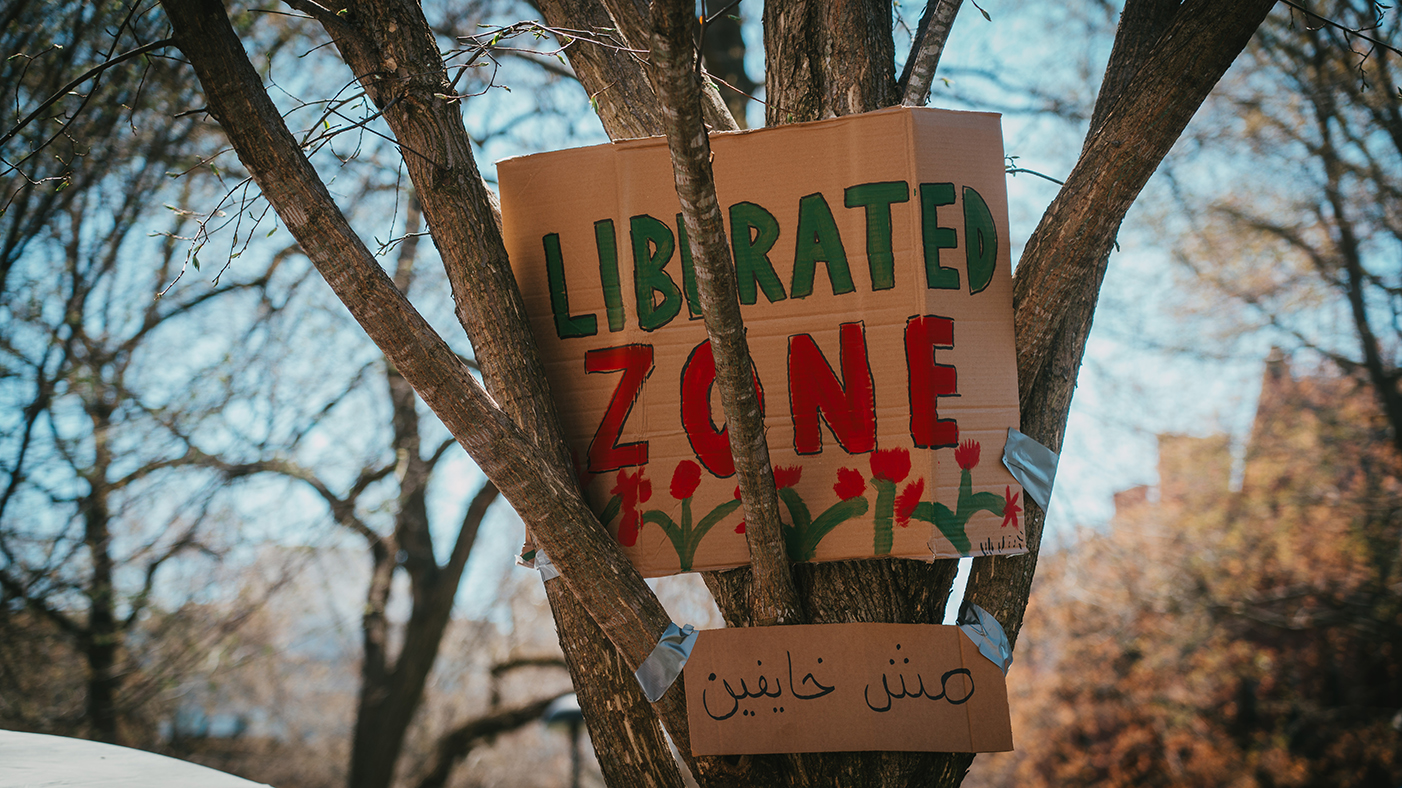
Students set up a Gaza Solidarity Encampment on Harvard Yard (Photo: Micah Fong)
Police continue to crack down on growing movement of Gaza Solidarity Encampments, students stand their ground
Police throughout the country have continued to heavily repress students engaging in protest in solidarity with Gaza. Despite the brutalization of student protesters on campuses such as University of Texas – Austin and the University of Southern California, students continue to stage encampments across the globe.
This is happening in the backdrop of US President Biden signing a bill into law that would provide USD 26 billion to Israel as it conducts genocide in Gaza. Even the European Union has backed a UN call for an investigation (which the US refuses to support) into the over 300 killed Palestinians found in mass graves beneath the ruins of two hospitals. Israel has also begun its attack on Rafah, killing five people in an air strike on a residential building in Rafah City.
Students at UT Austin have had to withstand brutal repression, as ultra-right wing Texas Governor Greg Abbot called in State Troopers, some mounted on horses, who violently clashed with protesters and made multiple arrests.
Despite the downpour of state violence, student protesters held their ground, chanting ““You don’t scare us!” and “Get off our campus!”
University of Texas students chanting “You don’t scare us” and “Get off our campus” to state troopers sent by Gov. Abbott with support of Biden and Democrats. But students can’t defeat the state on their own or on the campuses. They must turn to the working class to defend their… pic.twitter.com/VmVoGbitf1
Protesters also experienced a wave of repression at the University of Southern California, where arrests are currently underway as Los Angeles Police attempt to clear the encampment.
Happening now: USC protestors being arrested by heavy police presence, students are standing their ground to maintain the Gaza encampments. pic.twitter.com/8CjrwG07q3
Earlier in the day, Los Angeles police used batons and fists to violently beat organizers. Organizers continued to be defiant in the face of such repression, however, and managed to successfully de-arrest a protester who had been detained in a police car, surrounding the car and chanting, “Let him go!”
BREAKING: At USC’s Gaza solidarity encampment, protestors surround an LAPD car and successful de-arrest a student. Brutal crackdown by police is ongoing but the students are undeterred pic.twitter.com/nub0TqtQcf
— Palestinian Youth Movement (@palyouthmvmt) April 24, 2024
On the morning of April 24, Columbia student organizers made important announcements to those participating in the week-long protest, the “Gaza Solidarity Encampment” at Butler Lawn. The previous night, Columbia administration had threatened to bring in the National Guard to sweep the encampment, in a disturbing echo of the Kent State massacre in 1970 of four students protesting the US war in Vietnam by the Ohio National Guard.
However, that morning, students announced to the entire encampment that “we won a huge concession—we have it in writing that we are here for 48 hours and we will not be swept; we will not be moved!”
Due to a mass mobilization of both students and supporters, inside and outside campus gates, the administration was deterred from sweeping the camp, according to organizers. The administration has set a new deadline for an encampment sweep: Friday at 3 am.
As student organizers at Columbia plan for repression, other campuses across the country and around the world continue to establish their own encampments in solidarity with Gaza at universities such as Harvard and Brown. On April 24, students Sciences Po in Paris erected their own encampment in solidarity with Gaza.
Incredible video from @HarvardPSC
Just yesterday, Harvard University placed the Harvard Palestine Solidarity Committee (PSC) under suspension. Less than 24 hours later, students launched a Gaza solidarity encampment.
Students across the globe have issued messages of solidarity with the US students braving repression in solidarity with Gaza. The Arab and Maghreb Youth Student Front Against Normalization and in Support of Peoples’ Causes has called for a “global youth student battle in support of Palestinian resistance and all solidarity forces with it,” stating that “what happened at Columbia University in the United States today is the best evidence of what we say, as after six days of sit-ins inside the campus, many other American universities like the University of California witnessed student movements supporting Palestine, shaking the throne of the entity and pushing the Biden administration to ruthlessly suppress protests supporting the Palestinian people and demanding an end to the genocide in Gaza.”
The Student Front has called for a mobilization of all Arab and Maghreb youth students to “to intensify field movements in support of the Palestinian cause and to stop the genocidal war in steadfast Palestine, strengthening the Boycott, Divestment, and Sanctions (BDS) movement and protesting in front of American embassies and their symbols.”
The International People’s Assembly (IPA) also issued a statement denouncing the “brutal repression and mass arrests of students peacefully protesting their administrations’ investments in the Zionist entity and demanding an end to all academic partnerships and cooperation.”