Tag: Russia

  • Global South leaders join Victory Day events in Moscow as Europe stays away

    Spread the love

    Original article by Ana Vračar republished from peoples dispatch under a Creative Commons Attribution-ShareAlike 4.0 (CC BY-SA) license.

    Marking the 80th anniversary of Nazi Germany’s defeat, Global South leaders are gathering in Moscow, while EU remains absent
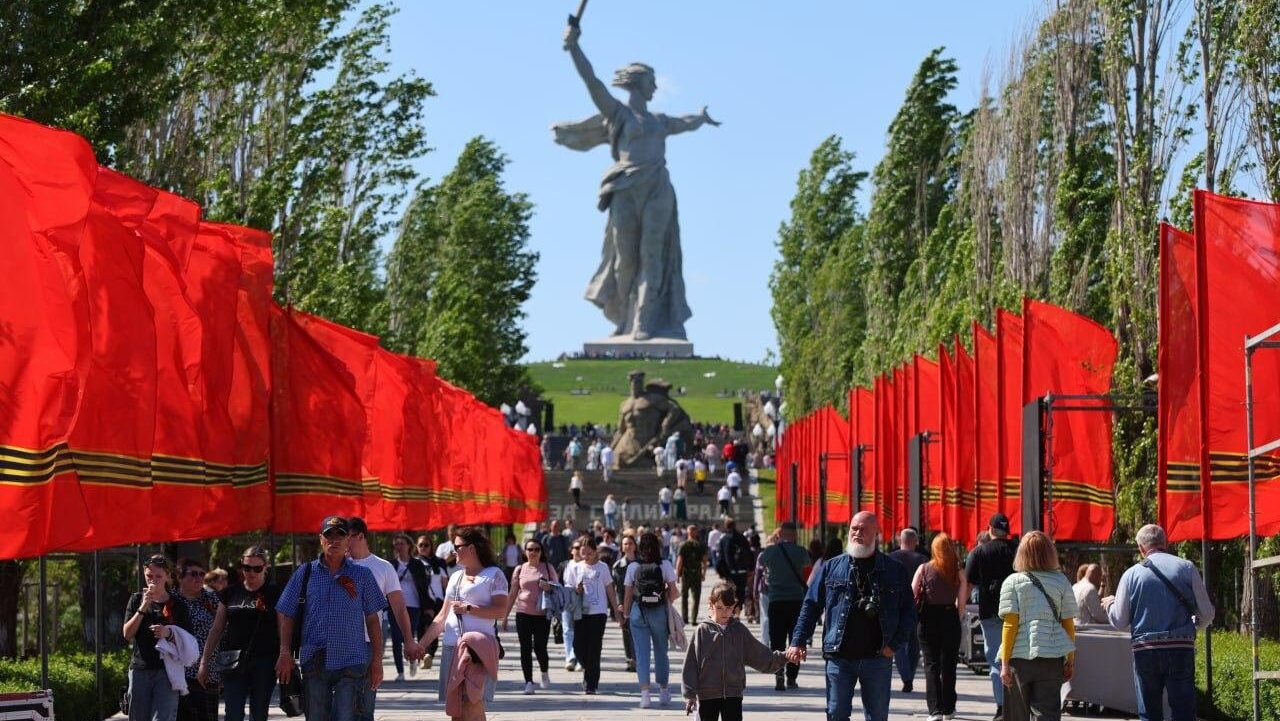
    Source: Ministry of Foreign Affairs of Russia/X

    Early high-level events marking the 80th anniversary of the defeat of Nazi Germany are underway in Russia, where the traditional Victory Parade on Friday, May 9, will welcome a host of world leaders and other guests to commemorate the Red Army’s role in the liberation of Europe. According to Russian authorities, 29 countries have confirmed their leaders will attend the event, including Brazil, Burkina Faso, China, Cuba, Venezuela, and Vietnam.

    Victory Day, falling on May 8 in most of Europe and on May 9 in Russia due to time zone differences, marks the official surrender of Nazi Germany in 1945. Although the date holds deep historical significance for Europe, its political leaders will be largely absent from this year’s events in Moscow. Slovakia is the only EU country to appear on the latest list of attendees, ignoring warnings from the bloc’s High Representative for Foreign Affairs, Kaja Kallas, who implied there would be ‘consequences’ for European officials participating in the event. Her threats mark the latest episode in a long-standing campaign of historical revisionism led by the EU, aimed at minimizing and obscuring the Soviet Union’s role in the liberation of Europe in World War II.

    Honoring Red Army’s role in defeating Nazi Germany

    In contrast to the EU, Global South leaders attending the events expressed their respect and acknowledged those who fought for liberation. At the beginning of his visit, Venezuelan President Nicolás Maduro stated simply: “It was the Red Army that liberated Europe.” Similarly, Chinese President Xi Jinping emphasized the importance of maintaining an accurate historical perspective on World War II and applying its lessons to the present, particularly when it comes to resisting Western domination.

    “Eighty years ago, the forces of justice around the world, including China and the Soviet Union, united in courageous battles against their common foes and defeated the overbearing fascist powers,” Xi wrote in an article for the Russian Gazette. “Eighty years later today, however, unilateralism, hegemonism, bullying, and coercive practices are severely undermining our world.”

    Despite efforts by Western governments to demonize the Red Army, many around the world still remember the USSR’s decisive role in the antifascist struggle, the immense sacrifices it made during the war, and the international solidarity it championed. “The peoples of the world have not forgotten who, in 1945, liberated them from Nazi enslavement and destruction,” stated Gennady Zyuganov, leader of the Communist Party of the Russian Federation, ahead of Victory Day.

    “Celebrating the 80th anniversary of the great victory over fascism, we must remember the origins of Nazism,” he added. “Imperialism, which gave birth to that plague, is not a thing of the past. It is no coincidence that today our former allies in the anti-Hitler coalition are erasing us from the list of victorious countries.”

    Left movements reclaim antifascist legacy for today’s struggles

    Although communist groups across Europe circulated statements honoring the Red Army’s role in World War II, some also voiced concern about the context of this year’s central commemoration in Russia – just as much as the revisionism of core EU countries

    Read more: Italy marks 80 years since liberation with calls against genocide and militarism

    It is in the spirit of reclaiming the resistance, that left and progressive groups across the region are organizing their own events. In Belgium, for example, activists have rallied around long-standing demands to re-establish May 8 as a public holiday. In former Yugoslav countries, actions will affirm the relevance of antifascism today, particularly in connection with solidarity for Palestine and mobilizations against genocide. All these events are not limited to remembrance: they aim to resist efforts to rewrite history in service of the Global North’s current political agenda.

    Original article by Ana Vračar republished from peoples dispatch under a Creative Commons Attribution-ShareAlike 4.0 (CC BY-SA) license.
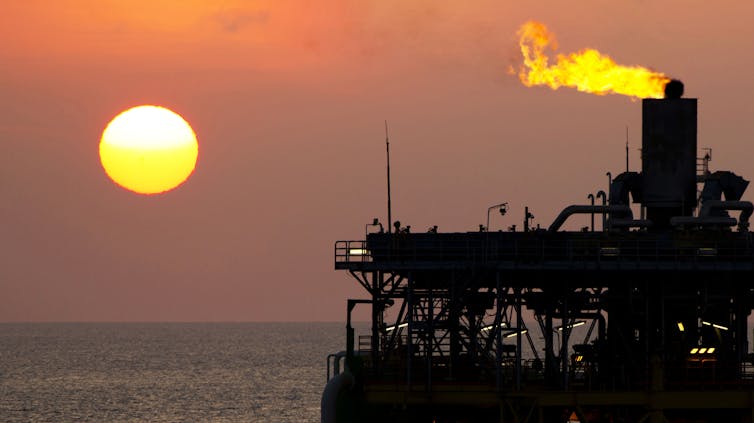
  • ‘Energy security’ is being used to justify more fossil fuels – but this will only make us less secure

    Spread the love

    corlaffra / shutterstock

    Freddie Daley, University of Sussex and Peter Newell, University of Sussex

    The UK government is about to host a summit with the International Energy Agency (IEA) on the future of energy security. It does so as the world grapples with war, geopolitical realignments and trade barriers, against a backdrop of accelerating climate upheavals. One of the expected outcomes of this summit is a new, agreed definition of what constitutes energy security in the 21st century.

    Common understandings of energy security have focused on making supplies reliable and affordable, with less attention paid to ensuring sources of energy are sustainable and less volatile over the medium- and long-term. This neglect compromises our collective security.

    The IEA’s 31 member countries and 13 associates include most of the world’s most powerful states. Its influence means that this new definition of energy security will be used to inform government policies and investment decisions around the world. Given the cost of energy infrastructure, and the lengthy time it takes to build these projects, this definition is set to shape our future, economically and climatically.

    But there is a very real risk that this definition will open the door to further investments into fossil fuel production under the guise of energy security.

    Annotated world map
    International Energy Agency (IEA) member and ‘association member’ countries. IEA, CC BY-SA

    After Russia invaded Ukraine, governments rushed to cut their reliance on Russian fossil fuels. This caused major disruptions as prices spiked and millions were pushed into energy poverty.

    Europe alone spent an extra €517–€831 billion (£444–£713 billion) on energy in 2021 and 2022, even though some imports from Russia continued through so-called “shadow fleets”. Some argued that high fossil fuel prices only embolden leaders like Putin and help fund their conflicts.

    Governments responded with “energy nativism”, as they sought to secure as much energy as possible for their citizens at whatever cost. This typically meant boosting renewables and bulk buying oil and gas. In the UK’s case, it also meant the previous government issuing hundreds of new licenses to drill for oil and gas to “increase energy security” – licenses the current government says it will honour).

    Shipments of liquified natural gas (LNG) were also redirected from poorer countries like Pakistan and Bangladesh towards the highest bidders in Europe and Asia. This raises the question of who exactly is becoming more energy secure and at what cost.

    Meanwhile, large fossil fuel exporters like Qatar, the US and Australia ramped up production. A US official even referred to its gas exports as “molecules of freedom”. Australia has exported so much natural gas it may have to buy its own gas back from Japan at market price.

    The sheer volume of investment in new oil and gas infrastructure like offshore rigs or LNG terminals, combined with long build times, has locked in higher fossil fuel production and pushed emissions to record levels. This poses significant risks for both exporters and importers, especially as future demand is uncertain and energy markets remain volatile.

    Fossil fuels remain dominant

    More fundamentally, continued reliance on fossil fuels is making humanity less secure. The vast majority of emissions still come from burning coal, oil or gas. Preventing climate catastrophe therefore requires us to phase out fossil fuels as fast as possible – with wealthy nations leading the charge. In their place, we’ll have to generate energy from renewable sources that do not replicate the volatility of globally traded fossil fuels.

    Yet despite some progressive policies, fossil fuels remain dominant across the global economy. Investment in oil and gas today is almost double the level it must fall below if the world is to reach net zero by 2050, according to the IEA’s own modelling.

    The pursuit of energy security has boosted renewables, but adding additional clean energy isn’t enough – it must ultimately displace fossil fuels entirely. This will require a whole-economy shift. That means cutting production of fossil fuels while also reducing demand, stabilising prices and building out clean energy fast enough to support the electrification of transport, industry and heating.

    But supply chains for batteries, solar panels and other key technologies are vulnerable. Delays and shortages could mean electricity prices spike, sparking social unrest. This is yet another risk of getting energy security wrong: if inflationary pressures drive the immiseration of the general public, governments and their energy plans will be short lived.

    The definition of energy security that comes out of the IEA summit should reflect the fact we’re now in a world of constant crises. True energy security means charting a path towards a world that is more socially, economically and environmentally secure. This means developing a well-managed global plan to phase out fossil fuels.

    Freddie Daley, Research Associate, Centre for Global Political Economy, University of Sussex and Peter Newell, Professor of International Relations, University of Sussex

    This article is republished from The Conversation under a Creative Commons license. Read the original article.

  • BP has been rowing back on renewables for years. So why was it helped by ‘net zero’ banks?

    Spread the love

    Original article by Rob Soutar republished from TBIJ under a Creative Commons Attribution-NonCommercial-NoDerivs 3.0 Unported License.

    Oil companies’ move to double down on fossil fuels should come as no surprise to anyone – not least its financers

    Last week, BP’s CEO Murray Auchincloss said his company had gone “too far, too fast” in its plan to transition away from fossil fuels. BP still says it aims to be a net zero company by 2050 but it will now take a different path to the one it set out in 2021 … doubling down on fossil fuels in the meantime.

    Perhaps the move shouldn’t have come as a surprise. After all, BP is a commercial enterprise with a responsibility to deliver returns for its shareholders. And since Russia’s invasion of Ukraine, which led many countries to prioritise energy security over long-term sustainability, oil and gas have remained reliably lucrative.

    What’s more, the company made a similar announcement two years ago, saying it would be ramping up its investments in oil and gas.

    But if BP had indicated such a significant change in direction so long ago, how did it continue to raise billions from banks that said they’d only do business with “net zero” companies?

    Milestone moment?

    At the 2021 climate talks in Glasgow, a number of the world’s leading banks made landmark pledges: to slash the footprint of their own operations and, crucially, the emissions of their lending and investment portfolios.

    It was hailed as a watershed moment. In theory, the vast stockpiles of money that had supported fossil fuel expansion would now be cut off for companies without net zero ambitions. The same year, the International Energy Agency warned that there must be no new oil and gas projects if the world is to reach net zero by 2050.

    Yet throughout 2023, after it said it would invest significantly more in fossil fuels, BP raised more than $5bn with help from “net zero” banks including NatWest, HSBC and Barclays.

    The deals illustrate a core problem with the banks’ net zero commitments. A key condition for companies they agreed to do business with was the existence of a “credible” transition plan. But it wasn’t always clear how the banks were assessing that credibility.

    Even before Auchincloss’ announcement last week, the world-leading Grantham Research Institute assessed the credibility of oil and gas companies’ transition plans – and found that BP’s fell well short.

    That lack of clarity on what was “credible” left the banks with enough wriggle room to maintain relationships with huge fossil fuel companies.

    Recommended Articles

    And those relationships have proved profitable. Since May 2021, global banks that have committed to net zero have poured almost $1 trillion into companies pursuing expansion of oil and gas projects that would push the world beyond its survivable limits.

    Looking long-term

    The policy environment has changed since Glasgow, when both fossil fuel companies and banks launched net zero targets. BP is not the only company of its kind to have “reset” its core business to oil and gas. But critics say that recent moves to boost fossil fuels and ensure quick returns are alarmingly short-sighted.

    In the UK, the costs of getting to net zero are cheaper than was anticipated just five years ago, according to a recent report by the Climate Change Committee. And in a low-carbon economy, fossil fuels could nosedive – leaving the oil and gas fields currently in development as “stranded assets” with little value.

    But crucially, the banks face considerable risks too. Their previous promises to work only with clients committed to the transition were made for a reason: they were feeling the pressure from climate-conscious investors.

    If the banks are found to have broken these promises, they could well be held to account by regulators – not to mention see their credibility shattered in the eyes of their investors.

    Reporter: Rob Soutar
    Deputy editor: Chrissie Giles
    Editor: Franz Wild
    Fact checker: Ero Parksakoulaki
    Production editor: Alex Hess

    TBIJ has a number of funders, a full list of which can be found here. None of our funders have any influence over editorial decisions or output.

    Original article by Rob Soutar republished from TBIJ under a Creative Commons Attribution-NonCommercial-NoDerivs 3.0 Unported License. Corrected a reference to “oil company’s” in the subheading in this version.

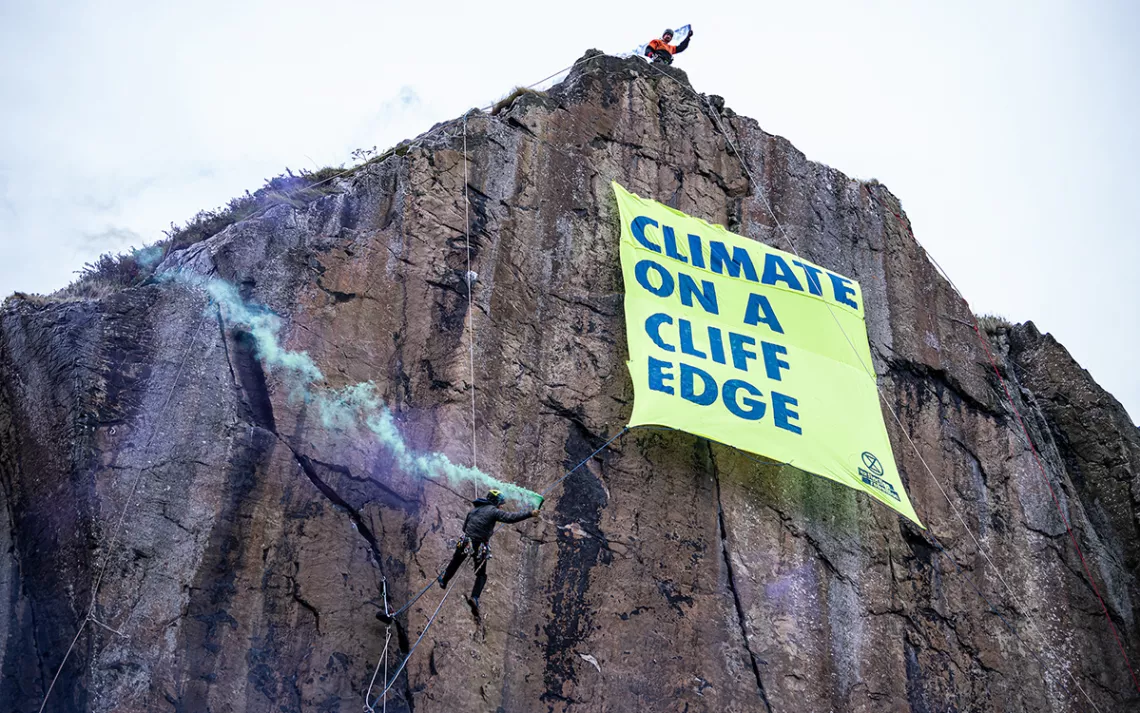
    Experienced climbers scale a rock face near the historic Dumbarton castle in Glasgow, releasing a banner that reads “Climate on a Cliff Edge.” One activist, dressed as a globe, symbolically looms near the edge, while another plays the bagpipes on the shores below. | Photo courtesy of Extinction Rebellion and Mark Richards
    Experienced climbers scale a rock face near the historic Dumbarton castle in Glasgow, releasing a banner that reads “Climate on a Cliff Edge.” One activist, dressed as a globe, symbolically looms near the edge, while another plays the bagpipes on the shores below. | Photo courtesy of Extinction Rebellion and Mark Richards
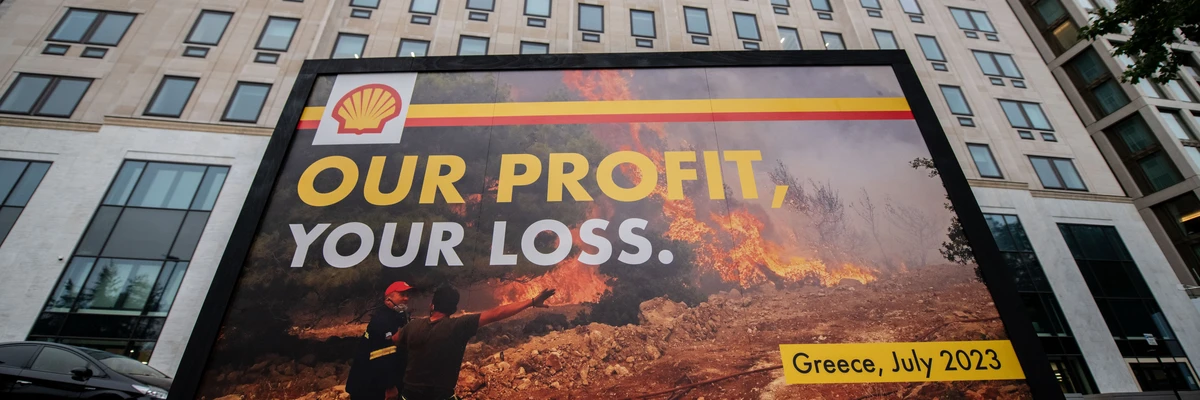
    Greenpeace activists display a billboard during a protest outside Shell headquarters on July 27, 2023 in London.
    Greenpeace activists display a billboard during a protest outside Shell headquarters on July 27, 2023 in London. (Photo: Handout/Chris J. Ratcliffe for Greenpeace via Getty Images)
    Neo-Fascist Climate Science Denier Donald Trump says Burn, Baby, Burn.
    Neo-Fascist Climate Science Denier Donald Trump says Burn, Baby, Burn.

  • Will Trump’s entire presidency be as damaging as his first month?

    Spread the love

    Original article by Paul Rogers republished from Open Democracy under a Creative Commons Attribution-NonCommercial 4.0 International licence

    Ater a disastrous press conference, it may be Trump, not Zelenskyy, who needs to watch his back
     | Andrew Harnik/Getty Images

    From blowing up at Zelenskyy to fast-tracking Executive Orders, what can we learn from Trump’s recent behaviour?

    Donald Trump’s presidency has barely entered its second month, and the change he has brought about has already been so significant and so rapid that it is hard to imagine how his administration will evolve in the long term.

    The substantial changes are, in part, due to the extensive planning done in anticipation of his winning a second term. The 900-page Project 2025 put together by the Heritage Foundation has provided a blueprint for Trump’s far-right conservatism that, combined with the decision to act very fast, has allowed him to already issue more than sixty Executive Orders – catching opponents off-guard.

    Looking to the future may be better helped by understanding both Trump’s behaviour and his overall outlook on life, with two recent examples pointing the way. Some commentators see the president as an unpredictable figurehead who is hardly able to direct affairs, but that doesn’t face up to his being the locus of power for now and, in any case, he has plenty of determined advisers who have been waiting years for his second presidency.

    The first example of Trump’s behaviour was shown by his reaction to a tragedy that happened just after his inauguration, when an American Airlines flight and a US Army helicopter collided and crashed into the Potomac River close to Ronald Reagan National Airport in Washington, DC. All 67 people on board the two aircraft were killed.

    While the cause of the crash is still under investigation, within hours Trump had blamed the diversity-linked hiring policies of previous Democrat administrations, claiming they had lowered personnel standards in air traffic control. A tragedy became an occasion for immediate political point scoring.

    More recently, we have seen Trump use social media to promote the new ‘Trump Gaza’. The president shared a bizarre AI-generated video in which the area had been ethnically cleansed of its Palestinian population and transformed into “the Riviera of the Middle East”. Perhaps most telling is the full-colour representation of the main street, which Trump envisages as being dominated by a 60-foot high golden statue of himself.

    Together, these instances point to someone who is comprehensively self-obsessed. He might be seen as an egotist or narcissist but certainly has an element of the solipsist in his make-up as well. He is, in other words, beyond egocentric.

    But Trump’s impact on the world stage has to reckon with how the world is already changing, especially the rise of the global oligarchy, with vast power concentrated in the hands of a few hundred super-rich individuals. It’s clear that the president views these people as the true exemplars of success – he has formed a singularly powerful group of them around him.

    Most notable among Trump’s circle of favoured oligarchs is Elon Musk, who supported his 2024 election campaign to the tune of $277m and has since been given an unofficial role in government and attended Cabinet meetings and Oval Office press conferences.

    The wealth of Musk and two other oligarchs close to Trump, Jeff Bezos and Mark Zuckerberg, extends to $905bn, as US Senator Bernie Sanders reminded us last month. Writing in the Guardian, Sanders pointed out that this is “more wealth than the bottom half of American society – 170 million people”, adding that “since Trump’s election their wealth has grown by $217bn”.

    This is in line with the findings in Oxfam’s 2025 Davos Report, which last week reported that while the number of people in poverty has remained near stagnant for the past 35 years, extreme wealth is surging. Four more people become billionaires each week, and the world is now on course to have five trillionaires and well over four thousand billionaires within the next decade.

    The rising global oligarchy is not easily mapped with precision. Some members of the super-rich stay well out of the public eye, a few become patrons of the arts and philanthropists, but many others are heavily involved in the use of political power.

    Though a degree of oligarchic power is evident in many countries worldwide, there are particular concentrations in a handful of nations, particularly Russia, China, India and the US – where Mark Twain’s quip about having “the best government money can buy” still stands.

    Between Trump’s personality and his billionaire associates, the best guide to the next four years is to simply assume that ‘self’ and ‘wealth’ will be the president’s constant driving forces. It is not a happy prospect and will require persistent opposition, combined with repeated expressions of more positive ways forward. But is there anything that might limit him as he works to remake the US?

    The first answer might just be his very associates. Many incredibly wealthy people are used to getting their own way, which could easily lead to disagreements sufficient to unbalance the administration. That will be much to the dislike and anger of Trump, who may well end up causing great disruption as he finds and disposes of the scapegoats who can keep the blame well away from him.

    Then there is internal opposition stemming from numerous legal challenges that are already being mounted, many of them in recognition of the mass use of executive orders, which may undermine the authority of Article II of the US constitution.

    Trump is also likely to run into problems due to the huge and vast array of experience and knowledge that will have been lost as a result of his administration’s decision to fire many thousands of federal employees from the Internal Revenue Service, Department of Energy, the Department of Agriculture, the Forestry Service, National Parks, US AID and elsewhere. This is eventually likely to lead to numerous mistakes and delays right across government.

    Then there is the matter of US foreign policy, where the ‘Trump Gaza’ fiasco is the clearest possible indicator that Trump just does not have a clue how many people feel. Beyond that, though, is the question of Trump’s view of Vladimir Putin. It is becoming uncomfortably clear that either the Russian president has some kind of hold over Trump or else Trump really does see him as simply another very powerful and hugely rich person just like himself – a kindred spirit in a new oligarchic world of disorder.

    This leads to one other question: how long will Trump even be in the White House? A clue may come from Friday’s notorious press conference with Ukrainian president Volodymyr Zelenskyy. People across the world will have seen clips of Zelenskyy being hung out to dry by Trump and his vice-president, JD Vance, but watching the entire 45-minute video, not just the blow-up, reveals a rather different element.

    The conference was largely good-natured for the first 35 minutes, with Zelenskyy comfortably holding his own and Trump even praising Ukraine while doing his usual trick of claiming to be the greatest American since George Washington. It is only at the end that Vance moves in aggressively on Zelensky in a manner seemingly designed to get Trump to lose his cool.

    Perhaps it is Trump, not Zelensky, who should be worried when reflecting on the experience – and who should watch his back. It may have been on the last day of February but Vance’s behaviour was not too far from the Ides of March.

    Original article by Paul Rogers republished from Open Democracy under a Creative Commons Attribution-NonCommercial 4.0 International licence

  • ‘We Are Governed by Children’: Disgust as Trump and Vance Bully Zelenskyy in Oval Office

    Spread the love

    Original article by Jake Johnson republished from Common Dreams under Creative Commons (CC BY-NC-ND 3.0). 

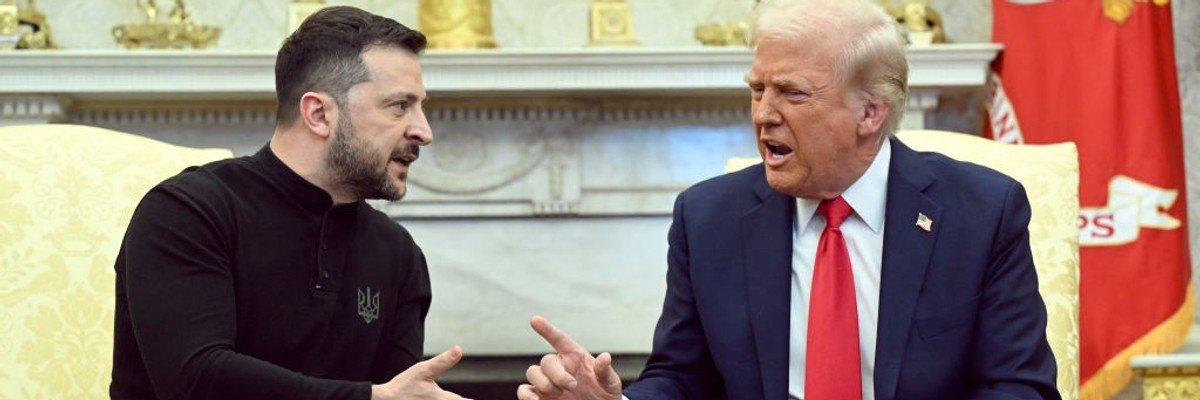
    U.S. President Donald Trump and Ukrainian President Volodymyr Zelenskyy meet in the Oval Office of the White House on February 28, 2025. (Photo: Saul Loeb/AFP via Getty Images)

    “An utter embarrassment for America. This whole sad scene,” wrote U.S. Sen. Chris Murphy.

    A White House meeting on Friday between U.S. President Donald Trump, Vice President JD Vance, and Ukrainian President Volodymyr Zelenskyy rapidly devolved into chaos as the two American leaders took turns berating Zelenskyy with television cameras rolling and the global public looking on.

    Both Trump and Vance bizarrely demanded that Zelenskyy show more gratitude for the military aid the U.S. has provided Ukraine since Russia launched its full-scale invasion in February 2022 and pressured him to accept an as-yet-undefined deal to end the war.

    Vance told Zelenskyy he must “say thank you” and chided him for “trying to fight it out in the American media when you’re wrong,” but Trump intervened to say, “I think it’s good for the American people to see what’s going on here… that’s why I kept this going so long.”

    “You have to be thankful,” Trump told the Ukrainian president, who has repeatedly thanked the American public for the U.S. government’s military assistance.

    “You don’t have the cards,” Trump continued as Zelenskyy tried in vain to interject. “You’re buried there, your people are dying, you’re running low on soldiers.”

    Insisting that Russian President Vladimir Putin can’t be trusted to uphold a bilateral cease-fire, Zelenskyy is demanding security guarantees against a future Russian attack in any agreement to end the conflict—a demand that Trump has thus far rejected.

    “Your country is in big trouble,” Trump, who falsely suggested last week that Ukraine started the war, told Zelenskyy during the Oval Office meeting, which was meant to kick off talks regarding U.S. access Ukraine’s rare earth minerals.

    Zelenskyy left the White House on Friday without signing a minerals deal.

    “You’re either going to make a deal or we’re out,” Trump told Zelenskyy during Friday’s meeting, a clear threat to withdraw U.S. support for Ukraine. “And if we’re out, you’ll fight it out and I don’t think it’s going to be pretty.”

    Observers were aghast at Trump and Vance’s conduct during Friday’s meeting, which was likened to an ambush. At one point, as Trump responded dismissively to Zelenskyy’s call for security guarantees as part of any cease-fire deal, Ukraine’s ambassador to the United States was seen with her head in her hands.

    “Wow. Just wow,” said CNN‘s Dana Bash following the meeting.

    Zeteo‘s Mehdi Hasan wrote on social media that it is “insane that this just happened.”

    “We are governed by children,” he added.

    Watch the full exchange:

    U.S. lawmakers also voiced disgust over Trump and Vance’s behavior, with Sen. Chris Murphy (D-Conn.) writing that the meeting was “an utter embarrassment for America.”

    Shortly after the meeting concluded, Trump took to his social media platform to accuse Zelenskyy of disrespecting the U.S. “in its cherished Oval Office.”

    “He can come back when he is ready for peace,” Trump added as backlash over his treatment of Zelenskyy continued to pour in.

    “Trump berates Zelensky, the leader of a democratic country courageously fighting Russian imperialism, while he allies himself with Putin, a dictator who started the bloodiest European war in 80 years,” U.S. Sen. Bernie Sanders (I-Vt.) wrote on social media.

    “Sorry, President Trump,” Sanders added. “We believe in democracy, not authoritarianism.”

    Original article by Jake Johnson republished from Common Dreams under Creative Commons (CC BY-NC-ND 3.0).