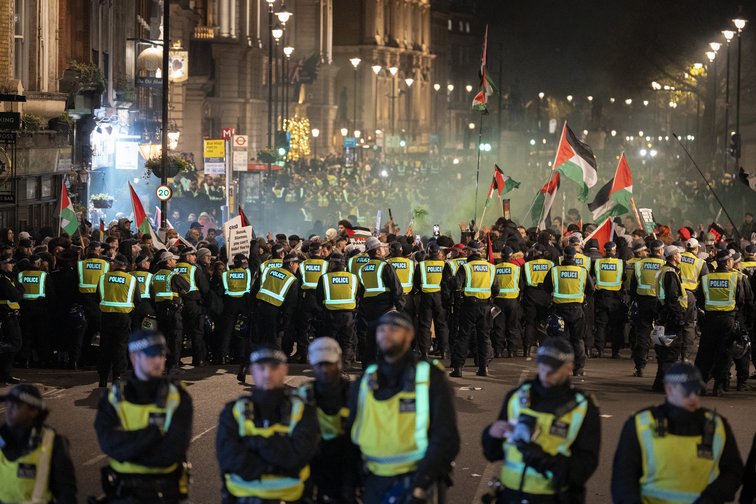
Police officers and protesters clash in Trafalgar Square during a March for Palestine in London, October 14, 2023
CAMPAIGNERS celebrated a ”huge victory for democracy” today after the Court of Appeal ruled key anti-protest legislation was forced through unlawfully.
The Home Office had appealed a High Court ruling that struck down laws brought in by the previous Tory government in 2023.
The measures expanded police powers to interfere with protests, lowering the threshold from what is considered “serious disruption” to community life, from “significant” and “prolonged” to “more than minor.”
Civil rights group Liberty challenged the law change, arguing that the measures had been voted down months earlier and that then home secretary Suella Braverman had used secondary legislation, which requires far less parliamentary scrutiny, to implement them.Ms Braverman used so-called “Henry VIII powers” to introduce the laws by clarifying the definition of “serious disruption” under the Public Order Act 1986.
Liberty argued that the broad redefinition of “serious disruption” effectively granted the police “almost unlimited powers to impose conditions on protests.”
The High Court ruled it unlawful last May, but the previous government initiated an appeal, which was continued by Labour after it came to power.
Upholding the ruling today, Lord Justice Underhill, Lord Justice Dingemans and Lord Justice Edis said that ”the term ’serious’ inherently connotes a high threshold … [and] cannot reasonably encompass anything that is merely ‘more than minor’.”
Liberty’s lawyers say police feedback was ‘directly incorporated into the final text’ of Braverman’s anti-protest laws | Richard Baker / In Pictures via Getty Images
High Court told government only sought feedback from people it knew would agree with its controversial changes
Only police were consulted on anti-protest laws before they were forced through by the UK government, according to human rights lawyers suing the home secretary.
Campaign group Liberty has been in court this week challenging James Cleverly over amendments to the Public Order Act that were pushed through by his predecessor, Suella Braverman, last year.
Liberty was given permission to take legal action against Braverman in October after she used secondary legislation – subject to less parliamentary scrutiny – to strengthen police powers to shut down protests that cause “more than minor disruption to the life of the community”.
The group says Braverman’s actions amounted to a “serious overreach” and that she acted unlawfully because the changes to the law had already been rejected in the House of Lords.
And Liberty has labelled a consultation on the proposed laws in 2022 as “one-sided” and “unfair” – because the Home Office only consulted police. The government gave the Met, Staffordshire Police, Essex Police, the National Police Chiefs’ Council, and the College of Policing opportunities to give their views on the legislation, but did not seek input from anyone who might be impacted by the laws.
Liberty argued: “The [home secretary] voluntarily embarked upon a process of consultation about the contents and drafting of the regulations but then only consulted a narrow group of stakeholders in support of the amendments rather than an even-handed group representative of all those whose interests may be adversely impacted.”
Its lawyers also say police feedback was “directly incorporated into the final text” of the amendments to the Public Order Act, including on the definition of “serious disruption to the life of the community”.
The new powers have been criticised by Liberty and other human rights groups due to the vagueness of the new language, which campaigners say allows police to shut down almost any protests. The changes forced through by Braverman mean officers can interfere with and arrest anyone taking part in protests that they believe will cause “more than minor disruption to the life of the community”.
Police feedback on “cumulative disruption” was also included in the final amendments to the act. Under this law, officers must take into account all “relevant cumulative disruption”, regardless of whether or not your protest is related to any other protest or disruption in the same area. Before this amendment, there was no explicit requirement for police to consider this.
While the government held multiple meetings with police representatives in December 2022 to seek input and “refine policy”, Liberty argues that the fact that no rights groups or members of the public were consulted is rooted in “procedural unfairness” and that the changes must be reversed.
Katy Watts, Liberty’s lawyer leading the case said: “The government has shown it’s determined to put itself above the law, avoid scrutiny and become untouchable – so it’s no surprise it only consulted people it knew would agree with its new law.
“Our democracy exists to make sure a government can’t just do whatever it wants, and an important part of that is consulting a wide range of voices on new laws – especially those likely to raise reasonable concerns. This improves government decision making and helps to make our laws better. The government’s failure to do this is just one of the ways it acted unlawfully when it forced these powers though.”
The laws were initially brought in to clamp down on protests by climate activist groups like Just Stop Oil, Insulate Britain, and Extinction Rebellion, but other protesters are now also being targeted.
The government has accused pro-Palestine protesters of “hijacking legitimate protests”, “shouting down and coercing elected representatives”, and has also called them “un-British” and “undemocratic”.
In a new ‘defending democracy policing protocol’ released this week, the government pledged £31m of additional funding to protect MPs after safety fears were raised.
The Home Office said it wants to “protect the democratic process from intimidation” but according to its own policy paper, only met with police representatives from the National Police Chiefs Council, the Association of Police and Crime Commissioners, and the College of Policing.
The Home Office did not respond to a request for comment.
The two-day hearing ended yesterday and Liberty’s lawyers expect a decision could take up to three months.

 Police officers and protesters clash in Trafalgar Square during a March for Palestine in London, October 14, 2023