This work by Middle East Monitor is licensed under a Creative Commons Attribution-NonCommercial-ShareAlike 4.0 International License.
General view of the Israeli Knesset (parliament) in Jerusalem. [Noam Moskowitz – Knesset – Handout/Anadolu Agency via Getty Images]
Israel’s opposition Democrats party asked the Central Elections Committee on Monday to disqualify the Jewish Power party, led by extremist National Security Minister Itamar Ben-Gvir, from the Oct. 27 general election, citing incitement to racism, Anadolu reports.
The petition also accused the party of undermining democracy, the rule of law and judicial authority, according to Israel’s Channel 12.
The Democrats said Kahanist lawmakers had used political power and parliamentary immunity to defy court orders, challenge the Supreme Court’s authority and incite “violent racism.”
This work by Middle East Monitor is licensed under a Creative Commons Attribution-NonCommercial-ShareAlike 4.0 International License.
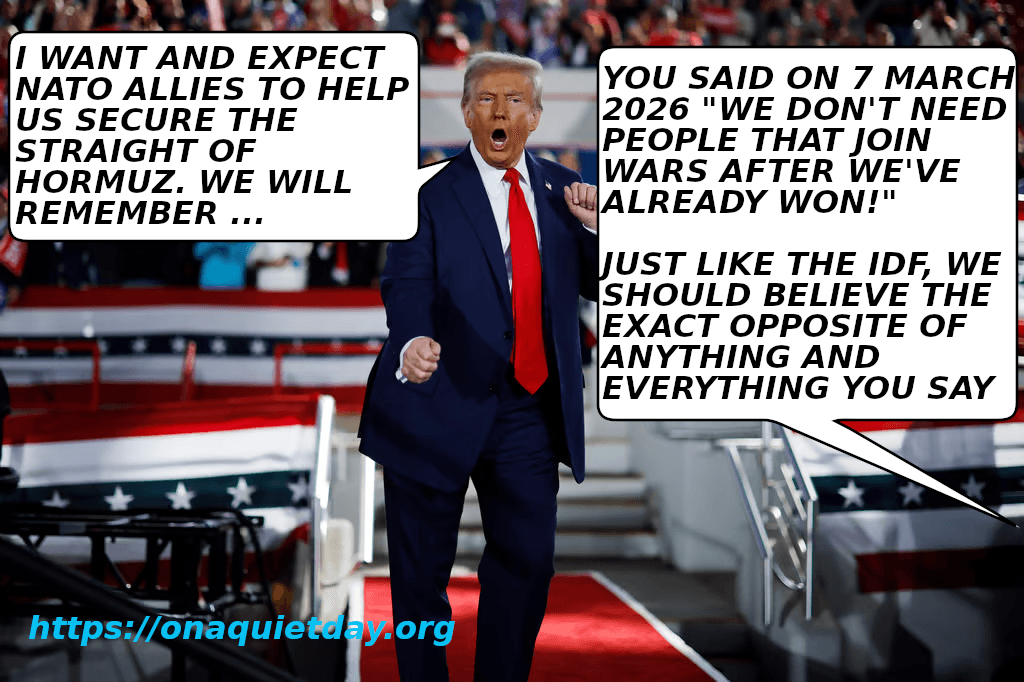
Donald Trump calls for help from NATO allies in securing the Strait of Hormuz despite saying on 7 March 2026 that they don’t need people to join wars after they’ve already won. He’s challenged with the claim that he lies as much as the IDF.
This work by Middle East Monitor is licensed under a Creative Commons Attribution-NonCommercial-ShareAlike 4.0 International License.
Israeli settlers are seen as Palestinian residents remain confined inside their homes in the village of Qusra, south of Nablus in the West Bank, on August 20, 2026, after the Israeli military declared three residential properties a “closed military zone” following repeated attacks and blockade by Israeli settlers. [Issam Rimawi – Anadolu Agency]
Human Rights Watch and Amnesty International called on the EU on Tuesday to ban trade with illegal Israeli settlements in the occupied Palestinian territories, urging European Commission President Ursula von der Leyen to act on measures she proposed a year ago.
In a joint statement ahead of von der Leyen’s annual State of the EU address, the groups said “almost none” of the measures she proposed last year had been adopted.
They urged von der Leyen to revive her proposal to suspend the trade component of the EU-Israel Association Agreement and impose sanctions on Israeli officials and settlers, while also proposing an EU-wide ban on trade with Israeli settlements.
The groups said the EU was “lagging behind” as an increasing number of member states and allies moved to restrict trade with the settlements.
They pointed to the worsening situation in Gaza and the West Bank, saying the number of Palestinians killed in Gaza had risen to nearly 74,000 from at least 64,000 when von der Leyen delivered her previous address in 2025.
The groups said Israeli authorities continued to restrict humanitarian aid and had confined Gaza’s population to about 30% of the territory. They statement added that plans to remove Palestinians from Gaza were being openly discussed.
In the occupied West Bank, including East Jerusalem, HRW and Amnesty said settlement expansion had accelerated, alongside home demolitions, land seizures and the displacement of Palestinians.
They said at least 88 Palestinians, including 22 children, had been killed in the West Bank in 2026, bringing the total since October 2023 to nearly 1,100.
The groups also cited Israel’s adoption of a death penalty bill and the continued detention of Palestinians without charge or trial, alleging that many detainees had been subjected to torture.
On Lebanon, the statement said Israeli attacks had killed at least 4,383 people since the start of the March escalation, citing Lebanon’s Health Ministry. The figure included 261 children, 399 women and 135 medical workers.
The groups said von der Leyen should not rely solely on EU humanitarian aid to Palestinians and called on her to use the bloc’s influence to address the circumstances that have created the need for such aid.
They said she should “actively and vocally” engage with member states, particularly Germany and Italy, to secure support for an EU-wide settlement trade ban.
The organizations also called for the suspension of the EU-Israel Association Agreement, and sanctions against Israeli officials.
They urged the EU to consider using its blocking statute to protect the International Criminal Court and those cooperating with it from US sanctions.
The groups said another year of “failures, inaction and half-hearted proposals” would further undermine the EU’s credibility.
This work by Middle East Monitor is licensed under a Creative Commons Attribution-NonCommercial-ShareAlike 4.0 International License.
Donald Trump calls for help from NATO allies in securing the Strait of Hormuz despite saying on 7 March 2026 that they don’t need people to join wars after they’ve already won. He’s challenged with the claim that he lies as much as the IDF.
This work by Middle East Monitor is licensed under a Creative Commons Attribution-NonCommercial-ShareAlike 4.0 International License.
A view of a damaged building, belonged to medical charity Doctors Without Borders (MSF), following the Israeli attack in al-Mawasi, Khan Yunis, Gaza on February 21, 2024 [Ashraf Amra/Anadolu Agency]
An Israeli airstrike damaged a Doctors Without Borders (MSF) bus carrying humanitarian workers in Gaza City on Monday, injuring one staff member, the organisation said.
In a statement posted on X, MSF said the bus was carrying 10 of its humanitarian staff when it was damaged in an Israeli air strike, leaving one worker injured.
It said the targeted vehicle was clearly identifiable by the organisation’s large logo displayed on its roof.
“Once again, Israeli forces have shown a blatant disregard for the safety of humanitarian and medical personnel. Nowhere is safe in Gaza. Civilians, healthcare workers and humanitarian staff must be protected,” the statement said.
MSF stressed the need to respect international law and prevent attacks on medical and humanitarian vehicles displaying clear and distinctive markings.
According to the United Nations and international human rights organisations, Israel has been committing genocide in Gaza since 8 October 2023, killing more than 73,000 Palestinians and injuring more than 174,000, most of them women and children.
This work by Middle East Monitor is licensed under a Creative Commons Attribution-NonCommercial-ShareAlike 4.0 International License.
Donald Trump calls for help from NATO allies in securing the Strait of Hormuz despite saying on 7 March 2026 that they don’t need people to join wars after they’ve already won. He’s challenged with the claim that he lies as much as the IDF.
This work by Middle East Monitor is licensed under a Creative Commons Attribution-NonCommercial-ShareAlike 4.0 International License.
U.S. President Donald Trump raises his hand to wave goodbye while preparing to board his vehicle during his departure from Aras an Uachtarain on September 12, 2026, in Dublin, Ireland. [Artur Widak – Anadolu Agency]
US President Donald Trump reiterated on Monday that he was “open” to engaging with Iran to end the war launched by the United States and Israel against Iran in February.
“The failing Nation of Iran wants to make a deal, quickly and badly. I will determine whether or not the USA will choose to engage — The concept of which we are open to,” Trump wrote on his Truth Social platform.
Iran’s Revolutionary Guard said on Monday that it had shot down an advanced US MQ-1 drone over the Strait of Hormuz, as diplomatic efforts faced a setback with the postponement of a meeting between Iran and Gulf states.
This work by Middle East Monitor is licensed under a Creative Commons Attribution-NonCommercial-ShareAlike 4.0 International License.
Donald Trump calls for help from NATO allies in securing the Strait of Hormuz despite saying on 7 March 2026 that they don’t need people to join wars after they’ve already won. He’s challenged with the claim that he lies as much as the IDF.
Mobilization in Caracas demanding the return of Nicolás Maduro. Photo: Francisco Trias
The implications of this case extend far beyond Venezuela. The entire process against Nicolás Maduro and Cilia Flores threatens to establish the US court system as one with global and unlimited jurisdiction.
Venezuelan President Nicolás Maduro is not guilty. This is a statement of law and fact, since Maduro has not been convicted of any crime. He has pleaded not guilty to every charge brought against him, and the accusations made by the United States remain precisely that: accusations. Under the presumption of innocence – recognized in the United States Constitution and in Article 14 of the International Covenant on Civil and Political Rights – the burden rests entirely upon the prosecution to prove guilt. It is not Maduro who must prove his innocence, but it is the United States government that must prove his guilt.
On January 3, 2026, United States forces illegally entered Venezuela, attacked targets in and around Caracas, seized President Maduro and his wife and an elected official, Cilia Flores, and transported them to the United States. Two days later, shackled and injured, Maduro appeared before a federal court in Manhattan. “I am innocent. I am not guilty,” he told the court. Both defendants entered pleas of not guilty and are now imprisoned in Brooklyn while awaiting a trial provisionally scheduled for June 2027.
The charges against Maduro
The United States alleges that Maduro participated in conspiracies to import cocaine, possess machine guns and destructive devices, and collaborate with organizations Washington has designated as terrorist groups. These charges developed out of an indictment announced during Donald Trump’s first presidency in March 2020. The case was substantially expanded after Maduro was kidnapped through a fourth superseding indictment. An indictment, however, is not evidence tested before a court. It is a document prepared by prosecutors and approved through a grand-jury proceeding at which the defense is normally neither represented nor permitted to challenge the government’s account.
The prosecution relies heavily upon the idea that Maduro directed the so-called Cartel de los Soles, or Cartel of the Suns. But even organizations deeply hostile to the Venezuelan government acknowledge that this is not a cartel in the conventional sense. The name has long been used as an umbrella expression for disparate Venezuelan officials allegedly involved in criminal activity, long before Maduro entered political life. It does not describe an organization with a demonstrated membership, command structure, headquarters or chain of authority comparable to Mexico’s Sinaloa Cartel. When Washington designated the Cartel de los Soles a foreign terrorist organization in 2025, the Associated Pressnoted that it was “not a cartel per se.”
This matters because the prosecution’s language performs much of its political work. Allegations concerning individual acts of corruption are assembled into the image of a unified organization, the organization is then attributed to the Venezuelan state, and responsibility for everything allegedly done by anyone within that loose network is placed upon Maduro. The indictment must still demonstrate that Maduro knowingly joined the specific conspiracies charged. Political authority over a state in which crimes occur does not by itself establish personal criminal responsibility for those crimes.
Case is dead on arrival
Venezuela is not a major producer of coca leaf or cocaine. The principal cocaine-producing countries remain Colombia, Peru and Bolivia. Venezuela has been used as a transit territory, particularly for cocaine originating in neighboring Colombia. But transit through a country does not prove that its president commands the traffic, and nor does it substantiate the extravagant political image of Venezuela as the central source of the drugs entering the United States. The US Drug Enforcement Administration’s own 2025 threat assessment concentrated overwhelmingly upon Mexican organizations and their supply chains. The global cocaine trade operates primarily through production in the Andean region, maritime export corridors, Central America and Mexico, not through a single organization supposedly commanded from the Venezuelan presidential palace. The International Criminal Court’s investigation into the situation in Venezuela, for example, is an investigation into alleged crimes within its jurisdiction. It is not a conviction of Maduro and has not produced an individual judgment of guilt against him.
The US government is expected to rely upon cooperating witnesses, including former Venezuelan intelligence chief Hugo Carvajal and former general Clíver Alcalá. Both men pleaded guilty to serious offenses in the United States. Their evidence cannot be treated as disinterested truth. Cooperating defendants may hope to obtain sentencing benefits by assisting prosecutors. Their claims must therefore be corroborated and subjected to cross-examination. Until that happens, their statements do not establish Maduro’s guilt. In fact, it is better to see their statements as proof of their own attempt to lighten their sentences and launder their soiled reputations.
The circumstances under which Maduro was brought before the US court create an even deeper problem. Washington did not request extradition through an agreed legal process. It employed military force within another sovereign country without Venezuela’s consent or authorization from the United Nations Security Council. Article 2(4) of the UN Charter prohibits the threat or use of force against the territorial integrity or political independence of a state, subject to narrow exceptions such as self-defence. Arresting a person accused of drug offenses is not one of those exceptions. International-law specialists described the operation as an unlawful use of force, while governments including Brazil, Mexico, and China condemned the violation of Venezuelan sovereignty.
Maduro’s lawyers have argued that the prosecution violates the immunity enjoyed by an incumbent head of state. Venezuela continued to recognize Maduro as its constitutional president when the United States seized him – a fact tacitly recognized by the United States when it calls Delcy Rodriquez the Acting President. Washington cannot necessarily extinguish the international legal status of another country’s head of state merely by withholding diplomatic recognition. The defense has consequently requested dismissal of the indictment on immunity grounds and has separately challenged the narco-terrorism count for lacking an adequate jurisdictional connection to the United States. Oral argument on these questions is scheduled for November 2026.
The case of former Honduran president Juan Orlando Hernández exposes the selectivity of Washington’s supposed war against narco-states. Hernández was a close US ally during his presidency from 2014 to 2022. After leaving office, he was extradited – not abducted through a military invasion – and tried in the same federal district in New York where Maduro is now being prosecuted. In March 2024, a jury convicted Hernández after a three-week trial. Prosecutors presented evidence that he had accepted millions of dollars from traffickers, protected cocaine shipments with the Honduran police and military, and helped move more than 400 tons of cocaine towards the United States. He was sentenced to 45 years in prison. Unlike the claims against Maduro, these allegations were tested through testimony, cross-examination and a jury verdict. Yet on December 1, 2025, President Donald Trump pardoned Hernández and secured his release, claiming that the former president had been treated unfairly.
The contrast could hardly be more revealing. Trump pardoned a former president whose participation in cocaine trafficking had been established in a US courtroom, while threatening and eventually invading Venezuela to seize a president against whom no verdict had been rendered. Hernández belonged to Washington’s political camp; Maduro did not. One was released despite his conviction, while the other was captured despite his legal innocence. This disparity does not by itself disprove the accusations against Maduro, but it demolishes the claim that Washington acted from a consistent concern about narcotics. The determining distinction was political alignment, not the strength of the evidence.
The implications of this case extend far beyond the specific circumstances of Maduro and Cilia Flores or their consequences for Venezuela. Allowing a foreign state to override the jurisdiction of another country’s legal system, pursue an accusation for which there is no evidence, and proceed with a trial that lacks a basis in international law effectively establishes the US court system as one with global and unlimited jurisdiction. The ambivalence of governments around the world toward this case is therefore alarming, as it risks signalling consent and normalizing such gross overreach. This is particularly relevant for Mexico, which is already facing a series of accusations and extradition demands from the United States with clear political implications. The outcome of Maduro’s trial could set an important precedent for how Mexico – and other countries – are treated in similar circumstances.
Nicolás Maduro is not guilty therefore expresses the only defensible conclusion at this stage. He was seized through an act of military force, placed before the courts of the state that had pursued his overthrow for years, and charged based on a politically constructed theory that has yet to survive adversarial examination. He remains innocent unless and until admissible evidence proves otherwise beyond a reasonable doubt. Sovereignty is not an ornament, an indictment is not a verdict, and an accusation issued by a powerful state does not become truth merely because that state possesses the weapons to seize the accused.
Stephanie Weatherbee Brito is the co-coordinator of the International Peoples Assembly (IPA).
Vijay Prashad is an Indian historian and journalist. He is the author of forty books, including Washington Bullets, Red Star Over the Third World, The Darker Nations: A People’s History of the Third World, The Poorer Nations: A Possible History of the Global South, and How the International Monetary Fund Suffocates Africa, written with Grieve Chelwa. He is the executive director ofTricontinental: Institute for Social Research, the chief correspondent for Globetrotter, and the chief editor ofLeftWord Books(New Delhi). He also appeared in the films Shadow World (2016) and Two Meetings (2017).
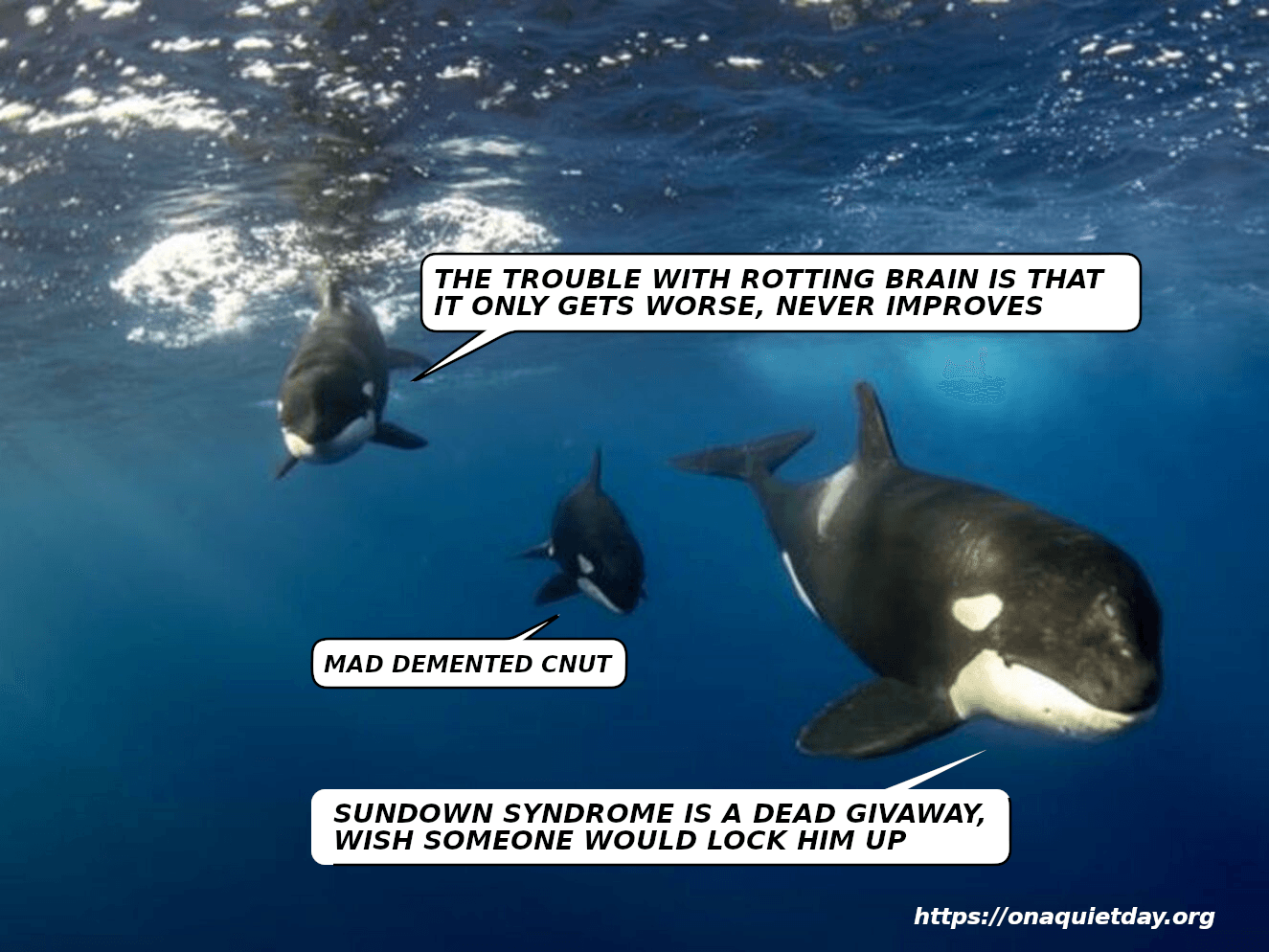
Climate science denier Donald Trump confirms that he knows nothing about democracy and that more liquid gold is being secured according to his policy of global privateering.Orcas discuss rotting brain, front Orca says Sundown Syndrome is a dead givaway and he wishes someone would Lock Him Up