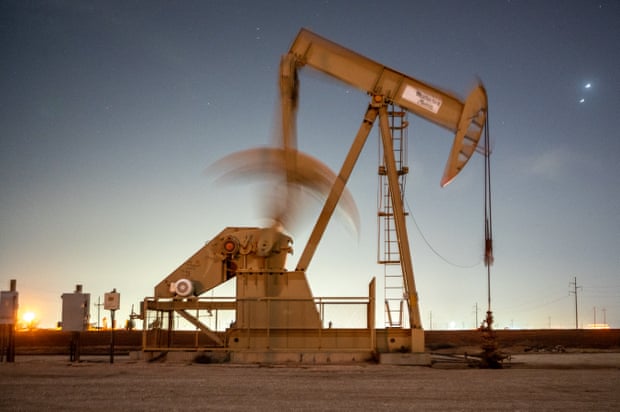
Expected greenhouse gas emissions from US oil and gas fields has jumped under Trump, after previously dropping under Biden, forecasts show. Photograph: Bloomberg/Getty Images
Tariff chaos hampers Trump’s pledge to ‘drill, baby, drill’, but analysis still shows surge in planet-heating emissions
Donald Trump’s ambitions for the US to “drill, baby, drill” for more fossil fuels have ironically been hampered by the economic chaos unleashed by his own tariffs, but the US is still on track to increase oil and gas extraction, causing a surge in planet-heating emissions, a new analysis shows.
The US was already the world’s leading oil and gas power, producing more of the fossil fuels than any country in history during Joe Biden’s administration. But Trump has sought to escalate this further, declaring an “energy emergency” to open up more land and ocean for drilling and launching an unprecedented assault on environmental regulations in his first 100 days back in the White House.
This new political climate means that the expected amount of greenhouse gas emissions from active and planned projects in US oil and gas fields has jumped under Trump, after previously dropping under Biden, forecasts shared with the Guardian show.
Despite awarding more drilling leases than Trump in his first 100 days, Biden also pursued policies to combat the climate crisis that saw oil and gas companies revise down their production estimates. That situation has now reversed, threatening a pulse of new pollution that will further add to the fever of a planet already suffering from heatwaves, floods, droughts and other disasters accelerated by global heating.
“The uptick in embodied emissions from forecast US oil and gas production is worrying,” said Olivier Bois von Kursk, policy adviser at the International Institute for Sustainable Development, which tracks emissions projections from the lifetime of projects, based on data from research consultancy Rystad Energy. “The world can’t afford more climate chaos.”
…
The International Energy Agency, which has forecast that global oil and gas demand will peak by 2030, has said that no new major fossil fuel projects can occur if the world is to stay within agreed temperature limits and avoid catastrophic climate impacts. Last year was the hottest, worldwide, ever recorded and governments are collectively failing to meet targets to avert escalating disasters.
…
Tariffs on solar panels from Vietnam, Cambodia and Malaysia have been ratcheted up to as much as 3,521%. “We don’t want windmills in this country,” the president said shortly after his inauguration in January. “We don’t want windmills. You know what else people don’t like? Those massive solar fields.”
Neo-Fascist Climate Science Denier Donald Trump says Burn, Baby, Burn.Elon Musk urges you to be a Fascist like him, says that you can ignore facts and reality then.Orcas discuss Donald Trump and the killer apes’ concept of democracy. Front Orca warns that Trump is crashing his country’s economy and that everything he does he does for the fantastically wealthy.
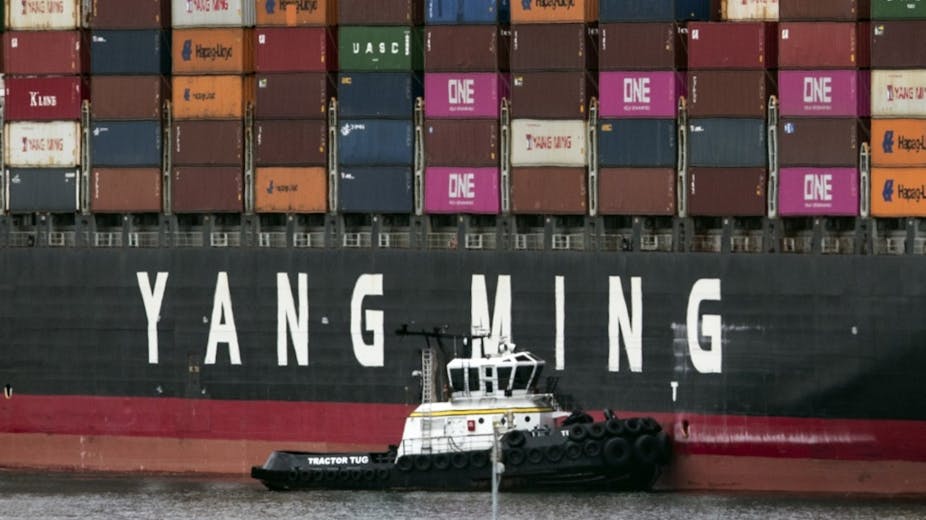
US ports are now starting to see scheduled shipments from China decline as the result of Donald Trump’s 145% tariffs on Chinese goods. The port of Los Angeles, the biggest port for Chinese goods in the US, is predicting scheduled shipments in early May to be about a third lower than the same time last year.
Declining numbers of ships arriving stocked with Chinese imports are likely to affect US supermarket shelves soon, and after warnings from US supermarket bosses, Trump responded by saying trade talks between the US and China were under way in the past few days. But Chinese president Xi Jinping quickly denied talks were happening, suggesting he has no intention of backing away from a fight with the US.
As one of the most powerful leaders in the history of the People’s Republic of China, Xi has fashioned himself as a nationalistic icon. So if China perceives Trump’s tariffs as a bully tactic designed to undermine it, backing down from a confrontation with the US would seriously undermine Xi’s strongman image and rhetoric.
This is something that Trump probably hadn’t considered. At a rally marking his 100 days in office, the US president was still suggesting that China would just back down and “eat the tariffs”.
While tariffs appear to be the primary weapon in the trade war, China might have more tactics to hit back at Trump and the US economy. The question is what might they be?
A few weeks ago it seemed like Washington might punish China’s lack of willingness to negotiate with more tariffs, but now it’s clear that Trump is willing to make a deal and is trying to get China to come to the table. Trump is now implying that US tariffs on China could come down substantially. And US treasury secretary Scott Bessent has called the trade war with China “unsustainable”.
Leveraging agriculture and energy
China has reduced its reliance on US farm imports since the trade war began in Trump’s first presidency. This is bad news for Washington as agriculture is one few sectors in the US that actually has a large trade surplus with China. The 125% retaliatory tariffs will harm the sector’s profitability.
But China’s retaliatory tariffs aren’t the only issue American farmers have to contend with. As the trade war escalates, China has been using bureaucratic hurdles to restrict US agricultural products from entering China and as a potential negotiation tool. For instance, China has delayed the renewals of export license renewals of US pig farmers, and refused to renew licenses of poultry farmers for “health and safety” reasons.
Beijing’s actions might be designed to particularly hit the economy in core Trump supporting states. A major part of Trump and the Republican party’s base lies in “red states”, such as Nebraska, Iowa and Kansas, all have significant farming communities. Focusing on agricultural issues is a tactic that Beijing realises will hit home with Trump voters.
Out of the 444 US counties designated by the United States Department of Agriculture (USDA) as farming-dependent, 77.7% voted for Trump during the 2024 US presidential election. So, any hardship faced by the agriculture sector due to Trump’s own actions is likely to lose him support from a major political base. And with mid-term elections in 2026, Trump has to tread carefully when antagonising Beijing.
Another support base that Beijing might seek to undermine is those involved in the fossil fuel sector. In the past, the US has been a top supplier of natural gas to China.
China has not imported natural gas from the US since early February 2025, and has sought its natural gas from Australia, Indonesia, and Brunei. As the trade war continues, it is unlikely that the US would be able to sell its natural gas to China anytime soon, and this will have an impact on the energy industry – one of Trump’s major political support bases.
Restricting minerals
Another huge problem that the US faces stems from China’s restriction of the export of critical minerals. They include seven rare earth minerals namely samarium, gadolinium, terbium, dysprosium, lutetium, scandium and yttrium. While these are used in the clean energy and automobile sectors, the biggest concern would come from the US defence complex.
The White House probably anticipated export restrictions of critical minerals from China. After all, Beijing had banned the export of critical minerals to Japan in 2010 over a fishing trawler dispute, and stopped exporting “dual-use” metals that can be used to produce civilian and military technology, such as gallium, germanium and tungsten.
What’s next?
For the last few years, China has been trying to overcome an ailing economy that was primarily fuelled by a real-estate crisis. Trump probably expected China to buckle under pressure and come crawling to the negotiation table. After all, the Chinese Communist Party needs to fix its economy fast. The establishment has long relied on delivering economic prosperity to legitimise its rule over China.
Right now the tit-for-tat battle continues. By April 11, US tariffs on China peaked at 145%, while China’s retaliatory tariffs on US goods reached an unprecedented 125%.
Although it is clearly fighting back, China could go even further by selling off US treasuries and increasing US interest rates and thus borrowing cost. But unlike Trump, Xi often plays the long game. After all, Trump’s term as president will be over in less than four years, while Chinese president Xi has no term limits. All the latter has to do is exercise patience, and a friendlier US president might come around.
The Trump administration is a serious threat to democracy. They’re also laughably incompetent. But the result is no laughing matter.
…
Clown-show fascism describes a regime marked simultaneously by hubristic and defiant assaults on the democratic and constitutional order on the one hand and, on the other, a nearly laughable incompetence in just about every other area of the regime’s activity. The first characteristic certainly applies to the Trump administration, and it’s chilling and frightening and not at all funny. Just ask Mahmoud Khalil.
Yet at the same time, in other areas, the incompetence has been staggering. Trump’s constant about-faces and walk backs on tariffs have been an international embarrassment. Elon Musk’s DOGE has fired federal workers willy-nilly only to turn around and rehire many after the Musketeers realized they weren’t deep-state bloodsuckers and the work they did was kind of essential, after all—you know, like the people who tend the country’s nuclear weapons stockpile.
It can be hilarious to watch. But it carries two consequences that are no laughing matter.
First and more obviously, we have the prospect of the impact of Trump’s tariffs policy on real people. Will they cause inflation and a recession, as most experts now believe? As fate would have it, Trump will go to bed the night of his 100th day in office—Tuesday—and wake up the very next morning to the release of the first-quarter GDP number. Economists expect anemic results. The Atlanta Fed even predicts negative growth, around -2.5 percent. During Trump’s first week in office, its forecast nudged a gaudy 4 percent, but the president’s actions have liberated that figure ever downward.
Second and more insidiously: Even the gross incompetencies take us into treacherous territory because they contribute to making this all about one man, the man who must be in front of the cameras every day. He doesn’t have policies so much as he has urges, which he must announce to the world on a constant basis in a desperate plea that we keep him front of mind at all times. Some of those urges are cruel; some of them are a joke. What unites them is that they make the story entirely about him.
That is not how it’s supposed to work in democracies. Which we still are, for now, as we reach this 100-day mark. Only 1,361 to go.
Neo-Fascist Climate Science Denier Donald Trump says Burn, Baby, Burn.Elon Musk urges you to be a Fascist like him, says that you can ignore facts and reality then.
President Donald Trump listens to Jeff Crowe speak during an event on energy production in the East Room of the White House, April 8, 2025, in Washington
TRUMP’S 90-day tariff reprieve spells 90 days of geopolitical turbulence, US bullying and the threat of war.
All three have been constant features of the period of US “unipolar” power, especially since the beginning of what even US presidents have termed the “forever wars.” But Trump’s aggression is global.
That is not changed by the 90-day pause on tariffs (above a 10 per cent base line) on everyone except China, on whose products tariffs are now being hiked well above 100 per cent.
Yes, it identifies China as his main target. Yes, it is an affronted response to the one big country which has met his threats with defiance.
But the escalation against China and suspension — not removal — of threatened tariffs elsewhere are part of the same strategy. Trump is trying to browbeat the world into siding with the United States against China in a conflict the US, not China, has decided on.
Successive US governments have slapped sanctions (which, not being UN-authorised, have no international legal standing) on Chinese products.
But the universal tariff threat ratchets up the pressure. Align with our demands, the US says, or we have already identified the level of economic pain we are going to inflict on you.
Those demands are intended to force all markets open to whatever the US wants. Economist Michael Roberts points to the catch-all list of supposedly unfair practices the US objects to, including “currency manipulation, ‘opaque’ licensing, ‘discriminatory’ product standards, ‘burdensome’ customs procedures, data localisation and so-called ‘lawfare’ of taxes and regulation.”
This is the extraterritorial imposition of US power writ large. Other countries may not decide their own policies on procurement, the quality or safety of goods, tariffs (!), protecting their citizens’ data from US acquisition, or how to tax and regulate US companies operating on their territory. It is outrageous.
Neo-Fascist Climate Science Denier Donald Trump says Burn, Baby, Burn.Elon Musk urges you to be a Fascist like him, says that you can ignore facts and reality then.
Traders work on the floor of the New York Stock Exchange during morning trading on April 3, 2025 in New York City. (Photo: Michael M. Santiago/Getty Images)
Instead of strategically imposing tariffs, Trump has chosen to “give the country the most massive tax increase in its history, possibly exceeding $1 trillion on an annual basis.”
As stocks “nosedived” on Thursday, economists, policymakers, and campaigners around the world continued to warn about the impacts of U.S. President Donald Trump’s trade war, which includes a 10% universal tariff for imports and steeper duties—that he claims are “reciprocal”—for dozens of countries, set to take effect over the next week.
“This is how you sabotage the world’s economic engine while claiming to supercharge it,” wrote Nigel Green, CEO of the international financial consultancy deVere Group. “Trump is blowing up the post-war system that made the U.S. and the world more prosperous, and he’s doing it with reckless confidence.”
As Bloomberg detailed after the president’s “Liberation Day” remarks from the White House Rose Garden:
China’s cumulative tariff rate of 54% includes both the 20% duty already charged earlier this year, added to the 34% levy calculated as part of Trump’s so-called reciprocal plan, according to people familiar with the matter. The European Union’s rate is 20% and Vietnam’s is 46%, White House documents showed. Other nations slapped with larger tariffs include Japan with 24%, South Korea with 25%, India with 26%, Cambodia with 49%, and Taiwan with 32%.
In Europe on Thursday, “the regional Stoxx 600 index provisionally ended down around 2.7%,” while “the U.K.’s FTSE 100 was down 1.6%, with France’s CAC 40 and Germany’s DAX posting deeper losses of 3.3% and 3.1%, respectively,” according to CNBC.
In the United States, CNBC reported, “the broad market index dropped 4%, putting it on track for its worst day since September 2022. The Dow Jones Industrial Average tumbled 1,200 points, or 3%, while the Nasdaq Composite fell 5%. The slide across equities was broad, with decliners at the New York Stock Exchange outnumbering advancers by 6-to-1.”
However, as Economic Policy Institute (EPI) chief economist Josh Bivens noted last week, “because most households depend overwhelmingly on wages from work as their primary source of income and not returns from wealth-holding, the stock market tells us nothing about these households’ economic situations.”
And Trump’s tariffs are expected to hit U.S. households hard, as the cost of his taxes on imports are passed on to consumers.
“Tariffs can be a legitimate and useful tool in industrial policy for well-defined strategic goals, but broad-based tariffs that significantly raise the average effective tariff rate in the United States are unwise,” Bivens and EPI senior economist Adam Hersh stressed in a Thursday statement—which also called out Trump for mischaracterizing one of the think tank’s 2022 analyses.
“Further, the second Trump administration’s rationale, parameters, and timeline for tariffs have been ever-shifting,” Bivens and Hersh continued. “As the original post cited by the administration argues, tariffs should not be a goal unto themselves, but a strategic tool to pair with other efforts to restore American competitiveness in narrowly targeted industrial sectors.”
Instead of strategically imposing tariffs, Trump has chosen to “give the country the most massive tax increase in its history, possibly exceeding $1 trillion on an annual basis, which comes to $7,000 per household,” warned Center for Economic and Policy Research co-founder and senior economist Dean Baker. “And this tax hike will primarily hit moderate and middle-income families. Trump’s taxes go easy on the rich, who spend a smaller share of their income on imported goods.”
Baker—like various other economists and journalists—also took aim at Trump’s claims that the tariffs are reciprocal, explaining:
Trump’s team calculated our trade deficit with each country and divided it by their exports to the United States. Trump decided that this figure was equal to that country’s tariff on goods imported from the U.S.
Trump’s method of calculating tariffs is comparable to the doctor who assesses your proper weight by dividing your height by your birthday. Any doctor who did this is clearly batshit crazy, and unfortunately so is our president. And apparently none of his economic advisers has the courage and integrity to set him straight or to resign.
However, outside Trump’s administration, the intense criticism continued to mount, including from groups focused on combating the fossil fuel-driven climate emergency, which also endangers the global economy.
Andreas Sieber, associate director of policy and Campaigns at 350.org, said Thursday that “Trump’s tariffs won’t slow the global energy transition—they’ll only hurt ordinary people, particularly Americans.”
“Despite his claims he ‘gets’ economic policy, his record tells a different story: Tariffs are tanking U.S. stocks and fueling inflation,” Sieber added. “The transition to renewables is unstoppable, with or without him. His latest move does little to impact the booming clean energy market but will isolate the U.S. and drive up costs for American consumers.”
Allie Rosenbluth, U.S. campaign manager at Oil Change International, similarly emphasized that “Trump’s tariffs will hurt working families first and foremost, raising costs for essentials we depend on and threatening to plunge the U.S. economy into a recession. Though Trump pretends to care about the cost of living for ordinary people, his real loyalties lie with his fossil fuel industry donors.”
“If he actually cared about energy affordability, he would stop bullying other countries into buying more U.S. liquefied natural gas (LNG), which boosts the fossil fuel industry’s profits, but results in increased prices for domestic consumers and pushes us further toward climate catastrophe,” she asserted. “The one step countries can take to hit Trump where it hurts most is wean off their dependency on fossil fuels from the United States.”
The impact of Trump’s new levies won’t be limited to working-class people in the United States. Nick Dearden, director of U.K.-based Global Justice Now, pointed out that “Trump has set light to the global economy and unleashed a world of pain, not least on a group of developing countries that will suffer tremendous impoverishment as a result of his punitive tariffs.”
“All those affected must come together and stand up to this bully by building a very different international economy that promotes the interests of ordinary people rather than the oligarchs standing behind Trump,” he argued. “For all its scraping and crawling, the U.K. got no special treatment here, and the government should learn this lesson fast: They need to stop giving away our rights and protections in a futile effort to appease Donald Trump.”
Leaders in the United States are also encouraging resistance to Trump. U.S. Sen. Chris Murphy (D-Conn.) said Wednesday that “this week you will read many confused economists and political pundits who won’t understand how the tariffs make economic sense. That’s because they don’t. They aren’t designed as economic policy. The tariffs are simply a new, super dangerous political tool.”
Murphy made the case that “the tariffs are DESIGNED to create economic hardship. Why? So that Trump has a straight face rationale for releasing them, business by business or industry by industry. As he adjusts or grants relief, it’s a win-win: the economy improves and dissent disappears.”
“But as long as we see this clearly, we can stop him. Public mobilization is working. Today, a few Republicans joined Democrats to vote against one set of tariffs,” he added, referring to a resolution that would undo levies on Canadian imports. “The people still have the power.”
Neo-Fascist Climate Science Denier Donald Trump says Burn, Baby, Burn.Elon Musk urges you to be a Fascist like him, says that you can ignore facts and reality then.Orcas discuss Donald Trump and the killer apes’ concept of democracy. Front Orca warns that Trump is crashing his country’s economy and that everything he does he does for the fantastically wealthy.