Anti-ICE protests continue as judges block Trump’s National Guard deployment in Portland and Chicago

Spread the love

Original article by Natalia Marques republished from peoples dispatch under a Creative Commons Attribution-ShareAlike 4.0 (CC BY-SA) license.
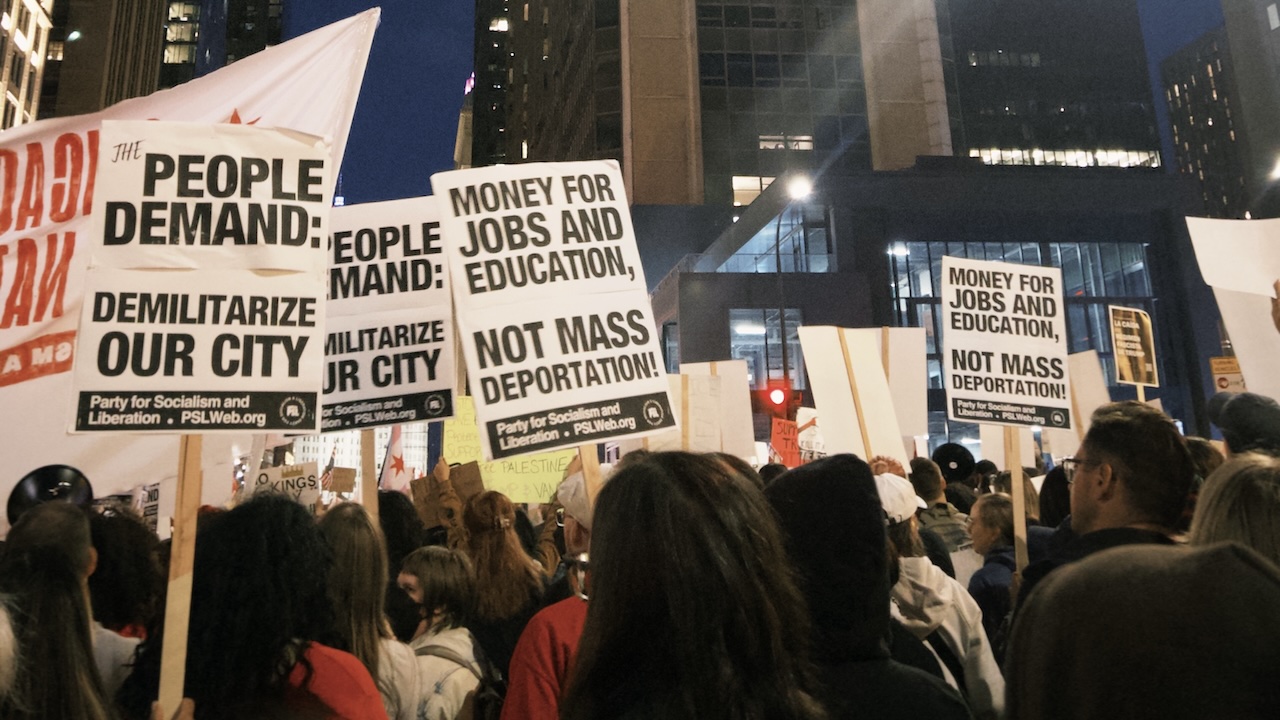
Demonstrators in Chicago on October 8 (Photo: Saja Bilasan)

“The oath we took as soldiers absolutely comes with an asterisk, and this is it,”: Veteran activists in Portland urge National Guard Troops to defy Trump’s orders

A US federal judge issued a temporary restraining order on October 9, blocking the Trump administration’s deployment of hundreds of National Guard troops to Chicago. Hundreds were already stationed in the midwestern city at the time of this ruling. This comes days after a separate judge blocked the deployment of the National Guard to Portland, Oregon. 

Currently, there are around 500 National Guard troops in the greater Chicago area, 2,400 in Washington, DC, and 100 still in Los Angeles down from a peak of 4,700 in June. 

With the support of the Governor of Tennessee, the state’s National Guard troops are set to begin patrolling the city of Memphis. Unlike Chicago, Los Angeles, and Portland, Tennessee’s Republican governor Bill Lee is supportive of Trump’s federal takeover efforts and therefore is sending troops from his own state to Memphis – thus eliminating the legal obstacles Trump has faced in other states.

Chicago’s Mayor Brandon Johnson called the judge’s order a “win for the people of Chicago and the rule of law.” The previous day, Trump called for the jailing of both Johnson and Illinois Governor JB Pritzker for “failing to protect Ice Officers”. But Johnson asserted that, as protests against violent ICE raids continue in Chicago, that there is “no rebellion,” there are “just good people standing up for what is right.”

Federal troops blocked in Portland

Trump announced the deployment of federal troops to Portland on September 27, characterizing the West Coast city as “war ravaged” and claiming that ICE facilities were under attack by “Antifa, and other domestic terrorists.”

According to federal judge Karin Immergut, who was appointed by Trump during his first term, there is “substantial evidence that the protests at the Portland ICE facility were not significantly violent or disruptive in the days – or even weeks – leading up to the President’s directive ordering the deployment of troops to Oregon.”

Top Trump adviser Stephen Miller described Immergut’s ruling as a “legal insurrection.”

On September 22, Trump announced that he was declaring “Antifa” a domestic terrorist organization, despite the fact that Antifa is a decentralized movement with no central organization attached.

Amid attempts by the Trump administration to militarize the city, Portland residents have continued to protest. Demonstrations continued against ICE, including a march to the ICE facility in Portland in the early afternoon of Saturday, October 4 – which was attacked by federal agents deploying tear gas, smoke canisters, and pepper balls at protesters. Protesters outside the ICE facility also experienced similar brutal crowd control tactics by federal agents once again that evening – including tear gas, flash-bang grenades, and pepper balls – despite no clear provocation by demonstrators.

Portland veterans urge National Guard members to disobey

On October 6, dozens of veterans, some with anti-war veteran group About Face, held a press conference, with some speakers and signage urging National Guard members to disobey Trump’s orders. Several signs read “Trump is the real enemy within,” referencing the President’s previous statements claiming that he is sending troops to so-called “Democrat-run” cities to protect from “invasion from within”. Other signs read: “Veterans say: Duty to disobey”, “No war in Portland”, and “Guard, go home.”

“Trump is signaling in very clear terms he wants to go to war in American cities,” said Portland City Councilor Mitch Green, an Army veteran who served in the US invasion of Afghanistan, at the press conference. “He said he wants to use Portland as a training ground and that soldiers should do ‘whatever they want’ to protesters. While it’s unclear what the role of the National Guard will be, these threats are as serious as anything in American history. The oath we took as soldiers absolutely comes with an asterisk, and this is it.”

Original article by Natalia Marques republished from peoples dispatch under a Creative Commons Attribution-ShareAlike 4.0 (CC BY-SA) license.

Donald Fuhrump says that Amerikkka doesn't bother with crimes or charges anymore, not being 100% Amerikkkan and opposing his real estate intentions is enough.
Donald Fuhrump says that Amerikkka doesn’t bother with crimes or charges anymore, not being 100% Amerikkkan and opposing his real estate intentions is enough.
Orcas discuss how Trump was re-elected and him being an obviously insane, xenophobic Fascist.

Continue ReadingAnti-ICE protests continue as judges block Trump’s National Guard deployment in Portland and Chicago

Climate Movement Says ‘Hurricane Helene Must Be a Wake-Up Call’

Spread the love

Original article by Jessica Corbett republished from Common Dreams under Creative Commons (CC BY-NC-ND 3.0). 

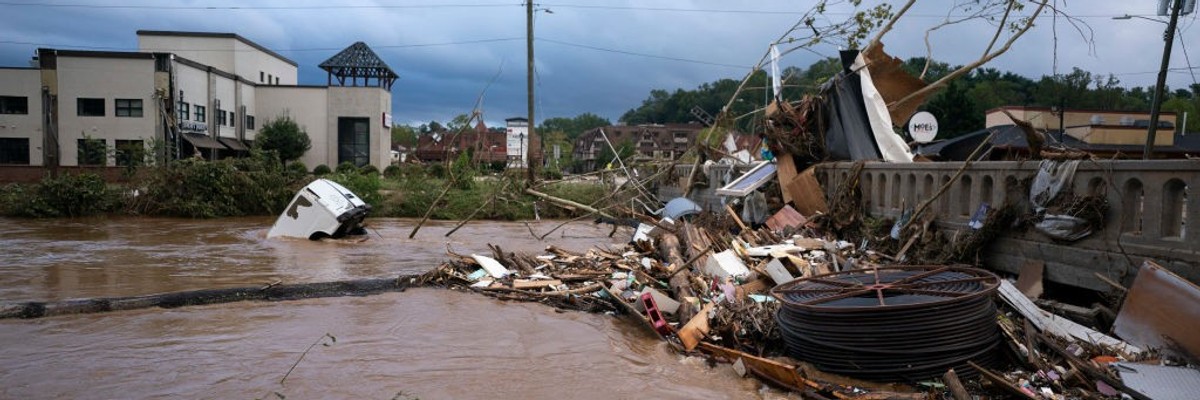
A van flows in floodwaters near the Biltmore Village in the aftermath of Hurricane Helene on September 28, 2024 in Asheville, North Carolina. (Photo: Sean Rayford/Getty Images)

“To those insisting that, ‘This is not the time!’ to have those other conversations, I say: This is *exactly* when we need to be having them,” said one climate scientist.

As emergency crews have worked through the weekend to rescue people and restore essential services across several southeastern U.S. states, green groups in recent days have pointed to the death and damage from Hurricane Helene as just the latest evidence of the need for sweeping action on the climate emergency.

Helene made landfall as a Category 4 hurricane with 140 mph winds in Florida’s Big Bend region late Thursday, then left a path of destruction across hundreds of miles of Georgia, the Carolinas, and Tennessee. As of early Sunday, at least 64 people are confirmed dead—including at least two people in Virginia—though that figure is expected to rise.

“Moody’s Analytics said it expects $15 billion to $26 billion in property damage,” The Associated Press reported Sunday on what is now a post-tropical cyclone. “AccuWeather‘s preliminary estimate of the total damage and economic loss from Helene in the U.S. is between $95 billion and $110 billion.”

The youth-led Sunrise Movement said Sunday that “any reporting about Hurricane Helene needs to be clear—this is not normal. This is not just a tragedy. This is a crime. Fossil fuel companies have known this would happen for the last 50 years. They lied to the public and bought out our government just to make a profit. Make them pay.”

Greenpeace USA similarly declared on social media Saturday that “#HURRICANE HELENE MUST BE A WAKE-UP CALL FOR CLIMATE JUSTICE!”

“We are heartbroken,” the group said, noting the dozens of people killed. “Communities have been devastated. The corporations heating the climate must be held accountable.”

Dozens of communities across the United States have already launched climate liability lawsuits against Big Oil, which knew for decades that fossil fuels would heat the planet but promoted disinformation and raked in huge profits. Recently there have been calls for legal action by the U.S. Department of Justice and potential homicide cases brought by state and local prosecutors.

“Our hearts and solidarity go out to everyone facing the devastation. Please support mutual aid relief efforts and demand oil companies #StartDrillingStartPaying!” Greenpeace said Saturday.

Sunrise executive director Aru Shiney-Aja on Sunday offered a “friendly reminder that fossil fuel companies get 20 BILLION dollars in [government] subsidies every year,” while the Federal Emergency Management Agency (FEMA) “runs out of money to respond to disasters like Helene.”

Both Shiney-Aja and Greenpeace shared footage from Asheville, North Carolina, which endured what Ryan Cole, the assistant director of Buncombe County Emergency Services, described as “biblical flooding.”

Just two years ago, The New Lede reported that “from wildfires racing through the drought-stricken West, to heavy flooding in the central and eastern regions of the United States, extreme weather events are spurring many Americans to seek refuge in more environmentally stable cities, so-called ‘climate havens,'” including Asheville.

This weekend, Asheville—which is over 2,000 feet above sea level and more than 250 miles from the coast—and surrounding communities are contending with disrupted water, power, and communications services due to what officials are reportedly calling “Buncombe County’s own Hurricane Katrina.”

Noting Asheville’s elevation and distance from the coast, Lucky Tran, director of science communications and media relations at Columbia University in New York City, said Sunday that “no place is safe from climate change. We all suffer the consequences. We must all take action. We are all in this together.”

As The New York Times reported Sunday:

People across western North Carolina chainsawed their way to loved ones and drove for hours Saturday on dwindling gas tanks in search of food and power, in what one resident described as a “mini-apocalypse” after Hurricane Helene.

Authorities said the region was facing a historic disaster a day after the powerful storm swept through the Southeast, downing power lines and washing out highways. Landslides, spotty cellphone service, and a gas shortage complicated rescue and recovery efforts. Some stranded people were being airlifted to safety.

Antonia Juhasz, a leading climate and energy journalist and author, said Saturday that “Asheville, North Carolina is being wiped off the map by the worst storm to hit the region in a generation. This is what the climate crisis looks like: the production and use of fossil fuels changes the climate, intensifying extreme weather events and making them more frequent.”

As hurricane scientist Jeff Masters detailed Friday, fossil fuel-driven climate change “makes the strongest hurricanes stronger,” boosts rainfall from such storms, leads to more rapid intensification, and causes sea-level rise that increases storm surge damage.

In an effort to emphasize the climate change connection to extreme weather, from heatwaves to hurricanes, some climate campaigners have suggested naming such events after oil and gas companies.

“What did a Helene ever do to deserve getting this horrific hurricane named after her? We should be naming hurricanes after fossil fuel CEOs instead. How about Hurricane Darren?” said Fossil Free Media director Jamie Henn, taking aim at ExxonMobil’s Darren Woods.

Daniel Swain, a climate scientist focused on extreme weather, said on social media Saturday, “The images and stories just beginning to emerge from eastern TN and western NC in the aftermath of widespread catastrophic flooding wrought by Helene are genuinely horrifying, and the full scale of the disaster is likely as yet untold.”

“This was, by far, the most extreme rain event in observed record across much/most of the region, where reliable records date back over 100 [years]. Unsurprisingly, the flooding which resulted has also been widespread, historic, and generally catastrophic across a broad region,” he explained. “These floods, which were concentrated in valleys containing rivers and typically modest creeks and streams, involved extremely large volumes of water moving downhill at high velocity. This was not a gradual or ‘gentle’ inundation by any means.”

Swain stressed that “sometimes ‘worst-case’ scenarios really do come to pass, and I think we often lack the collective imagination to fully envision what that looks like. That’s a problem, because being honest about risks that exist is [the] first step toward mitigating them and preventing harm!”

“Ultimately, there many folks in FL, GA, NC, and TN who are in need of urgent assistance—and that is/should be foremost priority,” he added. “But to those insisting that, ‘This is not the time!’ to have those other conversations, I say: This is *exactly* when we need to be having them.”

The AP reported that “in Atlanta, 11.12 inches (28.24 centimeters) of rain fell over 48 hours, the most the city has seen over two days since record-keeping began in 1878,” while “in Florida’s Big Bend, some lost nearly everything they own, emerging from the storm without even a pair of shoes.”

Along Florida’s Gulf Coast, “Helene shoved a wall of water estimated at least 10 feet high into the lowest-lying areas of Steinhatchee,” according to USA Today.

South of there, in Pinellas County, officials have identified over 18,000 homes damaged by Helene—and at least 11,000 are “uninhabitable,” as the Tampa Bay Times put it.

Highlighting the connection between climate change and more intense hurricanes, Congressman Maxwell Frost (D-Fla.) said Thursday that “the climate crisis is here. We must act to save lives.”

Original article by Jessica Corbett republished from Common Dreams under Creative Commons (CC BY-NC-ND 3.0). 

Continue ReadingClimate Movement Says ‘Hurricane Helene Must Be a Wake-Up Call’