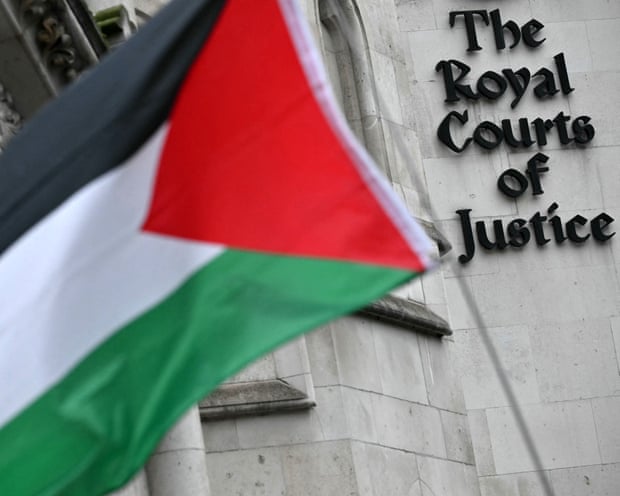
Palestine Action activists are appealing their unprecedented terrorism convictions. Their sentencing in June 2026 was the first time in British legal history that criminal damage convictions were sentenced as terrorism.
At a press conference in London, Simon Natas, the lawyer for Ellie Kamio, Charlotte Head, Fatema Zainab and Samuel Corner, told the press that in his 15 years working on similar cases, he would have been completely shocked if any of those were charged with a terrorism connection.
Also speaking were Emma and Sukaina – the mothers of Ellie and Fatema – as well as Dr James Smith and Dr Shahd Hammouri.
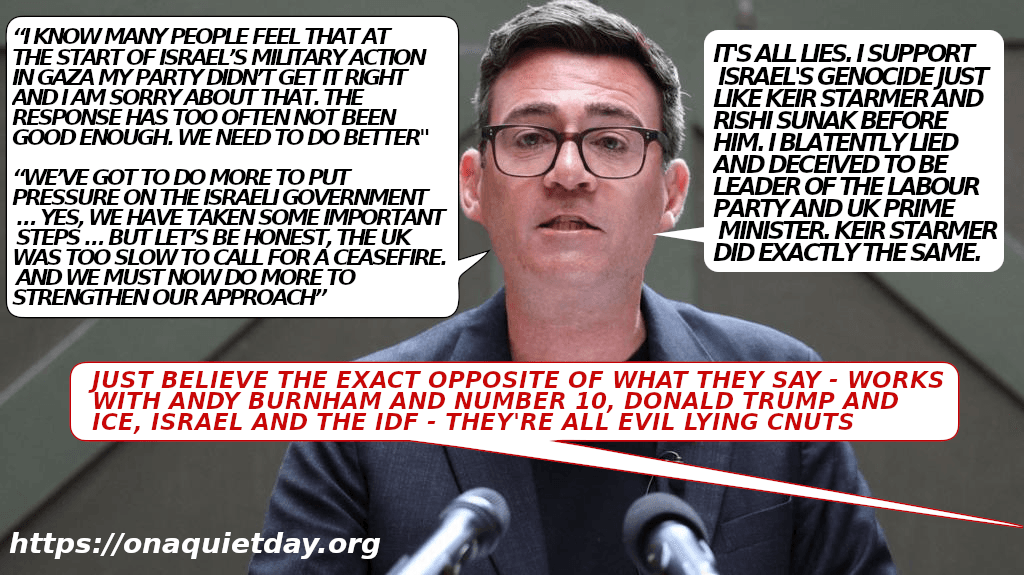
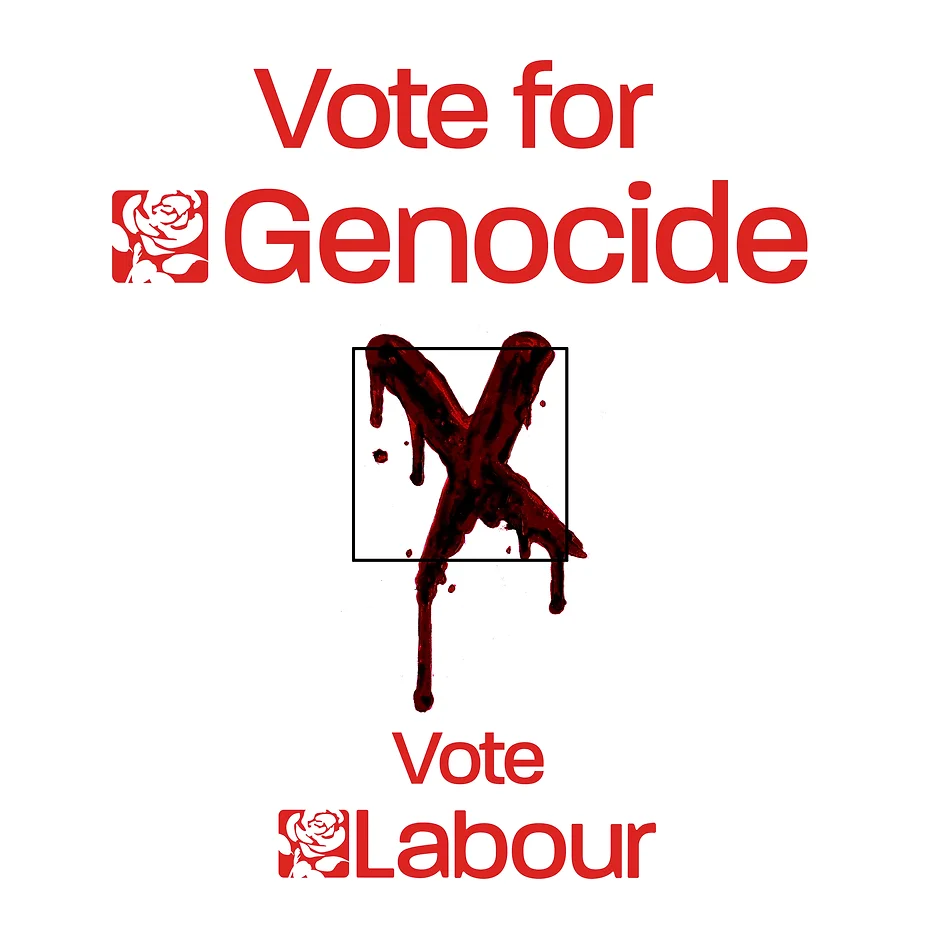
Keir Starmer objects to criticism of the IDF. He asks how could anyone object to them starving people to death, forced marches like the Nazis did, bombing Gaza’s hospitals and universities, mass-murdering journalists, healthworkers and starving people queuing for food, killing and raping prisoners and murdering children. He calls for people to stop obstructing his genocide for Israel. New Labour UK Prime Minister Andy Burnham continues Labour party policy of active support and complicity in Israel’s genocide.UK Prime Minister Andy Burnham admits to blatently lying and engaging in deception to become leader of the UK Labour Party and Prime Minister.Vote Labour for Genocide.
The US has issued sanctions against the UK-based direct action organisation Palestine Action, describing it as a “transnational terror group”.
The US Department of the Treasury labelled Palestine Action a specially designated global terrorist on Wednesday, which allows the US to freeze the assets of foreign individuals and entities.
The powers used to sanction the organisation in the US were introduced by President George W Bush shortly after the 9/11 attacks by al-Qaida on the twin towers in New York.
Announcing the sanctions on Palestine Action and two other organisations, the Treasury secretary, Scott Bessent, said: “Far-left extremists, their fronts, and their enablers should be on notice: we will bring the full weight of our economic tools to bear. Political terrorism has no place in our society and we will continue to cut the financial lifelines of these groups until they are eliminated.”
Climate science denier Donald Trump confirms that he knows nothing about democracy and that more liquid gold is being secured according to his policy of global privateering.Donald Trump warns against following the Onaquietday.org blog, says that he’s heard that she’s a which with a black cat and a dangerous kitchen.Palestine Action joke that appeared in the UK satirical magazine ‘Private Eye’.
Throughout history, almost every national liberation struggle has been labelled “terrorism” by the powers exercising colonial rule or foreign occupation. This strategy is nothing new.
The British Empire branded IRA fighters in Ireland and EOKA guerrillas in Cyprus as terrorists. France portrayed Algeria’s National Liberation Front (FLN) as a criminal organisation. The same happened to the Mozambique Liberation Front (FRELIMO), the People’s Movement for the Liberation of Angola (MPLA), the South West Africa People’s Organisation (SWAPO) in Namibia, and even Nelson Mandela’s African National Congress (ANC).
History, however, vindicated these movements and condemned the colonial regimes that sought to perpetuate their domination.
This pattern reveals a constant: those who occupy a territory seek to strip the occupied people of any legitimacy to resist.
The dehumanisation of resistance is a colonial strategy. By labelling every resistance fighter a “terrorist”, attention is shifted away from illegal occupation, apartheid and the denial of self-determination, and redirected towards the reaction of the occupied people.
This narrative, however, encounters clear limits within international law itself.
From the United Nations Charter to Resolution 1514 (XV) on decolonisation and Resolution 2625 (XXV), which reaffirms the principle of peoples’ self-determination, the understanding has been consolidated that peoples subjected to colonial domination, foreign occupation or racist regimes have the right to struggle for their liberation.
Several subsequent resolutions of the United Nations General Assembly recognised the legitimacy of national liberation movements and acknowledged that such resistance may take the form of armed struggle, provided that it remains subject to the rules of international humanitarian law.
This is precisely why the international community has never automatically equated national liberation movements with terrorist organisations.
International humanitarian law regulates the manner in which armed conflicts must be conducted and imposes obligations on all belligerents, including resistance movements.
However, it does not eliminate the political and legal right of a people to resist occupation. Confusing these two dimensions serves only the interests of occupying powers, because it transforms a conflict of a political and legal nature into a mere policing matter.
The history of the so-called “State of Israel” itself exposes this contradiction.
Before 1948, Irgun and Lehi were regarded as terrorist organisations by the British government because of attacks such as the bombing of the King David Hotel and the assassination of UN mediator Folke Bernadotte.
Years later, their leaders reached the highest levels of government, and Menachem Begin received the Nobel Peace Prize. This demonstrates that the label “terrorist” often reflects political circumstances more than any permanent legal definition.
In the contemporary context, this debate remains highly relevant. Palestine continues to be recognised by the United Nations as a territory under occupation, while Western Sahara remains on the UN list of Non-Self-Governing Territories, awaiting the fulfilment of its people’s right to self-determination.
In this context, the Islamic Resistance Movement (Hamas), which emerged during the First Intifada, and the Polisario Front, recognised by the United Nations as the representative of the Sahrawi people in the Western Sahara peace process, belong to the historical tradition of national liberation movements.
As with South Africa’s ANC, Algeria’s FLN, Namibia’s SWAPO, Mozambique’s FRELIMO and many other movements, both base their struggle on their peoples’ claim to the right of self-determination in the face of occupation or foreign domination.
This does not mean that every military action carried out by resistance organisations is automatically legitimate under international law.
The rules of international humanitarian law apply to all parties to a conflict and prohibit deliberate attacks against civilians, regardless of the cause being defended.
However, possible violations of these rules do not, in themselves, invalidate the legal legitimacy of the struggle for self-determination, nor do they automatically transform a national liberation movement into a terrorist organisation under international law. These are distinct questions, frequently conflated for political convenience.
There is no colonialism without resistance. There never has been.
The French Resistance against Nazi occupation, Vietnamese guerrillas, Algerian fighters, South Africans who confronted apartheid, African liberation movements, the Polisario Front and the Palestinian resistance all demonstrate that no people will indefinitely accept the loss of their land, sovereignty and dignity.
The real question, therefore, is not why resistance exists.
The question the world should be asking is why military occupations, colonial processes and regimes that deny entire peoples the right to determine their own destiny continue to exist.
As long as there is colonisation, apartheid, illegal annexation and denial of self-determination, there will be armed resistance movements.
And international law, despite political pressure and attempts to criminalise liberation movements, continues to uphold the fundamental principle that the freedom of peoples is not an act of terrorism, but a fundamental right of humanity.
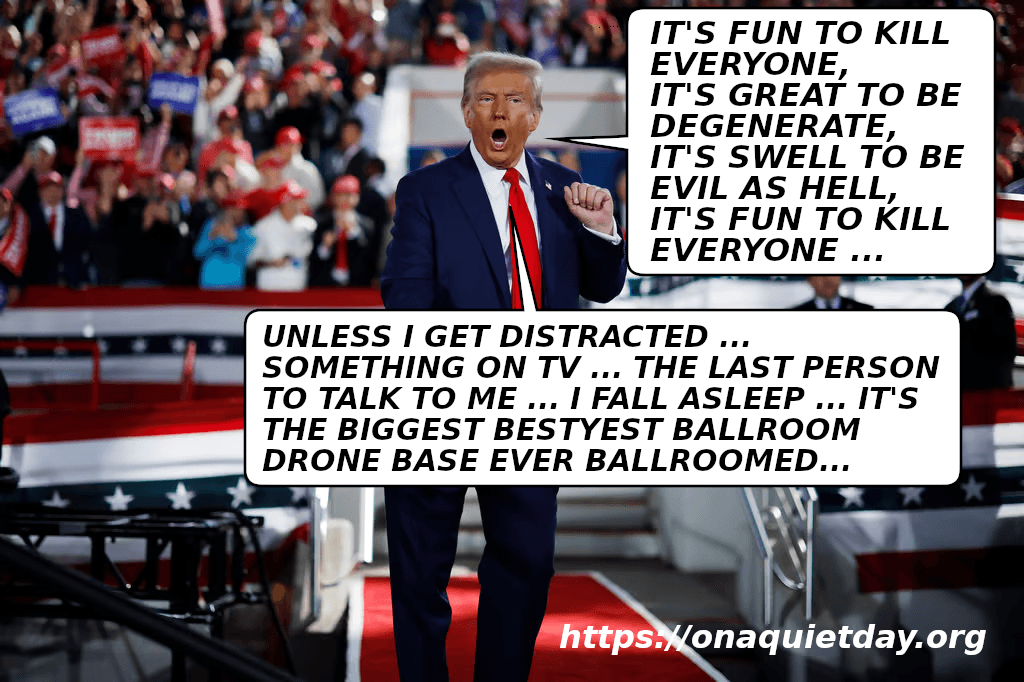
Donald Trump sings and dances, says that it’s fun to kill everyone … unless he gets distracted or falls asleep.Orcas discuss rotting brain, front Orca says Sundown Syndrome is a dead givaway and he wishes someone would Lock Him Up
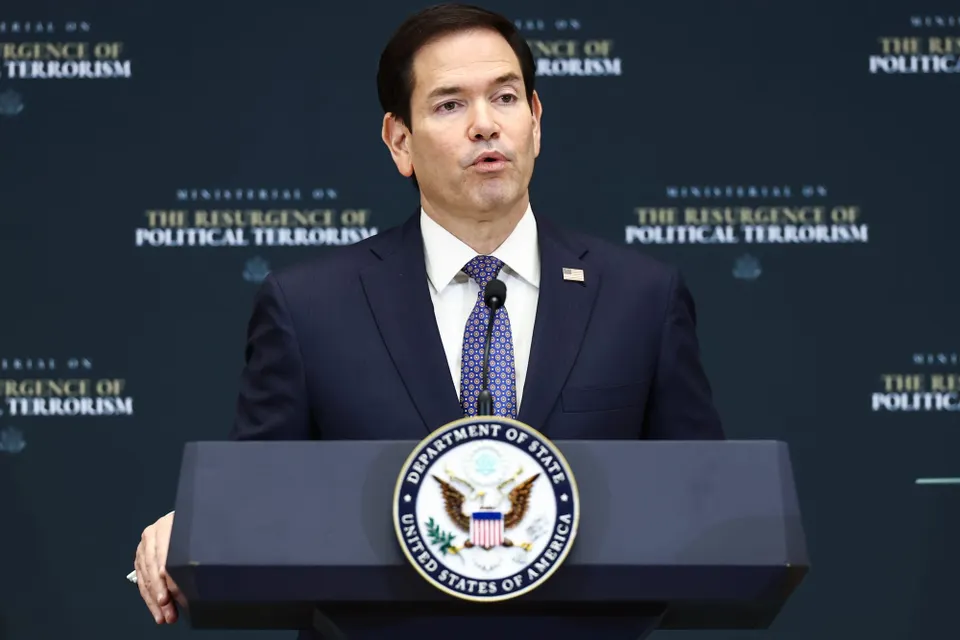
The US secretary of State, Marco Rubio, speaks at a meetting about the “resurgence of far-left terrorism” in Washington DC on 16 July, 2026 | Finn Gomez/Getty Images
When Marco Rubio gathered representatives from 66 countries in Washington this month, his aim was clear and aggressive: target the “resurgence of far-left terrorism”. Framing the threat as a global emergency, the US secretary of state called on intelligence agencies and security forces around the world to unite to “crush this evil forever”.
“We can, and we must, identify and map this threat and rebuild our counterterrorism architecture to defeat it,” Rubio warned attendees. “Just as we have done together before, now we must do it together again.”
Referencing various left-wing guerrilla and political organisations that were active across Latin America in the 20th century, he added: “Every one of our friends here from the nations of the Western Hemisphere remember – remember the decades of kidnappings and bombings and assassinations and executions, the violent terror of the Tupamaros, of the Montoneros, of the FARC, of the ELN.”
Outside the conference room, the State Department was making the same point to the wider American public. It released a document on the same topic, which used extremely vague data to draw parallels between the Latin American guerrillas of the 1960s and 1970s and very different situations in Europe and the US to demonstrate that “left-wing terrorism” exists – and has previously been ‘defeated’.
In Latin America, this messaging amounts to an open endorsement of the state terrorism and genocide that 20th-century military dictatorships and regional repressive coordination efforts – such as Plan Condor, an illegal operation by military regimes in Argentina, Bolivia, Brazil, Chile, Paraguay and Uruguay to capture and disappear political opponents across borders – deployed to combat the guerrillas.
Rubio’s threat appears clear: Washington is willing to repeat that extreme state violence – and the egregious human rights violations it led to – in order to stop modern-day “left-wing terrorists”.
Given that no armed movements like those 20th-century guerrillas Rubio mentioned actually exist in our region today, which groups or individuals is the US government referring to? Understanding this will allow us to understand the pattern of political persecution it seeks to export worldwide.
Among them are “antifa”– decentralised groups that confront the far right, racism, and colonialism through street tactics and digital activism. The current US administration has repeatedly referred to these groups as a kind of highly organised international conspiracy; Donald Trump designated them as a terrorist organisation in September 2025, even though they are clearly not an organisation.
Trump’s White House has also labelled some of the groups opposing the systematic persecution of migrants by the US Immigration and Customs Enforcement (ICE) as “domestic terrorists”.
Perhaps the most famous case of US authorities criminalising dissidents in recent years combined both “antifa” and “anti-ICE”. In July last year, police violence towards an anti-deportation protest outside the Prairieland detention facility in Texas led to riots in which a police officer was shot and received a non-life-threatening injury. Eleven people were arrested; the US government determined that they were part of the “antifa cell” in North Texas. Last month, six people were handed prison sentences ranging from 30 to 70 years, while the activist who shot the officer received a 100-year sentence.
Clearly, the primary targets of this political persecution are protest and social movements, especially those associated with various forms of direct action.
In both the US and Europe, there has been a trend in recent years to classify protesters or activists who employ direct-action tactics – which, in some cases, result in property damage – as terrorists or violent extremists. These incidents are framed, prosecuted, and tried as “national security” cases.
Take the situation of Palestine Action in the UK. The government proscribed the direct action group as a terrorist organisation last year, and last month, four of its activists had a ‘terrorist connection’ applied to sentences for criminal damage at a factory owned by the UK branch of Elbit Systems, an Israeli weapons manufacturer. Five more Palestine Action activists now also face being sentenced as terrorists for breaking windows and throwing red paint at a branch of Barclays Bank, which held shares in Elbit Systems. In both cases, jurors were not told that reaching a guilty verdict could lead to the protesters being sentenced as terrorists.
But the content of Rubio’s speech – with its anti-Marxist and anti-left rhetoric – suggests the persecution could extend beyond direct-action groups, impacting all kinds of progressive opposition groups. In fact, Trump administration officials have repeatedly referred to the Democratic Party itself (which is hardly suspected of Marxism) as an “extremist organisation”.
The shift toward the far right and the resulting political weaponisation of the definition of terrorism is a hallmark of the current US administration and several of its allies in the region.
In May of this year, the new US counterterrorism strategy was released, identifying three major sources of terrorist activities: “narco-terrorists and transnational gangs,” “historical Islamist terrorists,” and “violent left-wing extremists, including anarchists and anti-fascists.” Far-right terrorism is not listed as a concern, even though the most serious acts of violence in the US – aside from the attacks of 11 September 2001 – were carried out by white supremacists or other far-right groups.
The guest list of Rubio’s meeting earlier this month suggests that, for now at least, tackling “far-left terrorism” is a low priority for most governments; the majority opted to dispatch mid-to-low-level diplomatic or law enforcement representatives, rather than cabinet ministers. The two notable exceptions were Israel and Argentina, both of which sent their foreign ministers.
In Argentina’s case, Pablo Quirno was not only one of the highest-profile foreign officials present, but reportedly spoke at the event in a strong show of alignment between right-wing president Javier Milei and the US administration.
The concept of “far-left terrorism” has not been part of Argentina’s security agenda since the 1990s. But last year, this concept found its way into Milei’s National Intelligence Plan, which listed “anarchist terrorism” as one of the risk scenarios that Argentine intelligence agencies must monitor – without any clarification of what it actually refers to.
The Argentine government must now explain what role it played in Rubio’s meeting and what it considers “left-wing terrorism”. It is crucial that the entire political spectrum put a stop to these encroachments, which use counterterrorism policies as an excuse for political persecution, the curtailment of freedoms, and the legitimisation of state violence.
CELS is an Argentine human rights organisation with a broad agenda that includes defending the right to protest.
Keir Starmer objects to criticism of the IDF. He asks how could anyone object to them starving people to death, forced marches like the Nazis did, bombing Gaza’s hospitals and universities, mass-murdering journalists, healthworkers and starving people queuing for food, killing and raping prisoners and murdering children. He calls for people to stop obstructing his genocide for Israel. New Labour UK Prime Minister Andy Burnham continues Labour party policy of active support and complicity in Israel’s genocide.Palestine Action joke that appeared in the UK satirical magazine ‘Private Eye’.