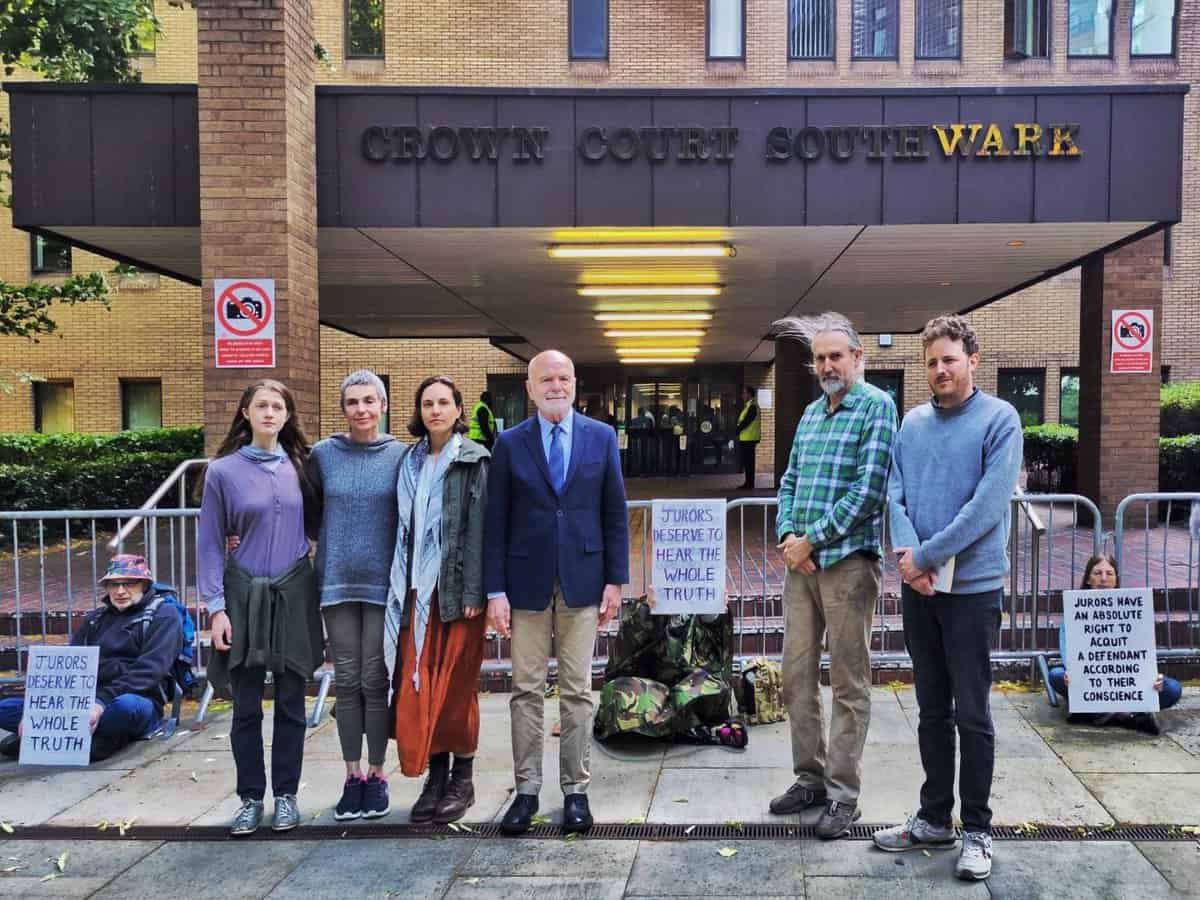
UN Special Rapporteur on Environmental Defenders under the Aarhus Convention Michel Forst attended the trial of five Just Stop Oil supporters at Southwark Crown Court. He attended as an observer because of his serious concerns.
The jury is now deliberating the verdict in a case involving Just Stop Oil supporters Daniel Shaw, Cressie Gethin, Lucia De-Abreu-Whittaker, Louise Lancaster, and Roger Hallam. The five are currently on trial at Southwark Crown Court. They are charged with conspiracy to cause a public nuisance in connection with the M25 gantry actions in November 2022.
They were first arrested in 2022 either pre-emptively in police raids at their homes after attending a Zoom call (in which a Sun journalist was present), or travelling near the M25. The Sun alleged it had ‘infiltrated’ the meeting, tipping off the police and enabling National Highways to secure a public injunction. Some of the five defendants were imprisoned for up to 113 days without trial. They were released subject to stringent conditions including a 10pm to 7am house curfew, stipulations not to be within a one-mile radius of the M25, no contact with other defendants, and not to participate in any climate change demonstration.
The trial began on 24th June, presided over by Crown Court Judge Hehir.
At the start of the trial, the office of the UN Special Rapporteur on Environmental Defenders released a statement expressing its views on the criminal prosecution of Daniel Shaw. Due to his “grave concerns” about the criminalisation of UK environmental defenders, Special Rapporteur Michel Forst attended the trial in person on 4th and 5th July. [1]
During the trial so far, Judge Hehir has ordered nine separate arrests from the courtroom: three times each for Roger Hallam and Daniel Shaw, twice for Louise Lancaster, and once for Cressie Gethin. Additionally, the defendants have collectively spent seven nights in remand since the trial began, with Daniel, Roger, and Louise each spending two nights, and Cressie spending one night.
On the 4th of July, the prosecution made a historic concession by admitting to the following, in the list of agreed facts to be presented for the jury’s consideration:
“1. On 17 December 2020, Her Majesty’s Treasury published the New Zero Interim Report which states, ‘Climate change is an existential threat to humanity. Without global action to limit greenhouse gas emissions, the climate will change catastrophically with almost unimaginable consequences for societies across the world.’ In recognition of the risks, the UK became, in 2019, the first major economy to implement a legally binding net zero target.
2. Scientific consensus is that beyond 1.5 degrees Celsius warming above pre-industrial levels risks catastrophic and irreversible consequences for humanity, which will be irreversible.
3. Over the past five years, the global average temperature rise since pre-industrial times has averaged just under 1.3 degrees Celsius. For the 12 months to June 2024, it averaged 1.63 degrees Celsius and is estimated to top 1.5 degrees Celsius permanently before 2030.
4. In October 2022, the UK Government opened the 33rd licensing round to allow oil and gas companies to explore for more fossil fuels in the North Sea.”
Despite the presence of these agreed facts and the explicit provision for the defence of ‘reasonable excuse’ under section 78 of the Police, Crime, Sentencing and Courts Act 2022, Judge Hehir ruled that the defendants would not be allowed any defence under law, repeating at various points in the trial as well as in his written directions to the jury that any facts pertaining to “man-made climate change” were “entirely irrelevant” to the defendants’ charges.
‘The cost to Rubert Murdoch of keeping the full, sordid details secret is staggering.’
Hugh Grant has settled a High Court claim against the publisher of the Sun newspaper after being offered what he referred to as an “enormous sum of money.”
The actor was suing News Group Newspapers (NGN) for claims that reporters had used private investigators to burgle his house and tap his phone. NGN denies the claims, rejecting any wrongdoing by staff at the Sun.
…
Murdoch’s NGN has settled more than 1,000 cases without making any admission of liability, and has paid out £1 billion to keep cases out of court.
Former footballer Paul Gascoigne, actress Sienna Miller, comedian Catherine Tate, Spice Girl Melanie Chisholm, and radio presenter Chris Moyles have all settled cases with the NGN. Miller settled a lawsuit against NGN in 2021, which at the time her lawyers said was due to the risk of having to pay millions of pounds in legal fees even if she won.
An earlier allegation that Hugh Grant made against the publisher in relation to the now defunct News of the World was settled in 2012. The newspaper, which at one time was the world’s highest-selling English-language newspaper, was shut down by Murdoch in 2011 following public outcry to the phone hacking revelations. The phone hacking scandal broke over a decade ago, when investigations showed the newspaper was engaged in phone hacking activities, targeting celebrities, members of the Royal Family, politicians, and the phones of the relatives of the deceased in high-profile cases.
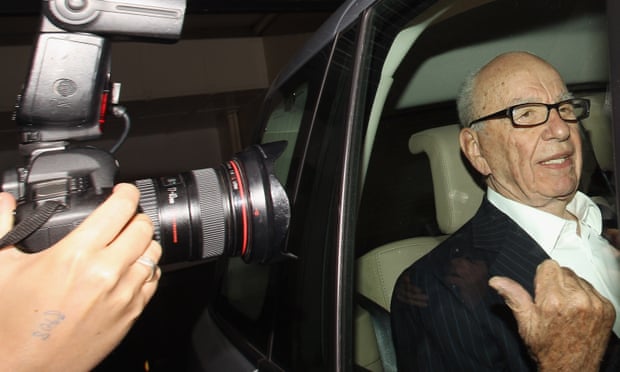
Rupert Murdoch leaving his London flat at the height of the phone-hacking scandal in 2011. Photograph: Oli Scarff/Getty Images
High court hears allegations media mogul oversaw ‘culture of impunity’ at the Sun and News of the World
Rupert Murdoch “turned a blind eye” to an extensive cover-up of wrongdoing at his newspapers, Prince Harry’s lawyers have alleged at the high court in London.
The direct allegations against the 93-year-old billionaire about activity at his publications are the latest stage in Harry’s war against the tabloid media, with lawyers for the Duke of Sussex and others accusing the media mogul of overseeing a “culture of impunity” at News Group Newspapers, the publisher of the Sun and the now defunct News of the World.
Court papers, which cover a period from the mid-1990s until 2016, also allege that Sir Will Lewis, the newly appointed publisher of Jeff Bezos’s Washington Post, played a key role in deleting millions of potentially incriminating emails, when he was tasked with managing the fallout from phone hacking.
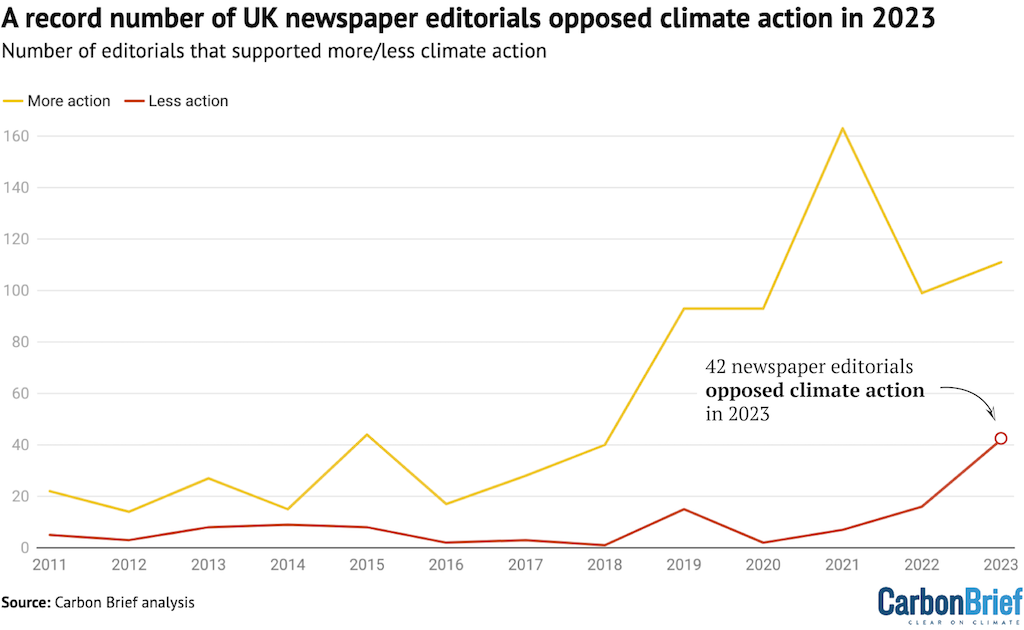
Graphic by Joe Goodman for Carbon Brief shows record opposition to climate action by UK’s right-leaning newspapers in 2023.
Last year saw a record number of UK newspaper editorials opposing climate action – almost exclusively from right-leaning titles – new Carbon Brief analysis shows.
The analysis is based on hundreds of UK national newspaper editorials, which are the formal “voice” of the publications.
The 354 editorials published in 2023 relating to energy and climate change add to thousands more collected in a long-running project started by Carbon Brief.
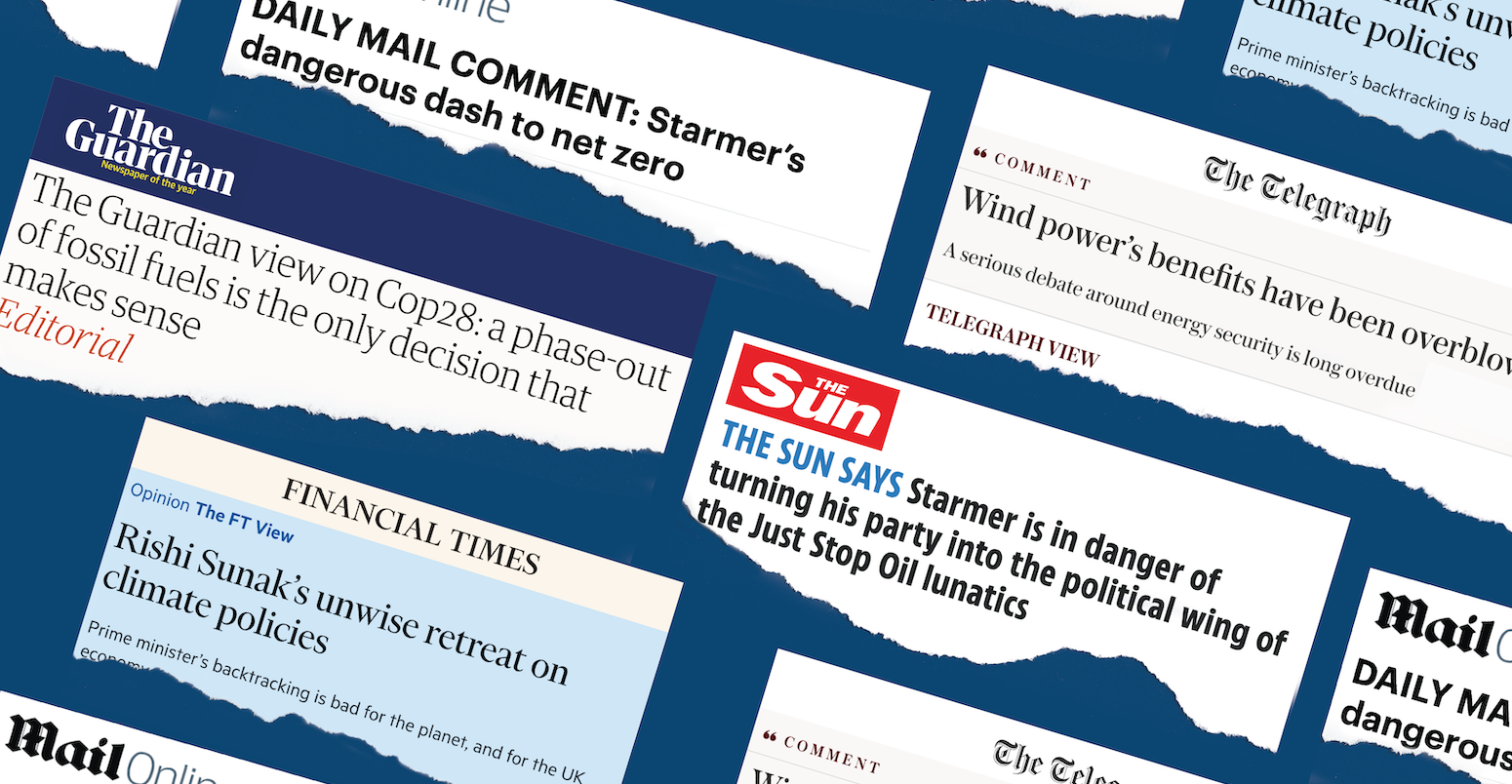
Newspapers such as the Sun and the Daily Mail published42 editorials in 2023 arguing against climate action – nearly three times more than they have printed before in a single year.
They called for delays to UK bans on the sale of fossil fuel-powered cars and boilers, as well as for more oil-and-gas production in the North Sea. In response to such demands, prime minister Rishi Sunak performed a “U-turn” in September on some of his government’s major net-zero policies.
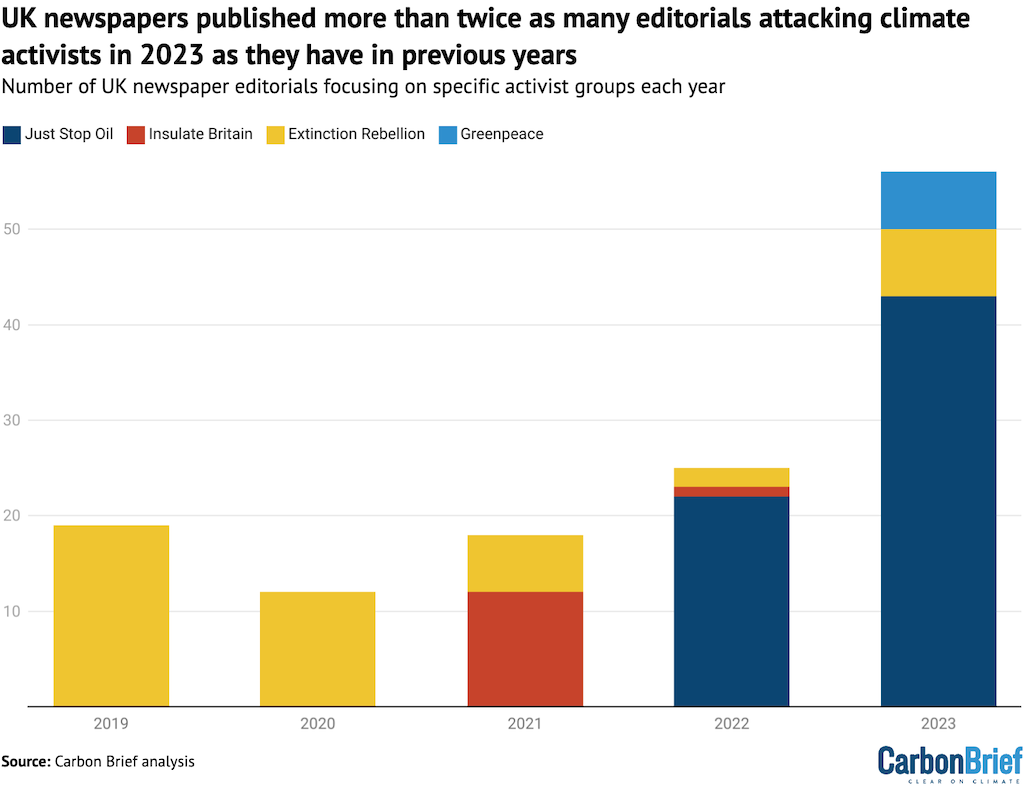
Last year also saw a surge in hostility towards climate protesters, with editorial attacks doubling compared to recent years.
This analysis is part of a project assessing the attitudes of UK newspapers to climate change and energy since 2011. It shows that after a period of embracing climate action, right-leaning publications have largely returned to their historic stance of arguing against climate action.
Carbon Brief captured 354articles in its database of climate- and energy-related newspaper editorials last year, touching on topics ranging from UK energy bills to flooding in Libya.
Roughly half of these – 174in total – specifically called for either more or less climate action. The main focus of these editorials was the UK government’s net-zero target and the policies it is implementing, or failing to implement, in order to achieve this goal.
As the chart below shows, the 42 editorials arguing for less action last year marked a new record for the past 13 years of climate coverage.
Number of UK newspaper editorials arguing for more (yellow) and less (red) climate action, 2011-2023. Source: Carbon Brief analysis.
There was a clear partisan divide in attitudes towards climate action.
Nearly every editorial published in left-leaning and centrist titles that offered an opinion on climate action advocated for more to be taken. These made up around three-quarters of the articles calling for “more action” overall.
The Guardian, for example, published editorials calling for an end to oil exploration in the UK and for the world to get rid of fossil fuels “entirely”.
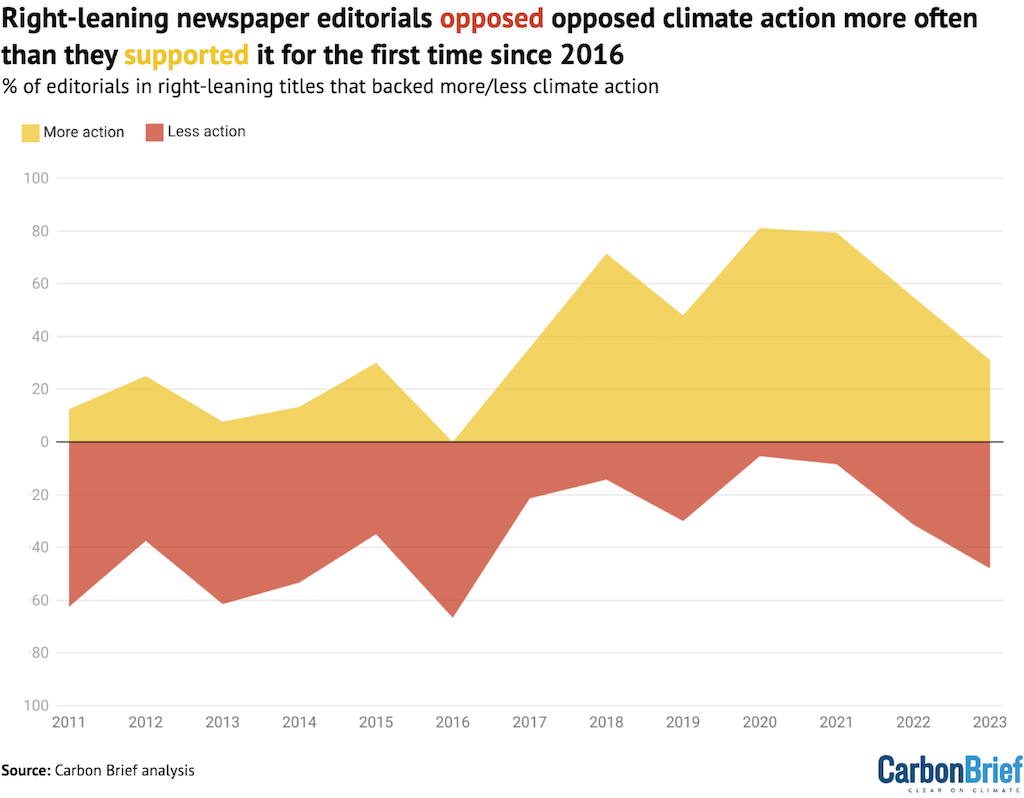
By contrast, around half of the climate-related editorials published in right-leaning titles, such as the Sun and the Daily Mail, actively opposed climate action. Only one-third of these editorials supported climate action and the remainder expressed a mix of views.
As the chart below shows, the past two years have seen a dramatic fall in the share of right-leaning newspaper editorials supporting climate action – and a rise in the share opposing it.
Prior to this downward trend, right-leaning titles with long histories of climate scepticism had been showing growing enthusiasm for climate action. The Daily Express and the Sun even launched special climate initiatives in 2021, as the UK prepared to host the COP26 summit.
The drop in support for climate action among right-leaning newspapers was followed by the government rolling back some of its climate policies in 2023. (See: Cost of net-zero.)
The share of right-leaning UK newspaper editorials arguing for more (yellow) and less (red) climate action, 2011-2023, %. Source: Carbon Brief analysis.
Carbon Brief also analysed a smaller set of 64 editorials from the 354 published in 2023 that discussed notable energy sources – specifically, renewables, nuclear power and fracking for shale gas.
Within this group, there were 14 editorials that were explicitly anti-renewable energy.
This is the highest number since 2013, when there was widespread opposition to wind energy within the right-leaning press.
Some of the criticism last year was reminiscent of that era. The Sun, for example, said solar and wind generation “will never reliably power a country this size and with such variable weather”.
(While other low-carbon energy sources would be needed, the Climate Change Committee has concluded that the UK could achieve a reliable decarbonised power system by 2035 in which wind and solar meet 70% of demand.)
A Sunday Telegraph editorial said that “supposed progress” in renewables had “only been achieved thanks to lavish subsidies”. (In fact, wind and solar remain the cheapest way to generate electricity in the UK.)
By far the most common anti-climate action narrative in newspaper editorials last year was the economic impact of what the Sun on Sunday called “bonkers net-zero policies that will just push prices up”. (Energy prices remain elevated thanks to expensive gas.)
The cost of net-zero, especially the up-front cost of buying electric vehicles and heat pumps, was consistently framed by right-leaning newspapers as something British people, in the words of the Sun, “just cannot afford”. (These papers invariably fail to mention the costs of inaction.)
This has been a popular topic among some right-wing and climate-sceptic commentators since the net-zero target was first proposed. This is in spite of analysis indicating that a net-zero transition would, ultimately, save UK households money.
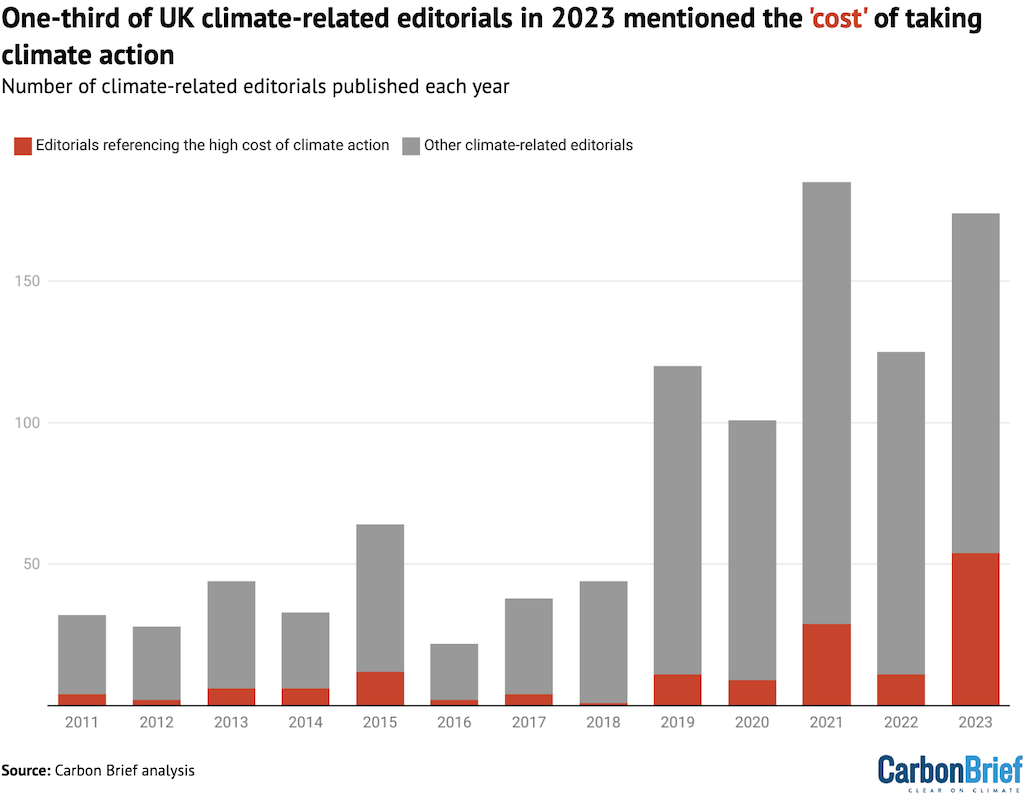
As the chart below shows, costs emerged as an even bigger talking point in 2023, with one-third of all climate-related editorials referencing the issue. There were twice as many editorials in the past year mentioning the high costs of action than there has ever been.
Annual number of climate-related editorials mentioning the economic costs of climate action (red), with remaining climate-related editorials published that year indicated in grey, 2011-2023. Source: Carbon Brief analysis.
Many, such as the Daily Mail, cited the wider economic situation in the UK as a reason not to act on climate change:
“When net-zero was made legally binding by 2050, Britain had not had Covid, the Ukraine war and rampant inflation. Now the country is skint and can’t afford it.”
(It is worth mentioning that publications such as the Daily Mail have been making similar arguments since long before any of these issues emerged. In 2017, it stated that climate action had only come at a “crippling cost to Western economies”.)
In light of what they argued were “unaffordable” costs, these publications argued that the best course of action would be to abandon “unrealistic” net-zero policies.
(The Office for Budget Responsibility has said that the costs of failing to act on climate change would be “much larger” than the costs of taking action.)
Right-leaning publications published numerous editorials calling for the government to delay or scrap plans to phase out gas boilers and internal combustion engine cars, introducedunder former Conservative prime minister Boris Johnson. One Daily Telegraph editorial said:
“There would surely be huge political benefits to scrapping all these pointlessly punitive measures.”
On 20 September, Conservative prime minister Rishi Sunak gave a speech in which he announced a series of rollbacks of net-zero policies that he said would protect “hard-working British people” from “unacceptable costs”. These included delays to the phase-out of fossil fuel-powered vehicles and boilers, as well as efficiency rules.
(Far from reducing costs, the rollbacks are expected to cost renters £2bn per year and drivers £6bn cumulatively, by leaving homes more draughty and cars more expensive to run.)
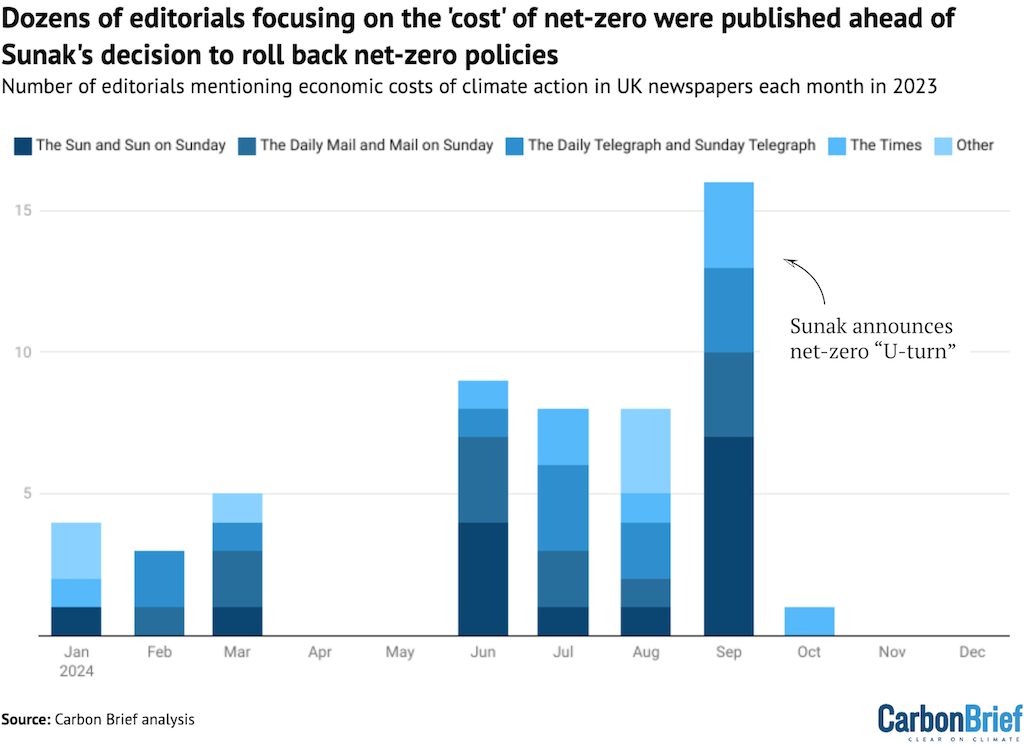
As the chart below shows, the speech followed a flurry of editorials warning of the costs of net-zero. After Sunak’s announcement, these editorials almost stopped entirely.
Monthly number of editorials mentioning the cost of climate action in UK newspapers in 2023. Source: Carbon Brief analysis.
Left-leaning and centrist publications rejected the notion that net-zero policies would inevitably place an economic burden on people in the UK.
The Guardian noted that, while “reaching net-zero will be costly and disruptive”, this just made it vital to have a “well-thought-out plan to share the cost equitably”. The Financial Times made the case for “green growth”, stating:
“True leadership…would involve finding ways to carry voters with [Sunak] through the challenges ahead and seizing on the green transition to rekindle growth and spur innovation.”
Sunak’s net-zero rollback was widely perceived by the UK press as an attempt to put “clear blue water” between himself and Keir Starmer, the leader of the opposition Labour party.
Meanwhile, there was a concerted effort in the right-leaning press to discredit Labour’s two flagship climate announcements – namely, pledges to spend £28bn each year on “green” investment and to stop issuing new oil-and-gas licences.
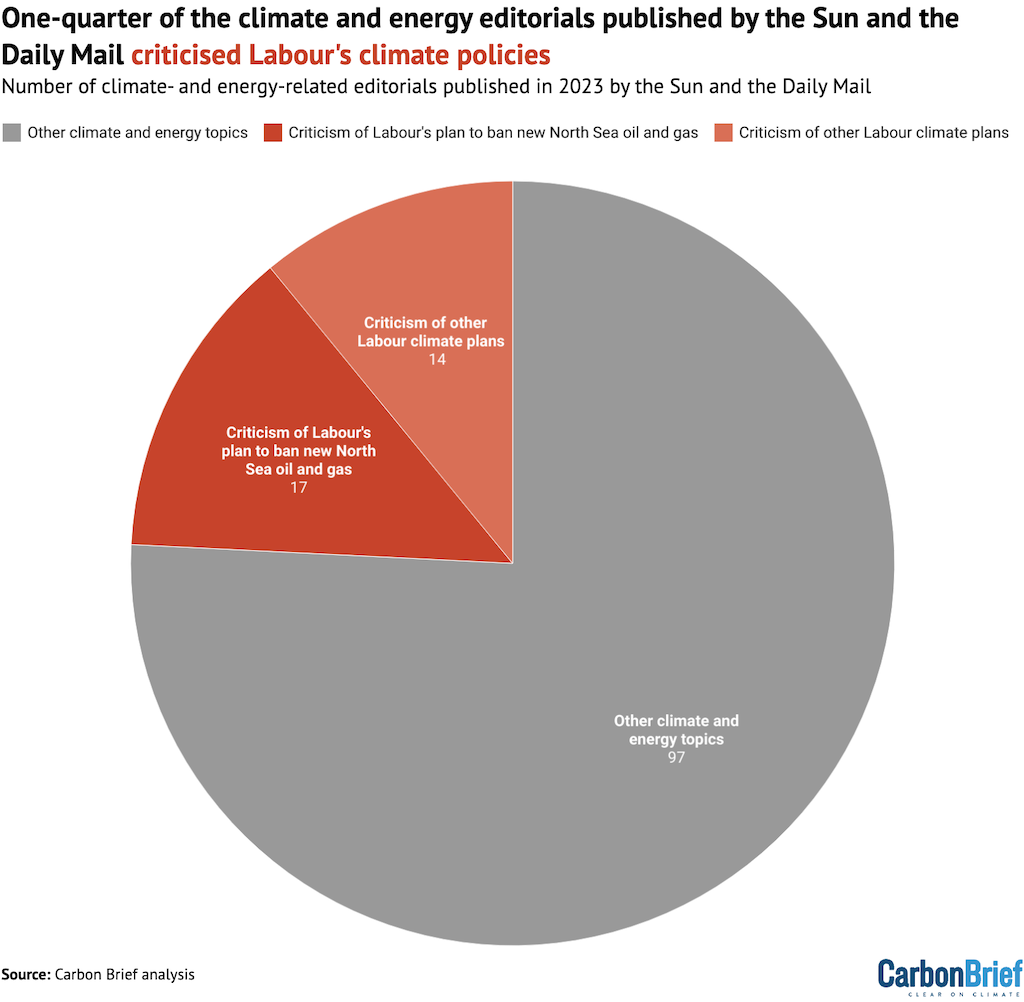
This was particularly evident in the Sun and the Daily Mail, the UK’s two most widely read national newspapers. Of the 128 climate- or energy-related editorials from these newspapers captured in Carbon Brief’s database last year, 31 took aim at Labour’s climate proposals.
Number of climate- and energy-related editorials published in the Sun and the Daily Mail in 2023 that focused on criticising Labour’s plans to end new North Sea oil and gas licensing (dark red) and other Labour climate policies (light red). The grey area represents other climate- and energy-related editorials in those newspapers that did not focus on Labour. Source: Carbon Brief analysis.
The debate around North Sea oil and gas was a major talking point last year, with many right-leaning editorials stating that new drilling licences would be vital for the UK’s energy security. (After a surge of interest in 2022, fracking was virtually forgotten last year, with just two editorials mentioning it in 2023.)
Labour officially announced in May that it planned to stop all new oil-and-gas developments.
Right-leaning newspapers responded by implying that environmental activist group Just Stop Oil and low-carbon energy tycoon Dale Vince were responsible for setting Labour’s policies. This claim was based on the fact that Vince, who had financially supported Just Stop Oil, had also given £1.5m to Labour.
In total, there were 16 editorials in the Sun, the Sun on Sunday and the Daily Mail about Vince’s support for Just Stop Oil and Labour. They described Vince as “bankrolling” Labour and helping to “dictate its green agenda”, framing Labour as “allies” of Just Stop Oil and “in their pocket”.
(Vince’s £1.5m in donations to Labour were spread over 10 years. The Labour Party has received donations totalling nearly £30m in the most recent 12 months for which official data is reported. The Conservatives have received £43m over the same period.)
These narratives were later picked up by then net-zero secretary Grant Shapps, who wrote a letter to Starmer in July concerning Vince’s support, and called Labour the “political wing of Just Stop Oil”.
(Responding to criticism, Starmer said in August that Labour would honour existing North Sea licences and maintain oil-and-gas fields “for decades to come”. He called Just Stop Oil’s more radical demands “contemptible”. Vince announced in October he would stop funding Just Stop Oil.)
More broadly, there was also an effort to frame Labour’s “green” policies as what the Sun called a “turn-off for much of the electorate”. This was particularly true following the Uxbridge by-election in July, where the Labour London mayor Sadiq Khan’s anti-air pollution policy, the ultra-low emissions zone (ULEZ), was viewed as significant in Labour narrowly missing out on winning the seat.
There were also many editorials throughout 2023 attacking shadow net-zero secretary Ed Miliband, with the Sun stating:
“Labour wanted to gamble a monstrous £28bn a year in borrowed money on a ‘green industrial revolution’ dreamed up by Ed Miliband, a man voters rejected in 2015 as incompetent.”
Climate activists have been a major target for right-leaning newspapers in recent years, especially since Extinction Rebellion’s mass protests in 2019.
Yet their hostility towards climate activists reached new levels last year. There were 56 editorials taking aim at these groups, with 43 of these targeting Just Stop Oil. As the chart below shows, this is more than double the previous record of 25, set in 2022.
Editorials in the Sun and the Daily Mail described Just Stop Oil as a “criminal cult”, “eco-loons” and “deranged”. The Sun devoted entire editorials to targeting individual activists for taking flights or driving a car to the supermarket to buy fruit.
Number of editorials in right-leaning UK newspapers criticising climate activist groups between 2019 and 2023. Source: Carbon Brief analysis.
In a year that saw the government introduce strict and controversial new legislation to crack down on protests, UK newspapers were vocal in their support for tougher treatment of climate activists.
Prior to new penalties being introduced under the Public Order Act, a Times editorial about Just Stop Oil protests stated that “the law is as asinine as the tactics of those narcissists”.
The Sun, meanwhile, said the police were “too busy with fashionable woke causes and politely escorting Just Stop Oil protesters to bother with catching crooks”.
Methodology
This is a 2023 update of previous analysis conducted for the period 2011-2021 by Carbon Brief in association with Sylvia Hayes, a PhD researcher at the University of Exeter. The 2022 update can be found here.
The full methodology can be found in the original article, including the coding schema used to assess the language and themes used in editorials concerning climate change and energy technologies.
The analysis is based on Carbon Brief’s editorial database, which is regularly updated with leading articles from the UK’s major newspapers.