‘Greenwashing’ banks raised 1 trillion dollars for fossil fuel giants

Spread the love

Original article by Josephine Moulds republished from TBIJ under a Creative Commons Attribution-NonCommercial-NoDerivs 3.0 Unported License.

NatWest among several banks in ‘net zero’ alliance continuing to support the fossil fuel industry

At a glance

  • Banks with net zero pledges helped raise $1 trillion for companies expanding fossil fuels
  • Among them is NatWest, which may have broken climate pledge by funding BP
  • BP is developing a ‘carbon bomb’ in Azerbaijan, host of COP climate talks

Less than a hundred miles from where world leaders are discussing how to meet their climate pledges, BP is drilling for gas.

The Shafag-Asiman project, a sprawling gas field off the Azerbaijani coast, could inject more than 1 billion tonnes of carbon into the atmosphere. That is more than the UK would emit over three years, striking a major blow to efforts to slow down global warming.

BP has said it intends to invest heavily in new oil and gas fields in the coming years. But it would be unable to pursue these dirty projects without billions in support from big banks. NatWest, for one, helped BP raise almost $500m last year in an apparent breach of its climate commitments.

Banks will be in focus at Cop29, currently underway in Baku, Azerbaijan, as world leaders discuss how to raise trillions of dollars for countries suffering the effects of climate change.

Although talks are unlikely to address their continued support for dirty energy, more than 140 banks worldwide have pledged to cut emissions associated with their lending and investments to almost zero by 2050.

In May 2021, the IEA, the global body coordinating countries’ energy policies, sounded the alarm. Any new oil and gas developments would make it inevitable that temperatures would rise by more than 1.5 degrees. In other words, they would devastate the planet.

https://flo.uri.sh/visualisation/20019523/embed

Meanwhile, at BP’s Shafag-Asiman field, engineers were celebrating after finding fossil gas several thousand metres under the seabed – a new discovery that could significantly increase its output from the region. And the bankers were preparing to raise billions more for BP.

That’s not all. Since May 2021, global banks that have committed to net zero have poured almost $1 trillion into companies pursuing expansion of oil and gas projects that would push the world beyond its survivable limits. Taken together these projects would produce almost seven times the annual emissions of the US.

“It’s indefensible,” said John Lang, founder of the Net Zero Tracker, which evaluates big companies’ green plans. “There’s no way we can meet the temperature goals of the Paris Agreement if we continue financing the exploration of oil and gas.”

He said banks with net zero commitments covering direct and indirect emissions could not fund oil and gas expansion. “It’s greenwashing, plain and simple.”

NatWest said it could not comment on specific customers. It said it had conducted a review into its relationships with a number of oil and gas companies “to ensure they had a credible transition plan aligned with the 2015 Paris Agreement”. It refuted the suggestion it had not met its public commitments.

BP said it is aiming to be a net zero company by 2050 or sooner and believes its strategy is consistent with the goals of the Paris Agreement.

‘Net zero’

It was at Cop26 three years ago that a number of major banks first pledged that by 2050 they would cut almost all the emissions from their lending and investments to zero and invest in financial products to offset the remaining emissions – which has come to be known as “net zero”. NatWest, for instance, promised to stop funding companies that do not have a credible plan to shift their business away from fossil fuels. Its support for BP suggests it may have broken that promise.

BP reported record profits in February last year and promptly announced it would scale back its climate commitments and increase investments in oil and gas. It then enlisted the help of NatWest and a host of other ‘net zero’ banks to raise a total of $5.3bn in 2023 – and went on to invest $4.8bn in its oil and gas operations in the first half of this year.

In April, BP announced the first oil to be extracted from a new platform off the coast of Azerbaijan, which is expected to be operating until at least 2049, just a year before the world is supposed to have cut its dependence on fossil fuels.

https://flo.uri.sh/visualisation/19957754/embed

The world-leading Grantham Research Institute assessed how credible the largest oil and gas companies’ transition plans were. It said BP’s fell short by a significant margin.

Many of the world’s biggest banks trumpet their net zero pledges to bolster their green credentials. But Nigel Topping, a member of the UK’s Climate Change Committee, explains that even when banks commit to cutting emissions associated with their financing in line with net zero, “it doesn’t stop them from financing companies who are continuing to expand [oil and gas production]”.

More than 180 companies expanding fossil fuel production have raised money from ‘net zero’ banks since May 2021, according to an analysis of data from the environmental campaign group, Rainforest Action Network. Their expansion projects are spread across the globe, from ConocoPhillips in the Arctic circle to Petrobras near the mouth of the Amazon river, and Shell in the UK’s North Sea.

A TBIJ analysis of the Global Oil and Gas Exit list, compiled by environmental campaign group Urgewald, shows these expansionary projects could produce almost 90 billion barrels of oil equivalent, which scientists say should stay in the ground. Around half of that is oil and half is gas, according to Urgewald, and calculations suggest it could generate more than 34 billion tonnes of CO2 emissions when burned.

Topping said: “The fundamental problem is that the transition is not driven by regulation … The only people who can make companies change are regulators, and the regulators are letting us down.”

Lead image: Offshore oil rigs at Baku Bay, near Baku, Azerbaijan. Anatoliy Zhdanov / Sipa US / Alamy Stock Photo

Reporter: Josephine Moulds
Environment editor: Rob Soutar
Deputy editors: Katie Mark & Chrissie Giles
Editor: Franz Wild
Production editor: Alex Hess
Fact checker: Somesh Jha

TBIJ has a number of funders, a full list of which can be found here. None of our funders have any influence over editorial decisions or output.

Original article by Josephine Moulds republished from TBIJ under a Creative Commons Attribution-NonCommercial-NoDerivs 3.0 Unported License.

Continue Reading‘Greenwashing’ banks raised 1 trillion dollars for fossil fuel giants

Extreme Weather Events Linked to Climate Change Have Cost the World $2 Trillion Over the Past Decade, Report Finds

Spread the love

https://www.ecowatch.com/climate-change-extreme-weather-events-global-cost.html

Parts of Sanibel Causeway and its bridge are washed away after Hurricane Ian passed through in Sanibel, Florida on Sept. 29, 2022. Joe Raedle / Getty Images

According to a new report by the International Chamber of Commerce and consultancy firm Oxera, extreme weather events over the past 10 years have cost a total of $2 trillion globally. The countries that have faced the biggest losses include the U.S., China and India.

The report tracked nearly 4,000 extreme weather events from 2014 through 2023. In total, the results found that these events affected more than 1.6 billion people and cost around $2 trillion in economic losses.

Over just the past two years, losses linked to extreme weather cost the world $451 billion. According to the report, that is about 19% more than the losses from the previous 8 years analyzed in the study.

“The data from the past decade shows definitively that climate change is not a future problem: major productivity losses from extreme weather events are being felt in the here and now by the real economy,” John W.H. Denton AO, secretary-general of the International Chamber of Commerce, said in a statement.

The report also warned about the increase in frequency of these extreme weather events, noting that there has been an 83% increase in climate disasters when comparing 1980–1999 to 2000–2019. 

Original article at https://www.ecowatch.com/climate-change-extreme-weather-events-global-cost.html

Continue ReadingExtreme Weather Events Linked to Climate Change Have Cost the World $2 Trillion Over the Past Decade, Report Finds

‘We Are Not Taxing the Very Wealthy Enough’: Runaway Inequality About to Get Worse

Spread the love

Original article by Jake Johnson republished from Common Dreams under Creative Commons (CC BY-NC-ND 3.0).

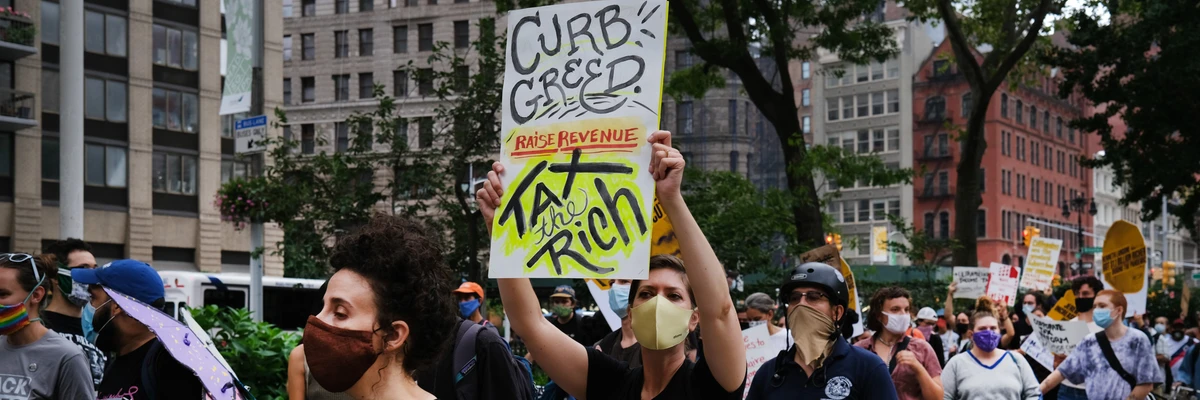
People participate in a “march on billionaires” event on July 17, 2020 in New York City.
(Photo: Spencer Platt/Getty Images)

“Americans overwhelmingly prefer raising taxes on the ultra-wealthy and huge corporations to making cuts to critical programs like healthcare, medical research, and infrastructure,” said Sen. Elizabeth Warren.

The United States’ astronomical levels of economic inequality are poised to become further entrenched in the coming years as what The New York Timesdescribed Sunday as “the greatest wealth transfer in history” gets underway, with the richest members of the Baby Boomer generation set to pass trillions of dollars in assets on to their descendants—often paying little or nothing in taxes.

“Most will leave behind thousands of dollars, a home, or not much at all. Others are leaving their heirs hundreds of thousands, or millions, or billions of dollars in various assets,” the Times reported. “Of the $84 trillion projected to be passed down from older Americans to millennial and Gen X heirs through 2045, $16 trillion will be transferred within the next decade.”

The newspaper added that thanks to the loophole-ridden U.S. tax system, “heirs increasingly don’t need to wait for the passing of elders to directly benefit from family money, a result of the bursting popularity of ‘giving while living‘—including property purchases, repeated tax-free cash transfers of estate money, and more—providing millions a head start.”

“The trillions of dollars going to heirs will largely reinforce inequality,” the Times observed. “The wealthiest 10% of households will be giving and receiving a majority of the riches. Within that range, the top 1%—which holds about as much wealth as the bottom 90%, and is predominantly white—will dictate the broadest share of the money flow. The more diverse bottom 50% of households will account for only 8% of the transfers.”

Don Moynihan, a professor at Georgetown University’s McCourt School of Public Policy, argued that the Times analysis further demonstrates that “we are not taxing the very wealthy enough.”

The Times noted that individuals in the U.S. can pass nearly $13 million in assets to heirs without paying the federal estate tax, which only applies to around two of every 1,000 American estates.

“As a result, although high-net-worth and ultrahigh-net-worth individuals could inherit more than $30 trillion by 2045, their prospective taxes on estates and transfers is $4.2 trillion,” the Times observed.

The explosion of wealth inequality in the U.S. over the past several decades has prompted growing calls for systemic reform but little substantive action from lawmakers. In 2017, congressional Republicans and then-President Donald Trump contributed to the inequality boom by ramming through tax legislation that disproportionately benefited the wealthiest Americans.

Now in control of the U.S. House, Republicans are trying to make the Trump tax cuts for individuals permanent and eliminate the estate tax altogether—a move that would give the nation’s wealthiest households another $2 trillion in tax breaks.

In April, Sen. Bernie Sanders (I-Vt.) led several of his colleagues in offering an alternative proposal: Legislation that would impose progressively higher taxes on estates worth between $3.5 million and $1 billion, as well as a 65% levy on estates worth more than $1 billion.

“At a time of massive wealth and income inequality, we need to make sure that people who inherit over $3.5 million pay their fair share of taxes,” Sanders said last month. “We do not need to provide a huge handout to multi-millionaires and billionaires. It is unacceptable that working families across the country today are struggling to file their taxes on time and put food on the table, while the wealthiest among us profit off of enormous tax loopholes and giant tax breaks.”

Sen. Elizabeth Warren (D-Mass.), a co-sponsor of Sanders’ legislation, tweeted Monday that “Americans overwhelmingly prefer raising taxes on the ultra-wealthy and huge corporations to making cuts to critical programs like healthcare, medical research, and infrastructure.”

“Congressional Republicans need to get on board,” the senator added.

Morris Pearl, a former managing director at the asset management behemoth BlackRock and the chair of the Patriotic Millionaires, stressed in an interview with the Times that structural changes to the U.S. tax code—not just a crackdown on wealthy tax cheats—are necessary to slow the rise of inequality.

“People are following the law just fine. I generally don’t pay much taxes,” said Pearl, whose group has warned that democracy “will not survive” unless the rich are taxed much more aggressively.

Stressing the ease with which rich families in U.S. are able to pass assets on to their heirs tax-free, Pearl told the Times that he currently holds stock that his wife’s father, “who died a long time ago, bought in the 1970s,” an investment that “has gone from a few thousand dollars to many hundreds of thousands of dollars”—unrealized capital gains that are not subject to taxation.

University of California, Berkeley economists Emmanuel Saez and Gabriel Zucman have estimated that $2.7 trillion of the $4.25 trillion in wealth held by U.S. billionaires is unrealized.

“I’ve never paid a penny of taxes on all that,” Pearl said of his inherited equities, “and I may not ever, because I might not sell and then my kids are going to have millions of dollars in income that’s never taxed in any way, shape, or form.”

Original article by Jake Johnson republished from Common Dreams under Creative Commons (CC BY-NC-ND 3.0).

Continue Reading‘We Are Not Taxing the Very Wealthy Enough’: Runaway Inequality About to Get Worse