Devastation in Gaza poses an increasingly serious problem for Starmer

Spread the love

Original article by Paul Rogers republished from Open Democracy under a Creative Commons Attribution-NonCommercial 4.0 International licence.

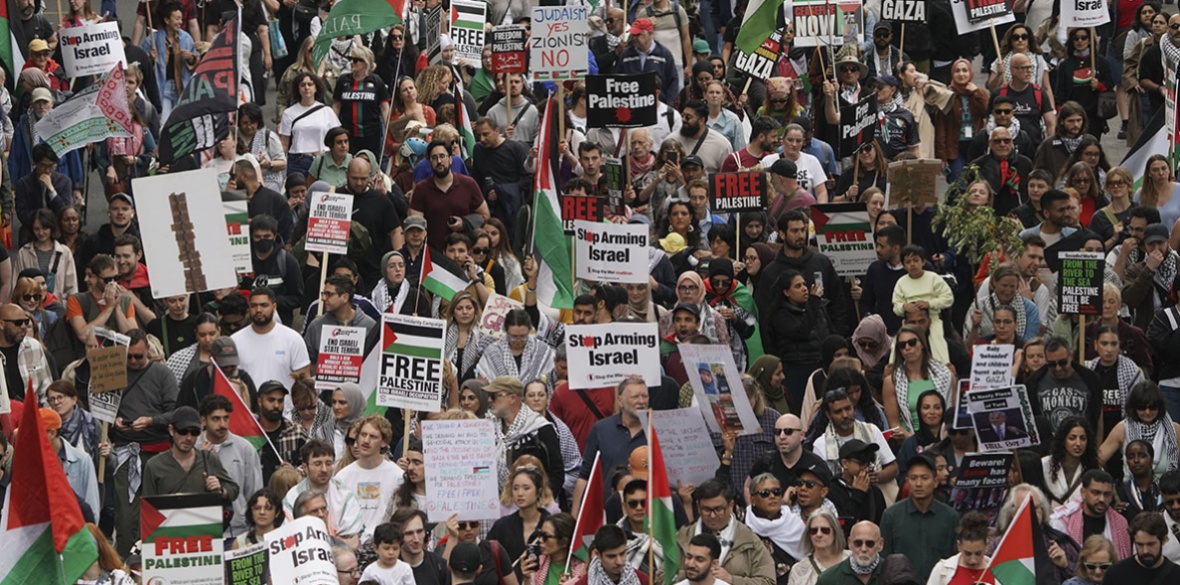
Labour’s stance on Gaza under Keir Starmer cost the party votes at the general election | Chris Kleponis/CNP/Bloomberg via Getty Images.

Starmer’s stance on Gaza has already reduced support for Labour – and that will only worsen in the coming months

The Labour Party’s landslide general election victory on 4 July has been compared to the party’s previous wins under Tony Blair in 1997 and Clement Atlee in 1945. But Keir Starmer won a far smaller vote share than either Blair or Attlee and, unlike in 1997 and 1945, the mood of the victors was hardly euphoric – more damp squib than firework display.

The party’s win was not down to any widespread love of Starmer’s policies, but a deeply embedded antagonism to the 14 years of the Tory rule, aided by Nigel Farage’s Reform Party taking votes from the Conservatives, the collapse of the SNP vote in Scotland and an unusually low national turnout.

Labour was further held back by an unexpectedly large number of voters who abandoned the party – many of whom were motivated by its stance on Israel’s assault on Gaza. The mainstream media has wrongly attributed this to the UK’s substantial Muslim minority, portraying it as just a sectarian issue – ignoring the anger and hurt felt by many on the left.

Independent candidates stood primarily on a pro-Gaza ticket across many parts of the north of England, the Midlands and London. Five were elected – a record for a general election – and many more came close, most notably Leanne Mohamad in Ilford North, who managed to reduce new health secretary Wes Streeting’s majority from 5,218 to just 528.

Overall, in 57 constituencies, Labour’s biggest challenger was an independent or a candidate from the Green Party or the Workers Party. The Greens’ leap forward was particularly notable – they came in second place in 40 seats, all currently held by Labour, up from three in 2019.

As the new independent candidates said repeatedly throughout the election campaign, Gaza is just one reason for dissent from the new Starmer norm. Many traditional Labour supporters are also unhappy that the party is moving decidedly rightwards and embracing Big Business, as revealed last week by openDemocracy. Labour now seems likely to end up as a centre-right party – effectively disenfranchising several million people.

Even so, Labour’s position on Gaza was undeniably a big factor in its fall in majorities in many seats. It presents a problem for Labour in general and Starmer in particular that is simply not going to go away – and has several components.

The first is that Israeli prime minister Binyamin Netanyahu and his far-right Knesset supporters have long espoused the view that defeating Hamas in Gaza requires inflicting punishment on the whole civilian population. It is this so-called Dahiya doctrine that is largely responsible for the appalling loss of life among Palestinians.

The death toll in Gaza is at least 37,000, with as many as 10,000 missing, mostly buried under the rubble, and well over 70,000 wounded. The Lancet, the world’s leading medical journal, recently published a letter that suggested that if indirect deaths – including those due to disease, malnutrition and increased infant mortality – are included then the total number of human lives lost could reach 186,000.

The second is that there is no end in sight for the current war. There are occasions when talks seem to be getting underway but they repeatedly come to nothing, as they have done for the past six months at least. The Palestinian suffering is huge but the Hamas military leadership believes it can persevere, especially as claims by the Israeli Defence Forces (IDF) that most of Gaza has been cleared of Hamas turn out to be false.

Israel’s current leadership has little interest in a long-term ceasefire. Netanyahu will certainly persist with his attack on Gaza until at least the US presidential election in November, now hoping that Donald Trump surviving the recent shooting will help to secure his win. Meanwhile, Israel’s steady encroachment on Palestinian land and people in the West Bank is a further sign of a long-term insistence on permanent control “from the river to the sea”.

Finally, there is one more factor that is rarely understood. The sheer scale of the loss of life and wider Palestinian suffering due to the Israeli assault on Gaza has already caused a long-term – perhaps permanent – shift in attitudes towards Israel and support for Gaza in the UK, which reaches far beyond Muslim communities.

This shift will likely only increase as more and more evidence emerges about the Israeli conduct of the war. Last week the highly experienced foreign correspondent, Chris McGreal, published a report on the IDF’s repeated use of fragmentation artillery shells in densely populated urban areas. Perhaps the most devastating of all such ordnance being used is the Israeli M339 tank shell, whose manufacturer, Elbit Systems, describes it as “highly lethal against dismounted infantry”. No doubt even more so against children.

The deliberate human impact, especially on children, is appalling and causes injuries that would be difficult to treat even in well-equipped and fully functioning hospitals – of which there are none left in Gaza due to Israel’s bombing campaign.

Other similar reports will surely follow McGreal’s and the combined impact will last years, substantially adding to calls for international legal action against Netanyahu and his government.

This is where Starmer is so vulnerable. Thanks largely to the work of a handful of investigative journalists, especially Declassified UK, we know more than the British government would like about the UK’s close links with Israel – including the multiple roles of RAF Akrotiri in Cyprus in aiding Israel and the hundreds of thousands of pounds flowing from the Israeli lobby to Cabinet ministers.

Unless there is a radical change in policy towards Israel now that Starmer is in Downing Street, the assault in Gaza will remain a problem for Labour well into the future. Add to this the wider view that Labour is moving markedly to the right and the huge parliamentary majority may not be as stabilising as it first seemed.

Original article by Paul Rogers republished from Open Democracy under a Creative Commons Attribution-NonCommercial 4.0 International licence.

Vote For Genocide Vote Labour.
Zionist Keir Starmer is quoted "I support Zionism without qualification." He's asked whether that means that he supports Zionism under all circumstances, whatever Zionists do.
Zionist Keir Starmer is quoted “I support Zionism without qualification.” He’s asked whether that means that he supports Zionism under all circumstances, whatever Zionists do.

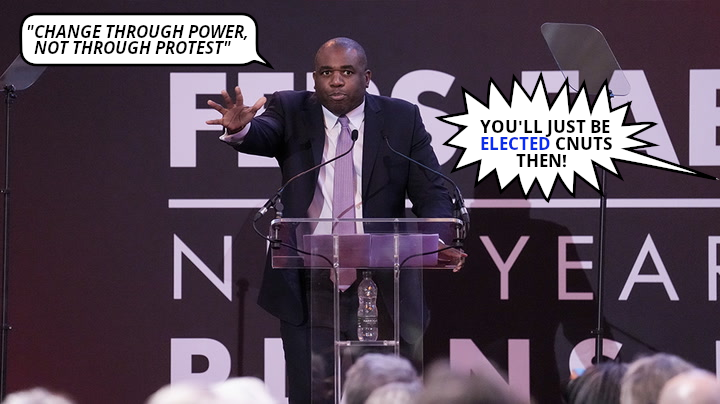
UK Labour Party Shadow Foreign Secretary repeatedly heckled at a speech to the Fabian Society over his and the Labour Party's support for and complicity in Israel's genocide of Gaza.
UK Labour Party Shadow Foreign Secretary repeatedly heckled at a speech to the Fabian Society over his and the Labour Party’s support for and complicity in Israel’s genocide of Gaza.

dizzy: We get news stories in the UK recently – since the general election and the new Labour government – of Zionists Keir Starmer and Foreign Secretary David Lammy calling on Israel for a ceasefire, even allegedly saying this to Benjamin Netanyahu, etc. That’s very difficult to accept and you can see through their actions e.g. objecting to ICC warrants, that they are fully supportive, assisting, aiding and abetting, complicit in Israel’s actions.

Continue ReadingDevastation in Gaza poses an increasingly serious problem for Starmer

George Monbiot: Labour can end austerity at a stroke – by taxing the rich and taxing them hard

Spread the love

https://www.theguardian.com/commentisfree/article/2024/jul/14/labour-end-austerity-tax-rich-uk-economic-growth

 Illustration: Kingsley Nebechi/The Guardian

The focus on growth to ease the UK’s economic ills will not be nearly enough, but there is a way to raise the sums needed

Never let your opponents define the terms of a debate. All too often, Labour has allowed the Conservatives and the billionaire press to demonise the notion of “tax and spend”. It went to great lengths before the election to assure voters it had no such intention. Now it drives home the message: instead, our needs will be met by “growth, growth, growth”. But tax and spend is the foundation of a civilised society.

Few of the changes this country requires can be achieved while adhering to the “tough spending rules” the new government has imposed on itself. We urgently need massive public investment in the NHS, social care, schools, environmental protection, social housing, local authorities, water, railways, the justice system and virtually all functions of government. We need a genuine levelling up, across regions and across classes. The austerity inflicted on us by the Conservatives was unnecessary and self-defeating and Labour has no good reason to sustain it.

The new government insists it is ending austerity. It isn’t. As the Institute for Fiscal Studies (IFS) pointed out in June, Labour’s plans mean that public services are “likely to be seriously squeezed, facing real-terms cuts”. Similarly, the Resolution Foundation has warned that, with current spending projections, the government will need to make £19bn of annual cuts by 2028-29. However you dress it up, this is austerity.

We are constantly told: “There’s no money.” But there is plenty of money. It’s just not in the hands of the government. The wealth of billionaires in the UK has risen by 1,000% since 1990. The richest 1% possess more wealth than the poorest 70%. Why do they have so much? Because the state does not; they have not been sufficiently taxed.

https://www.theguardian.com/commentisfree/article/2024/jul/14/labour-end-austerity-tax-rich-uk-economic-growth

Continue ReadingGeorge Monbiot: Labour can end austerity at a stroke – by taxing the rich and taxing them hard

With the UK creeping out of recession, here’s an economist’s brief guide to improving productivity

Spread the love
Keep on digging. kstuart/Shutterstock

Nigel Driffield, Warwick Business School, University of Warwick

At the end of last year, the UK was officially in recession. The economy shrank by 0.3% between October and December 2023, after a previous contraction between July and September.

New figures for January 2024 show a slight improvement. But there is nothing to indicate that the UK has made meaningful progress when it comes to productivity growth – and how the UK needs to produce more goods and services if living standards and wages are to improve.

Productivity growth in the UK has been virtually non-existent since the financial crisis of 2008. It lags significantly behind countries like Germany and France, and even further behind the US.

Growing productivity is not easy. Having researched this area of the economy extensively, I’m acutely aware of the the challenges facing firms which are trying to be more productive. They include everything from investment levels and access to research and development to regional inequality and a shortage of skills.

But there are some things that could be done to improve the situation. And two of the most important ones are greater investment, and a more localised approach to the national economy.

For example, one major problem in the UK is that its labour market prioritises what economists call “flexibility” – allowing firms to hire and fire employees fairly easily (compared say with France, where it is more difficult) – and getting people into entry-level jobs. It is much less focused on training and development.

Major investment in training at all levels, from basic skills through to high-level technical and managerial skills, would make workers more productive. It would allow greater job mobility, which in turn leads to a better match between demand and supply.

The UK also needs to invest in what’s known as “capital equipment” – the stuff that businesses use to produce things. For a building company this might mean buying a JCB digger instead of shovels, or for a dressmaker it could be buying a sewing machine. Put simply, if UK industries had more kit, productivity would improve.

A recent change to capital allowances which allows firms to offset investment against tax is welcome. But companies need to know that this will stay, and not be subject to political changes and inconsistent economic policy.

Freedom to grow

So money needs to be spent, and investments need to be made. But another crucial element is that the money needs to be invested locally, in the places where people actually live and work.

To be truly beneficial, this needs close collaboration between local authorities, education providers and the private sector. Local knowledge about where certain sectors are being held back, what skills are required and where they are needed, is fundamental.

Local authorities should be able to address these issues, rather than having to constantly defer to London. This means doing two more things (neither of which have ever had national government support).

The first is simplifying the workings of local government, which is notoriously complex and a constant drag on regional productivity.

And the second is helping those local governments financially, not just in terms of the current funding crisis, but also by allowing then to plan investments in skills and infrastructure over the long term, rather than having to bid piecemeal for short term funding.

Labelled cogs in a machine.
Everything connects. EtiAmmos/Shutterstock

It is clear to me from the work I have done in the West Midlands area of England that the UK economy is far too centralised. Everything from access to finance and venture capital, to investment in skills and infrastructure is heavily skewed towards the south east.

Away from that region, the UK has a low level of what economists call “aglomeration economies”, where a particular industry is concentrated within a geographical area, and supported by decent infrastructure and a good supply of skilled workers.

Compared to Germany or France, public transport in the UK is expensive and patchy, meaning people in towns often can’t access employment opportunities in cities which are relatively close by. This means that we see high levels of inequality over short distances, where poverty exists close by to great wealth.

This kind of imbalance could be addressed by combining increased investment (both public and private) with a much greater willingness to understand the various British regions which make up a currently disunited kingdom. These two steps would make the whole economic system more resilient, and in the long term, more productive.

Nigel Driffield, Professor of International Business, Warwick Business School, University of Warwick

This article is republished from The Conversation under a Creative Commons license. Read the original article.

Continue ReadingWith the UK creeping out of recession, here’s an economist’s brief guide to improving productivity

Contempt, gagging and UN intervention: inside the UK’s wildest climate trial

Spread the love
UN Special Rapporteur on Environmental Defenders under the Aarhus Convention Michel Forst attended the trial of five Just Stop Oil supporters at Southwark Crown Court. He attended as an observer because of his serious concerns.

https://www.theguardian.com/environment/article/2024/jul/12/contempt-gagging-un-intervention-uk-wildest-climate-trial-just-stop-oil

Prosecution of five Just Stop Oil activists over M25 protest led to chaotic scenes in court and concerns about ‘judicial persecution’

As part of his role as UN rapporteur for environmental defenders, Michel Forst has been watching proceedings against climate activists at courts across Europe.

But he may not have seen anything like what unfolded at Southwark crown court in London over the past two and a half weeks, where five Just Stop Oil activists were convicted for conspiring to cause gridlock on the M25 in November 2022.

On the days Forst visited, he witnessed three of the five defendants being arrested in court and dragged to the cells, protesters outside attempting to warn jurors they were not hearing the full case and a judge desperately trying to maintain control over his courtroom.

The judge, Christopher Hehir, had ruled that information about climate breakdown could not be entered into evidence, and could only be referred to by defendants briefly as the “political and philosophical beliefs” that motivated them – which he would tell the jury were in any case irrelevant to their deliberations.

But the defendants had other plans. They sought to turn Hehir’s court into a “site of civil resistance”, causing as much disruption as necessary to ensure that if the jury could not see their evidence on climate breakdown, then the jurors could at least be in no doubt it was being kept from them.

By the time the jury retired to consider a verdict, police had been called into court no fewer than seven times, four of the five defendants had been remanded to prison and 11 others were facing contempt of court proceedings for protests outside the courtroom.

By the end of the trial, Whittaker De Abreu, the only one who had not represented herself, was the only defendant left in court.

As a punishment for their “persistent disruption”, Hehir slashed the time given to each defendant from one hour to 20 minutes. He further prohibited any mention of the climate crisis, the legal defences he had disallowed or the principle of jury equity – the idea that jurors can acquit based on their conscience.

As Hallam, Shaw, Lancaster and Gethin gave their speeches from behind the reinforced glass screen of the dock, they each proceeded to flout Hehir’s prohibitions, arguing they had been denied a right to a fair trial.

Hallam told jurors: “It’s blindingly obvious to us here first that you have not been given all the evidence you need. You cannot be sure of our guilt if you are not sure that you have not been given the evidence … we have received no good reason why we are not allowed to tell you what is blindingly obvious, namely what I’m not allowed to speak about. If you are not allowed to hear the blindingly obvious then it’s not a fair trial is it?”

It took just a day’s deliberations for the jury to unanimously find them guilty.

Given the recent history of UK climate protest trials, in which defendants have been sentenced to jail for merely mentioning the words “climate change”, and notwithstanding the dramatic arrests in court, Forst said he was surprised the judge gave them an opportunity to mention climate breakdown at all.

“But the little latitude they had to mention climate change was in the meantime emptied of its very meaning by the fact that, overall, the jury was told to ignore most of it,” he added.

https://www.theguardian.com/environment/article/2024/jul/12/contempt-gagging-un-intervention-uk-wildest-climate-trial-just-stop-oil

Continue ReadingContempt, gagging and UN intervention: inside the UK’s wildest climate trial

The UK doesn’t work for Disabled people. Neither Labour or the Conservatives will change that

Spread the love

Original article by Mikey Erhardt republished from Open Democracy under a Creative Commons Attribution-NonCommercial 4.0 International licence

Neither Keir Starmer nor Rishi Sunak has any real plan to improve the lives of Disabled people | Jonathan Hordle – ITV via Getty Images

So far, we’ve heard more about Starmer and Sunak’s parents than the UK’s 16 million Disabled people

“This election is about who our country works for — the patriotic belief that Britain can be better and must be better,” said Kier Starmer concluding the first leaders’ debate earlier this month.

There are at least 16 million Disabled people in the UK – we make up a quarter of the population. We know this country doesn’t work for us, we’ve known that our entire lives. We disproportionately live in poverty, achieve poorer outcomes in education, and are more likely to be unemployed or earn less.

Yet every leadership debate so far has given more time to talking about Starmer and Rishi Sunak’s parents than these problems, which face millions of Disabled people up and down the country.

The general election campaign has solidified that neither the Labour leader nor his rival, incumbent Conservative prime minister Rishi Sunak, has any interest in improving our lives.

It is not as if the Conservatives or Labour don’t know about the issues we face. A United Nations report published in April confirmed that the UK is violating our human rights; a parliamentary committee last month found that “Disabled people undeniably encounter unnecessary and severe barriers to accessing suitable housing in England”; and the Department of Work and Pensions is under investigation by the Equality and Human Rights Commission over its treatment of Disabled claimants.

Disabled people in the UK are not a homogenous group. Some of us experience greater injustice than others. But we also have many things in common. We all want to live in an inclusive society where everyone has a fulfilling life and feels connected and valued.

We know politicians do not place the same worth on our lives as others; every day we experience discrimination, oppression and barriers to our inclusion and full participation in society because they won’t take the action needed to change it.

Years of deep cuts to services and neglect mean societal infrastructure, such as housing, transport and street environment, consistently fails to meet our needs. This structural decline has coincided with anti-migrant, anti-trans and racist policies, leaving ever-increasing numbers of us in poverty, homeless, incarcerated or dead.

The UN report was clear: “There has been no significant progress for Disabled people throughout the UK concerning their right to living independently and being included in the community.

“While some reforms and policies have been undertaken to provide financial support, accessible housing, and transport, this has been inadequate considering the cost-of-living crisis.”

One would expect this damning conclusion to be a key feature of the election campaign. But over the past four weeks, Labour and the Tories have both failed to provide anything of substance to help Disabled people.

Sunak’s Conservatives have instead pledged to shave £12bn a year from the cost of benefits, much of which would come from a crackdown on the personal independence payment (PIP) given to people with extra care or mobility needs. The party also seeks to tighten the work capability assessment (WCA), which would see more Disabled people declared fit to work and denied their benefit.

Labour’s manifesto, meanwhile, is notable for what it lacks. Previous promises to overhaul the welfare system, end punitive sanctions and co-produce disability-related policy with Disabled people are all missing – as are commitments to end care charges, increase carers’ allowance and ensure better provision of accessible housing.

Labour’s vows to improve SEN (special education needs) provision in schools and introduce changes to support Disabled people to gain and retain jobs are sticking plasters at best. Its manifesto sports a glaring lack of immediate investment in disability and carer benefits and social care – and we all know you can’t fix things without investment.

With so little real change on offer, Disabled people must unite and fight back. We can draw inspiration from the experiences of UK-based Disabled activists and the radical disabled resistance of the past 40 years. No changes affecting us have come through without collective struggle and organising.

As part of the DPO Forum England, a collective of Disabled people’s organisations in England, we are committed to joining forces nationwide and unifying our demands. That’s why we came together to create the Disabled People’s Manifesto, which contains radical policy demands for systemic overhaul and transformation. 

We, as Disabled people, must now come together and demand our politicians take up the manifesto and commit to creating a country that values equity, dignity, respect, trust, and support as much as we value anything else. Our political system should be focused on supporting Disabled people to live the lives we have a right to, which no candidate sweating under the bright studio lights can deliver on their own.

Together, we can create space for ourselves and our ideas, and integrate the energy, dedication and skills of our community to create a new future.

Original article by Mikey Erhardt republished from Open Democracy under a Creative Commons Attribution-NonCommercial 4.0 International licence

Jeremy Hunt’s benefit crackdown will worsen an already terrible system

The government’s insulting Disability Action Plan won’t deliver any change

How the DWP fought to withhold evidence its policies kill disabled people

Continue ReadingThe UK doesn’t work for Disabled people. Neither Labour or the Conservatives will change that