By KENNY STANCIL Apr 21, 2023
Original article republished from Common Dreams under Creative Commons (CC BY-NC-ND 3.0).
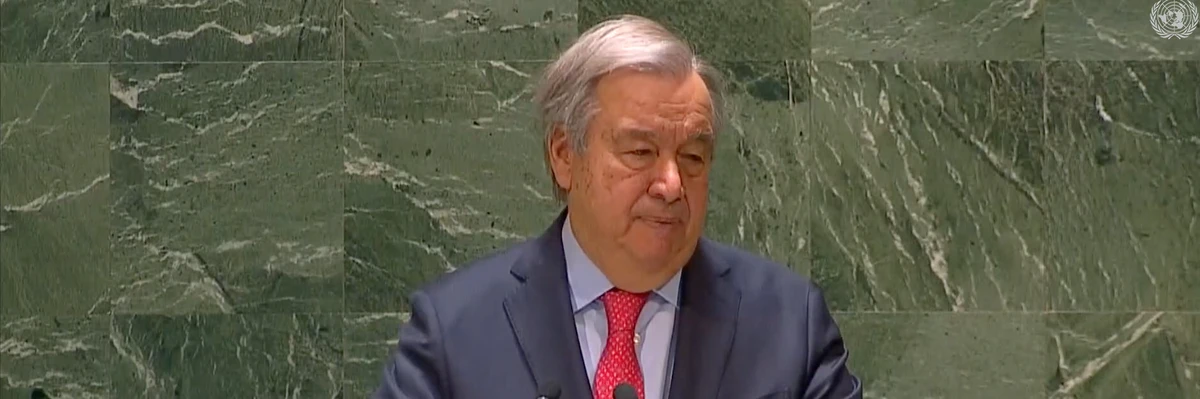
“We have the tools, the knowledge, and the solutions,” said U.N. Secretary-General António Guterres. “But we must pick up the pace.”
The World Meteorological Organization warned Friday that climate change indicators are “off the charts,” one day after United Nations Secretary-General António Guterres told officials from wealthy countries that their refusal to halt fossil fuel expansion amounts to a civilizational “death sentence” and pleaded with them to urgently decarbonize the global economy.
The WMO’s State of the Global Climate 2022 report details how record-high greenhouse gas levels are causing “planetary scale changes on land, in the ocean, and in the atmosphere.”
Measured concentrations of the three main heat-trapping gases—carbon dioxide, methane, and nitrous oxide—have never been higher, and emissions continued to increase in 2022, the WMO points out. Last year’s mean global temperature was 1.15°C above preindustrial levels, and the eight years since 2015 have been the eight hottest on record despite the cooling effects of a rare “triple-dip” La Niña event over the past three years. The return of El Niño conditions in 2023 is expected to exacerbate heating.
Ocean heat content continued to soar in 2022, reaching a new record high. “Around 90% of the energy trapped in the climate system by greenhouse gases goes into the ocean, somewhat ameliorating even higher temperature increases but posing risks to marine ecosystems,” including through ocean acidification, the WMO notes. “Ocean warming rates have been particularly high in the past two decades.”
“Today’s policies would make our world 2.8°C hotter by the end of the century… This is a death sentence.”
Global mean sea level also continued to climb and hit a new record high in 2022. According to the WMO, “The rate of global mean sea level rise has doubled between the first decade of the satellite record (1993-2002, 2.27 mm/yr) and the last (2013-2022, 4.62 mm/yr).” In addition to ocean warming, a major contributor to rising sea levels is land ice loss from Earth’s glaciers and the Greenland and Antarctic ice sheets. The rapid melting of glaciers and sea level rise will persist for “thousands of years,” says the WMO, underscoring the importance of slashing planet-heating pollution to protect the billions of people living near coastlines.
In 2022, Antarctic sea ice dropped to its lowest extent on record, the Greenland Ice Sheet ended with a negative total mass balance for the 26th consecutive year, and the average thickness of reference glaciers for which scientists have long-term observation data decreased by more than 1 meter (bringing the total cumulative loss since 1970 to nearly 30 meters), the WMO notes. The European Alps shattered records for glacial melt last year, with significant losses also seen in High Mountain Asia, western North America, South America, and parts of the Arctic.
As the report makes clear, these dangerous meteorological trends have harmed biodiverse ecosystems and unleashed devastating socioeconomic consequences around the globe, felt most acutely by those rendered vulnerable due to preexisting patterns of inequality.
“While greenhouse gas emissions continue to rise and the climate continues to change, populations worldwide continue to be gravely impacted by extreme weather and climate events,” said WMO Secretary-General Petteri Taalas. “For example, in 2022, continuous drought in East Africa, record-breaking rainfall in Pakistan, and record-breaking heatwaves in China and Europe affected tens of millions, drove food insecurity, boosted mass migration, and cost billions of dollars in loss and damage.”
Prior to the release of the WMO’s annual report, Guterres on Thursday challenged the leaders of high-income countries to immediately strengthen lifesaving climate action rather than continue to prolong the life of the climate-wrecking fossil fuel industry.
Addressing the fourth meeting of the Major Economies Forum, convened by U.S. President Joe Biden, Guterres told “the major emitters” in a recorded video message that “today’s policies would make our world 2.8°C hotter by the end of the century.”
“This is a death sentence,” said Guterres.
Echoing what he said last month when the Intergovernmental Panel on Climate Change published its latest comprehensive assessment, the U.N. chief stressed that “it is still possible to limit global temperature rise to 1.5°C. But only if the world takes a quantum leap in climate action. And that depends on you.”
“The science is clear: new fossil fuel projects are entirely incompatible with 1.5°C,” the warming cap agreed to in the 2015 Paris accord, Guterres continued. “Yet many countries are expanding capacity.”
Though the U.N. chief declined to single anyone out by name, Biden has faced mounting criticism for rubber-stamping more permits for fossil fuel extraction on public lands and waters than his White House predecessor, including the recent approval of ConocoPhillips’ massive Willow oil drilling project in the Alaskan Arctic. The Biden administration has also moved to expand fracked gas export capacity, especially in the U.S. Gulf South, since Russia invaded Ukraine last February.
Jean Su, director of the Center for Biological Diversity’s Energy Justice program, did call out Biden in a statement issued Thursday.
“Behind the green screen of Biden’s climate promises, he continues to greenlight destructive fossil fuel expansion in project after project,” said Su. “We need a real reduction in the oil and gas burning up our future, starting with reversing the Willow approval and an end to all new fossil fuel project permits.”
Guterres, for his part, urged the summit participants “to change course.” He elaborated:
Phase out coal by 2030 in OECD countries and 2040 in all others. End all licensing or funding—both public and private—of new fossil fuel projects. Make sure generation of electricity is net-zero by 2035 in developed countries, and 2040 elsewhere. Decarbonize major sectors faster—from shipping, aviation, and steel, to cement, aluminum, and agriculture—in close cooperation with the private sector. Put a price on carbon. And shift fossil fuel subsidies to finance a just transition to renewables. The International Energy Agency estimated that these subsidies came to $1 trillion in 2022—which is insanity.
In addition to bolstering mitigation efforts by winding down fossil fuel production and expediting a just transition to clean energy, rich nations must also deliver on their unfulfilled climate finance promises, Guterres continued.
Biden opened Thursday’s summit by announcing $1 billion for the Green Climate Fund—a small fraction of the $886 billion military budget he requested last month and a far cry from what experts say is needed.
“We must accelerate climate justice by reforming the international financial system,” said Guterres. “As major shareholders of the Multilateral Development Banks, I urge you to push them to coordinate their operations better, and to overhaul their business models and approaches to risk, in order to turbocharge climate action and sustainable development.”
“You have the power to ensure that they leverage their funds to mobilize much more private finance at reasonable cost to developing countries, and that they end all support for fossil fuels,” he added. “You can pressure them to urgently transition and scale-up their funding to renewables, adaptation, and loss and damage.”
Responding to the WMO’s report, published ahead of Earth Day, the U.N. chief emphasized that “we have the tools, the knowledge, and the solutions. But we must pick up the pace.”
Original article republished from Common Dreams under Creative Commons (CC BY-NC-ND 3.0).