UN chief urges immediate reopening of Strait of Hormuz amid global trade crisis

Spread the love

This work by Middle East Monitor is licensed under a Creative Commons Attribution-NonCommercial-ShareAlike 4.0 International License.

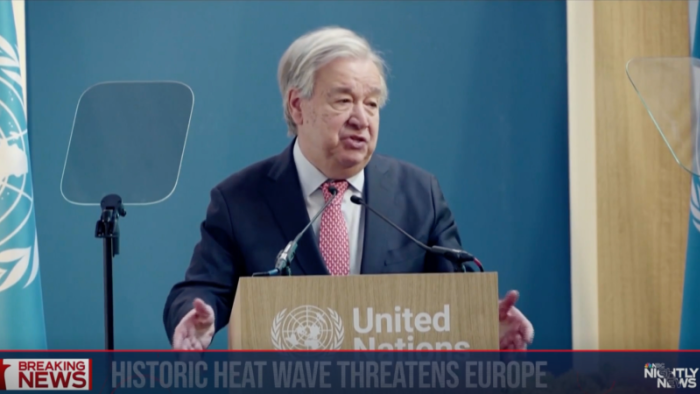
United Nations Secretary-General Antonio Guterres speaks in New York, United States on April 14, 2026. [Islam Doğru – Anadolu Agency]

UN Secretary-General Antonio Guterres on Monday urged the reopening of the Strait of Hormuz amid stalled US-Iran peace talks, Anadolu reports.

“I appeal to the parties: Open the Strait. Let ships pass. No tolls. No discrimination. Let trade resume. Let the global economy breathe,” Guterres said at a high-level UN Security Council debate on maritime security.

The Strait of Hormuz—through which roughly one-fifth of global oil and liquefied natural gas flows—has faced major disruptions since early March after the US and Israel launched a joint offensive against Iran on Feb. 28. The war is currently on a halt and efforts to end it permanently are underway.

“Since early March, the disruption of shipping through the Strait of Hormuz has struck at global energy security, food supplies, and trade. The Strait of Hormuz is one of the world’s most critical maritime chokepoints,” Guterres said.

Safe, unimpeded passage is an economic and humanitarian “imperative,” he said, adding: “The economic shock has been immediate – and everyone is paying the price.”

READ: Germany’s Merz says US has ‘no exit strategy’ in Iran war, calls Tehran ‘skilled negotiator’

Beyond economic indicators, Guterres highlighted the human cost of the crisis. More than 20,000 seafarers remain stranded at sea, while over 2,000 commercial vessels are caught in uncertain and often dangerous conditions.

“These men and women are not parties to any conflict,” he said. “They are civilian workers keeping the world supplied.”

Guterres emphasized that international law must be upheld, including navigational rights guaranteed under the Law of the Sea. He referenced UN Security Council Resolution 2817, stressing that safe and unimpeded passage through the strait is a fundamental principle.

“The Charter’s prohibition of the threat or use of force applies fully at sea,” he said.

The UN chief urged all parties to pursue restraint and dialogue, offering his mediation to help resolve tensions. He pointed to past efforts such as the Black Sea Grain Initiative as proof that cooperation is possible even during conflict.

“The ocean must be a zone of peace and cooperation — not confrontation or coercion,” Guterres said.

READ: Top diplomats of Iran, Qatar, Saudi Arabia discuss efforts for ceasefire with US

This work by Middle East Monitor is licensed under a Creative Commons Attribution-NonCommercial-ShareAlike 4.0 International License.

Keir Starmer explains that UK is actively supporting Israel's genocidal expansion and repeats his previous quotation that he supports Zionism "without qualification". Keir Starmer said “I said it loud and clear – and meant it – that I support Zionism without qualification.” here: https://www.jewishnews.co.uk/keir-starmer-interview-i-will-work-to-eradicate-antisemitism-from-day-one/
Keir Starmer explains that UK is actively supporting Israel’s genocidal expansion and repeats his previous quotation that he supports Zionism “without qualification”. Keir Starmer said “I said it loud and clear – and meant it – that I support Zionism without qualification.” here: https://www.jewishnews.co.uk/keir-starmer-interview-i-will-work-to-eradicate-antisemitism-from-day-one/
Climate science denier Donald Trump confirms that he knows nothing about democracy and that more liquid gold is being secured according to his policy of global privateering.
Donald Trump sings and dances, says that it's fun to kill everyone ...
Donald Trump sings and dances, says that it’s fun to kill everyone …

Continue ReadingUN chief urges immediate reopening of Strait of Hormuz amid global trade crisis

UN chief warns Gaza hunger gains are ‘fragile’ as 1.6M still face extreme food insecurity

Spread the love

This work by Middle East Monitor is licensed under a Creative Commons Attribution-NonCommercial-ShareAlike 4.0 International License.

Displaced Palestinians, who struggle with hunger, wait to receive hot meal, distributed by charity organizations, in al-Mawasi region of Khan Yunis, Gaza on December 17, 2025. [Abed Rahim Khatib – Anadolu Agency]

UN Secretary-General Antonio Guterres on Friday warned that while famine in the Gaza Strip has been averted, the humanitarian situation remains extremely fragile, with more than 75% of the population facing acute food insecurity and critical risks of malnutrition, Anadolu Agency reports.

“Famine has been pushed back. Far more people are able to access the food they need to survive,” Guterres told a news conference at the UN headquarters in New York. “Gains are fragile, perilously so.”

He said 1.6 million people in Gaza, more than 75% of the population, are projected to face “extreme levels of acute food insecurity and critical malnutrition risks.”

“And in more than half of Gaza, where Israeli troops remain deployed, farmland and entire neighborhoods are out of reach. Strikes and hostilities continue, pushing the civilian toll of this war even higher and exposing our teams to grave danger,” he said.

Guterres also renewed calls for “a durable ceasefire,” saying: “We need more crossings, the lifting of restrictions on critical items, the removal of red tape, safe routes inside Gaza, sustained funding, and unimpeded access, including for NGOs.”

The Integrated Food Security Phase Classification (IPC) released its news findings on Friday, noting that famine conditions in the enclave have been temporarily offset following a reduction in hostilities and improved access for humanitarian and commercial food deliveries. The latest report, however, warned that the overall situation in Gaza remains critical.

The UN chief also touched on Israel’s refusal to move onto the second phase of the Gaza ceasefire plan until the return of the remains of a final deceased hostage.

“It is essential to move to phase two, and I don’t think that we should have any pretext to avoid it,” said Guterres.

“It’s very important to move with the peace process as a whole. And it’s not only phase two. It’s to make sure that phase one, and namely the ceasefire, are fully implemented,” he added.

READ: Egypt, Russia stress need to sustain Gaza ceasefire agreement

ICJ ruling on occupied West Bank ‘must be implemented’

On the situation in the West Bank, Guterres warned that “we cannot lose sight of the rapidly deteriorating situation” in the Palestinian territory occupied by Israel.

He stressed that Palestinians face “escalating Israeli settler violence, land seizures, demolitions and intensified movement restrictions.”

“Tens of thousands have been displaced following operations by Israeli forces in the northern West Bank,” he added.

Guterres emphasized that provisional measures indicated by the International Court of Justice “are binding and must be implemented.”

He also reaffirmed his support for the UN agency for Palestinian refugees (UNRWA), calling it “an indispensable role in serving the Palestinian people.”

Saying that the crisis in Palestine is “born of human decisions,” the UN chief urged for an end to “perverse and prolonged suffering.”

“Palestinians need a horizon of hope. The ceasefire must be implemented in full. The endless cycle of violence must be broken,” he said.

READ: WHO chief says over 10,600 patients evacuated from Gaza, warns many still waiting

This work by Middle East Monitor is licensed under a Creative Commons Attribution-NonCommercial-ShareAlike 4.0 International License.

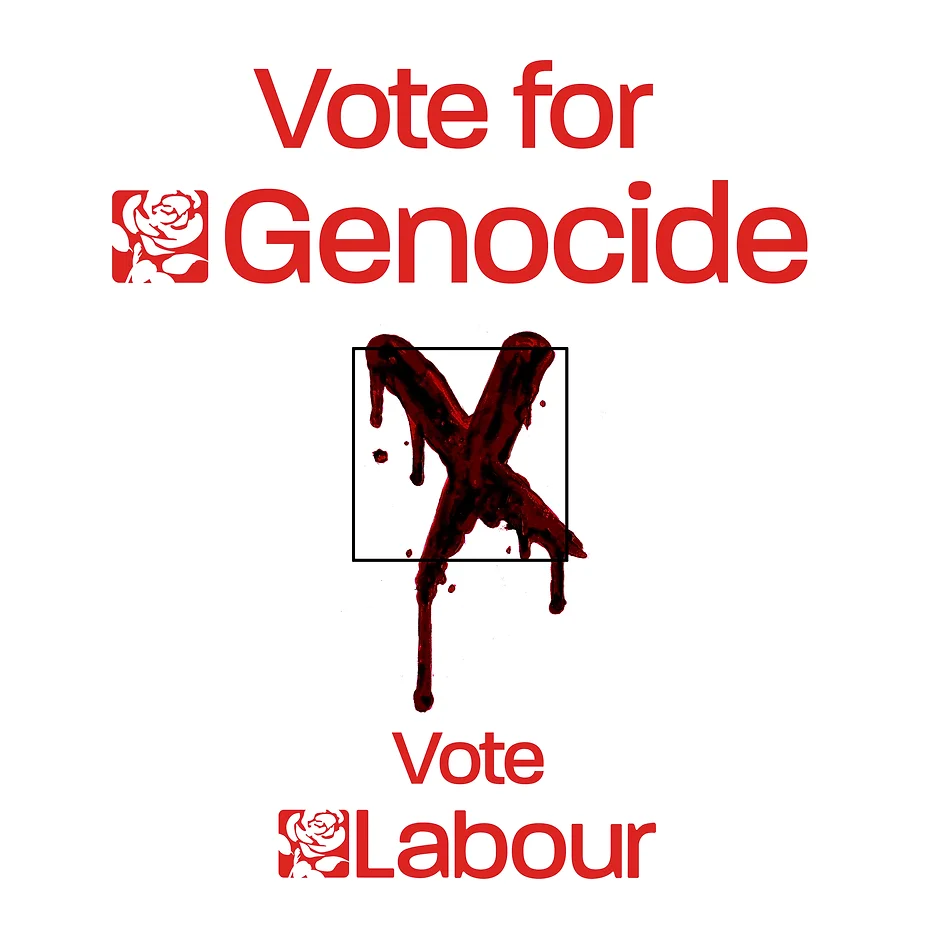
Vote Labour for Genocide.
Keir Starmer objects to criticism of the IDF. He asks how could anyone object to them starving people to death, forced marches like the Nazis did, bombing Gaza's hospitals and universities, mass-murdering journalists, healthworkers and starving people queuing for food, killing and raping prisoners and murdering children. He calls for people to stop obstructing his genocide for Israel.
Keir Starmer objects to criticism of the IDF. He asks how could anyone object to them starving people to death, forced marches like the Nazis did, bombing Gaza’s hospitals and universities, mass-murdering journalists, healthworkers and starving people queuing for food, killing and raping prisoners and murdering children. He calls for people to stop obstructing his genocide for Israel.
Orcas discuss Genocide-supporting and complicit Zionists. Donald Trump, Keith Starmer, David Lammy, Rachel Reeves, Angela Rayner and Wes Streeting are acknowledged as evil genocide-complicit and supporting cnuts.

Continue ReadingUN chief warns Gaza hunger gains are ‘fragile’ as 1.6M still face extreme food insecurity

‘I will not shut up’: UN chief says he will keep pushing for 2-state solution

Spread the love

This work by Middle East Monitor is licensed under a Creative Commons Attribution-NonCommercial-ShareAlike 4.0 International License.

United Nations Secretary-General Antonio Guterres gives a speech in New York City, United States. on Monday, May 05, 2025.[Selçuk Acar – Anadolu Agency]

UN Secretary-General Antonio Guterres said he will “not shut up” while speaking out on the future of the two-state solution to the Palestinian issue, stressing that he will continue to push for political progress, Anadolu reports.

His remarks came during the 2025 UN Reham Al-Farra (RAF) Fellowship session on Friday, where he warned young journalists that the world is facing a “perfect storm” of conflicts, climate chaos, deepening inequality and unregulated artificial intelligence.

The UN chief said he would not give up on efforts to advance a political path forward, stressing that avoiding a return to past violence is “not enough.”

“It is absolutely essential that we move to Phase Two, and that the final result is the two-state solution… There will be no peace in the Middle East without the self-determination of the Palestinian people.”

He added that even if the Security Council cannot deliver such progress, he “will not shut up” if developments move away from international law and the UN Charter.

READ: Gaza ceasefire remains incomplete without West Bank, Qatari prime minister says

‘A perfect storm’: Conflicts, climate and a paralyzed Security Council

Earlier in his address, Guterres painted a bleak global picture, saying today’s international landscape is dramatically more dangerous than when he took office in 2017.

He cited the Russia-Ukraine war, the “level of death and destruction” in Gaza, escalating violence in Sudan, Myanmar and the Sahel, and the spread of terrorism across Africa.

He sharply criticized the Security Council’s inability to act, calling it “paralyzed” and structurally outdated, with no permanent representation from Africa or Latin America and a veto system that “protects violations of international law.”

Climate overshoot: ‘My generation has failed’

On the climate crisis, Guterres delivered one of his starkest warnings, declaring: “My generation has failed in relation to climate action.”

He said the world is heading toward a temperature overshoot above 1.5°C, with devastating consequences for human health, food security and global stability. Current national emissions pledges amount to only 10% reductions by 2035, far below the 60% required, he added.

READ: UN General Assembly renews mandate of UN agency for Palestinian refugees for 3 years

Calls for Global South representation and institutional reform

Answering questions from fellows, Guterres said the UN is pushing for reforms to strengthen the voice of the Global South, but such changes ultimately depend on member states, adding: “Power is never distributed. Power is taken.”

He noted that emerging economies – Brazil, India, China, Indonesia and others – represent a growing share of global output, while global governance structures still reflect the world of 1945.

Humanitarian funding collapse and widening inequalities

Guterres also warned that reduced contributions to development and humanitarian aid, including cuts by the United States and other donors, have resulted in a “deep disaster” for communities facing hunger, lack of health services and collapsing essential infrastructure.

To adapt, UN agencies are consolidating supply chains, procurement and logistics to preserve as many resources as possible for crisis-affected populations.

A message to young people: Don’t give up, transform the system

Addressing widespread youth distrust in multilateral institutions, he urged young journalists to fight for reform rather than abandon the system.

“There is no solution to global issues without strong multilateral institutions… The answer is not to get rid of them, but to transform them,” he added.

READ: UN chief: Israel committed war crimes in Gaza

This work by Middle East Monitor is licensed under a Creative Commons Attribution-NonCommercial-ShareAlike 4.0 International License.

Keir Starmer objects to criticism of the IDF. He asks how could anyone object to them starving people to death, forced marches like the Nazis did, bombing Gaza's hospitals and universities, mass-murdering journalists, healthworkers and starving people queuing for food, killing and raping prisoners and murdering children. He calls for people to stop obstructing his genocide for Israel.
Keir Starmer objects to criticism of the IDF. He asks how could anyone object to them starving people to death, forced marches like the Nazis did, bombing Gaza’s hospitals and universities, mass-murdering journalists, healthworkers and starving people queuing for food, killing and raping prisoners and murdering children. He calls for people to stop obstructing his genocide for Israel.
Orcas discuss Genocide-supporting and complicit Zionists. Donald Trump, Keith Starmer, David Lammy, Rachel Reeves, Angela Rayner and Wes Streeting are acknowledged as evil genocide-complicit and supporting cnuts.
Experiencing issues with this image not appearing. I suspect because it's so critical of Zionist Keir Starmer's support of and complicity in Israel's genocides.
Genocide denier and Current UK Prime Minister Keir Starmer is quoted that he supports Zionism without qualification. He also confirms that UK air force support has been essential in Israel’s mass-murdering genocide. Includes URLs https://www.declassifieduk.org/keir-starmers-100-spy-flights-over-gaza-in-support-of-israel/ and https://youtu.be/O74hZCKKdpA
Continue Reading‘I will not shut up’: UN chief says he will keep pushing for 2-state solution

Over 200 global figures urge UN to dismantle Israeli apartheid and end impunity

Spread the love

This work by Middle East Monitor is licensed under a Creative Commons Attribution-NonCommercial-ShareAlike 4.0 International License.

UN Secretary General Antonio Guterres (C) makes a speech as he attends the three-day International Palestine Conference, led by France and Saudi Arabia and attended by Turkiye at the United Nations Trusteeship Council in New York, United States on July 28, 2025. [Selçuk Acar – Anadolu Agency]

More than 200 prominent figures from across the world, including political leaders, academics, human rights advocates, journalists, religious scholars and cultural icons, have issued a joint letter to United Nations Secretary-General António Guterres calling for “the dismantling of apartheid” and “an end to impunity” for Israel’s crimes against the Palestinian people.

The letter issued yesterday warns that “silence has become complicity and hesitation a betrayal of the very Charter upon which the United Nations was founded.” It accuses Israel of committing “one of the most extensive massacres in modern history” in Gaza during June and July 2025, in which more than 60,000 Palestinians – including over 17,000 children – were killed, and over two million displaced.

The letter presents what it calls “seven myths” that have sustained Israel’s oppression since before its creation. It describes the 1948 Nakba as a “deliberate erasure” of the indigenous Palestinian people, with over 500 villages destroyed and more than 700,000 Palestinians made stateless, and rejects the narrative of Israel’s “birth” as a lawful or just event.

Tracing an unbroken chain of violence, the signatories cite the massacre at Deir Yassin in 1948, the atrocities at Sabra and Shatila in 1982, the brutal assault on Jenin in 2002, repeated bombardments of Gaza from 2008 to 2021, and the devastation unleashed since 7 October 2023. These, they argue, expose a “deliberate project of colonial expansion, racial domination, and cultural erasure, underpinned by… legal impunity.”

The appeal condemns Israel’s June 2025 attack on Iran as an unprovoked act of aggression against a sovereign state and accuses it of “normalising assassination” as a state policy. It warns that the regime’s “vast apparatus of disinformation” has been used to criminalise resistance, silence dissent, and invert the moral order by branding victims as aggressors.

READ: Israeli agriculture minister proposes Libya to host displaced Gazans

Affirming the Palestinian right to resist occupation under UN General Assembly Resolution 37/43, the letter insists that justice can only come through “a democratic referendum, inclusive of all indigenous inhabitants, be they Muslim, Christian, or Jew, and excluding those settled by colonial force.”

Declaring Zionism “not reformable” and the Israeli state “inherently exploitative, oppressive, war-mongering and unjust,” the signatories call for its dismantlement as a political and legal entity. They urge the UN to take “urgent and unequivocal action” not only in response to the June–July 2025 atrocities, but as “a historical reckoning for the accumulated crimes committed over more than a century against the Palestinian people.”

“Liberation from apartheid. Liberation from impunity. Liberation from a structure that for more than 80 years has perpetuated occupation, dispossession, and mass murder,” the letter concludes. “No arsenal of lies, no machinery of occupation, and no doctrine of impunity can withstand the long moral reckoning that history demands.”

Continue ReadingOver 200 global figures urge UN to dismantle Israeli apartheid and end impunity

Humanity at the climate crossroads: highway to hell or a livable future?

Spread the love

Humanity at the climate crossroads: highway to hell or a livable future?

Damian Carrington

The choice in the new IPCC report is stark: what we do in the next few years will determine our fate for millennia

After a 10,000-year journey, human civilisation has reached a climate crossroads: what we do in the next few years will determine our fate for millennia.

That choice is laid bare in the landmark report published on Monday by the Intergovernmental Panel on Climate Change (IPCC), assembled by the world’s foremost climate experts and approved by all the world’s governments. The next update will be around 2030 – by that time the most critical choices will have been made.

The report is clear what is at stake – everything: “There is a rapidly closing window of opportunity to secure a liveable and sustainable future for all.”

“Continued emissions will further affect all major climate system components, and many changes will be irreversible on centennial to millennial time scales,” it says. To follow the path of least suffering – limiting global temperature rise to 1.5C – greenhouse gas emissions must peak “at the latest before 2025”, the report says, followed by “deep global reductions”. Yet in 2022, global emissions rose again to set a new record.

Humanity at the climate crossroads: highway to hell or a livable future?

Continue ReadingHumanity at the climate crossroads: highway to hell or a livable future?