Tag: University of Massachusetts

  • Trump’s Horrific, Illegal Iran War Has ‘Costs Us Billions While Making Us Less Safe’

    Spread the love

    Article by Brad Reed republished from Common Dreams under Creative Commons (CC BY-NC-ND 3.0).
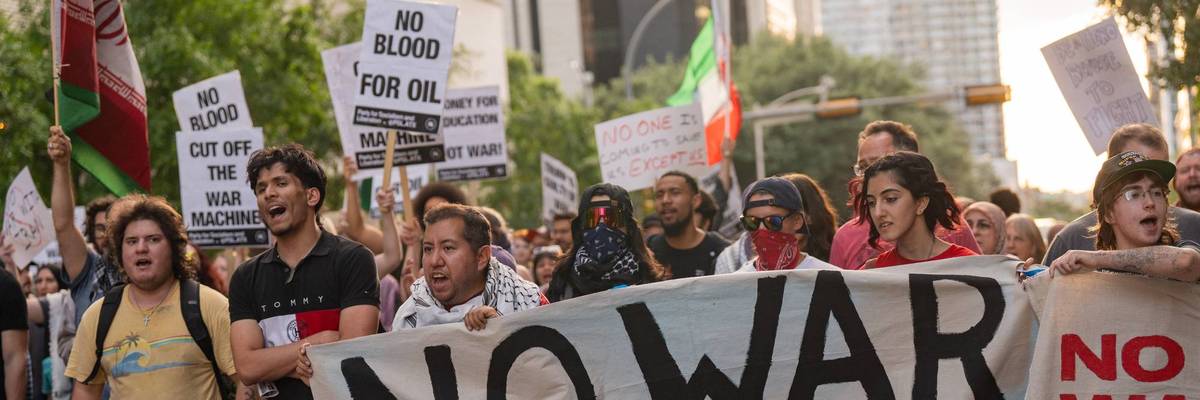
    Protesters march to show opposition to the war in Iran in Austin, Texas, on April 8, 2026. 
    (Photo by Mikala Compton/The Austin American-Statesman via Getty Images)

    “This is a self-inflicted wound, it’s a choice, and it can be undone.”

    A group of experts says that President Donald Trump’s illegal war with Iran, which has been massively expensive and has made Americans less safe, shows the need for a radical overhaul of US foreign policy.

    Scholars at the Political Economy Research Institute (PERI) at the University of Massachusetts on Wednesday are holding a webinar to present ideas for reducing the US military footprint and using the savings to invest in programs that will directly benefit working-class Americans.

    RECOMMENDED…
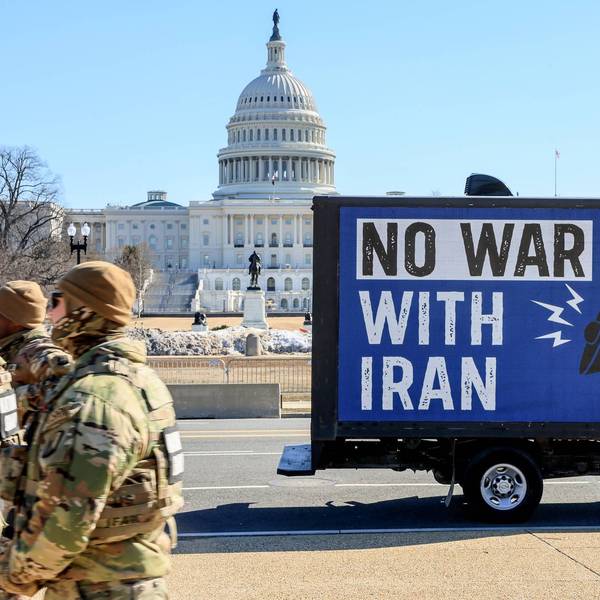
    Win Without War Billboard Truck Circles U.S. Capitol On State Of The Union Day, Calling On Congress For No War On Iran

    CBO Finds Trump’s Iran War Has Already Cost Nearly $40 Billion—And That’s a ‘Conservative’ Estimate

    US Vice President JD Vance

    ‘I Wouldn’t Call It a War,’ Says JD Vance After 6 Months of Trump’s Failed, Costly, and Illegal War on Iran

    In a video posted on social media ahead of the webinar, PERI experts advocated for making major changes to US foreign policy, which they argued has left the country overstretched.

    “The Iran War costs us billions while making us less safe,” says a message accompanying the video on PERI’s social media account. “By reining in military spending and taxing the wealthy to pay their fair share, we can fund critical services like universal preschool, infrastructure investments, and Medicare for All.”

    Lindsay Koshgarian, program director of the National Priorities Project (NPP), made the case that the US can no longer enforce a policy of “maintaining dominance over the entire world.”

    “We have endless wars in the Middle East, a war of choice with Iran at the moment,” said Koshgarian. “Clearly, something is broken about our foreign policy. It’s extremely costly and, in fact, it actually makes us less safe.”

    Koshgarian then outlined her plan for what she described as “a smaller, safer military” that would slash US presence overseas and generate between $200 billion to $500 billion of savings per year.

    Heidi Peltier, senior researcher at the Watson School of International and Public Affairs at Brown University, pointed to Trump’s request for an “astronomical” $1.5 trillion military budget to argue that America’s priorities have become completely warped.

    “The money is there,” Peltier said. “The question really is, what are our priorities?”

    Peltier’s research aims to “demilitarize” federal spending by reducing the annual US Department of Defense budget by 10%, which would free up $100 billion more to spend on domestic priorities.

    Aaron Medlin, professor of international studies at Boston College, pointed to the ways Trump’s illegal war had made the price of energy more expensive and was inflicting economic pain on working-class Americans.

    Medlin said that his work focuses on raising taxes on the wealthy by taxing income generated from owning assets at the same rate as income generated from working, while also imposing a minimum tax on fortunes over $100 million, and small levies on stock, bond, and derivatives trades.

    In total, Medlin estimates that the proposed tax package would raise more than $2 trillion annually.

    “The United States is just becoming unaffordable for a huge share of Americans,” he said. “This is a self-inflicted wound, it’s a choice, and it can be undone.”

    The experts’ proposals for reducing the US military footprint and taxing extreme wealth came on the same day that petroleum industry analyst Patrick De Haan estimated that Americans have now spent over $75 billion more on gasoline since the start of the Iran War.

    When higher gas prices are combined with rising rates for diesel, the Costs of War Project at Brown’s Watson Institute estimates that Americans have spent an extra $121.7 billion.

    Article by Brad Reed republished from Common Dreams under Creative Commons (CC BY-NC-ND 3.0).

    Orcas discuss Donald Trump and the killer apes' concept of democracy. Front Orca warns that Trump is crashing his country's economy and that everything he does he does for the fantastically wealthy.
    Orcas discuss Donald Trump and the killer apes’ concept of democracy. Front Orca warns that Trump is crashing his country’s economy and that everything he does he does for the fantastically wealthy.
    Climate science denier Donald Trump confirms that he knows nothing about democracy and that more liquid gold is being secured according to his policy of global privateering.
    Climate science denier Donald Trump confirms that he knows nothing about democracy and that more liquid gold is being secured according to his policy of global privateering.
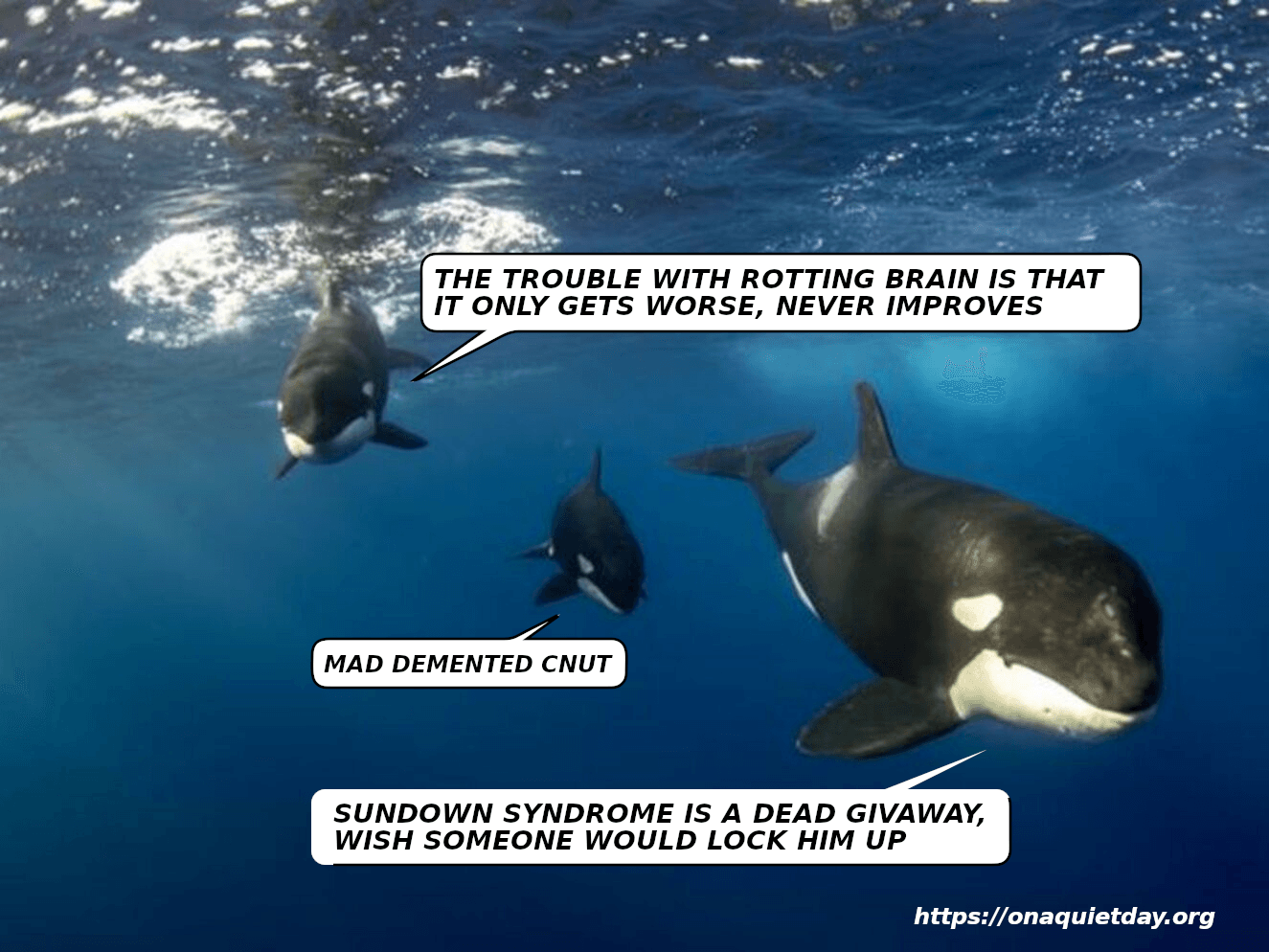
    Orcas discuss rotting brain, front Orca says Sundown Syndrome is a dead givaway and he wishes someone would Lock Him Up
    Orcas discuss rotting brain, front Orca says Sundown Syndrome is a dead givaway and he wishes someone would Lock Him Up
  • Wealthiest 10% of US Households Responsible for 40% of Greenhouse Gas Emissions: Study

    Spread the love
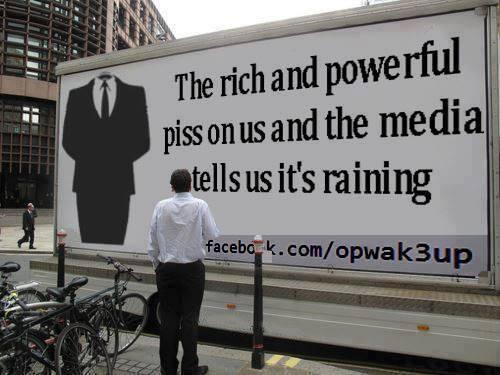
    Image reads "The rich and powerful piss on us and the media tells us it's raining"

    Original article by BRETT WILKINS republished from Common Dreams.

    “Without policies such as regulations or taxes on very polluting investments, it’s unlikely that wealthy individuals making a lot of money from fossil fuel investments will stop investing in them,” says one economist.

    The richest tenth of U.S. households are responsible for 40% of all the nation’s greenhouse gas emissions, a study published Thursday revealed, underscoring what progressives say is the need for regulations and taxes on carbon-intensive investments.

    Published in PLOS Climate, the study—which was led by University of Massachusetts, Amherst sustainability scientist Jared Starr—analyzed 30 years of U.S. household income data and the greenhouse gas emissions generated in creating that income.

    “We find significant and growing emissions inequality that cuts across economic and racial lines,” the paper notes. “In 2019, fully 40% of total U.S. emissions were associated with income flows to the highest earning 10% of households.”

    “Among the highest-earning 1% of households (whose income is linked to 15-17% of national emissions), investment holdings account for 38-43% of their emissions,” the publication continues. “Even when allowing for a considerable range of investment strategies, passive income accruing to this group is a major factor shaping the U.S. emissions distribution.”

    “It just seems morally and politically problematic to have one group of people reaping so much benefit from emissions while the poorer groups in society are asked to disproportionately deal with the harms of those emissions.”

    The study’s findings are consistent with research published in 2021 by the Institute for European Environmental Policy and the Stockholm Environment Institute that estimated the wealthiest 1% of humanity was on track to produce 16% of all global CO2 emissions by 2030. Additionally, a 2022 Oxfam report found that a single billionaire produces a million times more carbon emissions than the average person.

    Starr toldThe Washington Post that “as you move up the income ladder, an increasing share of emissions is associated with investments.”

    According to the Post:

    Then there were “super-emitters” with extremely high overall greenhouse gas emissions, corresponding to about the top 0.1% of households. About 15 days of emissions from a super-emitter was equal to a lifetime of emissions for someone in the poorest 10% in America.

    The team found that the highest emissions linked to income came from white, non-Hispanic homes, and the lowest came from Black households. Emissions peaked until age 45 to 54, and then declined.

    “It just seems morally and politically problematic to have one group of people reaping so much benefit from emissions while the poorer groups in society are asked to disproportionately deal with the harms of those emissions,” said Starr.

    The study asserts that “results suggest an alternative income or shareholder-based carbon tax, focused on investments, may have equity advantages over traditional consumer-facing cap-and-trade or carbon tax options and be a useful policy tool to encourage decarbonization while raising revenue for climate finance.”

    https://twitter.com/DocJeffD/status/1692280658868199457?ref_src=twsrc%5Etfw%7Ctwcamp%5Etweetembed%7Ctwterm%5E1692280658868199457%7Ctwgr%5Ed429f5e8f3765f4359e1961ae8212d483614e153%7Ctwcon%5Es1_c10&ref_url=https%3A%2F%2Fwww.commondreams.org%2Fnews%2Fgreenhouse-gas-emissions

    Lucas Chancel, a French economist who was not part of the study, told the Post that “all Americans contribute to climate change, but clearly not in the same way.”

    “Without policies such as regulations or taxes on very polluting investments,” he stressed, “it’s unlikely that wealthy individuals making a lot of money from fossil fuel investments will stop investing in them.”

    Original article by BRETT WILKINS republished from Common Dreams.

    This article is about the rich having high climate impacting investments in addition to high climate impacting lifestyles.

    RELATED