Ceasefire Collapsing as Iran Shuts Down Strait of Hormuz Again, Accusing US of ‘Piracy’

Spread the love

Original article by Stephen Prager republished form Common Dreams under Creative Commons (CC BY-NC-ND 3.0).
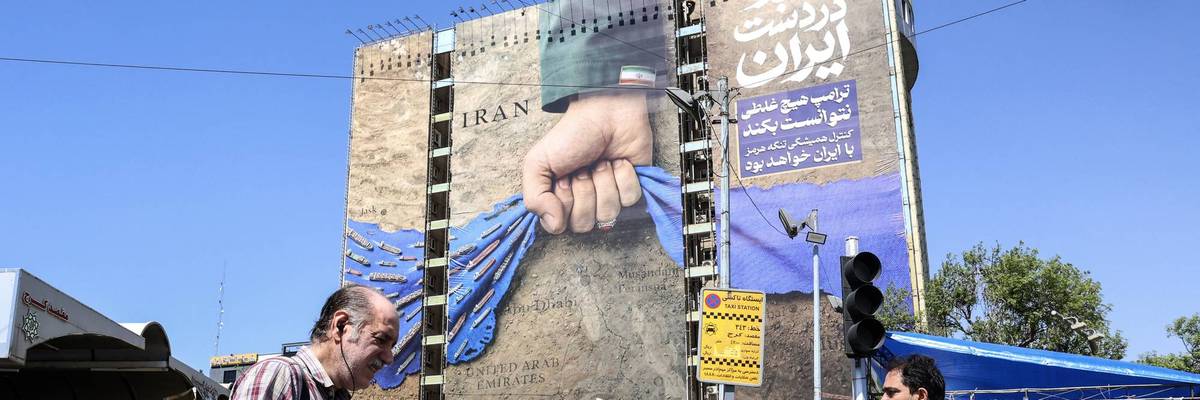
Iranians walk past a large billboard referring to the Strait of Hormuz in Tehran’s Vanak Square on April 15, 2026. (Photo by AFP via Getty Images)

Trump’s recent actions have convinced Tehran that the US is not “a trustworthy partner for any kind of deal,” according to one Iranian professor.

The ceasefire between the US and Iran is in grave peril after Iran announced on Saturday that, in response to the continued US blockade, it would once again impose travel restrictions on the Strait of Hormuz after briefly reopening it on Friday.

Iran has used the strait—through which about 20% of the world’s oil passes—as a chokepoint on Western commerce in response to the illegal US-Israeli war launched in February, and it has been the linchpin of the two-week ceasefire between the two sides, which is scheduled to end Wednesday.

RECOMMENDED…

U.S. Vice President JD Vance Leads U.S. Delegation In Peace Talks With Iran In Pakistan

‘Designed-to-Backfire’: Trump Slammed for Closure of Hormuz Strait as Iran Talks Falter
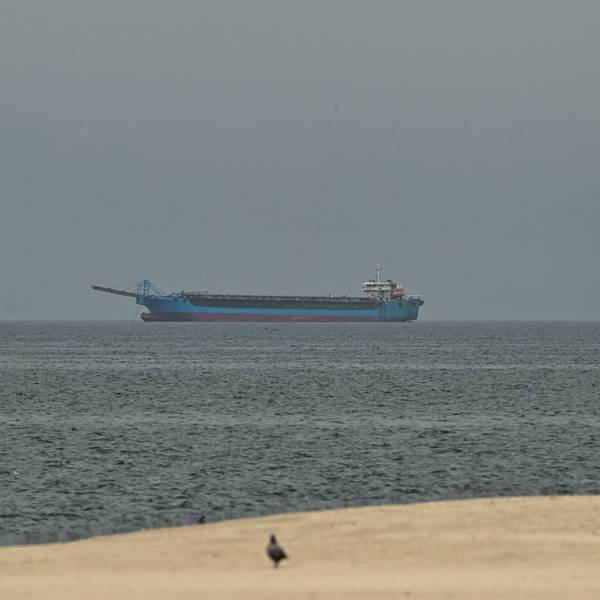
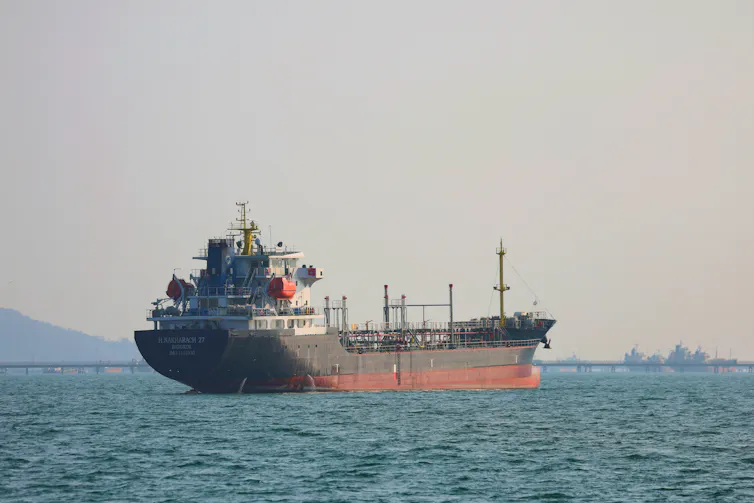
A ship is seen in the Persian Gulf

As US Blockades Strait of Hormuz, Iran Military Warns of Weapons ‘Enemy Has No Idea About’

Tehran announced Friday that the strait was “completely open” again in response to a ceasefire between Israel and Lebanon, which had taken effect. That agreement is also already falling apart following a slew of apparent violations by Israel, which has continued shelling southern Lebanon and demolishing homes even as displaced civilians return.

Iranian officials said they opted to reimpose their blockade of the strait because they believe that by continuing its own naval blockade of Iranian ports and vessels, which began over the past weekend, the US is not upholding its end of the deal.

According to a social media post from US Central Command on Saturday, the US military has already turned around at least 23 ships near the strait since its blockade began on April 13.

US President Donald Trump claimed Friday that Iran had agreed to reopen the strait without conditions, but that the US blockade would “remain in full force” until a broader deal was reached surrounding Iran’s nuclear program.

But Iranian Deputy Foreign Minister Saeed Khatibzadeh said during a panel Saturday that “That is not the term we agreed on.”

Iran’s military headquarters later issued a formal statement declaring that it would begin limiting travel through the strait.

“The Islamic Republic of Iran, following previous agreements met in the negotiations conducted in good faith, agreed to manage the passage of a limited number of oil and commercial ships through the Strait of Hormuz,” the statement said. “Unfortunately, the Americans, with their repeated breaches of trust that are part of their history, continue their acts of piracy and maritime theft under the pretext of a so-called blockade.”

“This strategic waterway is under strict management and control by the armed forces,” it continued. “As long as the United States does not end the complete freedom of movement for vessels from Iran to their destinations and back, the situation in the Strait of Hormuz will remain under strict control and will remain as it was before.”

Islamic Revolutionary Guard Corps (IRGC) gunboats later opened fire on an oil tanker traveling through the strait on Saturday. No injuries were reported.

As Al Jazeera reporter Ali Hashem described, talks between the US and Iran have been brought “back to square one.”

The gap appears increasingly unlikely to be bridged by Wednesday, as Trump continues to demand that Iran allow the US to remove all its enriched uranium, which Iran has said is a nonstarter.

US and Israeli strikes in Iran have already killed more than 1,700 civilians, according to the US-based Human Rights Activist News Agency, and more than 3 million Iranians have been displaced since the war began, according to the United Nations Refugee Agency.

Trump said Friday that perhaps he “won’t extend” the ceasefire and that “the blockade is going to remain. If an agreement is not reached by Wednesday, he said, ”unfortunately, we’ll have to start dropping bombs again.“

The president said that Iran “got a little cute” on Saturday by closing the strait again, but said Iran “can’t blackmail us.”

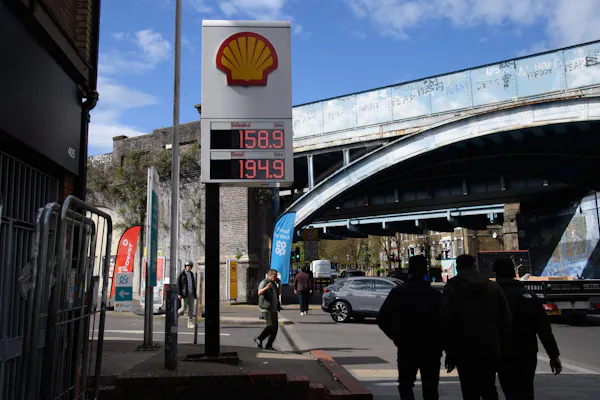
Shutting the waterway has, however, proven to be one of Iran’s most effective points of leverage against the US. It has caused gas prices to soar above $4 and inflation to ripple through the entire Western economy, further tanking Trump’s already grim approval ratings as the US midterm elections approach.

Jennifer Parker, an adjunct fellow in naval studies at the University of New South Wales, told Al Jazeera that the US blockade of the strait does not have the ability to cripple Iran in the same way Iran can cripple the US.

“It is not the US blockade on Iranian ports that is impacting the majority of shipping going through that strait. It is the attacks the Iranian navy and IRGC have undertaken on civilian ships,” she said. “To solve the problem in the Strait of Hormuz, there either needs to be an agreement for Iran to stop attacking vessels, or a forcible military intervention that stops them from attacking vessels, and then general reassurance across the strait that it is clear of mines and that if the IRGC start trying to attack merchant ships, they will be defended… We are a long way from all of that.”

Iranian professor Mostafa Khoshcheshm said that Trump’s contradictory statements surrounding the ceasefire have convinced Tehran that the United States is not “a trustworthy partner for any kind of deal,” and that, as Trump continues to behave erratically, “Iran will continue the war.”

He told Al Jazeera: “Iran believes it has the upper hand and that this must be established in any future confrontation.”

Original article by Stephen Prager republished form Common Dreams under Creative Commons (CC BY-NC-ND 3.0).

Keir Starmer explains that UK is actively supporting Israel's genocidal expansion and repeats his previous quotation that he supports Zionism "without qualification". Keir Starmer said “I said it loud and clear – and meant it – that I support Zionism without qualification.” here: https://www.jewishnews.co.uk/keir-starmer-interview-i-will-work-to-eradicate-antisemitism-from-day-one/
Keir Starmer explains that UK is actively supporting Israel’s genocidal expansion and repeats his previous quotation that he supports Zionism “without qualification”. Keir Starmer said “I said it loud and clear – and meant it – that I support Zionism without qualification.” here: https://www.jewishnews.co.uk/keir-starmer-interview-i-will-work-to-eradicate-antisemitism-from-day-one/
UK Labour Party government ministers Keir Starmer, Angela Rayner and Rachel Reeves explain that they are partners complicit in Israel's Gaza genocide. The UK has provided Israel with arms, military and air force support. They explain that they don't do gas chambers but do do forced marches, starvation, destroy hospitals, mass-murders of journalists and healthcare workers.
UK Labour Party government ministers Keir Starmer, Angela Rayner and Rachel Reeves explain that they are partners complicit in Israel’s Gaza genocide. The UK has provided Israel with arms, military and air force support. They explain that they don’t do gas chambers but do do forced marches, starvation, destroy hospitals, mass-murders of journalists and healthcare workers.
Orcas discuss Genocide-supporting and complicit Zionists. Donald Trump, Keith Starmer, David Lammy, Rachel Reeves, Angela Rayner and Wes Streeting are acknowledged as evil genocide-complicit and supporting cnuts.

Continue ReadingCeasefire Collapsing as Iran Shuts Down Strait of Hormuz Again, Accusing US of ‘Piracy’

US naval blockade of Strait of Hormuz: what it involves and the risks attached

Spread the love
The US blockade of the Strait of Hormuz aims to cut off Iran’s oil exports and punish any ship that pays a toll for transiting the waterway. somkanae sawatdinak/Shutterstock

Basil Germond, Lancaster University

A US-sanctioned tanker with links to China, the Rich Starry, has transited the Strait of Hormuz, despite the US blockade of the waterway. According to the respected maritime news and intelligence agency Lloydslist, the Rich Starry is falsely registered in Malawi, but is Chinese owned and carrying a Chinese crew. It is subject to US sanctions for carrying Iranian goods. It is not known what the vessel is currently transporting.

Having been anchored off the UAE, the Rich Starry is not technically in breach of the blockade, but the incident has raised fears of a potential confrontation between the US and China in the region. Other vessels are reported to be waiting to transit the Strait, despite the US blockade.

The decision to impose a blockade on Iranian ports in the vicinity of the Strait was announced by the US president, Donald Trump, following the breakdown of US-Iran peace talks in Islamabad on April 11. Trump’s announcement was clarified by a statement on April 12 from US Central Command, which stipulated that the operation would prevent ships entering and exiting Iranian ports and coastal areas while not impeding vessels transiting the Strait to and from non‑Iranian ports.

Trump also announced that: “I have also instructed our Navy to seek and interdict every vessel in International Waters that has paid a toll to Iran. No one who pays an illegal toll will have safe passage on the high seas.” It remains unclear as to whether this will be implemented.

The Strait of Hormuz has been as good as closed since shortly after the US and Israel launched their attacks on Iran at the end of February. Most ship owners, charterers and insurers are unwilling to accept the financial risk – and risk to human life – that transiting the Strait under threat of Iranian attack would entail.

Blockades are used to convert naval dominance into advantage on land by preventing imports and exports of goods, in Iran’s case oil, to put pressure on an adversary’s population and government by hurting their economy. Likewise, Iran’s strategy of closing down the Strait after it was attacked intended to disrupt the global economy in order to put international pressure on the Trump administration.

Iran has long threatened to use its geographical proximity to the Strait of Hormuz to close it down. Having demonstrated how effective this can be in disrupting oil and liquid natural gas prices, Tehran has been flexing its muscles by demanding that ships wanting to transit the waterway pay a tariff of up to US$2 million (£1.5 million). Lloydslist reported on March 25 that “a total of 26 vessel transits through the strait have followed a route pre-approved under an IRGC [Islamic Republican Guard Corps] ‘toll booth’ system that requires the ship operators to submit to a vetting scheme”.

This was reportedly a sticking point in negotiations between the US and Iran in Pakistan on April 11. Tehran wants to retain control of the Strait and the ability to levy tolls from transiting ships. The US is demanding that the maritime right of free passage must be enforced. It was when the first round of talks ended in deadlock that the US president decided to impose the naval blockade.

Former US diplomat to the Middle East, David Satterfield, told the BBC on April 13 that it was now about which country could absorb more pain, adding: “The Iranians believe … that they can absorb more pain for a longer period than their opponents can.”

Expensive – and risky – gambit

The cost calculus is asymmetric. It will be more expensive for the US to maintain its blockade than it was for Iran to close the Strait. The question will be whether Washington can sustain interdiction long enough to effectively undermine the regime – always remembering that the Islamic Republic has potentially had decades to prepare for this sort of scenario.

A prolonged crisis in the Gulf will inevitably affect prices and disrupt the global economy. Justin Ng/Alamy Live News

If the blockade can be implemented effectively, it could – in time – have an effect on an economy wrecked by years of sanctions and further weakened by the recent war and nationwide protests in January. The question is how long that might take.

To be effective, the blockade will require considerable naval resources. The US is reported to have as many as 21 warships in the Middle East, including the aircraft carrier USS Abraham Lincoln and the USS Tripoli, an amphibious assault ship with a complement of marines who are trained to board ships using helicopters and small boarding craft.

This introduces another layer of risk as assets operating near to the Iranian coasts will need to be protected against Iranian missiles, drones and fast attack craft. So, this would be resource‑intensive, operationally demanding and thus politically exposed for the US.

How the US will go about enforcement remains to be seen. In December and January, US naval and coastguard ships boarded and seized several vessels linked to Venezuela’s shadow fleet that had broken America’s blockade. Whether it would pursue the same action with a vessel linked to China is another matter though. And while another option would be to fire warning shots, these can be dangerous around tankers because of the risk of oil spillage, as well as the obvious political risk attached to Chinese-linked vessels.

It’s not clear at present that imposing a blockade on the Strait of Hormuz will restore free navigation of the waterway any time soon. But it now appears that, in the absence of free navigation, some countries have decided to call America’s bluff and attempt to transit the waterway in defiance of the US blockade. And the big concern must be the serious risk of escalation if the US attempts to enforce the blockade on a Chinese-owned vessel.

None of this will be welcomed by the US president and his national security team.

Basil Germond, Professor of International Security, School of Global Affairs, Lancaster University

This article is republished from The Conversation under a Creative Commons license. Read the original article.

Climate science denier Donald Trump confirms that he knows nothing about democracy and that more liquid gold is being secured according to his policy of global privateering.
Keir Starmer explains that UK is actively supporting Israel's genocidal expansion and repeats his previous quotation that he supports Zionism "without qualification". Keir Starmer said “I said it loud and clear – and meant it – that I support Zionism without qualification.” here: https://www.jewishnews.co.uk/keir-starmer-interview-i-will-work-to-eradicate-antisemitism-from-day-one/
Keir Starmer explains that UK is actively supporting Israel’s genocidal expansion and repeats his previous quotation that he supports Zionism “without qualification”. Keir Starmer said “I said it loud and clear – and meant it – that I support Zionism without qualification.” here: https://www.jewishnews.co.uk/keir-starmer-interview-i-will-work-to-eradicate-antisemitism-from-day-one/

Continue ReadingUS naval blockade of Strait of Hormuz: what it involves and the risks attached

Strait of Hormuz ‘Is Open For Us,’ Says China’s Defense Minister as US Blockade Begins

Spread the love

Original article by Brad Reed republished from Common Dreams under Creative Commons (CC BY-NC-ND 3.0).

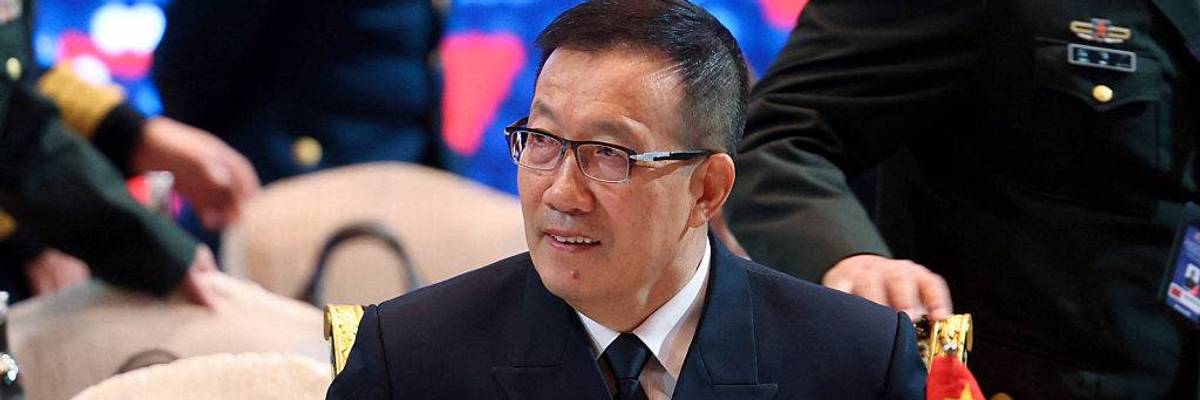
Chinese Defense Minister Dong Jun attends a luncheon in Kuala Lumpur on October 31, 2025. (Photo by Hasnoor Hussain/Pool/AFP via Getty Images)

Although President Donald Trump has ordered the US military to enforce a blockade around the Strait of Hormuz, Chinese Defense Minister Dong Jun warned on Monday against any effort to obstruct Chinese vessels.

As reported by Business Today, the Chinese defense minister emphasized that his country and Iran have reached an arrangement allowing the safe transportation of Chinese ships through the strait, and he said the US should not subject them to its blockade.

RECOMMENDED…

A ship is seen in the Persian Gulf

As US Blockades Strait of Hormuz, Iran Military Warns of Weapons ‘Enemy Has No Idea About’

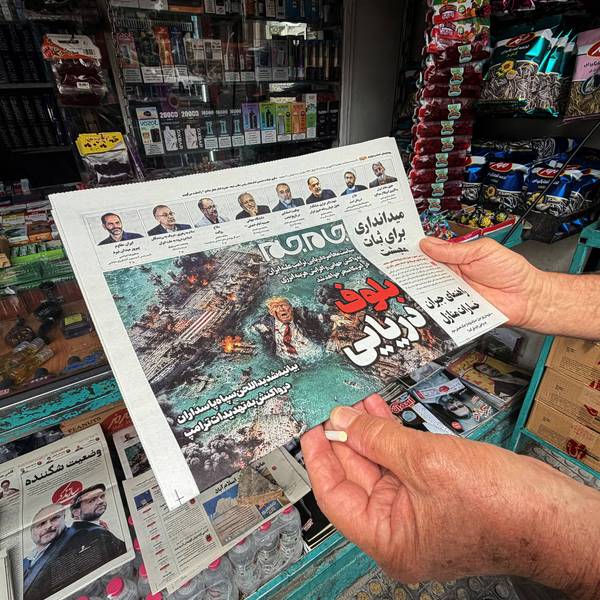
A man looks at the front page of the Jam Jam newspaper

‘Makes No Sense’: NATO Allies Bash Trump’s Strait of Hormuz Blockade as Oil Rises Above $100 a Barrel

“Our ships are moving in and out of the waters of the Strait of Hormuz,” the defense minister said. “We have trade and energy agreements with Iran. We will respect and honor them and expect others not to meddle in our affairs. Iran controls the Strait of Hormuz, and it is open for us.”

Trump announced a blockade on the Strait of Hormuz on Sunday, saying the US would not allow any ships that had cut deals with Iran for safe passage to be let through.

The blockade announcement came after US negotiators, led by Vice President JD Vance, failed to reach a peace agreement with their Iranian counterparts to bring an end to the conflict, which Trump launched illegally without any congressional approval six weeks ago.

The failure to reach a peace deal sent the price of oil upward yet again, as the price of Brent crude oil futures and WTI crude oil futures approached $100 per barrel.

Original article by Brad Reed republished from Common Dreams under Creative Commons (CC BY-NC-ND 3.0).

Keir Starmer explains that UK is actively supporting Israel's genocidal expansion and repeats his previous quotation that he supports Zionism "without qualification". Keir Starmer said “I said it loud and clear – and meant it – that I support Zionism without qualification.” here: https://www.jewishnews.co.uk/keir-starmer-interview-i-will-work-to-eradicate-antisemitism-from-day-one/
Keir Starmer explains that UK is actively supporting Israel’s genocidal expansion and repeats his previous quotation that he supports Zionism “without qualification”. Keir Starmer said “I said it loud and clear – and meant it – that I support Zionism without qualification.” here: https://www.jewishnews.co.uk/keir-starmer-interview-i-will-work-to-eradicate-antisemitism-from-day-one/
Climate science denier Donald Trump confirms that he knows nothing about democracy and that more liquid gold is being secured according to his policy of global privateering.
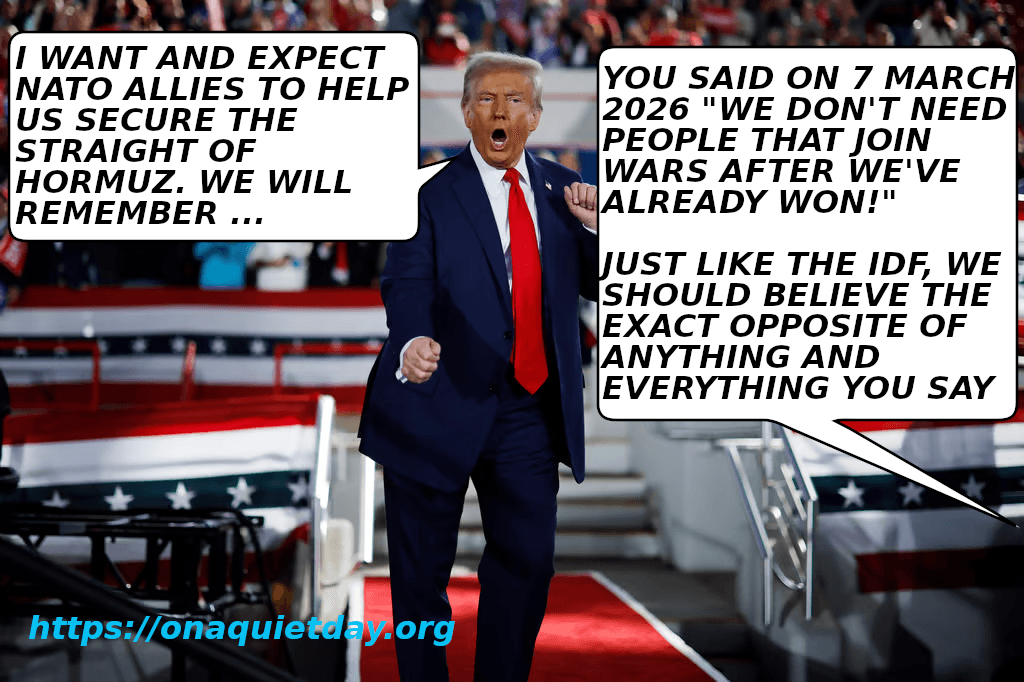
Donald Trump calls for help from NATO allies in securing the Straight of Hormuz despite saying on 7 March 2026 that they don't need people to join wars after they've already won. He's challenged with the claim that he lies as much as the IDF.
Donald Trump calls for help from NATO allies in securing the Straight of Hormuz despite saying on 7 March 2026 that they don’t need people to join wars after they’ve already won. He’s challenged with the claim that he lies as much as the IDF.
Continue ReadingStrait of Hormuz ‘Is Open For Us,’ Says China’s Defense Minister as US Blockade Begins

Cubans march against the US blockade

Spread the love

Original article republished from peoples dispatch under a Creative Commons Attribution-ShareAlike 4.0 (CC BY-SA) license.

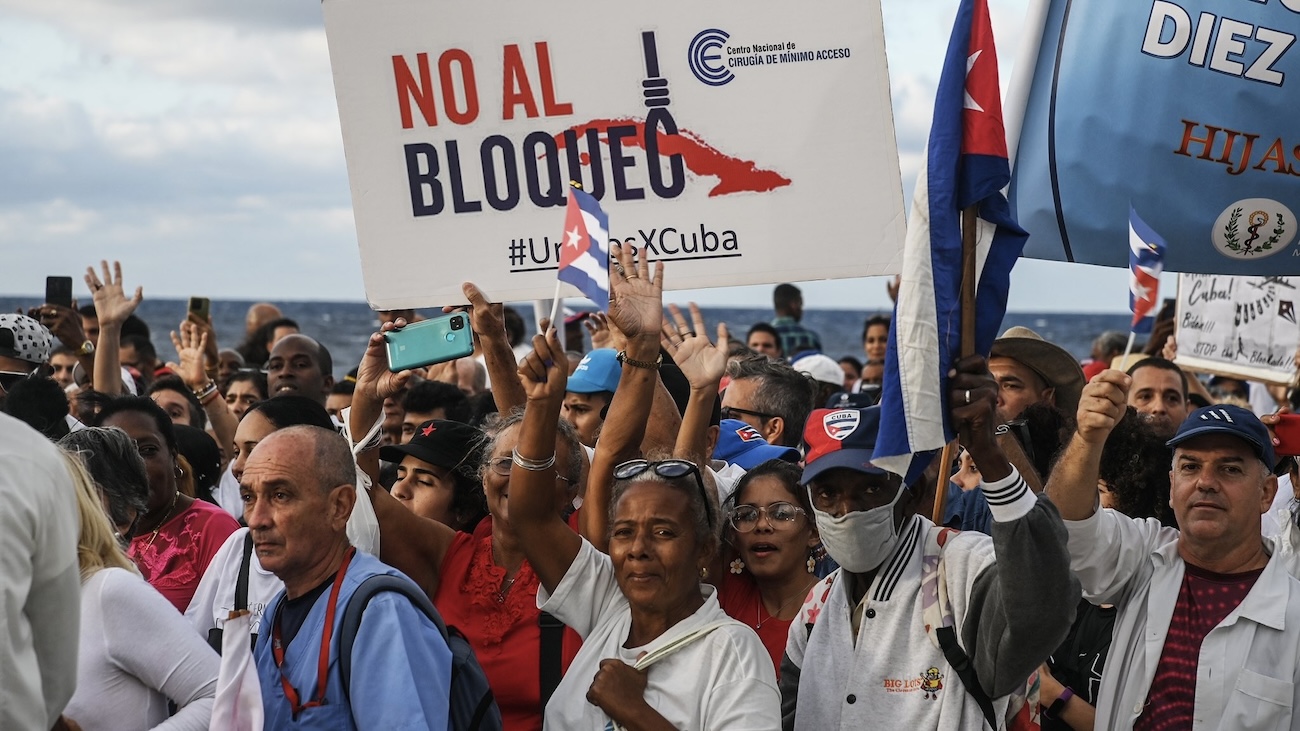
Over half a million Cubans filled the Malecón on Friday December 20 in a massive march against the US blockade. Photo: Presidencia Cuba

Hundreds of thousands of Cuban people participated in the mass demonstration against the six-decade US blockade of Cuba and the inclusion of Cuba on the US state sponsors of terrorism list.

“President Biden, take Cuba off the infamous list!” exclaimed the over half a million Cubans who marched on Havana’s malecón to the US Embassy. The mass march was called for by Cuban President Miguel Díaz-Canel earlier this week to demonstrate the absolute and total rejection of the Cuban people to the six-decade US-imposed blockade on the island as well as the inclusion of Cuba to the US State Sponsors of Terrorism list (SSoT) which together have wreaked havoc on the island’s economy.

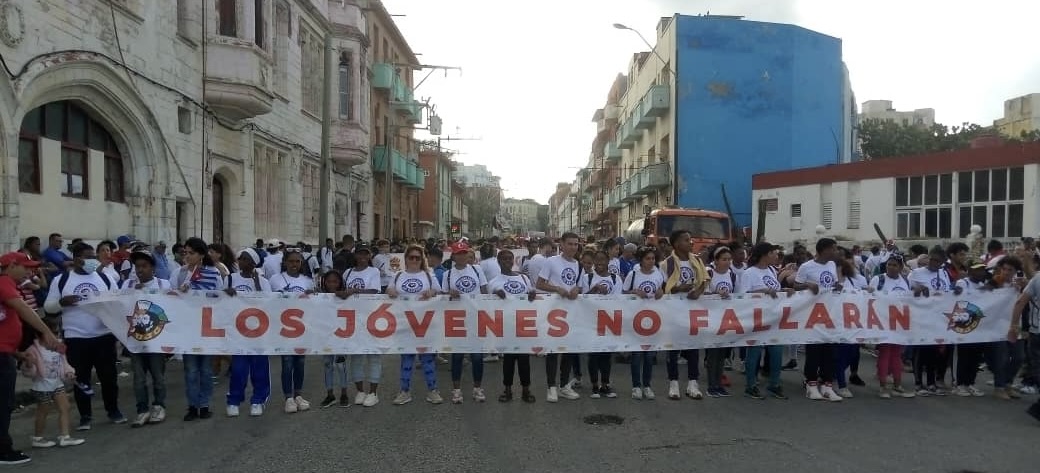
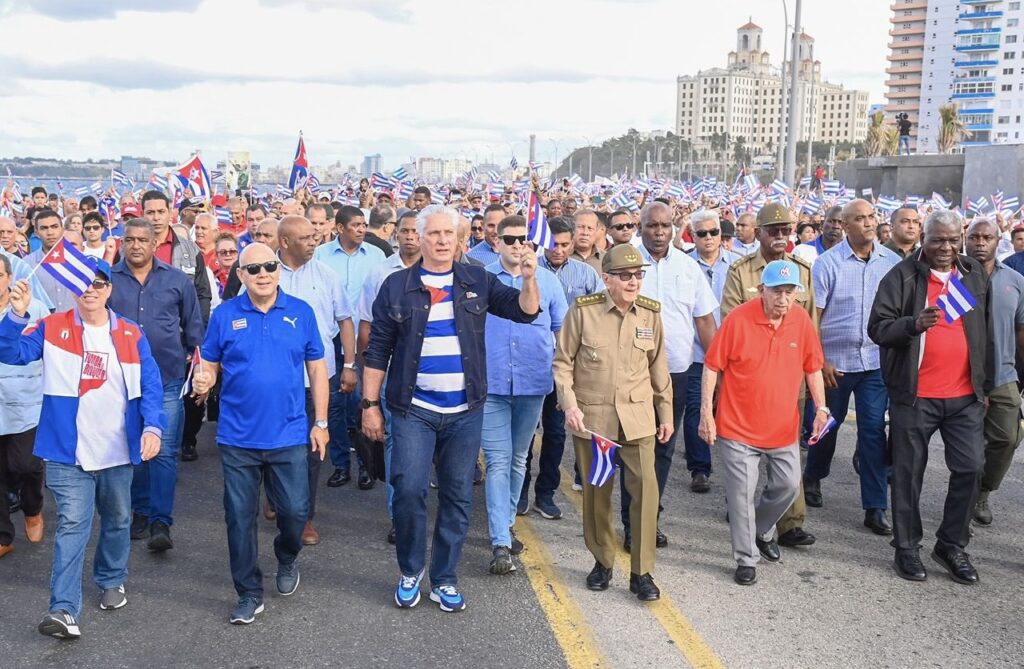
The march was led by Cuban President Miguel Díaz-Canel and General Raúl Castro who were flanked by over half a million Cubans from all sectors of life including students, doctors, construction workers, artists, and more. Cuban youth and students who participated in the massive mobilization carried banners reading “the youth will not fail!” and “this is the revolution!”

“The youth will not fail!” Photo: UJC

The mass mobilization began at the Anti-Imperialist Tribunal José Martí on the malecón, which is located directly in front of the US Embassy. There, the Cuban president delivered an address wherein he condemned the inaction of Joe Biden in reversing the policies of his predecessor Donald Trump which have tightened the economic and financial stranglehold on Cuba. Biden, he said, “has done nothing to move away from the line of reinforced blockade and economic asphyxiation of Cuba left as a legacy by the Republican administration that returns to the Oval Office in January.”

Read: The world once again votes to end the US blockade against Cuba

He also highlighted that people from across the US and the world have in the recent period called attention to the inhumane US policy that goes against international law, “In recent weeks and days there have been numerous pronouncements from US leaders and from other parts of the world demanding that Biden make use of his authority to at least remove the name of a nation that should never have been on this spurious list.”

He emphasized that, “When our international trade is persecuted and financial transactions are impeded, the people of Cuba are being denied food, medicine, fuel, goods, supplies and merchandise essential for their survival.”

Read: The blockade on Cuba is a failed policy but still has bipartisan support, says Dr. José R. Cabañas

In addition to condemning the illegal blockade, Díaz-Canel also alerted the Cuban people that there are currently paramilitary groups training in the south of Florida with the intention of carrying out terrorist attacks against Cuba. “They are based in South Florida and do not hide to train. They do it publicly, in plain sight and with the protection of local authorities, even violating their own laws and international treaties.”

The president’s announcement was both a warning and an attempt to expose the deep hypocrisy of calling Cuba a sponsor of terrorism, whilst in plain view of US authorities, these groups, “organize, promote and finance terrorist actions against social and economic structures in Cuba.” This phenomenon is not new and he reminded the people of how the US sheltered “self-confessed terrorists” and CIA agent Luis Posada Carriles and Orlando Bosch who were the architects of numerous criminal attacks against the Cuban people, the worst one being the 1976 bombing of a Cuban aircraft which resulted in the death of 73 people. “Knowing such antecedents,” Díaz-Canel stated, “no US ruler can classify Cuba as a terrorist state.”

Cuban President Miguel Díaz-Canel and General Raúl Castro marching on the malecón. Photo: Presidencia Cuba

The demand to end the over 60-year US blockade on Cuba and remove the country from the SSoT list has become even more urgent in light of the energy crisis on the island. In recent months, Cuba has suffered a series of blackouts due to its major challenge in accessing fuel to keep its power plants operating.

Read: Cuba, in the dark but not defeated

The election of far-right leader Donald Trump as president has also awoken fears that he may intensify existing unilateral coercive measures against Cuba.

However, as manifested in the mass mobilization, the Cuban people have vowed to remain firm in the face of any threat lodged at them by the US government and maintain that they are open to dialogue with any US administration based on mutual respect and equality.

In concluding his address, Cuban President Miguel Díaz-Canel declared, “If the United States persists in its determination to undermine our sovereignty, our independence, our socialism, it will only find rebellion and intransigence! Every administration that has tried has been outlived by the Cuban Revolution, and it will continue to be so. This is a march, yes, a very anti-imperialist march! Against US imperialism and its pretension to impose itself in Cuba by force or seduction, we will march now and always!”

Original article republished from peoples dispatch under a Creative Commons Attribution-ShareAlike 4.0 (CC BY-SA) license.

Continue ReadingCubans march against the US blockade

Cuba hit by strong earthquake

Spread the love

https://morningstaronline.co.uk/article/cuba-hit-strong-earthquake

People drive along a road littered with fallen power lines after the passing of Hurricane Rafael in San Antonio de los Banos, Cuba, November 7, 2024

AMAGNITUDE-6.8 earthquake shook eastern Cuba on Sunday, after the socialist island had already suffered weeks of hurricanes and power cuts.

The epicentre of the quake was about 25 miles south of Bartolome Maso, according to a report by the US Geological Survey.

The impact was felt across the east of the island, including in bigger cities such as Santiago de Cuba, as well as Holguin and Guantanamo.

On Wednesday, Hurricane Rafael, a Category 3 storm, ripped through western Cuba, with strong winds knocking out power across the island and destroying hundreds of homes.

In October, the island was hit by blackouts lasting for days, a product of Cuba’s energy crisis largely caused by the six-decade-old illegal US blockade, which prevents the import of vital parts for even minor repairs.

Shortly afterwards, a powerful hurricane struck the eastern part of the island, killing at least six people.

https://morningstaronline.co.uk/article/cuba-hit-strong-earthquake

Continue ReadingCuba hit by strong earthquake