This work by Middle East Monitor is licensed under a Creative Commons Attribution-NonCommercial-ShareAlike 4.0 International License.
A general view of Parliamentary session in Tehran, Iran. [Fatemeh Bahrami – Anadolu Agency]
The Iranian parliament has approved a measure to close the Strait of Hormuz to naval traffic following US strikes on three nuclear facilities, a senior lawmaker said on Sunday, Anadolu reports.
“The parliament has reached the conclusion that the Strait of Hormuz should be closed,” Major General Esmaeil Kowsari, a member of the parliament’s National Security Commission, said in statements carried by the state-run Press TV.
The Strait of Hormuz is considered the world’s most important gateway for oil transport.
“The final decision in this regard lies with the Supreme National Security Council,” Kowsari added.
The Supreme National Security Council serves as Iran’s highest security authority.
US President Donald Trump said early Sunday that his forces bombed three Iranian nuclear sites in Fordo, Natanz, and Isfahan.
The attacks came as the latest escalation in a US-backed Israeli military assault on Iran since June 13, prompting Tehran to launch retaliatory attacks on Israel.
Israeli authorities said at least 25 people have been killed and hundreds injured since then in Iranian missile attacks.
Meanwhile, in Iran, 430 people have been killed and more than 3,500 wounded in the Israeli assault, according to the Iranian Health Ministry.
This work by Middle East Monitor is licensed under a Creative Commons Attribution-NonCommercial-ShareAlike 4.0 International License.
Maxar Satellite Imagery provides an overhead view of the Fordow Fuel Enrichment Facility in Iran. [Getty Images]
US strikes on Iran’s Fordo nuclear facility “severely damaged” but did not destroy the underground complex, a senior American official told the New York Times on Sunday, Anadolu reports.
The official, speaking anonymously, acknowledged that B-2 stealth bomber attacks using bunker-buster bombs failed to eliminate the “heavily fortified” facility despite causing significant damage.
The US deployed six bunker-buster bombs against Fordo using B-2 bombers, while submarine-launched cruise missiles targeted Natanz and Isfahan facilities, amid escalating regional tensions.
US President Donald Trump announced that American forces conducted “very successful” strikes on the Iranian nuclear sites.
Defense Secretary Pete Hegseth described the operations as an “incredible and overwhelming success,” claiming the US has “devastated the Iranian nuclear program.”
Joint Chiefs Chairman Air Force Gen. Dan Caine said over 125 American aircraft participated in the mission, including stealth bombers, fighter jets, refueling tankers, a guided missile submarine, and surveillance aircraft.
Hostilities broke out on June 13 when Israel launched airstrikes on several sites across Iran, including military and nuclear facilities, prompting Tehran to launch retaliatory strikes.
Israeli authorities said at least 25 people have been killed and hundreds injured since then in Iranian missile attacks.
Meanwhile, in Iran, 430 people have been killed and more than 3,500 wounded in the Israeli assault, according to the Iranian Health Ministry.
This work by Middle East Monitor is licensed under a Creative Commons Attribution-NonCommercial-ShareAlike 4.0 International License.
Iranian Foreign Minister Abbas Araghchi gives a speech in Istanbul, Turkiye, on June 22, 2025. [Elif Öztürk – Anadolu Agency]
Iranian Foreign Minister Abbas Araghchi, during a press conference in Istanbul on Sunday, said the US has “crossed every red line” with the latest attack on Iranian nuclear facilities, warning that diplomacy may no longer be possible, Anadolu reports.
The recent US strikes on Iran are an “outrageous, grave, and unprecedented violation of fundamental principles of the Charter of the UN and international law,” Araghchi said.
“Iran condemns in the strongest terms the US’ brutal military aggression against Iran’s peaceful nuclear facilities,” Araghchi noted.
Araghchi stressed that Iran continues to defend its territory and sovereignty by all means against not just “US military aggression,” but also “Israel’s unlawful actions.”
The Iranian foreign minister underlined that calls for a return to diplomacy are “irrelevant,” as talks were already ongoing when the US attacks happened.
“We were in the middle of talks with the US when Israelis blew it up. And again, we were in the middle of talks, and negotiations with Europeans happened only two days ago in Geneva. This time, Americans decided to blow it up,” he said.
“It’s very unfortunate that Israel is doing — as the German chancellor called — a dirty job. … They supported that dirty job, it’s a shame,” Araghchi noted.
The Nuclear Non-Proliferation Treaty (NPT) cannot protect Iran despite its full commitment, Araghchi stressed, asking: “Why countries pursuing peaceful nuclear energy should rely on the treaty?”
Araghchi said he will travel to Moscow Sunday afternoon, and meet with Russian President Putin on Monday to discuss the latest situation after the recent US attacks.
Asked if Tehran will retaliate at US bases or close the Strait of Hormuz, Araghchi said: “There are variety of options available to us, and that’s it.”
“The world must not forget that it was the US which, amid a process to forge a diplomatic outcome, betrayed diplomacy by supporting the genocidal Israeli regime’s launch of an illegal war of aggression on the Iranian nation,” he said.
The US attack on Iran’s nuclear facilities threatens global peace, the top Iranian diplomat said.
“These strikes have severely undermined the international system and created serious problems in the region,” he added.
“We continue to defend our country in a heroic manner,” he said.
“Our armed forces are ready; our people, with a high level of self-confidence and a high level of motivation, are ready to defend themselves.”
Tensions in the region further escalated after US President Donald Trump announced Sunday that American forces carried out “very successful” airstrikes on three Iranian nuclear sites in Fordo, Natanz, and Esfahan, amid growing fears of a broader conflict.
The US targeted Iran’s nuclear sites with six bunker-buster bombs dropped on the Fordo facility with B-2 stealth bombers, along with dozens of submarine-launched cruise missile strikes on the Natanz and Isfahan facilities.
Following the US strikes, Iran called on the UN Security Council to convene an emergency meeting to condemn the attacks and hold accountable those who violate international law.
Hostilities broke out on June 13 when Israel launched airstrikes on several sites across Iran, including military and nuclear facilities, prompting Tehran to launch retaliatory strikes.
Israeli authorities said at least 25 people have been killed and hundreds injured in Iranian missile attacks since then.
Meanwhile, in Iran, 430 people have been killed and more than 3,500 wounded in the Israeli assault, according to the Iranian Health Ministry.
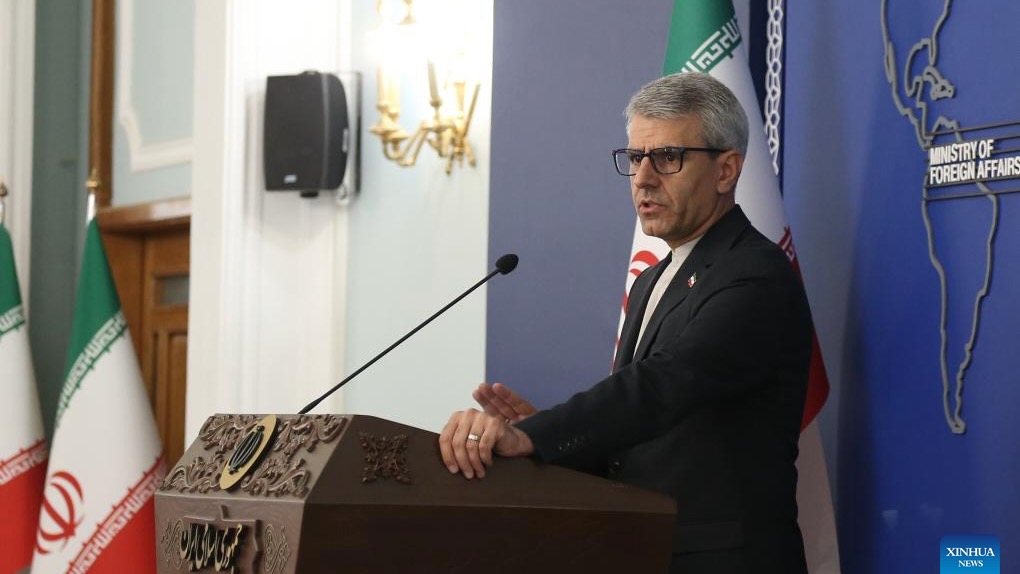
Esmail Baghaei, spokesperson for Iran’s Ministry of Foreign Affairs. Photo: MFA
Iran claimed the proposed nuclear deal submitted May 31 by the US did not reflect the essence of the five rounds of indirect talks between the two countries.
On Sunday, June 9, Iran condemned a fresh round of US sanctions on its citizens and commercial entities, calling them a reflection of the US’s long-standing hostility towards the country and its people.
Esmail Baghaei, spokesperson for Iran’s Ministry of Foreign Affairs, described the sanctions as a flagrant violation of international laws and another attempt to deny Iranians their fundamental rights and increase their hardships.
The administration of Donald Trump issued fresh sanctions against dozens of individuals and entities in Iran on Saturday, continuing its so-called maximum pressure campaign to force Iran to abandon its nuclear program.
The sanctions targeted the individuals and entities involved in banking and other commercial activities. Some of the entities are based in Hong Kong and the UAE. The US targeted them by accusing them of being involved in “money laundering” and “shadow banking” activities for sanctioned entities, such as the National Iranian Tanker Company.
NITC is sanctioned for its involvement in the export of Iranian oil which is targeted by the US as part of its maximum pressure campaign. The US has alleged that proceeds from the oil trade are used for the development of nuclear weapons by Iran.
Iran has claimed it has every right to have a peaceful civil nuclear program as a signatory of the Non-Proliferation Treaty (NPT) and denied it has any intention to develop nuclear weapons. It has termed US sanctions against it illegal and a violation of its sovereignty and demanded their immediate withdrawal.
The new sanctions were announced despite ongoing talks between Iran and the US on the nuclear issue. On May 31, the US submitted a proposal for a deal after five rounds of indirect talks.
Reflecting on the content of the US proposal, Baghaei said on Monday that it did not reflect the essence of the talks so far. He claimed that Iran is preparing its own proposal for a deal which will be submitted to the US through Oman in the coming days.
Iran has repeatedly made it clear that it will not consider any proposal for a deal if it is asked to abandon its peaceful nuclear program and sanctions imposed by the US are not lifted completely.
IAEA must not be politicized
Meanwhile, Russia warned on Sunday that any anti-Iran resolutions in the International Atomic Energy Agency (IAEA) board of governors meeting scheduled to begin on Monday will not “bring positive results.”
Russia’s permanent representative to Vienna, Mikhail Ulyanov, claimed that the expected anti-Iran resolution by European signatories of the Joint Comprehensive Plan of Action (JCPOA) – the UK, France, and Germany in collaboration with the US – would be counterproductive for the ongoing peace efforts.
Ulyanov was referring to the reports in western media which claimed that E3 along with the US have already drafted a resolution against Iran to be presented during the IAEA meeting. The draft accuses Iran of non-compliance in its safeguard obligations for the first time in two decades.
The resolution is part of E3’s threats of invoking snapback sanctions against Iran, which were withdrawn following the signing of the JCPOA in 2015 by a resolution in the UN Security Council.
The European signatories of the JCPOA have recently been following the US line on the Iran nuclear program. In the years following the US unilateral withdrawal from the deal in May 2018, however, these nations expressed a desire to revive it.
Iran has maintained that all calls for snapback sanctions are illegal. It has asserted that its decision to gradually withdraw from its commitments under the JCPOA were based on the provisions of the agreement itself and a response to the US and E3 failing to keep their own commitments under the deal first.
Reiterating the Iranian position, spokesperson for the Atomic Energy Organization of Iran (AEOI) Behrouz Kamalvandi said on Sunday that if others “return to their commitments [to JCPOA], we will do the same.”
Iran has warned E3 of counter measures to the imposition of snapback sanctions. On Sunday, Iran also warned the IAEA of counter measures if the said resolution was adopted, claiming such resolutions are “politically motivated” and a result of US dominance over the agency.
Elon Musk urges you to be a Fascist like him, says that you can ignore facts and reality then.Neo-Fascist Climate Science Denier Donald Trump says Burn, Baby, Burn.
“This latest shameful U.S. veto—one in a long list—gives Israel the green light to continue its genocide of Palestinians in Gaza,” said the head of Amnesty International.
For the fifth time since Israel launched its genocidal assault and siege of the Gaza Strip—and for the first time during President Donald Trump’s tenure—the United States has vetoed a United Nations Security Council resolution calling for a cease-fire, a move that came as Palestinians continue to suffer daily massacres, mass starvation, and ethnic cleansing in the embattled enclave.
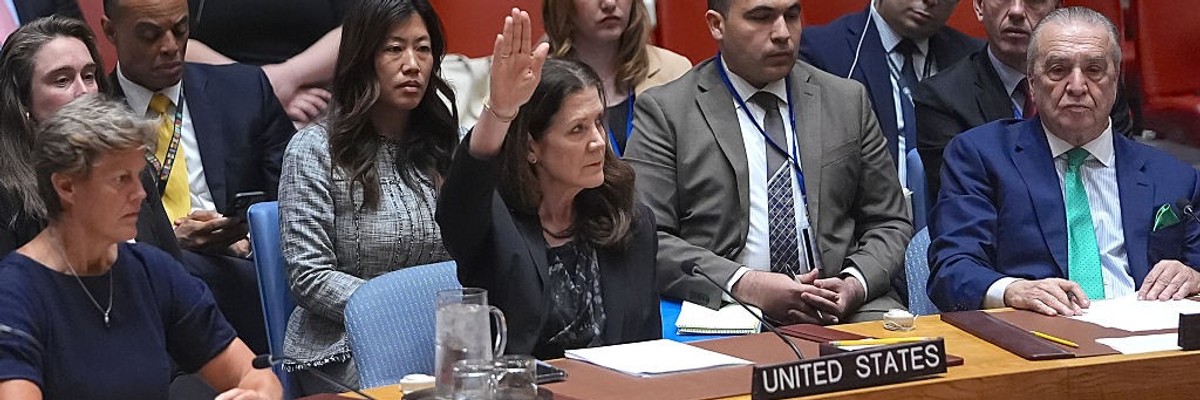
U.S. Ambassador to the U.N. Dorothy Shea—a former political officer at the American Embassy in Tel Aviv, Israel—was the lone vote against the Security Council draft resolution demanding an “immediate, unconditional, and permanent cease-fire” in Gaza and the release of all remaining hostages held by Hamas and other Palestinian resistance groups.
“Any product that undermines our close ally Israel’s security is a nonstarter,” Shea explained after sinking the resolution. In addition to diplomatic cover, the U.S. provides Israel with tens of billions of dollars in armed aid, including weapons that have been used in some of the Israel Defense Forces’ (IDF) deadliest massacres in Gaza.
#BREAKING UN Security Council FAILS TO ADOPT draft resolution that would have demanded an immediate, unconditional and permanent ceasefire in Gaza, and the release of all hostages held by Hamas and other groups
The resolution was put forth by the 10 non-permanent Security Council members—Algeria, Denmark, Greece, Guyana, Pakistan, Panama, Sierra Leone, Slovenia, Somalia, and South Korea—who explained Wednesday in a joint statement that the measure was “prompted by our deep concern over the catastrophic situation in Gaza, which deteriorated further after the resumption of hostilities in March.”
According toThe Palestine Chronicle, Hamas—which governs Gaza and led the October 7, 2023 attack on Israel—said the U.S. veto shows “Washington’s blind bias towards the occupation government” and support for Israel’s “crimes against humanity in Gaza.”
At least hundreds of Gazans, mostly children, have recently died from malnutrition and lack of medical care amid Israel’s tightened siege, according to local officials. Israeli airstrikes continue to kill and wound scores of Palestinians—and sometimes more—daily, and upward of 100 Gazans have been shot dead while desperately trying to secure humanitarian aid in recent days.
“This latest shameful U.S. veto—one in a long list—gives Israel the green light to continue its genocide of Palestinians in Gaza,” Amnesty International secretary general Agnès Callamard said in a statement. “It allows Israel to continue starving Palestinian civilians and creating conditions of life meant to bring about their destruction.”
In addition to vetoing five Security Council cease-fire resolutions, the U.S. last year used its veto power to block Palestine’s bid to become a full U.N. member. The U.S. also abstained from voting on two Security Council cease-fire resolutions during the Biden administration.
“The U.S. has squandered yet another crucial opportunity to demand that Israel ends civilian bloodshed,” Callamard added. “What possible justification can there be for blocking action by the U.N. Security Council that could help to end the harrowing starvation and suffering, free hostages, and lift Israel’s suffocating aid restrictions?”
Hand of Genocide:
US vetoes UNSC resolution for immediate ceasefire in Gaza, giving green light for continued genocide. pic.twitter.com/S3veRmFQUF
All told, more than 194,000 Palestinians have been killed or wounded—including over 14,000 people who are missing and believed dead and buried beneath rubble—during 606 days of an onslaught for which Israel is facing a genocide case at the World Court and Israeli Prime Minister Benjamin Netanyahu is wanted by the International Criminal Court for alleged war crimes and crimes against humanity including extermination and weaponized starvation.
Upward of 2 million Palestinians have also been forcibly displaced, often multiple times, most recently during Operation Gideon’s Chariots, the IDF’s ongoing campaign to indefinitely occupy and ethnically cleanse Gaza, possibly to facilitate Israeli recolonization, as pushed by far-right figures.
On Wednesday, International Committee of the Red Cross president Mirjana Spoljaric said conditions in Gaza are “worse” than last month, when she described them as “hell on Earth.”
All this, as a cease-fire proves as elusive as ever due to what pro-Palestine critics say is Netanyahu’s desire to prolong the war in order to delay his own criminal corruption trial and Hamas’ demand for a guaranteed end to Israel’s onslaught.
“The world is watching, day after day, horrifying scenes of Palestinians being shot, wounded, or killed in Gaza while simply trying to eat,” Tom Fletcher, the U.N.’s top humanitarian chief, said Wednesday. “We must be allowed to do our jobs. We have the teams, the plan, the supplies, and the experience.”
“It’s simply unconscionable to stand in the way of this resolution.”
Amnesty International USA executive director Paul O’Brien said: “Once again, the U.S. government, this time under Trump’s leadership, is on the wrong side of history. While it’s not a surprise the U.S. vetoed this resolution, it’s nonetheless devastating.”
“The language is focused on the urgency of the unconditional release of all hostages and unfettered access to humanitarian aid,” O’Brien added. “When children are dying of starvation and the fate of the hostages is uncertain, it’s simply unconscionable to stand in the way of this resolution.”
Neo-Fascist Climate Science Denier Donald Trump says Burn, Baby, Burn.Elon Musk urges you to be a Fascist like him, says that you can ignore facts and reality then.