Mobilization in Caracas demanding the return of Nicolás Maduro. Photo: Francisco Trias
The implications of this case extend far beyond Venezuela. The entire process against Nicolás Maduro and Cilia Flores threatens to establish the US court system as one with global and unlimited jurisdiction.
Venezuelan President Nicolás Maduro is not guilty. This is a statement of law and fact, since Maduro has not been convicted of any crime. He has pleaded not guilty to every charge brought against him, and the accusations made by the United States remain precisely that: accusations. Under the presumption of innocence – recognized in the United States Constitution and in Article 14 of the International Covenant on Civil and Political Rights – the burden rests entirely upon the prosecution to prove guilt. It is not Maduro who must prove his innocence, but it is the United States government that must prove his guilt.
On January 3, 2026, United States forces illegally entered Venezuela, attacked targets in and around Caracas, seized President Maduro and his wife and an elected official, Cilia Flores, and transported them to the United States. Two days later, shackled and injured, Maduro appeared before a federal court in Manhattan. “I am innocent. I am not guilty,” he told the court. Both defendants entered pleas of not guilty and are now imprisoned in Brooklyn while awaiting a trial provisionally scheduled for June 2027.
The charges against Maduro
The United States alleges that Maduro participated in conspiracies to import cocaine, possess machine guns and destructive devices, and collaborate with organizations Washington has designated as terrorist groups. These charges developed out of an indictment announced during Donald Trump’s first presidency in March 2020. The case was substantially expanded after Maduro was kidnapped through a fourth superseding indictment. An indictment, however, is not evidence tested before a court. It is a document prepared by prosecutors and approved through a grand-jury proceeding at which the defense is normally neither represented nor permitted to challenge the government’s account.
The prosecution relies heavily upon the idea that Maduro directed the so-called Cartel de los Soles, or Cartel of the Suns. But even organizations deeply hostile to the Venezuelan government acknowledge that this is not a cartel in the conventional sense. The name has long been used as an umbrella expression for disparate Venezuelan officials allegedly involved in criminal activity, long before Maduro entered political life. It does not describe an organization with a demonstrated membership, command structure, headquarters or chain of authority comparable to Mexico’s Sinaloa Cartel. When Washington designated the Cartel de los Soles a foreign terrorist organization in 2025, the Associated Pressnoted that it was “not a cartel per se.”
This matters because the prosecution’s language performs much of its political work. Allegations concerning individual acts of corruption are assembled into the image of a unified organization, the organization is then attributed to the Venezuelan state, and responsibility for everything allegedly done by anyone within that loose network is placed upon Maduro. The indictment must still demonstrate that Maduro knowingly joined the specific conspiracies charged. Political authority over a state in which crimes occur does not by itself establish personal criminal responsibility for those crimes.
Case is dead on arrival
Venezuela is not a major producer of coca leaf or cocaine. The principal cocaine-producing countries remain Colombia, Peru and Bolivia. Venezuela has been used as a transit territory, particularly for cocaine originating in neighboring Colombia. But transit through a country does not prove that its president commands the traffic, and nor does it substantiate the extravagant political image of Venezuela as the central source of the drugs entering the United States. The US Drug Enforcement Administration’s own 2025 threat assessment concentrated overwhelmingly upon Mexican organizations and their supply chains. The global cocaine trade operates primarily through production in the Andean region, maritime export corridors, Central America and Mexico, not through a single organization supposedly commanded from the Venezuelan presidential palace. The International Criminal Court’s investigation into the situation in Venezuela, for example, is an investigation into alleged crimes within its jurisdiction. It is not a conviction of Maduro and has not produced an individual judgment of guilt against him.
The US government is expected to rely upon cooperating witnesses, including former Venezuelan intelligence chief Hugo Carvajal and former general Clíver Alcalá. Both men pleaded guilty to serious offenses in the United States. Their evidence cannot be treated as disinterested truth. Cooperating defendants may hope to obtain sentencing benefits by assisting prosecutors. Their claims must therefore be corroborated and subjected to cross-examination. Until that happens, their statements do not establish Maduro’s guilt. In fact, it is better to see their statements as proof of their own attempt to lighten their sentences and launder their soiled reputations.
The circumstances under which Maduro was brought before the US court create an even deeper problem. Washington did not request extradition through an agreed legal process. It employed military force within another sovereign country without Venezuela’s consent or authorization from the United Nations Security Council. Article 2(4) of the UN Charter prohibits the threat or use of force against the territorial integrity or political independence of a state, subject to narrow exceptions such as self-defence. Arresting a person accused of drug offenses is not one of those exceptions. International-law specialists described the operation as an unlawful use of force, while governments including Brazil, Mexico, and China condemned the violation of Venezuelan sovereignty.
Maduro’s lawyers have argued that the prosecution violates the immunity enjoyed by an incumbent head of state. Venezuela continued to recognize Maduro as its constitutional president when the United States seized him – a fact tacitly recognized by the United States when it calls Delcy Rodriquez the Acting President. Washington cannot necessarily extinguish the international legal status of another country’s head of state merely by withholding diplomatic recognition. The defense has consequently requested dismissal of the indictment on immunity grounds and has separately challenged the narco-terrorism count for lacking an adequate jurisdictional connection to the United States. Oral argument on these questions is scheduled for November 2026.
The case of former Honduran president Juan Orlando Hernández exposes the selectivity of Washington’s supposed war against narco-states. Hernández was a close US ally during his presidency from 2014 to 2022. After leaving office, he was extradited – not abducted through a military invasion – and tried in the same federal district in New York where Maduro is now being prosecuted. In March 2024, a jury convicted Hernández after a three-week trial. Prosecutors presented evidence that he had accepted millions of dollars from traffickers, protected cocaine shipments with the Honduran police and military, and helped move more than 400 tons of cocaine towards the United States. He was sentenced to 45 years in prison. Unlike the claims against Maduro, these allegations were tested through testimony, cross-examination and a jury verdict. Yet on December 1, 2025, President Donald Trump pardoned Hernández and secured his release, claiming that the former president had been treated unfairly.
The contrast could hardly be more revealing. Trump pardoned a former president whose participation in cocaine trafficking had been established in a US courtroom, while threatening and eventually invading Venezuela to seize a president against whom no verdict had been rendered. Hernández belonged to Washington’s political camp; Maduro did not. One was released despite his conviction, while the other was captured despite his legal innocence. This disparity does not by itself disprove the accusations against Maduro, but it demolishes the claim that Washington acted from a consistent concern about narcotics. The determining distinction was political alignment, not the strength of the evidence.
The implications of this case extend far beyond the specific circumstances of Maduro and Cilia Flores or their consequences for Venezuela. Allowing a foreign state to override the jurisdiction of another country’s legal system, pursue an accusation for which there is no evidence, and proceed with a trial that lacks a basis in international law effectively establishes the US court system as one with global and unlimited jurisdiction. The ambivalence of governments around the world toward this case is therefore alarming, as it risks signalling consent and normalizing such gross overreach. This is particularly relevant for Mexico, which is already facing a series of accusations and extradition demands from the United States with clear political implications. The outcome of Maduro’s trial could set an important precedent for how Mexico – and other countries – are treated in similar circumstances.
Nicolás Maduro is not guilty therefore expresses the only defensible conclusion at this stage. He was seized through an act of military force, placed before the courts of the state that had pursued his overthrow for years, and charged based on a politically constructed theory that has yet to survive adversarial examination. He remains innocent unless and until admissible evidence proves otherwise beyond a reasonable doubt. Sovereignty is not an ornament, an indictment is not a verdict, and an accusation issued by a powerful state does not become truth merely because that state possesses the weapons to seize the accused.
Stephanie Weatherbee Brito is the co-coordinator of the International Peoples Assembly (IPA).
Vijay Prashad is an Indian historian and journalist. He is the author of forty books, including Washington Bullets, Red Star Over the Third World, The Darker Nations: A People’s History of the Third World, The Poorer Nations: A Possible History of the Global South, and How the International Monetary Fund Suffocates Africa, written with Grieve Chelwa. He is the executive director ofTricontinental: Institute for Social Research, the chief correspondent for Globetrotter, and the chief editor ofLeftWord Books(New Delhi). He also appeared in the films Shadow World (2016) and Two Meetings (2017).
Climate science denier Donald Trump confirms that he knows nothing about democracy and that more liquid gold is being secured according to his policy of global privateering.Orcas discuss rotting brain, front Orca says Sundown Syndrome is a dead givaway and he wishes someone would Lock Him Up
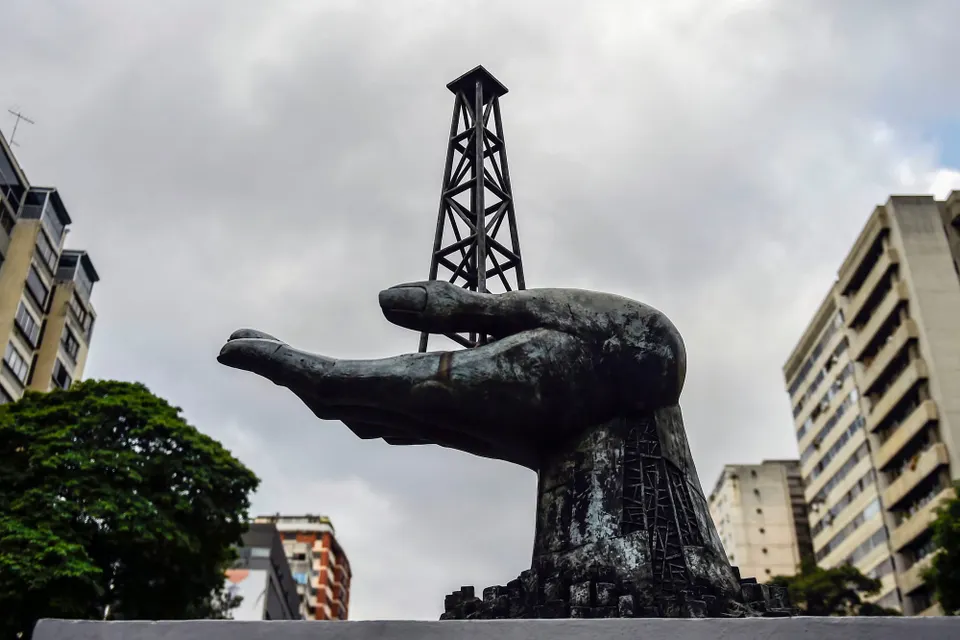
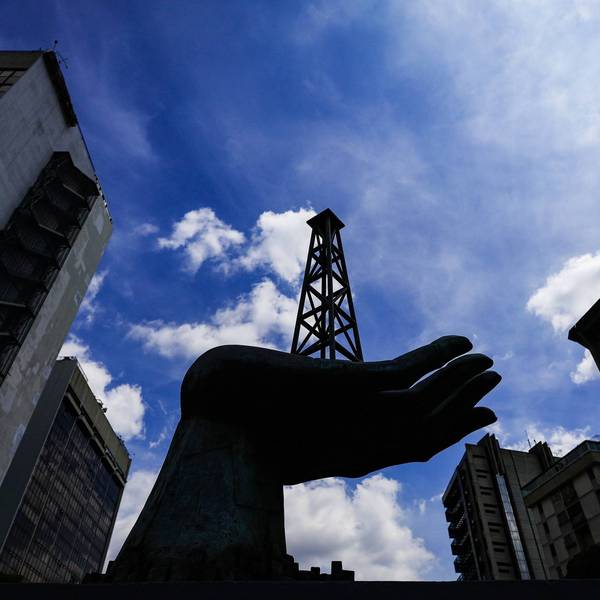
A monument in homage to the struggles of the Venezuelan people for the conquest of their oil | by LUIS ROBAYO/AFP/Getty Images
The Trump administration’s forcible appropriation of a fifth of Venezuela’s oil reserves is worse than the theft of national assets in post-Soviet Russia.
Nine months after United States special forces abducted Venezuelan President Nicolás Maduro and his wife in an early morning raid, the US claims to have struck a highly unusual deal to take control of about a fifth of Venezuela’s oil reserves, or about 65 billion barrels, over the course of a 100-year lease period.
The deal, which is structured through the US Department of Defense (which the Trump administration calls the Department of War), has no recent precedent. While the United States has often engineered military and covert regime change in countries around the world to appropriate resources, the Trump administration’s actions in Venezuela recalls the sorts of 20th century US interventions that lead to a series of revolutions in Latin America and also Iran in the 1950s.
To make sense of this moment, I caught up with Francisco Rodríguez, a Venezuelan economist, a senior research fellow at the Center for Economic and Policy Research, and professor of public and international affairs at the University of Denver. Rodriguez is also the author of four books, including his latest, The Collapse of Venezuela: Scorched-Earth Politics and Economic Decline.
The following is an edited excerpt of our interview. You can listen to the whole interview on our In Solidaritypodcast.
Aman Sethi: I’d like us to start with just getting your reactions to this, this oil deal. Specifically, if you could just talk through what you know so far, what this means, and whether this is how oil deals are normally done in Venezuela.
Francisco Rodriguez: Okay, a bit of the background. Venezuela had been under oil sanctions from the US between 2019 and this year. And the US after it carried out a military operation to capture Nicolás Maduro, it decided that it was going to try to forge, let’s call it a “cooperative relationship,” with the government of Delcy Rodriguez, who was Maduro’s vice president.
And what the US has been trying to do is sell the idea of ‘Now we’re gonna help the Venezuelan oil sector recover’. Venezuela is sitting on the world’s largest oil reserves , but it produces just 1% of world oil output.
January of this year just a few days after the military operation to take out Maduro, President Trump actually calls a lot of oil industry executives to the White House, says, “I want you to invest in Venezuela.” Many of these executives say, “We’re not so sure.” One of them actually says this country is really uninvestable under current conditions. So he gets a lukewarm reaction.
So now we have the announcement of this plan, and this plan — it promises that Venezuela is going to get $100 billion in oil investment. And that’s really important here, because that’s what most experts have said is needed to get Venezuela to produce what it was producing before the sanctions back in 2016 which was around two and a half million barrels.
Now it’s producing roughly one [million barrels per day]. It’s increased a bit to 1.2 million. So you want to get that up by 1.5 million barrels. You need 100 billion to do that. That sounds fine. Actually, that sounds great. If I’m Venezuela, and I’m told, “Hey, here’s the $100 billion you can put into your oil industry, and you’ll get more tax revenue. We’ll benefit.” I say, “Where do I sign?” So that part looks good.
But then let’s look at it in more detail because President Trump actually says two things almost in the same breath. He says Venezuela’s gonna get $100 billion of investment in the oil sector, but this is not going to cost a dime to US taxpayers.
Okay, wait.
So the US is not gonna pay for it. Venezuela is broke, so Venezuela is not gonna pay for it. Who is going to pay for it? Well you would think oil companies, large oil companies, right? Chevron, Exxon, Conoco. But they’re not here. They’re nowhere in the deal. No, they don’t wanna be part of this.
So where are these 100 billion going to come out of ?
Here’s where it gets really interesting and really murky. These $100 billion are going to be put out by a Barbados-based company that was created just a few years ago. It’s a company owned by a businessman with not the best reputation in the world. His name is Alejandro Betancourt. He’s best known for getting billions of dollars in no-bid contracts from the Chavez administration to build electrical plants, at least one of which was never completed. And he’s offering to the US a thirty-five percent stake in his company.
So the US Department of War is going to now own thirty-five percent of that company. And it’s also going to have the right to purchase at cost twenty percent of the company’s output. So that’s the deal.
The White House yesterday put out a statement saying that Venezuelan barrels of oil are going to start flowing into US reserves as of November. And basically, President Trump had already said that they were going to replenish the US Strategic Petroleum Reserve with oil that was a gift from Venezuela.
That’s the word that President Trump used.
So that means that probably as of today you will have Venezuela sending 40,000 barrels of oil to the US at cost. That’s a loss of about $500 million a year for Venezuela.
What is Venezuela getting in return? A promise that somebody, someday, is going to come up with $100 billion is going to be willing to lend them to Mr. Betancourt so that he can invest in the oil sector.
This deal is all wrong. This is the most impoverished country in Latin America.
How legal is this? Like, is this from a Venezuelan perspective, from an international contracts perspective?
There’s a set of legal objections to it. Now of course the problem is that in developing countries Venezuela ranks 146 out of 146 countries in terms of the rule of law.
Asking what is legal or not in a country that has no rule of law, this is almost like a theological question, really.
Because when we think about the law, laws are interpreted by courts, but the courts are controlled by the government. Article 150 of the Venezuelan Constitution says that the National Assembly has to approve the deal.
The National Assembly is 90% controlled by the government, so they could have taken the deal before the National Assembly. They didn’t. Why didn’t they do it? Because then they’d have to publish the contract, but they don’t want to publish the contract. Nobody wants to publish the contract.
There’s a set of other problems I could go down out of all of the different laws that have been violated. But one important one is Article 39 of the country’s hydrocarbons law states that you have to assign contracts in the oil sector through public competitive bidding. There was no public competitive bidding here.
In fact, a government vice-minister recently said, “The thing is that we’re under an economic emergency decree that we declared after the earthquake.” Really? You’re gonna use the earthquake as an excuse to give away 20% of the country’s reserves?
What does it smell like to you?
It smells like Trump essentially said, “I wanna do something about gas prices before the midterm and I wanna claim that I’m getting some of this oil from Venezuela. So I want some of that oil from Venezuela to come in and for me to say that I’m putting it into a strategic reserve, and this is bringing down oil prices. I wanna do that before the midterms. Sign me a deal.”
I think that’s essentially all there is. But from the standpoint of Venezuela, Venezuela has just given away 20% of its reserves to a company owned by a very shady figure.
After the invasion of Iraq when you had the occupation there was a public bidding round for the rights to exploit Iraqi oil. This was a competitive bidding process, it was transmitted through public television, so Iraqis could actually see the bidding taking place in real time.
This process was transparent. This is the complete opposite. This firm is going to get, over the life of the concession, the equivalent of $303 billion.
That’s the, that, that is what the private firm gets in profits.
That is what it’s going to get. That is the equivalent of three years of Venezuelan GDP. 65 billion barrels. Venezuela has a huge level of reserves. The Russian privatization program of 1996 was for 20 billion barrels of oil.
This is more than three times the size. And in Russia, which was a steal, which was horrible, there was a free-for-all. That’s what led to the rise of the Russian oligarchs. They at least had the decency to rig an auction. Here, there was no auction. They didn’t even pretend.
So this is not going to end up well. If you’re handing over these massive resources to connected political insiders this is not helping create a democracy. This is consolidating a crony capitalist oligarchy.
In your book you’ve likened studying the Venezuelan economy to the equivalent of being a rare disease specialist. For all of us outside who honestly don’t know very much about Venezuela, what is your analysis of the regime in power right now?
What is the point at which the people just say, “We’re done with this regime,” and they just get swept out?
We can understand the American motivations. We can understand Delcy Rodriguez is some kind of captive, but what about the entire country that sits below her? How are people taking this?
That’s a great question. And it forces one to think about how we got here. So Venezuela got here after about a quarter of a century of very deep polarization. Hugo Chávez, who came into power in 1999 was a populist and popular politician.
And, like many populist politicians, his message was, “Throw the bums out, people are tired of the old politics. You need change. You need to refound the republic.” And that convinced a lot of people. He was able to get a clear electoral mandate. He reformed the constitution.
He did what many leaders who have at least an authoritarian bent will do in those circumstances, which is say “We really need to change this, give more power to me.” So he really made the Venezuelan presidency all-powerful in that constitutional reform. And that really shaped Venezuelan politics over the next quarter century because you created a winner-take-all political system in which the opposition was completely out of anything.
So you ended up in this, this politics which was very polarized between the government and the opposition. Now, Chávez did some things that a lot of Venezuelans liked at the time. He was definitely somebody who sought out ways to let very large disadvantaged majorities which had been excluded from Venezuelan social, economic, and political life have a stake.
He also did a lot of things very badly.
He got a huge oil boom. He spent a lot of that money. He ran the country into debt. He hired people like Alejandro Betancourt to build electrical plants, some of which were never built. So the country lived through this deep polarization. And then Chávez died, and then he leaves Maduro. Then the economy starts doing poorly. Then he [Maduro] becomes more repressive because the opposition is really going after him. And then the opposition goes to the US, and the US says “Let’s get tough on this, let’s impose sanctions.”
They hurt the country’s oil industry. It leads to a huge decline in the country’s oil production. So they, they effectively create an economic catastrophe. So you end up in this trap, which is what in my book I call the trap of economically destructive political conflict.
And the whole– the puzzle that I try to explain in my book is, how is it that you get an economy to collapse, to lose seventy-one percent of per capita income? This is the equivalent of three consecutive great depressions without a war. And my answer is that this happens because there’s a moment in which this politics becomes so destructive that both sides are essentially playing scorched earth.
So you end up having this battle for the country that turns the economy into a political battlefield, and that’s where it collapses.
Then all of a sudden Trump decides to send in US forces, captures Maduro, and decides that he’s going to run the country with the people who are there. What we know and what he has said literally is that he’s put a gun to Delcy Rodriguez’s head. We also know that Delcy Rodriguez is complying with everything that Trump is asking for.
Is she doing it because she has a gun to her head, or is she doing it because this actually works in her favor and she can stay in power? Probably both.
I have, well, several questions from this, but, but let’s start with the question of sanctions. It’s possible for many governments to make many bad decisions and to do bad things to the economy.
But there is a very specific kind of bad thing that happens once sanctions are imposed, right? When you’re cut out of the US financial system, for example, that is a very, very particular form of economic punishment.
What is your assessment of the role that, that sanctions have actually played here? Because one thing that I’m struggling with is this narrative of “Venezuela let its oil industry completely collapse, and now we’re gonna fix it, and now everything will be fine”. I’m struggling with the dissonance, but maybe I don’t know enough.
That’s a very interesting question. It’s a very important question. It’s not an easy question to answer because well, you have many factors going on, and definitely there was a lot of mismanagement.
There were poor economic policies, so you have to disentangle the effects of those poor policies from the effect of sanctions.
My estimate is that approximately half of Venezuela’s economic contraction during its collapse period between 2012 and 2020 can be attributed to sanctions.
So in other words, this is a country that in the absence of sanctions would have gone through a major crisis. It would have seen, by my estimates, GDP decline by thirty-six percent, but not by seventy-one percent. And in fact, that thirty-six percent decline that would have occurred in the absence of sanctions actually puts it in line with other collapses generated by similar episodes of protracted exercise of bad policies particularly in Latin America.
And all of them have a very similar pattern. You have a commodity-dependent economy. You have a period in which deep imbalances accumulate. You start getting high levels of debt.
The country starts going into a current account deficit. You start seeing high levels of capital flight, and then you get a decline in the price of the commodity like what you got between 2014 and 2016. And there you get this deep economic crisis.
That is what happened in Venezuela between 2012 and 2016, which were the first three years of Maduro in power. In 2017 something different starts happening. And you start seeing that markets are expecting that the Venezuelan economy will begin to recover.
Because oil prices had fallen from $100 to $30, and then they had recovered to around $50, $60. What history teaches us is that the economy stabilizes and then begins to recover in that situation. That’s not what happened in Venezuela. In Venezuela, the economy continued shrinking at an accelerating rate. And the difference was that was the year in which sanctions began to be imposed.
So yes, sanctions did deep damage to this economy. These sanctions didn’t come out of the blue. These sanctions were part of a political strategy by the country’s opposition that was reacting to things that Maduro was doing which were very bad and were very evil and very authoritarian, and said, “We need to up the ante here by doing what we can do. We have allies in the US, that can help us start taking Maduro’s control from the country’s purse strings away.”
So in 2019, the Trump administration decided to recognize Juan Guaido, an opposition legislator, as Venezuela’s legitimate President. This is something that the US had never done before. The US had never recognized somebody with no de facto control over the territory as the President. And what happened as a result of that was that all of the country’s offshore assets, including all of the assets of PDVSA, the state-owned oil company, were transferred to the management of Guaido or his appointees. What that meant is that the country no longer had access to its funds. These funds were essentially handed over to the opposition. It made it impossible for the government even to carry out the most basic economic policy.
There’s nothing in politics that is for free, right? So you acquire a commitment when you have an external power like that, that is helping you. And that means that you can’t question what that external power is doing in your country because you essentially live off of them, right? And this, by the way, was literally true. The Venezuelan opposition — the Venezuelan National Assembly elected in 2015, whose term ended in 2020 — had around 80 opposition legislators who were getting paid monthly salaries out of an account in the Federal Reserve. So the US could literally cut the salaries of the opposition politicians if the opposition decided to go against it.
This is the typical Faustian bargain, right? You say, “I’m willing to do anything if you will help me regain power,” for good reasons.
But the reality is that these Faustian bargains don’t end well.
I’m imagining an Indian opposition leader touring Europe and America and asking for support to become the Prime Minister of India, and they would be, you know, laughed out of the country.
I understand that the dynamics are different but it does strike me as an unusual theory of power. In your book, you also talk about the fact that while Venezuela is shown as an exception to kind of ordinary politics, it in many ways is almost like a weather vane that shows you where politics is going.
But what does this moment in Venezuela tell us if we say Venezuela is, in some ways, the country of the future? What is it telling us now, especially in light of this deal?
I would love to be wrong but I do think that Venezuela might be initiating a model that the US is probably going to try to imitate in other countries.
President Trump actually considers Venezuela a success story, and he’s been trying to produce similar outcomes in Cuba and Iran. And there have been negotiations between Trump administration officials and officials in those countries where they’re proposing this type of deal. The type of deal is you stay in power, the opposition doesn’t come to power but you change completely the way in which you’re doing things, and you follow our orders essentially.
And I want to emphasize that this isn’t a government that rules the country with US support. This is a government that is carrying out the orders of the US . This is a government that has carried out military operations with US troops and Venezuelan troops in Venezuelan territory. It recognized Israel. And three days after Marco Rubio announced that the US was launching a campaign to dismantle the International Criminal Court, Venezuela says, “We’re leaving the International Criminal Court.” The first Latin American country to do so.
So this has become the most dependable US ally in the region. And it’s led to this thesis in Washington of, why seek regime change if you can get regime compliance? That’s essentially what they’re trying to do.
You were saying this looks like a somewhat of an odd concept coming from India and thinking about it in terms of the dynamics in that region.
I would say it’s not that foreign in Latin America. But you have to dig a little bit into history to go there. What the US did in Venezuela was actually what the US did in a number of countries at the beginning of the [20th] century including Cuba, Dominican Republic, Haiti, Panama. It basically imposed protectorates in these countries.
The Cuban one is interesting because Cuba, the US kind of occupied and took control of after the Spanish-American War. And then what the US did is that it forced the Cubans as a condition for independence to accept into their constitution to grant the US a standing right of intervention.
So basically, if the US disagreed, if it took exception to any key decisions of the Cuban government, the US had the right to intervene militarily, and the US, in fact, exercised that right four times in the subsequent twenty years from the signing of that amendment, known as the Platt Amendment.
And one of the problems with that, it’s no coincidence that it was precisely Cuba that saw the political movement that has been most antagonistic to the US emerge.
If you study the early 20th century in Cuba what you find is that Cuban politicians were acting very much in the way in which Venezuelan politicians are acting now
They understood that whoever was in power needed the support of the US. So they became politicians who were adept at lobbying Washington and at building political coalitions between Washington stakeholders to support them. And this means that they were not politicians that built a domestic political base, that were trying to answer the demands of their constituencies. So the protectorate regime, what it does is that it stifles institutional development in a way that basically doesn’t let the institutions of a democracy emerge.
And of course, if you have an electorate that cannot express its grievances, cannot express its demands through the political system, a big part of that electorate is going to become very angry, and then you end up with something like the Cuban Revolution. I think that is a very distinct risk now.
It’s a risk that we will enter into a pattern as a result of Washington’s idea that it can run Latin American countries by remote control, that we’re going to enter into a very similar political dynamics, which, in the end, is going to be bad for the region, but it’s also going to be very bad for the US standing in the region.
Climate science denier Donald Trump confirms that he knows nothing about democracy and that more liquid gold is being secured according to his policy of global privateering.Orcas discuss Donald Trump and the killer apes’ concept of democracy. Front Orca warns that Trump is crashing his country’s economy and that everything he does he does for the fantastically wealthy.Donald Trump urges you to ignore facts and reality and be a Climate Science denier like him. He says that he makes millions and millions for destroying the planet, Burn, Baby, Burn and Flood, Baby, Flood.
This work by Middle East Monitor is licensed under a Creative Commons Attribution-NonCommercial-ShareAlike 4.0 International License.
US President Donald J. Trump monitors U.S. military operations in Iran: Operation Epic Fury, February 28, 2026. [White House X Account – Anadolu Agency]
In January 2026, flushed with the swift, covert removal of Venezuelan President Nicolás Maduro, the Trump administration rolled the dice on a far more volatile and deeply rooted adversary. President Donald Trump operated under the seductive assumption that a high-tech, stealth excursion against the Islamic Republic of Iran would yield a parallel, cost-free triumph. Yet, months into the conflict sparked by the administration’s aggressive “Maximum Pressure 2.0” campaign and escalated via Operation Epic Fury, Washington finds itself trapped in a familiar, agonizing quagmire. Tactical brilliance has once again been mistaken for strategic victory. As Winston Churchill famously observed in the wake of early wartime triumphs, “Now this is not the end. It is not even the beginning of the end. But it is, perhaps, the end of the beginning.” By prioritizing spectacular kinetic displays over coherent political end states, the administration has committed critical strategic errors that echo America’s past blunders in the region, ultimately leaving the United States more vulnerable, its deterrence degraded, and the Middle East fundamentally destabilized.
The administration’s first and most glaring mistake was the illusion of the “quick win”—a fundamental misreading of Iranian resilience, nationalism, and asymmetric depth.
The opening salvos of the 2026 campaign achieved extraordinary tactical milestones, including the systematic destruction of Iran’s conventional naval assets and the stunning decapitation of Supreme Leader Ali Khamenei. Yet, as the Cato Institute observed shortly after the dust settled, “tactical successes cannot mask what has quickly become another strategic failure… the administration’s strategy is divorced from its ostensible aims.” Airpower and targeted assassinations did not trigger a domestic democratic uprising, nor did they erase decades of deeply entrenched institutional control. Instead, power quickly consolidated around an even harder-line, war-hardened faction of the Islamic Revolutionary Guard Corps (IRGC), proving General Omar Bradley’s timeless maxim that “amateurs talk about tactics, but professionals talk about logistics” and long-term sustainability.
Furthermore, the administration drastically underestimated Iran’s capacity for regional, asymmetric retaliation. For years, Washington’s defense establishment operated under the comfortable assumption that Tehran would limit its responses to localized attacks on U.S. assets or proxy skirmishes.
Instead, the conflict immediately metastasized into a multi-theatre conflagration. On day one, Iranian missiles and sophisticated loitering munitions struck across all six Gulf Arab states, completely shattering the regional security umbrella and exposing the fiction of impenetrable air defenses. Rather than dismantling Iran’s missile architecture, the war revealed that a staggering 70 percent of Iran’s ballistic missile stockpile and mobile launchers remained entirely intact, deeply buried in hardened underground “missile cities” and fully operational weeks into the fighting.
This massive miscalculation triggered the second strategic error: a failure to anticipate and mitigate crippling global economic blowback. The administration’s aggressive naval blockade was met with a brutal, symmetric counter-strategy in the maritime chokepoints. Tehran seized effective de facto control of the Strait of Hormuz—the vital artery through which 25 percent of the world’s oil transits—implementing a coercive toll and mining system that drove global crude prices past $100 a barrel. The economic ripples disrupted fragile global supply chains and sparked inflationary spikes across Western economies. In a supreme irony, the administration was forced to quietly ease certain oil sanctions and grant waivers to keep global energy markets afloat, giving Tehran unexpected economic leverage in the middle of a war meant to break its financial resolve.
This economic vulnerability recalls the warning of British Prime Minister Margaret Thatcher, who noted that defense cannot be sustained if it destroys the economic foundation upon which national power rests.
The deeper tragedy of this conflict lies in how it has perversely incentivized the very behavior Washington sought to deter. The administration’s stated rationale for military intervention was the total, permanent elimination of Iran’s nuclear program. However, by demanding what amounted to “unconditional surrender” while systematically dismantling the remaining diplomatic guardrails, the administration left Tehran with zero peaceful off-ramps. Before the outbreak of hostilities, regional intermediaries noted that Iran was willing to offer nuclear concessions that went well beyond the original international agreements. By replacing diplomacy with existential military threats, Washington has practically guaranteed that any post-war Iranian regime will view a functional nuclear deterrent not as a negotiable luxury, but as an absolute requirement for national survival. As the legendary strategist Carl von Clausewitz famously wrote, “War is the continuation of politics by other means.” When war loses its political objective and becomes merely punitive, it transforms into an engine of endless escalation.
Finally, the war has accelerated a structural shift toward an aggressively post-American global order, severely damaging U.S. credibility among allies and adversaries alike. Writing on the cascading geopolitical fallout of the conflict, foreign policy analyst Robert Kagan noted that the war has triggered an “accelerating global adjustment to a post-American world as a result of this massive miscalculation.” Far from isolating Iran, the conflict has bound Washington’s primary geopolitical rivals closer together. U.S. forces have faced an adversary heavily fortified by external collaboration, ranging from advanced Chinese semiconductor chips and real-time satellite imagery to shared tactical innovations in drone warfare.
The Trump administration entered this conflict under the hubristic assumption that it could unilaterally dictate the terms of a short, low-cost engagement. Instead, it has ignored the foundational rule of strategic statecraft: never launch a war without a clear, achievable definition of peace.
By chasing the mirage of an effortless regime collapse, the administration has degraded America’s conventional deterrence, exposed the global economy to severe energy shocks, and driven a resilient adversary deeper into the camp of our most formidable global competitors. If Washington does not pivot swiftly toward a realistic, diplomatically enforceable ceasefire, Operation Epic Fury will not be remembered as a historic triumph but as a textbook case of how tactical hubris breeds strategic disaster.
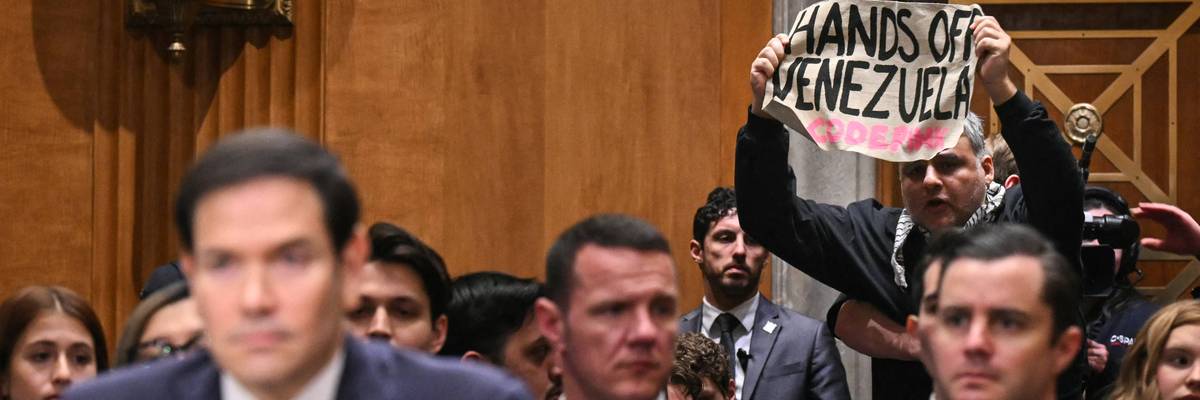
A protestor holds up a sign as US Secretary of State Marco Rubio testifies during a Senate Foreign Relations Committee hearing about US policy toward Venezuela on Capitol Hill in Washington, DC on January 28, 2026. (Photo by Saul Loeb/AFP via Getty Images)
“Rubio’s dangerously expansive vision to transform the United States into a colonizing power in the Americas must be challenged,” one watchdog leader said of the US secretary of state.
In addition to asserting that “there is no war against Venezuela,” despite US forces killing scores of people there while abducting its president earlier this month, Secretary of State Marco Rubio on Wednesday laid out for a Senate panel how the Trump administration intends to continue controlling the South American nation’s oil and related profits.
Legal experts have argued that US President Donald Trump’s blockade of Venezuela’s oil, abduction of Venezuelan President Nicolás Maduro and his wife, Cilia Flores—who have both pleaded not guilty to federal narco-terrorism charges—and bombings of boats allegedly smuggling drugs in the Caribbean Sea and Pacific Ocean all violate international law.
“The ongoing military actions in the Caribbean and South America, including the abduction of Venezuela’s president, are wrong, illegal under US and international law, and unconstitutional,” Robert Weissman, co-president of the group Public Citizen, said before the Senate hearing. “Congressional Republicans have blocked war powers resolutions that would end the US aggression in Venezuela, an extremely dangerous abdication of congressional responsibility to check presidential unlawfulness.”
“Marco Rubio’s central role in the planning and execution of the scheme to violate the sovereignty of Venezuela and steal the country’s oil merits a deep investigation by Congress, and potentially the removal of Rubio as secretary of state,” Weissman continued. “Rubio’s dangerously expansive vision to transform the United States into a colonizing power in the Americas must be challenged.”
Testifying to the Senate Foreign Relations Committee—on which he previously served—Rubio said that “Maduro is an indicted drug trafficker, not a legal head of state,” described his abduction as “an operation to aid law enforcement,” and declared that “the United States is prepared to help oversee Venezuela’s transition from a criminal state to a responsible partner.”
Rubio, the acting national security adviser, insisted that Trump wasn’t planning for any more military action in Venezuela—but also would not rule out such action, potentially without congressional authorization, in “self-defense” against an “imminent” threat.
Trump has repeatedly made clear through public statements that his Venezuela policy is focused on its petroleum reserves, seemingly to enrich the fossil fuel leaders who helped him return to power. American forces have seized several tankers in the Caribbean Sea linked to the country—which critics have condemned as “piracy”—and the first US sale of Venezuelan oil went to the company of a trader who donated millions to the president’s 2024 campaign, which Sen. Cory Booker (D-NJ) last week called “yet another example of his unchecked corruption.”
Describing US control of Venezuela’s nationalized petroleum industry, Rubio told the committee:
Objective number one was stability… And one of the tools that’s available to us is the fact that we have sanctions on oil. There is oil that is sanctioned that cannot move from Venezuela because of our quarantine. And so what we did is we entered into an arrangement with them, and the arrangement is this: On the oil that is sanctioned and quarantined, we will allow you to move it to market. We will allow you to move it to market at market prices—not at the discount China was getting. In return, the funds from that will be deposited into an account that we will have oversight over, and you will spend that money for the benefit of the Venezuelan people…
This is not going to be the permanent mechanism, but this is a short-term mechanism in which the needs of the Venezuelan people can be met through a process that we’ve created, where they will submit every month a budget of this is what we need funded. We will provide for them at the front end what that money cannot be used for. And they have been very cooperative in this regard. In fact, they have pledged to use a substantial amount of those funds to purchase medicine and equipment directly from the United States.
In an exchange with Senate Foreign Relations Committee Ranking Member Jeanne Shaheen (D-NH), Rubio said that an “audit process” has not yet been set up but will be, adding that “we’ve only made one payment” and it “retrospectively will be audited, but it was important we made that payment because they had to meet payroll. They had to keep sanitation workers, police officers, government workers on staff.”
Shaheen noted that the oil reportedly sold for $500 million, but only $300 million went to Venezuela’s government, now led by Maduro’s former deputy, Delcy Rodríguez, and asked Rubio about the remaining $200 million. The secretary said that the rest of the money was in a temporary account in Qatar that will ultimately become a US Treasury blocked account.
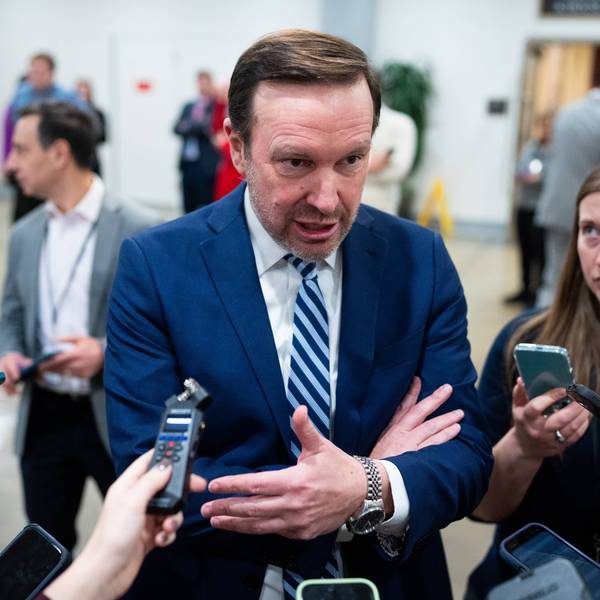
Summarizing the Trump administration’s plans, Sen. Chris Murphy (D-Conn.) said: “I think the scope of the project that you are undertaking in Venezuela is without precedent. You are taking their oil at gunpoint; you are holding and selling that oil; putting, for now, the receipts in an offshore Middle Eastern account; you’re deciding how and for what purposes that money is gonna be used in a country of 30 million people. I think a lot of us believe that that is destined for failure.”
Highlighting that “a month later, we have no information on a timetable for a democratic transition, Maduro’s people are still in charge, most of the political prisoners are in jail—and by the way, those that have been let out have a gag order on them from the government—the opposition leader is still in exile,” Murphy added, “this looks, already, like it is a failure.”
At one point during the nearly three-hour hearing, Leonardo Flores, a Venezuelan-American with the anti-war group CodePink, shouted, “Marco Rubio, you and Trump are thugs!”
US Capitol Police removed Flores from the hearing. As he was being led away, the protester said that “sanctions are a form of collective punishment of Venezuelan citizens. That’s a war crime. Hands off Venezuela! Hands off Cuba!”
Asked by Sen. Brian Schatz (D-Hawaii) on Wednesday, “Will you make a public commitment today to rule out US regime change in Cuba,” Rubio—the son of Cuban immigrants—replied: “Regime change? Oh no, I think we would like to see the regime there change. That doesn’t mean that we’re gonna to make a change, but we would love to see a change. There’s no doubt about the fact that it would be of great benefit to the United States if Cuba was no longer governed by an autocratic regime.”
Since the abduction operation, there have been “free Maduro” protests in both Venezuela and Cuba, which lost 32 citizens in the Trump administration’s attack on Caracas. Speaking to thousands of people gathered outside the US Embassy in Havana earlier this month, Cuban President Miguel Díaz-Canel said that “the current US administration has opened the door to an era of barbarism, plunder, and neo-fascism.”
“No one here surrenders,” he continued, taking aim at not only Trump but also Rubio. “The current emperor of the White House and his infamous secretary of state haven’t stopped threatening me.”
Donald Fuhrump says that Amerikkka doesn’t bother with crimes or charges anymore, not being 100% Amerikkkan and opposing his real estate intentions is enough.Elon Musk urges you to be a Fascist like him, says that you can ignore facts and reality then.Orcas discuss Donald Trump and the killer apes’ concept of democracy. Front Orca warns that Trump is crashing his country’s economy and that everything he does he does for the fantastically wealthy.
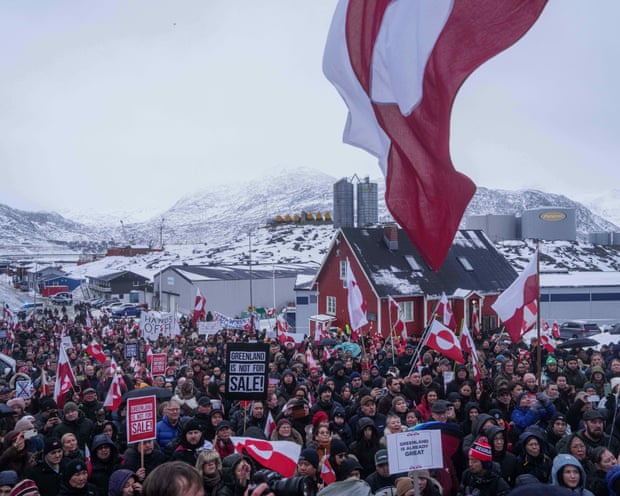
Protesters outside the US consulate in Nuuk, Greenland. Photograph: Evgeniy Maloletka/AP
Island’s PM joins demonstration chanting ‘Greenland is not for sale’ while rallies held across Danish realm
Thousands of Greenlanders carefully marched across snow and ice to take a stand against Donald Trump on Saturday. They held signs of protest, waved their national flag and chanted “Greenland is not for sale” in the face of increasing threats of an American takeover.
Just as they finished their trek from the small downtown of Greenland’s capital city, Nuuk, to the US consulate, the news broke that Trump had announced he would charge a 10% tariff on eight European countries from February over their opposition to US control of Greenland.
“I thought this day couldn’t get any worse, but it just did,” Malik Dollerup-Scheibel said after the Associated Press told him about Trump’s announcement. “It just shows he has no remorse for any kind of human being now.”
Trump has long said he thinks the US should own the strategically located and mineral-rich island, which is a self-governing territory of Greenland. Trump intensified his calls a day after the military operation to oust the former Venezuelan president Nicolás Maduro earlier this month.
Elon Musk urges you to be a Fascist like him, says that you can ignore facts and reality then.Donald Fuhrump says that Amerikkka doesn’t bother with crimes or charges anymore, not being 100% Amerikkkan and opposing his real estate intentions is enough.Orcas discuss how Trump was re-elected and him being an obviously insane, xenophobic Fascist.