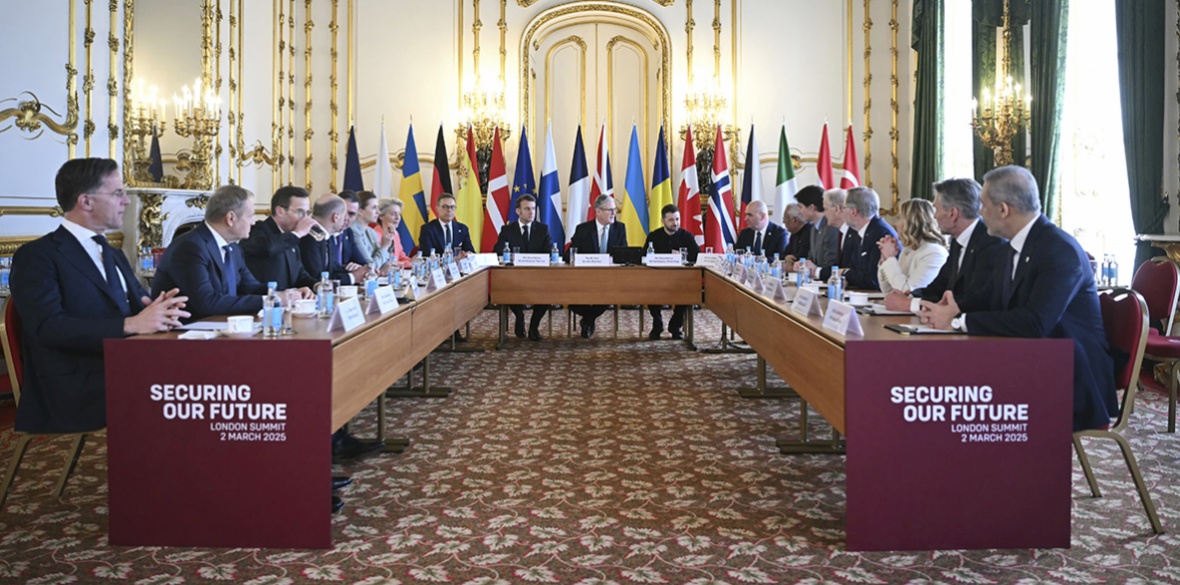
Prime Minister Keir Starmer (centre) hosts the European leaders’ summit to discuss Ukraine, at Lancaster House, London, March 2, 2025
PEACE campaigners slammed the continued rise in British military spending today as Sir Keir Starmer said Britain was ready to send troops to police a Ukrainian peace.
The Prime Minister hosted a summit at London’s Lancaster House today with European leaders, Canadian Prime Minister Justin Trudeau, Turkish Foreign Minister Hakan Fidan, Nato secretary-general Mark Rutte and the presidents of the European Commission and European Council, all showing their support for Ukrainian President Volodymyr Zelensky, who also attended.
The summit followed an extraordinary row between Mr Zelensky, US President Donald Trump and Vice-President JD Vance last week at the White House.
The US was not represented at the summit — underlining the deepening rift between European leaders and Washington.
Sir Keir told leaders it was time for them to step up and continue to support Kiev and meet a “once in a generation moment” for the security of Europe.
After the meeting he said a “coalition of the willing” could be sent to Ukraine to police a ceasefire, with British “troops on the ground and planes in the air,” but acknowledged that not all countries present had been willing to commit. He did not say which had and which hadn’t.
Zelensky meets Starmer and NATO secretary general Mark Rutte. (Photo: Simon Dawson / No 10 handout)
British aid is being used to open up Ukraine’s wrecked economy to foreign investors and enhance trade with the UK.
Amid the devastating war in Ukraine, British economic aid to the country is focused on promoting pro-private sector reforms and on pressing the government to open up its economy to foreign investors.
Recently-published Foreign Office documents on its flagship aid project in Ukraine, which supports privatisation, note that the war provides “opportunities” for Ukraine delivering on “some hugely important reforms”.
The government in Kyiv has in recent months been responding positively to these calls. Last month, president Volodymyr Zelensky signed a new law expanding the privatisation of state-owned banks in the country.
It follows the Ukrainian government’s announcement in July of its ‘Large-Scale Privatisation 2024’ programme that is intended to drive foreign investment into the country and raise money for Ukraine’s struggling national budget, not least to fight Russia.
Large assets slated for privatisation currently include the country’s biggest producer of titanium ore, a leading producer of concrete products and a mining and processing plant.
Ukraine envisaged privatising the country’s roughly 3,500 state-owned enterprises in a law of 2018, which said foreign citizens and companies could become owners.
The process stalled as a result of coronavirus and then Russia’s invasion in February 2022. But hundreds of smaller-scale enterprises are now being privatised, bringing in revenues of UAH 9.6bn (£181m) in the past two years.
“The resumption of privatisation amid the full-scale war is an important step, which is already yielding results,” Ukraine’s economy minister Yulia Svyrydenko said last month.
Another law enacted in June 2023 allows large-scale assets to be sold to foreigners or Ukrainians during the current martial law regime.
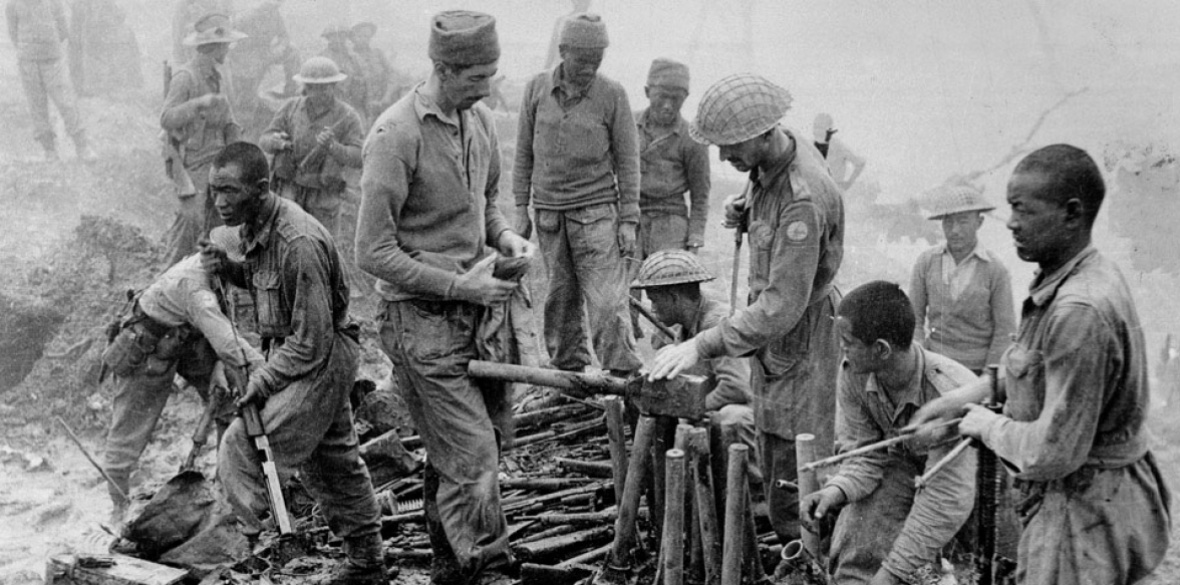
A photograph from the battle of Kohima, in north-east India, during World War II
We have long struggled for black and Asian Allied soldiers to be properly acknowledged in Europe’s commemorations — but now a worse travesty is upon us, as Russia’s crucial role is purged from the record, writes ROGER McKENZIE
…
President Putin took part in the commemoration of the 60th D-Day anniversary in 2004 and again, 10 years later, for the 70th anniversary — but he was not invited to this one.
The USSR, of which Russia was a key part, lost around 25 million people in the fight against Nazi Germany. But even this until recently undisputed fact is now under challenge.
In fact, the Red Army caused 80 per cent of all WWII German military losses and themselves lost 30 times more people than Britain, France and the US combined.
The Red Army’s defeat of the Nazis at Stalingrad is cited by many experts as being the decisive turning point in World War II. Between 150,000 and 250,000 Germans are estimated to have died at Stalingrad.
For Nazis, Stalingrad was not the battle that exacted the highest death toll, but the psychological impact of the battle was immense and was decisive in winning the war. It occupied and depleted massive Nazi resources which paved the way for the eventual Allied victory.
Over half a million Soviet soldiers and civilians died in the Battle of Stalingrad, among them numerous civilians. But that clearly was not enough to be invited.
Ukraine’s President Volodymyr Zelensky, on the other hand, was in attendance — as he always seems to be at pretty much anything. I now expect to see Zelensky at any event where a photo opportunity exists but the fact that he is invited to a commemoration of an event about the defeat of the Nazis is particularly insulting given the number of Nazis in his own forces and his applause in Canada last year for a veteran of a Waffen SS brigade that fought in Ukraine.
But the Russians are not the only ones that have been deliberately written out of history. The role of black people of African or Asian descent has continually been discarded.
…
More than 134,000 travelled from other colonies, including some 10,000 from the Caribbean to help defeat the Nazis. Only when casualties began to mount during the war were black people enlisted to join the fighting or become part of the Merchant Navy.
But there was no suspension in the standing orders of racism. Caribbean men joining the Merchant Navy were paid around one-third of the wages that white sailors were paid.
…
Around two and a half million fighters came from India to support the war effort. About the same time as the D-Day landing Indian, Gurkha and African soldiers fought the historic but little talked about — at least in Britain or the US — battles in Kohima, in north-east India.
These battles fought alongside British soldiers were among some of the toughest in the war and helped to turn the tide against the Japanese. Not for nothing did many of the troops who fought in battles in India and what is now Myanmar during the war call themselves “the Forgotten Army.”
I think they are probably wrong. I don’t think they were forgotten. I believe they were ignored because much of the fighting was carried out by black people. The Battle of Kohima and Imphal was the bloodiest of World War II in India, and it cost Japan many of its most elite fighters.
None of this seems to matter though to those that continue to hide the contribution made by people of African and Asian origin to the victory over the Nazis. We know the erasure of the role of the Red Army in World War II is being carried out for a different purpose.
The leaders of the Western powers can’t bring themselves to acknowledge the massive sacrifice of the Soviet people lest it demonstrate the skill and bravery of its soldiers and the refusal to be defeated by the seemingly invincible Nazis.
It is also part of the inexorable lurch towards a conflict with Russia as Nato ramps up the warmongering rhetoric that could lead to World War III and the catastrophic nuclear destruction of the planet.
Western powers seem far more willing to associate themselves with the Nazis surrounding the leadership of Ukraine and to hobnob with the likes of fascist-inspired Italian leader Giorgia Meloni.
I wonder how fast they will move for a photo opportunity should the far-right Marine Le Pen win the National Assembly election later this month or the next French presidential vote.
They say that history is written by the winners. Well, it seems not all the winners count. This means we must all call out the continued drive to rewrite history.