Stuart Fox, University of Exeter
One of the defining features of contemporary electoral politics in Britain is the age divide. Young people are far more likely to support Labour, and older people to support the Conservatives. This divide is still apparent following the 2024 election – but it hides the complexity of how young people in particular choose to vote.
To the extent that there is a “youth vote” in Britain, it is characterised not by support for a single party, but by a particularly fierce rejection of the Conservatives – alongside greater enthusiasm than their elders for left-wing, socially liberal alternatives to Labour.
YouGov surveyed 2,182 adults of all ages between July 5 and 8 for my research team at the University of Exeter. The sample was selected to be representative of the British adult population.
The data from this survey – published here for the first time – gives a snapshot of how people of different ages say they cast their votes. Five per cent of our respondents under 30 didn’t tell us how they voted so we don’t know how their votes might have changed the overall picture. More research in the coming months may give a fuller account.
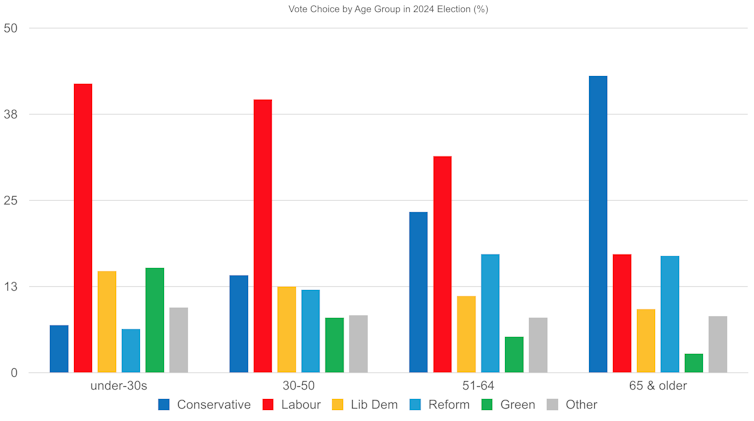
As the graph below shows, it’s only among the over-65s that the Conservatives won more support than Labour (by around 26 percentage points). They trailed Labour by around 8 points among the 51-64 age group, 26 points among 30- to 50-year-olds, and 35 points among the under-30s. Almost incredibly for Britain’s oldest and most successful political party, the Conservatives won barely 7% of the vote of under-30s in the survey.
Parties voted for by age group:
Another key characteristic of the 2024 election is the record-low combined vote share for Labour and the Conservatives, and concurrent record-high vote share for smaller parties. This was not a blip. Voters have been steadily shifting away from the two major parties for years. But in 2024, the extent to which they did so was unprecedented: overall, the combined Labour/Tory vote share was just 57%.
The rejection of the major parties is most profound among young voters. Their support has become fragmented to such an extent that it is not really accurate to speak of a singular “youth vote”. Less than half (49%) of under-30s surveyed voted for Labour or the Conservatives. This compares to 54% of 30- to 50-year-olds, 55% of 51- to 64-year-olds, and 60% of over-65s.
The combined vote share for smaller parties among the under-30s was greater – at 46% – than the 42% who voted for the Labour party. The most successful challengers to the major parties for the youth vote were the Greens and Liberal Democrats, each of whom were backed by 15% of under-30s in the survey.
“Others” – including the Scottish National Party, Plaid Cymru and independents – won a combined 10% of votes from young respondents aged under 30. But the young people surveyed were not simply casting around for any alternative to the major parties. Just 6% of under-30s in the survey said they backed Reform UK (compared with 17% among the over-50s).
Want more politics coverage from academic experts? Every week, we bring you informed analysis of developments in government and fact check the claims being made.
Sign up for our weekly politics newsletter, delivered every Friday throughout the campaign and beyond.
No Reform youthquake
In the closing days of the campaign, there was some suspicion that Reform might achieve a “mini youthquake” in this election or the next. A JLPartners poll found that Reform appealed strongly to soon-to-be-enfranchised 16- and 17-year-old voters, and mock school elections apparently saw Reform winning a great deal of support among schoolchildren across the country.
Our data suggests this did not materialise in 2024. Reform has had some success in appealing to young voters: among under-30s from poorer households, for example, 13% said they supported Reform, compared with 4% for those from wealthier households.
However, similar proportions of under-30s from poorer households also said they voted for the Liberal Democrats (11%) and the Greens (14%). While voters in older age groups who were fed up of Labour and the Conservatives were more likely to switch to Reform and may do so again in future, among the under-30s such voters appeared more likely to switch to the Liberal Democrats, Greens and nationalist parties in Scotland and Wales.
Turnout
Turnout is a crucial issue when considering how young people vote. They have always been less likely to vote than their elders in any particular election. This owes primarily to lower levels of political interest, as well as circumstances associated with early adulthood such as being financially precarious and being less settled in one location. This was true in 2024 as well.
The graph below shows self-reported turnout by age group. The figures are substantially higher than the true turnout numbers, reflecting the long-established tendency of people to exaggerate their voting behaviour in surveys, but they clearly illustrate the age divide: under-30s were the group most likely to say they hadn’t voted.
Turnout by age group:
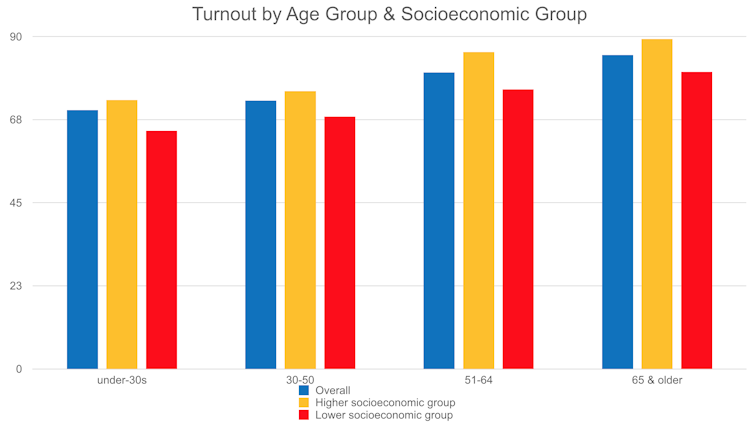
The graph shows not only was the turnout of under-30s lower than that of older age groups, but that of under-30s from poorer households was particularly low. Young people from poorer backgrounds are less likely to vote than their predecessors were 30 years ago, and so are under-represented in elections to an even greater extent today.
People who vote during early adulthood establish habits that make them likely to vote for the rest of their lives. Those who don’t form such habits by their late 20s are likely to remain serial abstainers.
Younger generations are becoming increasingly unlikely to vote in their first election, leading a greater proportion of them to develop lasting habits of non-voting.
It is this tendency that lies behind one of the major democratic challenges facing the UK: rising levels of disengagement with politics and with voting, as younger people age but continue their youthful pattern of avoiding the ballot box.
Stuart Fox, Lecturer in British Politics, University of Exeter
This article is republished from The Conversation under a Creative Commons license. Read the original article.