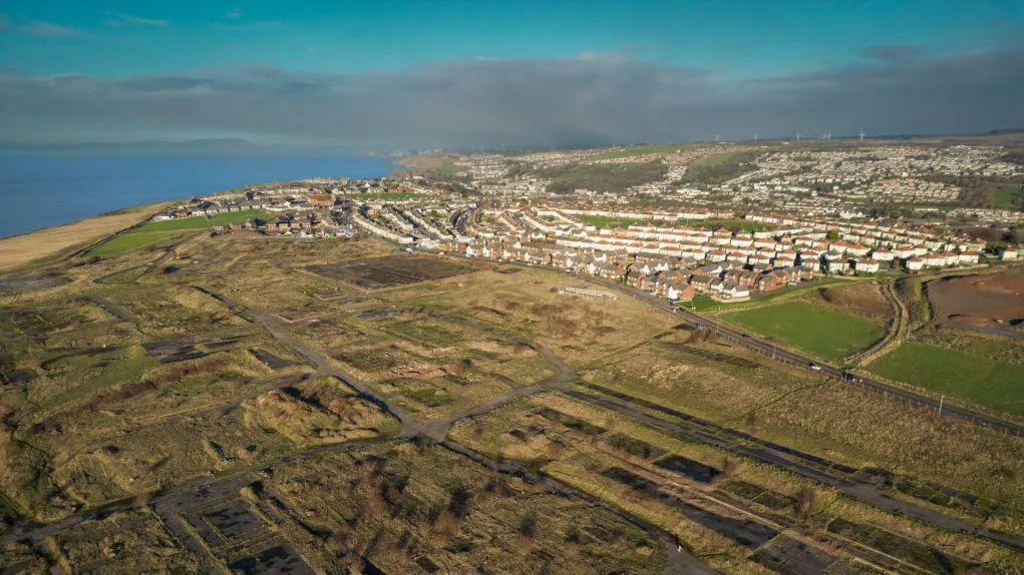
Former Secretary of State Michael Gove gave permission for the mine near Whitehaven in 2022
The government will no longer defend a decision, made by the previous government, to allow a controversial new coalmine in Cumbria.
The new Secretary of State for Housing, Communities and Local Government, Angela Rayner, has accepted there was an “error of law” in the decision to grant planning permission for the mine in December 2022.
Consequently, the government will not now be defending two legal challenges next week against the mine – by Friends of the Earth and South Lakes Action on Climate Change (SLACC).
It has instead informed the court that the decision to grant planning permission should be quashed.
BBC News has contacted West Cumbria Mining, the company behind the proposed mine, for comment.
The mine has been heavily criticised by climate campaigners and the government’s independent advisors on climate.
Two legal challenges over the climate impacts of burning the coal will be heard at the High Court in London next week.
It comes after the court ruled in June that permission for an oil drilling project in Surrey should not have been granted because the climate impacts of burning the fossil fuels had not been considered.
The government referred to that ruling in its decision on Thursday to withdraw support.
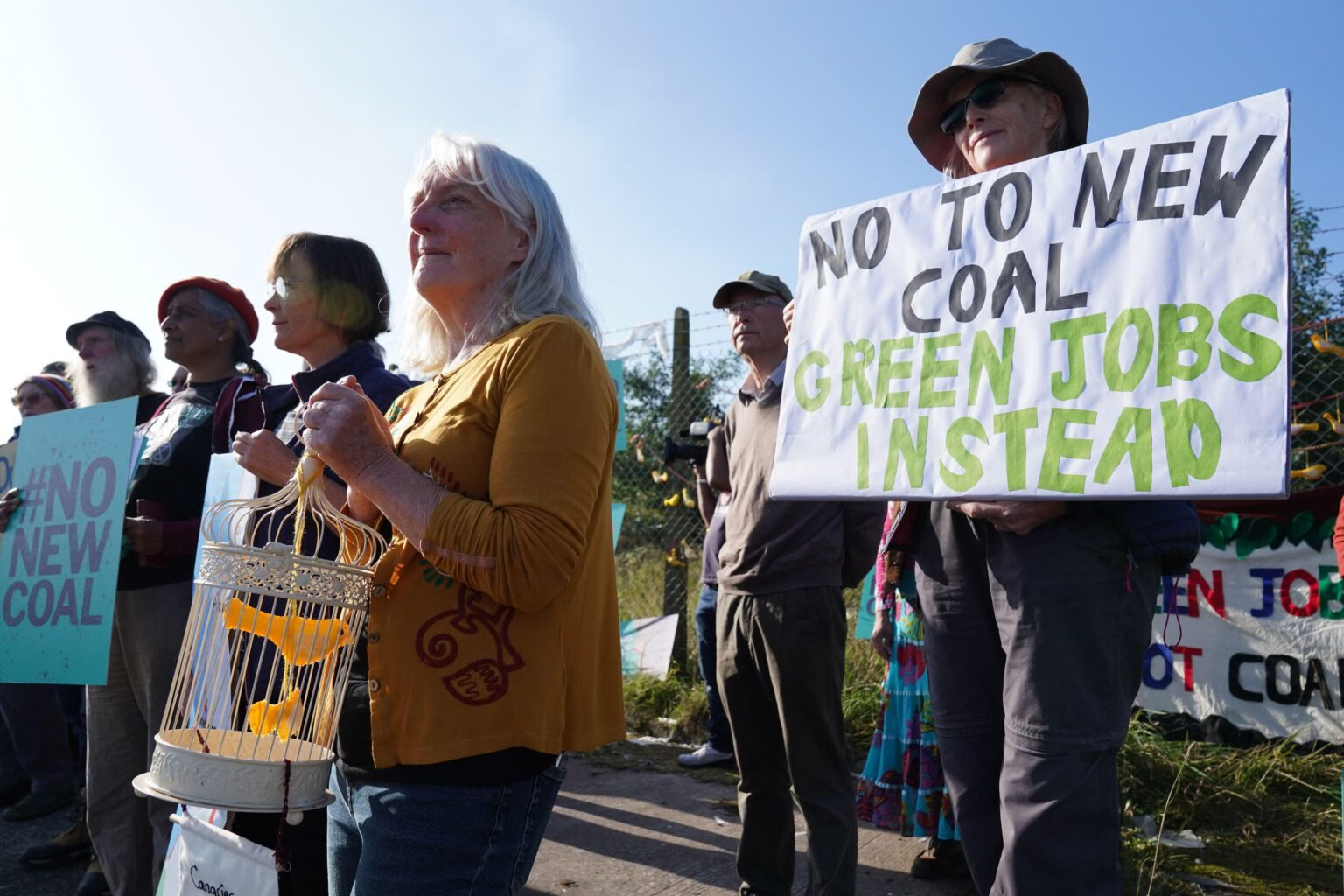
Demonstrators outside the proposed Woodhouse Colliery, south of Whitehaven, September 2021. Credit: PA Images / Alamy Stock Photo
Questions over compensation and employment could make it politically difficult for Labour to scrap the Whitehaven project, experts told DeSmog.
Labour has been urged to clarify its stance on the UK’s first deep coal mine in more than 30 years – as it fights an election campaign that has put clean energy at the fore.
The proposed mine in Whitehaven, Cumbria, would extract 2.8 million tonnes of coking coal a year from under the Irish sea to produce steel, emitting an estimated 220 millions tonnes of greenhouse gases over its lifetime.
The mine has become a political flashpoint in discussions over the UK’s commitment to reach net zero by 2050. In 2021, the International Energy Agency concluded that any new fossil fuel extraction was incompatible with global decarbonisation targets.
Ahead of a widely predicted victory at the 4 July election, Labour’s lack of clarity on the polluting mine poses awkward questions for a party that has based its manifesto on making Britain “a clean energy superpower”.
In the new manifesto, launched last week, Labour says it will not revoke existing oil and gas licences, but will also not grant any new licences. The party has explicitly ruled out issuing licences for new coal mines and says it will ban fracking for good.
The Woodhouse Colliery was granted planning permission by then Conservative levelling up secretary Michael Gove in December 2022, but has been plagued by controversy over its environmental impact and beset by legal delays.
So far, Labour has failed to address whether it would seek to overturn planning permission for the project, and has not responded to DeSmog’s requests for clarification.
In contrast, the party’s parliamentary candidate for the new Workington and Whitehaven constituency, where the mine would be built, has been vocal in his opposition.
Speaking to his local newspaper the News & Star last week, prospective MP Josh MacAlister said the mine was “a risky bet for new jobs”. “The easiest thing in the world would be to tell you the mine will solve our problems – but it won’t,” he said.
DeSmog understands that MacAlister has also addressed the issue at a number of local meetings, including to a mining heritage group in Whitehaven.
According to a source, he told dozens of residents in November that the area was better off without the mine. However, he reportedly stopped short of clarifying whether he would oppose the national party if it backed the scheme’s development.
When approached by DeSmog for comment, MacAlister’s team referred DeSmog to his views expressed in the News & Star, adding that they were “consistent with what he has said since being selected”.
A projection released by YouGov on 5 June shows that MacAlister is expected to win the seat in a landslide, with a predicted 53 percent of the vote to the Conservatives’ 25 percent.
Rebecca Willis, professor in energy and climate governance at the University of Lancaster, told DeSmog that “the mine has huge symbolic importance” both domestically and in terms of climate diplomacy.
“You can’t be a leading climate nation and provide consent for new coal mines,” she said. “Those two things are fundamentally incompatible.”
‘Non-Committal’
Despite Labour’s silence, MacAlister’s position appears to align with that of Ed Miliband, the party’s shadow climate change secretary.
Shortly after the mine was approved, Miliband co-authored an opinion piece for the News & Star with Cumberland’s council leader Mark Fryer. In the article, they argued that the mine would be “obsolete by the 2030s and 2040s at the latest, because of changes to the global steel industry which is rapidly moving towards clean steel production”.
Miliband reiterated this message at a March 2023 Cumberland Economic Summit event in west Cumbria.
Since then, the national Labour party has revealed little on its position.
Karl Conor, a former Labour councillor for Copeland, told DeSmog that given the controversies surrounding the scheme and the interest of the local community, MacAlister and Labour will be unable “to get through the campaign without having to nail their colours to the mast”.
In contrast to MacAlister, prospective Conservative MP Andrew Johnson has strongly backed the mine, telling the News & Star: “It offers the best prospect in years to create new jobs, attract significant investment into West Cumbria and help to deliver the upgrade to the coastal railway.
“If elected I will work tireless[ly] to fight for the mine to open and those jobs delivered”.
Claims by West Cumbria Mining that the project will create around 500 jobs have been strongly disputed.
Campaign group South Lakes Action on Climate Change (SLACC) group, which is bringing a legal challenge against the decision to greenlight the scheme, said that “no methodology” had been provided by the mining firm to support these claims.
A source in the new joint Cumberland authority told DeSmog they thought the local Conservative party would “try to make it [the local election campaign] about the mine”.
“In the same way they made the Uxbridge by-election all about ULEZ [London’s Ultra Low Emission Zone], Sadiq Khan’s flagship policy, the Tories’ electoral strategy will be to make it about the mine,” they said. “… If I was in their position, it’s what I’d be doing.”
Compensation Conundrum
Any new administration looking to block the Cumbria coal mine may be hit with a compensation claim that runs into the tens of millions, according to a well-placed legal expert.
Matthew McFeeley, a lawyer with Richard Buxton Solicitors, has been advising SLACC on its legal challenge. He told DeSmog that much will depend on the judicial review, which is scheduled to be heard on 16 July, less than a fortnight after the general election.
“If the court were to find that the planning permission had been unlawfully granted, then it would all have to go back to the secretary of state for a new decision,” McFeeley said.
In this scenario, he explained, a Labour administration could argue that the climate and environmental impacts of the project are too great, and refuse to grant permission.
If campaigners can successfully argue the mine’s planning permission is unlawful, the company behind the coaling scheme – West Cumbria Mining (WCM) – would not be able to issue any kind of compensation claim.
However, if the next government decided to revoke planning permission without a legal ruling, the taxpayer would be legally obliged to pay compensation, McFeeley said. The amount would depend on an assessment of how much WCM stood to lose from the permission being revoked.
The legal challenge is one of a number of hurdles WCM has to jump over before it can begin work at the site. McFeeley also indicated that the compensation claim could run into the tens of millions, or higher. “They’re investing their money at risk at this point,” he said.
WCM vacated its offices in west Cumbria on the eve of the 2021 public inquiry after the Singapore-based EMR Capital, one of the mine’s major financial backers, oversaw a “cost-saving” programme. The company has until the end of 2025 to get shovels in the ground.
Other hurdles also stand in the way of the mine’s construction – including approval of marine licences, habitat monitoring and a risk assessment.
Despite the many issues associated with the mine, Professor Willis, of the University of Lancaster, said that scrapping the plans may still prove awkward for an incoming government.
“There’s a timing issue for Labour here,” she said. “They’ve promised a lot in terms of green industrial policy through Great British Energy [Labour’s proposed state-owned energy company] and publicly-backed investment in green industries. But that will take a while to get going.
“So, at least over the next year, you’ll have the situation where they’ll be saying no to the mine but they’re not saying yes to anything else in the area. That’s quite difficult politically.
“Until the community actually sees a physical project with attached jobs being offered to them, they’re going to be pretty cynical about it.”
West Cumbria Mining did not respond to DeSmog’s request for comment.
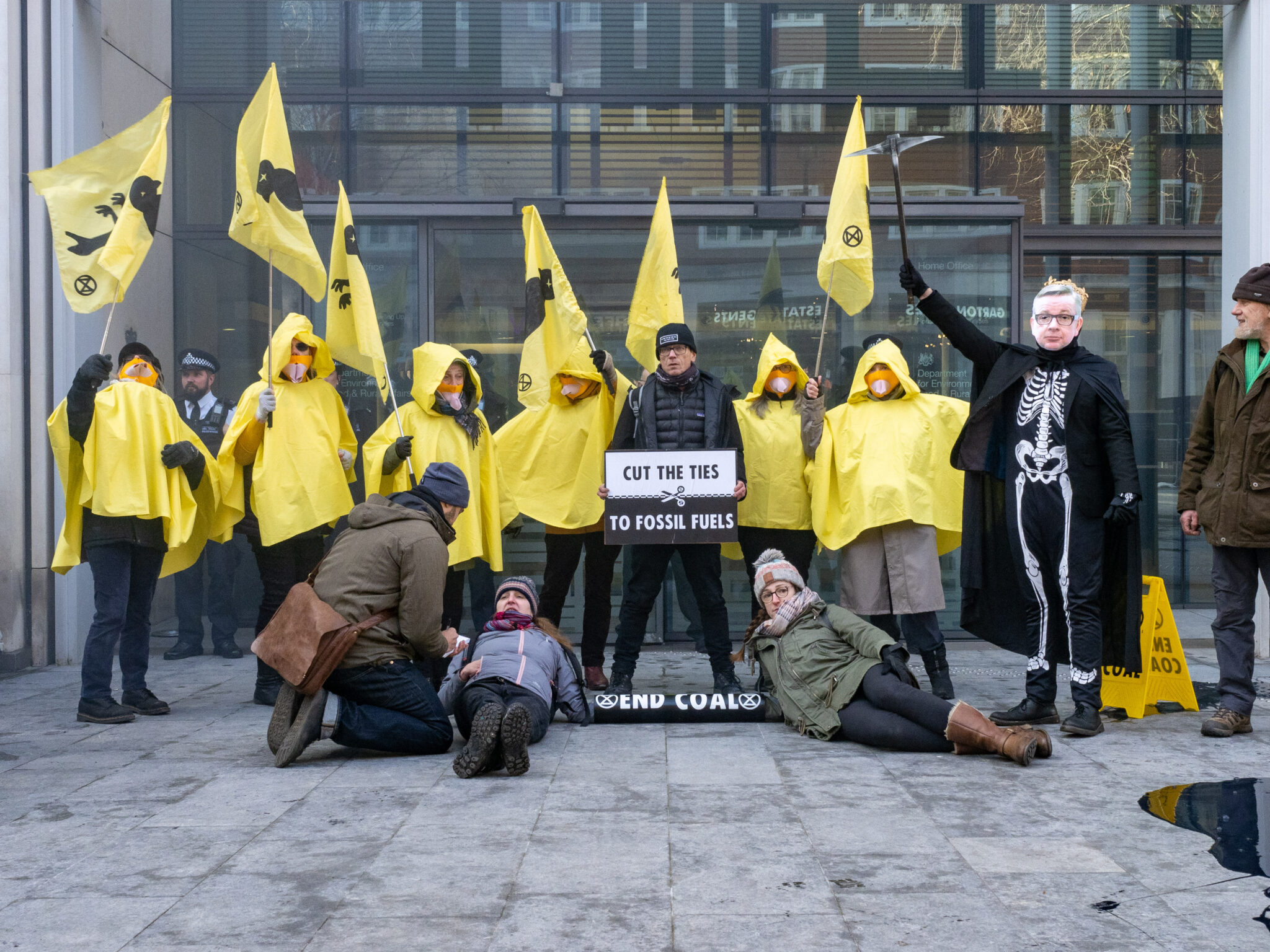
Image: William Joshua Templeton / Extinction Rebellion
Extinction Rebellion protests Michael Gove’s decision to allow coal mining at Whitehaven, Cumbria at the Department of Levelling Up, Housing & Communities in London.The mine is UK’s first new deep coal mine for 30 years.
Sarah Hart, a mother of two from Farnborough said: “2022 saw record global greenhouse gas emissions, and record global temperatures. Where is the government’s ambition to act on this Climate and Ecological Emergency? How dare they even think of opening a coal mine now? Gove claims this mine is carbon neutral but he completely ignores the emissions from burning the coal. We demand an end to all new fossil fuel projects.”
Dorothea Hackman, a 70 year old grandmother from Camden said: “Opening a coal mine today means the UK can’t argue that China and India should decrease their own coal emissions. Whitehaven coal isn’t even wanted by British steelworks, it’s going to be exported, there is no argument for domestic production.”
Extinction Rebellion is inviting everyone to Westminster from 21 April 2023 to demand a fair society and a citizen-led end to the fossil fuel era. Find out more about The Big One.
John Kerry, the US climate official, has said he is closely examining the UK government’s approval of a new coalmine, over concerns that it will raise greenhouse gas emissions and send the wrong signal to developing countries.
Kerry, Joe Biden’s special envoy for climate, said he was taking a close interest in the mine, the first to get the go-ahead in the UK for 30 years, and that he would speak out publicly against the approval if it did not meet strict criteria.
“I’m asking my people to give me a better download on exactly what the emissions implications are going to be,” he said in an interview on Friday evening.
“Coal is not exactly the direction that the world is trying to move in, or needs to move in. What I want to know is the level of abatement here [such as whether the resulting greenhouse gases will be captured and stored] and the comparison of this particular process in the production of steel,” he said.