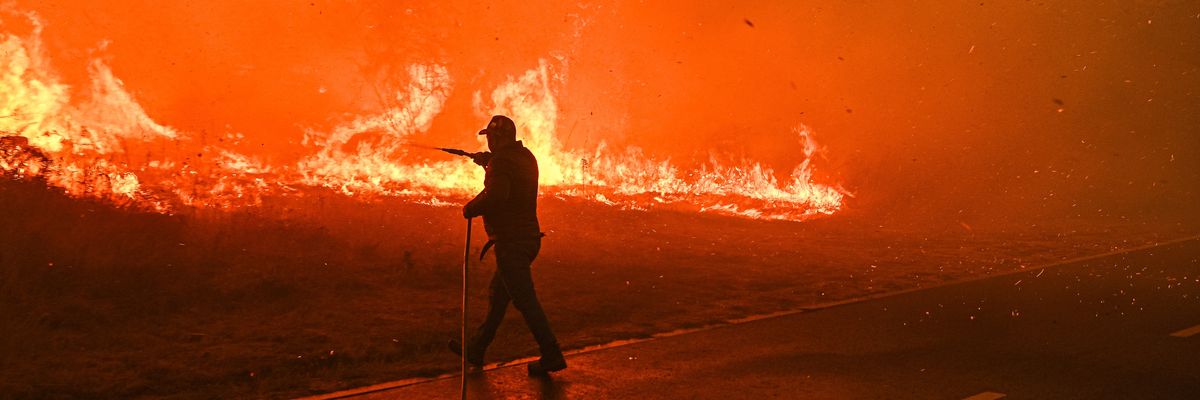
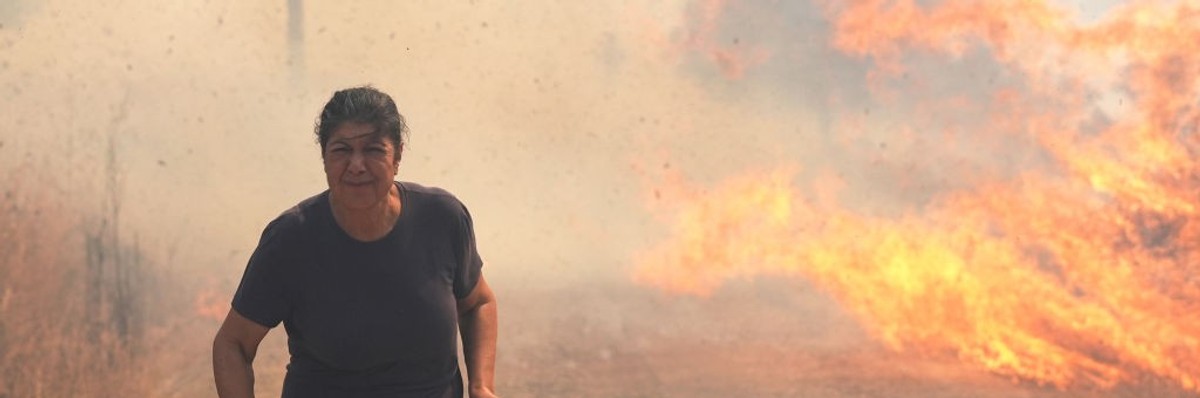
People around the world have contended with unprecedented weather events and their fatal effects caused by the climate catastrophe
After the world’s hottest summer since records began in 1850, the death toll from extreme weather in 2026 is already in the high tens of thousands. That is a conservative estimate and is certain to rise much higher.
As Cop31 continues and scientists warn that climate breakdown may be accelerating, the Guardian looks back at a year of droughts, fires and floods as a reminder that, unless the world takes urgent action to cut emissions, this disastrous year will be one of the best of the rest of our lives.
…
March Fourth-hottest March on record
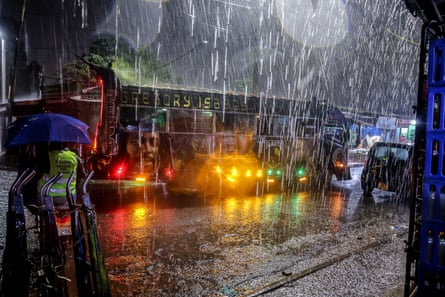
Motorists drive through heavy rains in the Kibera slums in Nairobi, Kenya. Photograph: Donwilson Odhiambo/Getty Images
Devastating floods across much of the world In Ethiopia, at least 131 people are killed in floods and mudslides that bury entire villages. Eighty die in Kenya and 18 in Tanzania. The Arabian peninsula is battered by fierce winds and heavy downpours that flood the streets of the desert kingdom. Hailstones the size of tennis balls fall in Oman and lightning storms leave cities in the UAE inundated with water. Many areas report record rainfall. At least 30 die in Afghanistan as heavy rains trigger landslides. Hong Kong is soaked in twice the usual monthly precipitation. Flood waters in southern Russia submerge homes and leave more than 300,000 without electricity. Huge tracts of farmland are left underwater in Argentina and Chile.
World’s energy imbalance accelerates rapidly The World Meteorological Organization reveals an alarming buildup of energy in Earth’s system. More than 90% is stored in the oceans, where warming has more than doubled over the past two decades compared with the average over the previous 45 years. This makes weather more extreme and threatens health and food supplies. António Guterres, the UN secretary general, says: “The global climate is in a state of emergency. Planet Earth is being pushed beyond its limits. Every key climate indicator is flashing red.” Guterres urges the world to cut fossil fuel emissions as rapidly as possible to minimise future risks. However, CO2 in the atmosphere continues to rise.
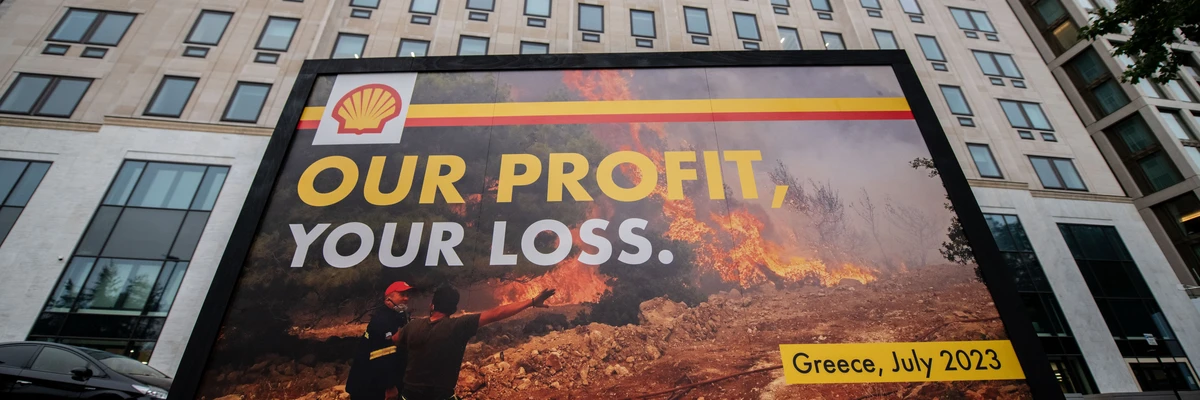
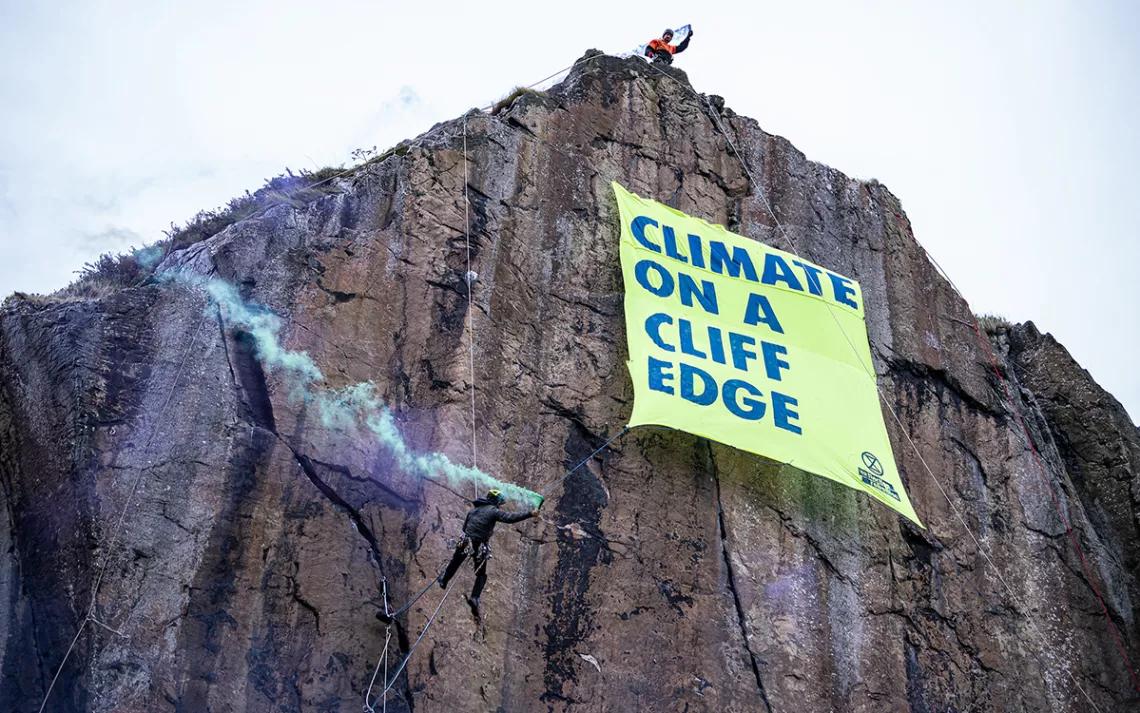
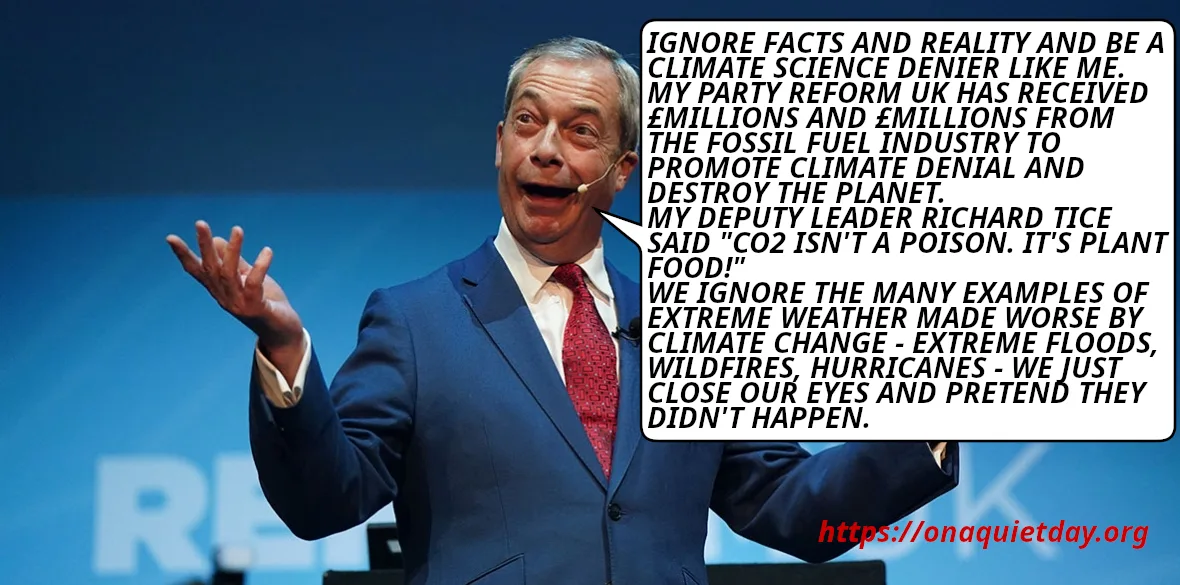
Greenpeace activists display a billboard during a protest outside Shell headquarters on July 27, 2023 in London. (Photo: Handout/Chris J. Ratcliffe for Greenpeace via Getty Images)Experienced climbers scale a rock face near the historic Dumbarton castle in Glasgow, releasing a banner that reads “Climate on a Cliff Edge.” One activist, dressed as a globe, symbolically looms near the edge, while another plays the bagpipes on the shores below. | Photo courtesy of Extinction Rebellion and Mark RichardsNigel Farage urges you to ignore facts and reality and be a climate science denier like him and his Deputy Richard Tice. He says that Reform UK has received £Millions and £Millions from the fossil fuel industry to promote climate denial and destroy the planet.
Green Party Co-leader Adrian Ramsay. Wikipedia CC.
Green Party co-leader Adrian Ramsay MP said
“The dire warning today from the World Meteorological Organization should serve as a wake-up call. With global temperatures predicted to breach internationally agreed safe limits in at least one of the next five years due to global inaction, we are facing a future filled with increasingly severe climate impacts.
“The Spending Review is the government’s chance to act. It must prepare for the climate consequences we can no longer avoid while also accelerating the path to net zero.
“In our submission, the Green Party has called for an additional £7 billion annually to be invested in making the changes we need to face the impact of climate change on all our lives – from flood defences to future-proofing homes and buildings. This is no longer an optional extra. It’s vital to protect lives and livelihoods.
“Delaying now means greater costs, deeper disruption, and irreversible damage. The science couldn’t be clearer, and the warning couldn’t be louder — the Government must respond with urgency and ambition. The Spending Review is the chance to do it.”
Orcas comment on killer apes destroying the planet by continuing to burn fossil fuels.
United Nations Secretary-General António Guterres speaks at the U.N. headquarters on February 22, 2023. (Photo: Lev Radin/Pacific Press/LightRocket via Getty Images)
“This is climate breakdown—in real time,” said United Nations Secretary-General António Guterres.
United Nations Secretary-General António Guterres said in a year-end message on Monday that “we have no time to lose” in the face of the worsening global climate crisis, which pushed temperatures to a record high this year and supercharged deadly extreme weather around the world.
“Today, I can officially report that we have just endured a decade of deadly heat,” Guterres said in a video message posted to social media. “The top 10 hottest years on record have happened in the last 10 years, including 2024.”
“This is climate breakdown in real time. We must exit this road to ruin,” he continued. “In 2025, countries must put the world on a safer path by dramatically slashing emissions and supporting the transition to a renewable future. It is essential—and it is possible.”
Guterres’ call to action came in the waning days of what scientists say is almost certain to be the hottest year on record and the first full year to breach the critical 1.5°C temperature threshold.
Celeste Saulo, secretary-general of the World Meteorological Organization (WMO), echoed Guterres’ warning about the dire consequences of the status quo, saying in a statement Monday that “if we want a safer planet, we must act now.”
“It’s our responsibility. It’s a common responsibility, a global responsibility,” Saulo said. “Every fraction of a degree of warming matters, and increases climate extremes, impacts, and risks. Temperatures are only part of the picture. Climate change plays out before our eyes on an almost daily basis in the form of increased occurrence and impact of extreme weather events.”
Last month, with emissions continuing to surge as the rich nations most responsible for the climate emergency refuse to ditch fossil fuels, world leaders convened for a U.N. climate summit in Azerbaijan that was swarmed by oil and gas lobbyists. The key gathering ended with a deal that climate advocates described as a step backward in the necessary push to rein in fossil fuel emissions.
Climate-denier and fossil fuel booster Donald Trump’s looming return to office in the U.S.—the world’s largest historical emitter—has campaigners and scientists increasingly concerned about the future of existing global climate agreements such as the Paris accord, from which the president-elect has pledged to withdraw once again.
One recent analysis projected that a second Trump administration could unleash an additional 4 billion tonnes of carbon dioxide equivalent by 2030, which would inflict $900 billion in global climate damages and deal a devastating blow to efforts to forestall runaway warming.
Throughout 2024, Guterres used his role as head of the U.N. to sound the alarm about the world’s dangerous trajectory, saying in an October address that “there is a direct link between increasing emissions and increasingly frequent and intense climate disasters.”
“We’re playing with fire,” he said, “but there can be no more playing for time.”
A resident tries to fight a wildfire burning on September 17, 2024 in Marco de Canaveses, Portugal. (Photo: Octavio Passos/Getty Images)
A new report contained “the bleakest news possible, especially with a climate denier U.S. president in office for the next four years,” said one climate scientist.
A day after U.S. voters elected climate-denying Republican Donald Trump in the presidential race, soon ushering in an administration that is sure to expand fossil fuel drilling, the European Union’s Earth observation agency announced that 2024 is “virtually certain” to be the hottest year on record and to hit a worrying temperature milestone.
The year is expected to be the first on record in which the temperature is more than 1.5°C hotter than before the Industrial Revolution, according to the Copernicus Climate Change Service (CCCS). The Paris climate agreement of 2015 urged countries to curb greenhouse gas emissions with the goal of limiting planetary heating to 1.5°C by the end of the century.
Over the past 12 months, said CCCS, global temperatures were 1.6°C warmer than the yearly average from 1850-1900.
“The average temperature anomaly for the rest of 2024 would have to drop to almost zero for 2024 to not be the warmest year,” said CCCS.
Last month was the second-hottest October ever recorded, with temperatures 1.65°C higher than preindustrial levels. It was the 15th month in the past 16 to be hotter than 1.5°C over preindustrial temperatures.
While a single year above the 1.5°C mark does not necessarily indicate that the Paris climate goal is out of reach, CCCS director Carlo Buontempo said the planet has “never had to cope with a climate as warm as the current one.”
“This inevitably pushes our ability to respond to extreme events—and adapt to a warmer world—to the absolute limit,” he told The Guardian.
Climate scientist Bill McGuire called the Copernicus report “the bleakest news possible, especially with a climate denier U.S. president in office for the next four years.”
Trump has pledged to expand fossil fuel extraction and do away with climate regulations introduced by the Biden administration, telling oil executives he would do so if they contributed $1 billion to his campaign in what was described as a quid pro quo.
The CCCS—which based its analysis on billions of measurements from satellites, ships, aircraft, and weather stations—noted in its report that October saw numerous extreme weather events tied to the warming planet. Heavy rains led to severe flash flooding in Spain, killing more than 200 people. Above average precipitation was also seen in Norway, France, China, southern Brazil, and parts of Australia, while Florida faced Hurricane Milton just two weeks after Hurricane Helene killed more than 230 people.
The World Meteorological Organization last week announced that carbon dioxide concentrations in the atmosphere are accumulating faster than at any other time in human history, rising more than 10% in the last two decades.
“The most effective solution to address the climate challenges is a global commitment on emissions,” Buontempo told The Guardian.
BBC journalist Navin Singh Khadka said on the news network that if the 1.5°C breach continues “in the long term, then we are warned there will be catastrophic consequences.”
Experienced climbers scale a rock face near the historic Dumbarton castle in Glasgow, releasing a banner that reads “Climate on a Cliff Edge.” One activist, dressed as a globe, symbolically looms near the edge, while another plays the bagpipes on the shores below. | Photo courtesy of Extinction Rebellion and Mark Richards
Civilians flee a forest fire that broke out close to residential areas at Cesmealti in Urla district of Izmir, Turkey on July 31, 2024. (Photo: Mahmut Serdar Alakus/Anadolu via Getty Images)
“We need to tackle the root cause and get serious about reducing record levels of greenhouse gas emissions,” said the head of the World Meteorological Organization.
As scientists around the world on Thursday released new data about recent record-smashing heat, one United Nations adviser placed blame for the lack of ambitious climate action on the fossil fuel industry’s decadeslong disinformation efforts.
“There is this prevailing narrative—and a lot of it is being pushed by the fossil fuel industry and their enablers—that climate action is too difficult, it’s too expensive,” Selwin Hart, a special adviser to the U.N. Secretary-General António Guterres and assistant secretary-general of the Climate Action Team, told The Guardian‘s Fiona Harvey.
“It is absolutely critical that leaders, and all of us, push back and explain to people the value of climate action, but also the consequences of climate inaction,” said Hart, former executive director of the Caribbean at the Inter-American Development Bank and Barbados’ ambassador to the United States and the Organization of American States.
Investigations by academics, journalists, and lawmakers as well as ongoing legal battles have exposed how Big Oil not only has heated and polluted the planet but also knew about the devastating impacts of fossil fuels decades ago and opted to spread lies so shareholders could make massive profits—which they continue to rake in today.
“Climate appears to be dropping down the list of priorities of leaders,” Hart said, pointing to polling that shows people around the world want a rapid transition to clean energy. “But we really need leaders now to deliver maximum ambition. And we need maximum cooperation. Unfortunately, we are not seeing that at the moment.”
According to The Guardian:
[Hart] warned that the consequences of inaction were being felt in rich countries as well as poor. In the U.S., many thousands of people are finding it increasingly impossible to insure their homes, as extreme weather worsens. “This is directly due to the climate crisis, and directly due to the use of fossil fuels,” he said. “Ordinary people are having to pay the price of a climate crisis while the fossil fuel industry continues to reap excess profits and still receives massive government subsidies.”
Yet the world has never been better equipped to tackle climate breakdown, Hart added. “Renewables are the cheapest they’ve ever been, the pace of the energy transition is accelerating,” he said.
Hart’s comments came as the European Union’s Copernicus Climate Change Service (C3S) announced that last month “was the second-warmest July globally in our data record, with an average ERA5 surface air temperature of 16.91ºC,” or 62.44ºF.
From June 2023 to June 2024, each month was the hottest on record, according to C3S. Samantha Burgess, the agency’s deputy director, noted that now, “the streak of record-breaking months has come to an end, but only by a whisker.”
“Globally, July 2024 was almost as warm as July 2023, the hottest month on record,” Burgess stressed. “July 2024 saw the two hottest days on record. The overall context hasn’t changed, our climate continues to warm. The devastating effects of climate change started well before 2023 and will continue until global greenhouse gas emissions reach net-zero.”
The U.N.’s World Meteorological Organization (WMO) said Thursday that the new C3S data “underlines the urgency of the Call to Action on Extreme Heat” issued by Guterres last month, shortly after July 22 became the hottest day ever recorded.
“Widespread, intense, and extended heatwaves have hit every continent in the past year,” said WMO Secretary-General Celeste Saulo in a statement. “At least 10 countries have recorded daily temperatures of more than 50ºC in more than one location. This is becoming too hot to handle.”
Saulo highlighted that “Death Valley in California registered a record average monthly temperature of 42.5ºC (108.5ºF)—possibly a new record observed for anywhere in the world. Even the remote frozen ice sheets of Antarctica have been feeling the heat.”
“The WMO community is committed to responding to the U.N. secretary-general’s Call to Action with better heat-health early warnings and action plans,” she pledged. “Recent estimates produced by WMO and the World Health Organization indicate that the global scale-up of heat-health warning systems for 57 countries alone has the potential to save an estimated 98,000 lives per year. This is one of the priorities of the Early Warnings for All initiative.”
“Climate adaptation alone is not enough,” she added. “We need to tackle the root cause and get serious about reducing record levels of greenhouse gas emissions.”
C3S wasn’t alone in releasing new data on Thursday; the U.S. National Oceanic and Atmospheric Administration (NOAA) also shared some key points for the country’s climate in July, with the full report set to be released on Tuesday.
NOAA’s top takeaways were:
The average temperature of the contiguous U.S. in July was 75.7ºF, 2.1ºF above average, ranking 11th warmest in the 130-year record.
The Park Fire is the fourth-largest wildfire in California history as of August 6; beginning on July 24, it burned approximately 401,000 acres and destroyed over 560 structures.
On July 15, a derecho that spawned 32 tornadoes broke the Chicago-area record for most tornadoes in a day.
On July 1, Beryl became the earliest Category 5 hurricane and the second Category 5 on record during the month of July in the Atlantic Ocean.
Other major events in July included California’s Thompson Fire, which forced over 13,000 people to evacuate, and Washington, D.C. enduring 101ºF on July 17, tying a record for the longest streak of temperatures above 100ºF. NOAA also found that “for the January-July period, the average contiguous U.S. temperature was 54.5ºF, 3.2ºF above average, ranking second-warmest on record.”