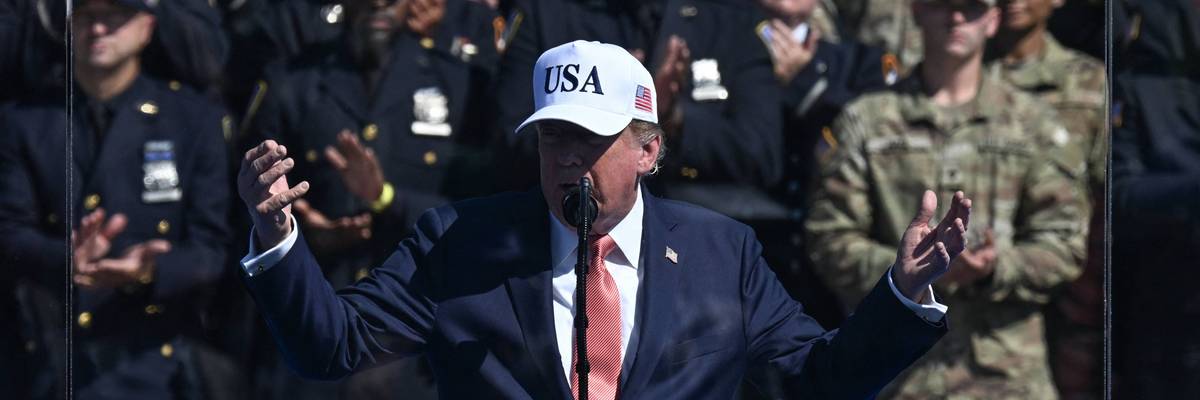
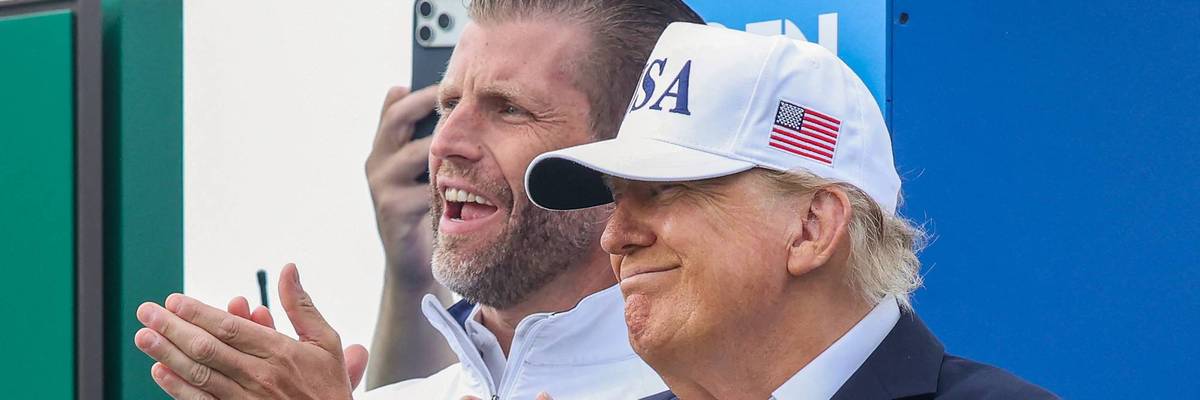
US President Donald Trump and son Eric Trump attend the final round of the Irish Open golf tournament at the Trump International Golf Links & Hotel in Doonbeg, Ireland on September 13, 2026. (Photo by Paul Faith/AFP via Getty Images)
“His wealth increases,” said an independent voter from Florida, “but the people in the country are just barely getting by.”
US President Donald Trump has made over $2 billion since returning to power last year, and polling results released Tuesday show a majority of Americans believe he has not only prioritized himself and his inner circle, but also engaged in illegal or unethical behavior to cash in on his control of the White House.
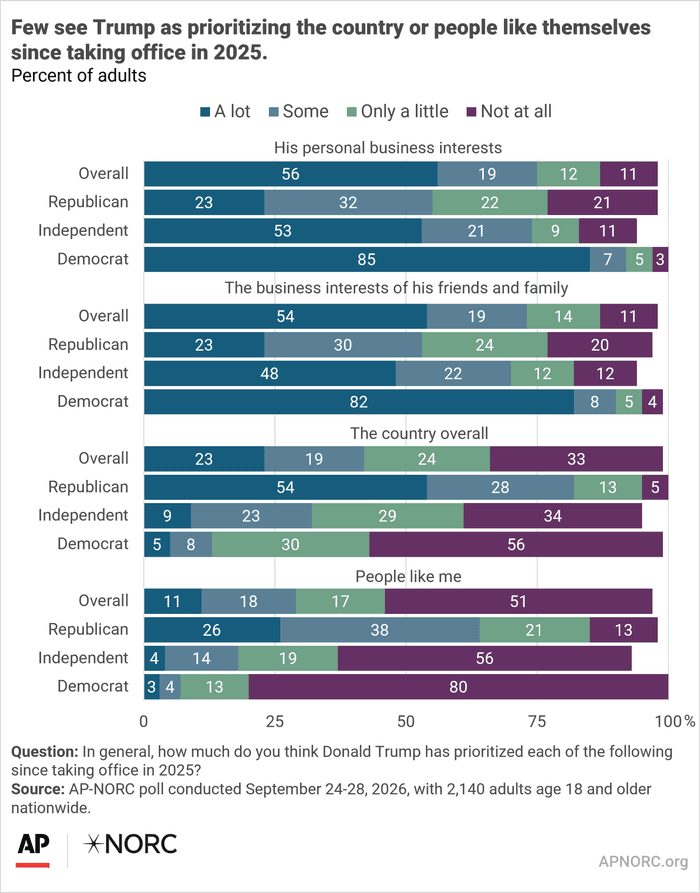
The Associated Press-NORC Center for Public Affairs Research surveyed 2,140 US adults from September 24-28 and found that 56% of Americans across the political spectrum believe that Trump has prioritized his personal business interests “a lot” since 2025. Another 19% said he has prioritized those “some.”
As for prioritizing the business interests of his friends and family, 54% said he has done so a lot, and 19% said some—figures published just days after an analysis estimating that companies backed financially by the president’s sons, Donald Trump Jr. and Eric Trump, have scored more than $6 billion in contracts from the US Department of Defense.
Meanwhile, as Americans struggle with the high cost of everything from gasoline and groceries to healthcare and housing, and with the midterm elections just weeks away, only 23% of those polled said the president has prioritized the country a lot, and 19% said some. Even worse, 11% said he’s prioritized “people like me” a lot, and 18% said some.
Trump—whose approval rating has recently plummeted to record lows, fueling GOP fears about losing majorities in both chambers of Congress next month—disclosed in July that he pocketed at least $2.2 billion, over half of which came from his family’s cryptocurrency grift.
That “completely unprecedented” windfall generated allegations of corruption—as have Trump’s stock trading disclosures since then, despite White House attempts to stress that his “stock and bond portfolio is independently managed by third-party financial institutions.”
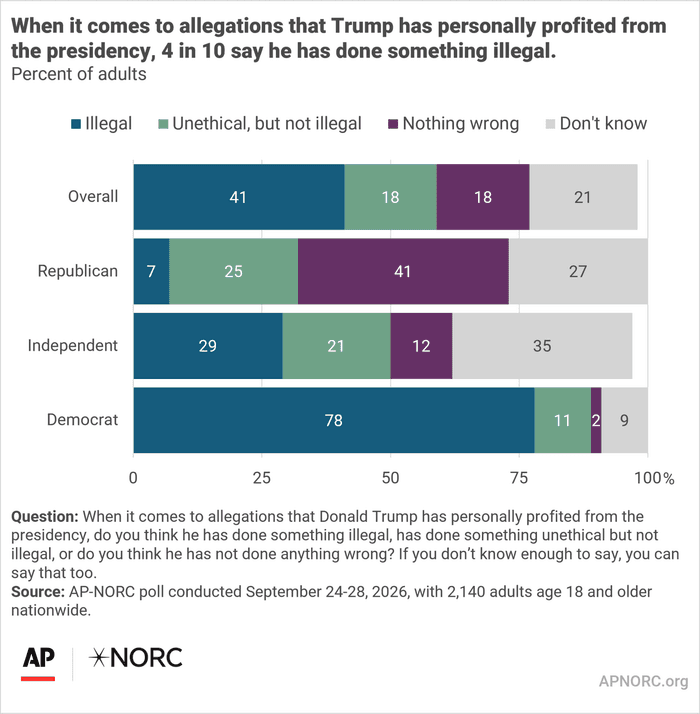
AP-NORC found that 59% of Americans across the political spectrum believe Trump has done something illegal (41%) or unethical but not unlawful (18%) to profit from the presidency. That includes 89% of Democrats, 50% of independents, and 32% of Republicans.
“His wealth increases,” 87-year-old retiree Barbara Thaxton, an independent from Summerfield, Florida, told the AP, “but the people in the country are just barely getting by.”
Last week, Senate Banking, Housing, and Urban Affairs Committee Ranking Member Elizabeth Warren (D-Mass.) released the “Trumpflation Tracker,” a tool that she said shows “families across the country exactly how much of a price they are paying for Trump’s and Republicans’ failed economic agenda.”
According to Warren’s tracker, during Trump’s second term, gasoline prices have soared 43.7%, healthcare costs are up 14.6%, residential electricity prices are 12.7% higher, childcare has risen 7.6%, and rent has jumped 5.1%. The tool suggests the average US household is paying thousands of dollars more due to GOP policies, from the president’s illegal war on Iran and tariffs to cuts in his party’s 2025 budget package.
🚨NEW from @SenateBanking and @SenWarren: The Trumpflation Tracker is shining a spotlight on how Trump's policies are making life more expensive for families.
Electric bills are up. Gas prices are up. Rent & grocery bills are up. Wage growth is slowing.
“So much for Trump’s ‘Golden Age’ of economic opportunity,” retiring Sen. Dick Durbin (D-Ill.) said in response to the tracker. “Inflation is up more than 5% since he returned to the White House. Whether it’s the president’s tariffs, war with Iran, or cuts to healthcare and food assistance, his administration is making it harder for you to afford the basics.”
Britain’s record donor made his fortune from a crypto exchange that asked few questions of its customers
In brief
Man who recently pledged £36m to Reform was convicted of failing to maintain proper money-laundering controls, before being pardoned by Trump
The platform demanded little more than an email from customers for long periods and as a result became a lure for dirty money, the US government argued
Delo pleaded guilty to one offence and other allegations, including fraud, were not tested at trial
When Ben Delo handed Reform UK £36m last week to become the biggest donor in British political history, a flurry of articles quickly followed seeking to explain exactly who this so-called “crypto billionaire” was.
Most told some version of the same story: Delo is an Oxford graduate who co-founded the cryptocurrency exchange BitMEX, became Britain’s youngest self-made billionaire at 34, gave millions to philanthropy and, along the way, fell foul of an obscure US financial law.
By and large, the articles did not dwell on that last part. Delo himself has described his offence under the Bank Secrecy Act as a “spurious blip”.
But US court records we have examined, building on reporting by Democracy for Sale, raise far more troubling questions about the business that made Delo his fortune. The prosecution’s wider case extended far beyond the single offence Delo admitted. Those allegations were disputed by Delo and BitMEX and were never tested at trial.
Documents filed by US prosecutors said Delo’s decisions turned BitMEX into a “magnet for money laundering and criminal activity”. They said the company processed trillions of dollars of transactions for its customers. For much of this time, they were required to provide nothing more than an email address. “No real name or other advanced verification is required,” trumpeted the website.
A document filed by US prosecutors ahead of Delo’s sentencing
The FBI said BitMEX, in which Delo owned almost a third of the shares during the period covered by the case, deliberately kept these requirements loose in order to drive up revenue. Delo personally intervened to help customers dodge restrictions on US trading, prosecutors claimed.
BitMEX generated more than $1.3bn in revenue during the five years covered by its criminal case, with prosecutors describing Delo as a “critical organiser and leader” of the “criminal decision” not to install the required safeguards.
In 2020, the US Department of Justice charged Delo and three other BitMEX executives with violating the Bank Secrecy Act by failing to maintain proper anti-money-laundering controls. Meanwhile, the US derivatives regulator, CFTC, brought a civil action against the founders and five companies behind BitMEX.
In response to the DoJ’s charges, Delo pleaded guilty to one offence as part of a pre-trial plea agreement in which the US government agreed not to prosecute him over other alleged offences it had investigated. At the sentencing, prosecutors set out this wider case against Delo, much of which was refuted by his lawyers who argued that his role was not compliance-related, but neither case was tested at trial.
Delo’s lawyers told us: “There is no truth in the serious allegation that our client was guilty of the types of improper, unlawful or criminal conduct that the DoJ crowed about but did not even try to prove.
“The prosecutors’ unproven references to money laundering, sanctions evasion and fraud were irrelevant to the charges brought against Mr Delo and were put forward purely for prejudice and no attempt was even made to evidence or otherwise substantiate them in court.”
Reform UK and BitMEX did not respond to our requests for comment. Nor did co-founder Arthur Hayes, whose own defence relied on similar arguments to Delo’s.
Delo, the “D” in BitMEX parent company HDR Global Trading, co-founded the company in Hong Kong in 2014 and, as chief operating officer, built and oversaw the exchange’s trading software. US regulators later said all three founders worked together on critical decisions.
After receiving a pardon from Donald Trump in 2025, Delo said “a legal wrong has been righted”, claiming he and his co-founders had been “sacrificed for political reasons”, referring to the Biden administration.
While Delo’s “crypto billionaire” label comes from the value of his stake in BitMEX during its height, the size of his wealth today is much less clear.
The current rules governing political donations are clearly not fit for purpose
Tim Picton, Spotlight on Corruption
But certainly the company described by prosecutors as a “platform for money-laundering” made Reform’s largest donor extremely rich. Prosecutors said he and his two co-founders each withdrew between $100m and $150m in dividends between 2014 and 2020.
Tim Picton, senior advocacy adviser at Spotlight on Corruption, told us: “Political parties should be required to check a donor’s source of funds before accepting any large sum of money.
“In the age of mega donors who have derived their wealth from loosely regulated sectors such as crypto, this is urgently needed alongside a cap on donations.”
Before BitMEX even launched, its founders were discussing how much they really needed to know about its customers. The answer, initially at least, was as little as possible.
“Basically just valid email address until we feel significant pressure to do otherwise,” said co-founder Arthur Hayes in an internal message to Delo in November 2014. And for years, that was all users needed – with BitMEX’s own website advertising this fact to prospective customers.
Prosecutors argued that without knowing who was behind an account, BitMEX was ill-equipped to check whether the bitcoin flowing through it belonged to an ordinary trader, a hacker, a darkweb marketplace or someone in a sanctioned country. Nor could it report suspicious customers to the authorities.
The upshot, prosecutors said, was that BitMEX became “in effect, a money laundering platform”.
Regulators in the US demand tighter customer ID controls than this – so BitMEX banned US customers. But it also launched what it described as a “hidden service” on Tor, a web system that obscures the user’s location.
A document filed by US prosecutors ahead of Delo’s sentencing
Delo admitted that BitMEX recorded logins from users known to be in the US and “did not immediately act to restrict [their] trading”.
In October 2018, Delo said BitMEX had frozen roughly 2,000 accounts associated with restricted jurisdictions, but not those in the US. When one valuable customer was caught logging in from a US territory, Delo instructed a colleague to “tell them to log in from Canada like they normally do”.
Delo’s lawyers said such examples gave a misleading picture of his wider conduct, producing evidence of hundreds of occasions on which he personally restricted US-linked users. Judge John Koeltl acknowledged that Delo had been “actively involved” in enforcing controls on US customers. He said BitMEX had introduced procedures over time to exclude US customers and “did screen out a considerable amount of business from United States customers”. But he said that “given the admittedly wilful nature of the violation, the crime remains a serious one”.
They said the exchange used distinctive bitcoin addresses, making funds easier to trace, and said BitMEX had an “excellent track record” of cooperating with US law enforcement.
Comprehensive identity checks for all customers were not introduced until 2020, by which point the “significant pressure” Hayes had anticipated had arrived. Prosecutors argued BitMEX had started strengthening controls only after US regulatory scrutiny in 2018; BitMEX disputed this, saying it decided to do so independently in 2019.
The US Attorney’s Office later described BitMEX’s restrictions on US customers as “toothless or easily overridden” in pursuit of its ultimate goal: US money.
At BitMEX’s corporate sentencing in January 2025, Judge Koeltl found that US users accounted for about $2bn in deposits and $155m of the exchange’s revenue.
For years, BitMEX knew remarkably little about many of its customers. It turned out that some of them had good reasons to want it that way.
FinCEN, the US Treasury’s financial crime regulator, identified at least $209m in BitMEX transactions, including from unregistered money services and so-called darknet markets, where drugs and counterfeit goods are bought and sold. BitMEX settled this case without admitting or denying the findings.
Among the criminal customers linked to the BitMEX, prosecutors cited Elliot Gunton, a hacker from Norwich who had been convicted as a teenager for accessing the personal information of thousands of people as part of the notorious 2015 TalkTalk cyberattack. Prosecutors said Gunton had an account linked to BitMEX.
There is no suggestion BitMEX was involved in Gunton’s hacking or that Delo knew who he was.
FinCen found that in October 2018, the company identified more than 40,000 accounts registered in the US; US territories; or US- or UN-sanctioned countries such as Cuba, Iran, Syria, North Korea or Sudan; as well as people logging in from Quebec. Delo’s lawyers told us that because he was not a US citizen and the companies were not US companies they were not “bound by US sanctions law when acting outside the US”.
Delo also had dealings with Sam Bankman-Fried, years before the entrepreneur was convicted of fraud.
Court papers describe how in December 2018, BitMEX blocked an account belonging to Bankman-Fried’s trading firm Alameda Research over US activity. By then, prosecutors said, it had traded from the US for more than six months without providing onboarding documents and deposited more than $100m into its BitMEX account.
Sam Bankman-Fried was helped by a BitMEX employee to overcome his company’s log-in banMichael M Santiago / Getty
When Bankman-Fried contacted Delo, he was put in touch with an employee who recorded that Alameda was “very appreciative we took care of their US log-in ban this week so quickly”. The employee then encouraged Bankman-Fried to move the account to a non-US entity, settling on the British Virgin Islands, despite prosecutors saying there was “no indication” Alameda stopped logging in from the US.
BitMEX maintained that Alameda supplied BVI incorporation documents and later provided evidence that its authorised traders lived outside the US. At sentencing, the Judge accepted a government calculation that counted Alameda’s deposits as coming from US customers, rejecting BitMEX’s broader challenge to the way US customers had been identified.
Prosecutors said the episode showed BitMEX knew US crypto traders could easily circumvent its restrictions.
When BitMEX itself pleaded guilty to the same breach of the Bank Secrecy Act in 2024, US attorney Damian Williams said the absence of meaningful anti-money laundering controls had opened the exchange up as a “vehicle for large-scale money laundering and sanctions evasion schemes”.
BitMEX’s issues with regulation were not confined to its dealings with its customers. As a crypto company, it had a banking problem.
So in 2015, the prosecution alleged, it acquired a Hong Kong company called Shine Effort before quickly transferring it to Delo for $1. Although Delo owned the company on paper, they said, he was holding it on behalf of the true owner, BitMEX.
Assisted by Hayes, Delo opened an HSBC account in Shine Effort’s name. Prosecutors alleged that he and Hayes presented Shine as an independent IT company.
Documents filed by the US attorney against BitMEX
Sentencing papers filed by prosecutors even allege that he, Hayes and another executive doctored internal BitMEX documents to present to the bank. More than $100m subsequently passed through the account.
The US Attorney’s Office later described the arrangement in starker terms. It said BitMEX, as part of its “willful evasion” of US anti-money-laundering laws, had lied to a bank so it could “pump millions of dollars through the US financial system”.
BitMEX, through its lawyers, told the court that it denied these allegations and the claims were never tested at trial. Under Delo’s plea agreement, prosecutors agreed not to bring bank- and wire-fraud charges relating to alleged misrepresentations to HSBC. Judge Koeltl said he would not consider the Hong Kong bank conduct at BitMEX’s sentencing as he believed it “too tangential” to the case; he did not rule on whether it happened.
In February 2022, Delo pleaded guilty to violating the Bank Secrecy Act by wilfully failing to establish the required anti-money-laundering programme at BitMEX.
Delo admitted knowing Americans were trading on BitMEX, knowing this required the exchange to identify its customers and knowing its existing controls were inadequate. When asked by the judge whether he knew at the time that what he was doing was “wrong and illegal”, Delo replied: “Yes, your honour.”
He admitted that he had not acted “quickly enough or effectively enough” to stop US customers illegally using the exchange.
“It was a terrible decision, the consequences of which I have to carry the rest of my life,” he told the court.
His lawyers, however, argued that his principal role at BitMEX was technical and that he was not involved in setting compliance policies. They said he had taken “numerous steps” to deal with problematic customers, including personally restricting hundreds of accounts.
Judge Koeltl accepted that others had “more responsibility over the company’s marketing and compliance functions than Mr Delo”, BitMEX had introduced controls over time and “did screen out a considerable amount of business from United States customers”. But, he added, “given the admittedly willful nature of the violation, the crime remains a serious one”.
Delo told the court that his guilty plea represented a “fair resolution” of the case. He was not convicted of money laundering, fraud or breaching sanctions, and was sentenced to 30 months’ probation and fined $10m.
His financial connection to BitMEX, however, did not end when he stepped down in 2020 after being charged. A 2024 court filing by BitMEX in 2024 said that he and his two co-founders still collectively owned 91% of its parent company, HDR Global Trading.
The following year, a federal judge fined HDR $100m after it pleaded guilty to the same Bank Secrecy Act offence. The money was due on 28 March 2025. On 27 March, Donald Trump pardoned the company and its founders, writing off the fine.
BitMEX settled with the CFTC and FinCEN in 2021 on a “neither admit nor deny” basis, while Delo and the other founders separately settled the CFTC case against them in 2022, each agreeing to pay $10m.
Delo neither admitted nor denied the CFTC’s allegations, except those admitted to in his guilty plea, and his $10m CFTC payment was counted as his $10m criminal fine.
What Delo has called a “blip” was also a period in which his business generated more than $1bn in revenue and paid him, according to prosecutors, more than $100m in dividends.
His fortune is now being used to boost the bank balance – and the election hopes – of Reform.
Delo’s record donation comes as parliament considers some of the biggest changes to political funding rules in years, including a £100,000 annual cap on donations from overseas voters and a ban on cryptoasset donations.
Steve Goodrich, head of research and investigations at Transparency International UK, said political parties relying on funding from a handful of individuals presents a “major corruption risk”.
“No politician or party should leave themselves so dependent on so few sources of funds, especially when one of them has been convicted for serious anti-money laundering failings,” he said, adding that a wider cap would reduce the risks surrounding the source of these donations and “what might be expected in return”.
Picton from Spotlight on Corruption said: “The current rules governing political donations are clearly not fit for purpose. The government must ensure that its new know your donor regime is tightened up to more closely mirror the customer due diligence checks as laid out by anti-money laundering regulations.”
What next?
The Representation of the People Bill, currently making its way through Parliament, would introduce new checks on outsized political donations and a cap on donations from overseas voters
We will continue to report on the crypto money flowing into British politics, contact us at info@thebureauinvestigates.com with your tips
Reporters: Nathaniel Peutherer and Lawrence Marzouk Enablers editor: Lawrence Marzouk Production editor: Alex Hess Deputy editor: Chrissie Giles Editor: Franz Wild
The Bureau has a number of funders, a full list of which can be found here. None of our funders have any influence over editorial decisions or output.
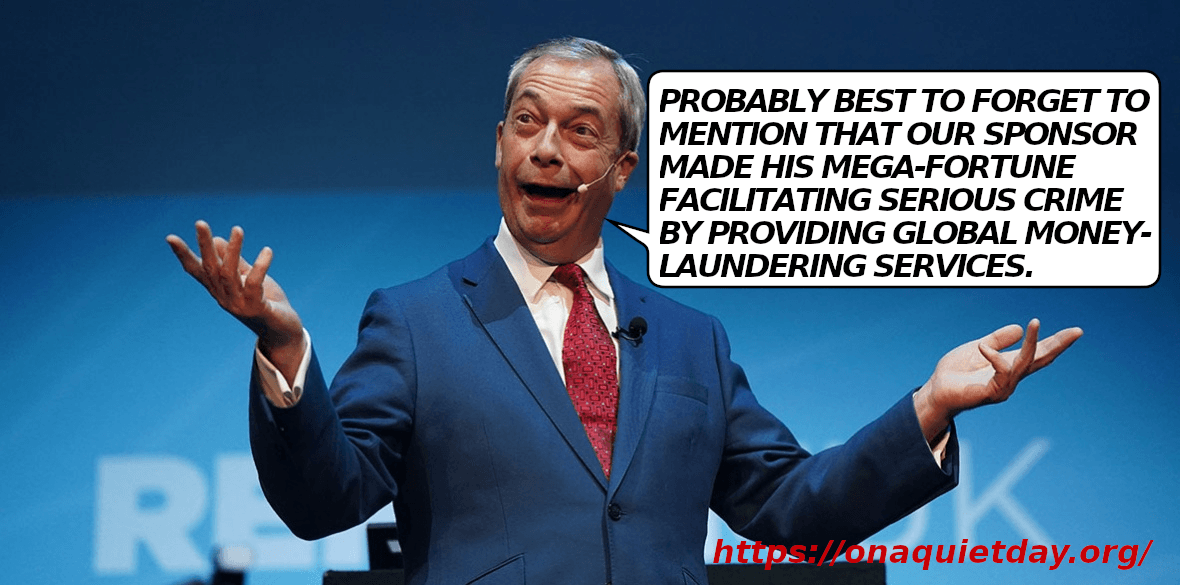
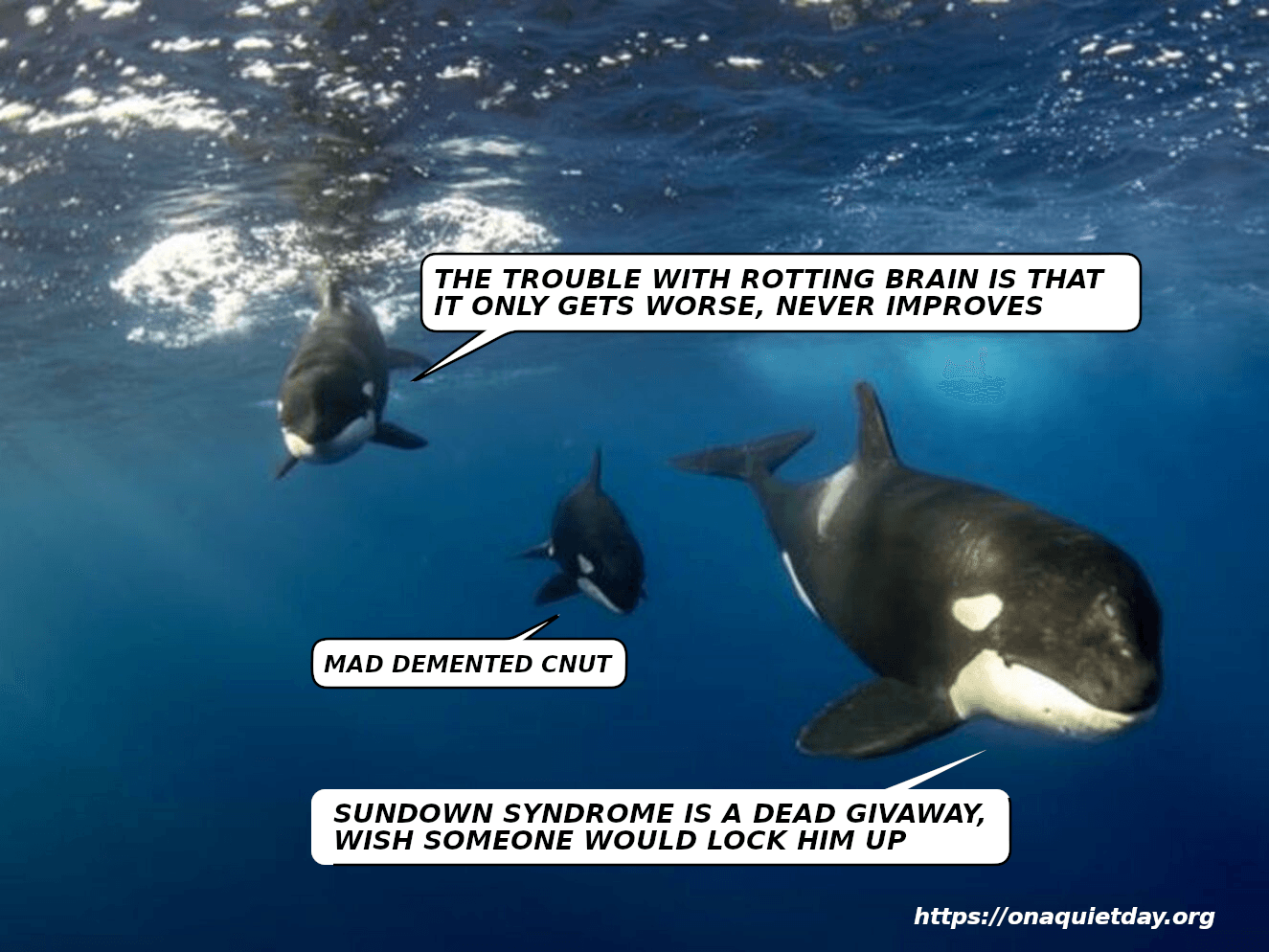
Reform UK 2025 Ltd’s Nigel Farage says it’s probably best to forget to mention that their sposor made his mega-fortune facilitating serioius crime by providing global money-laundering services.Orcas discuss how Trump was re-elected and him being an obviously insane, xenophobic Fascist.
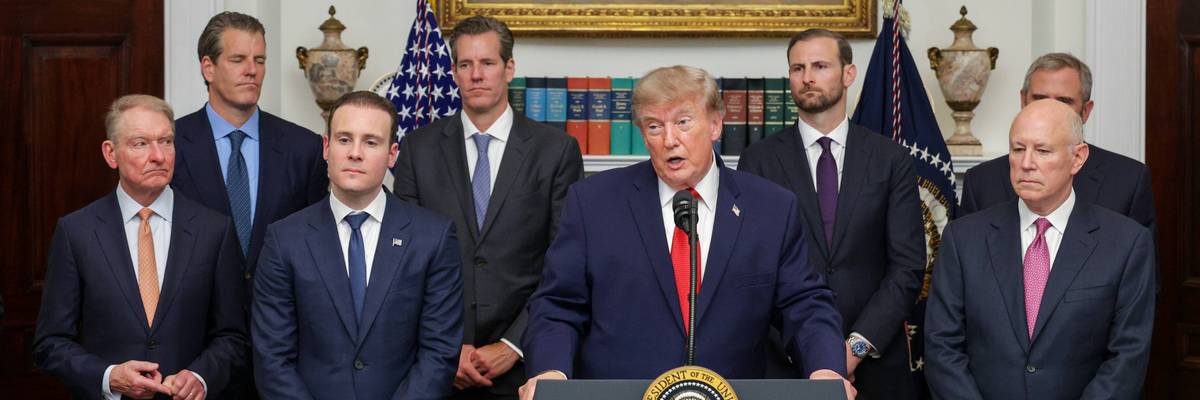
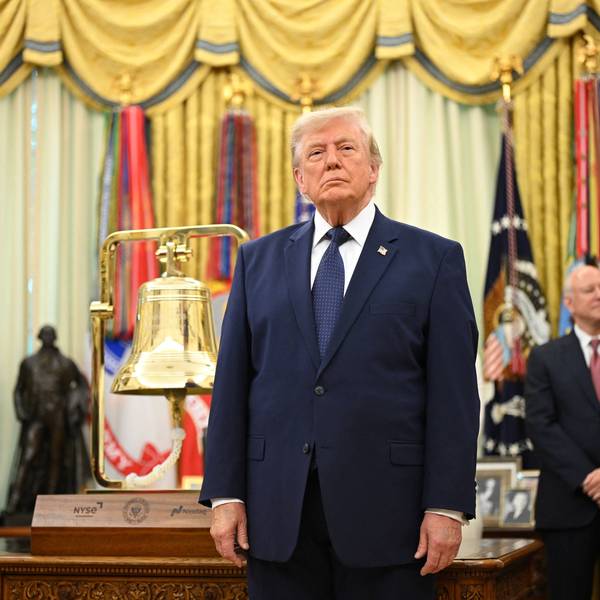
President Donald Trump delivers remarks as he is joined by (L-R, front) Chairman of the US Securities and Exchange Commission (SEC) Paul Atkins, Commodity Futures Trading Commission (CFTC) Chairman Michael Selig, and Chairman of the NYSE and CEO of Intercontinental Exchange Jeffrey Sprecher, during a summit of crypto and technology leaders in the Roosevelt Room of the White House on August 19, 2026 in Washington, DC. (Photo by Alex Wong/Getty Images)
Whatever level of outrage there is over this example of Trump’s corruption and conflict of interests, it’s likely not enough.
The Trump family has made a fortune from its crypto business. By granting his business a bank charter, the Office of the Comptroller of the Currency (OCC) in the Treasury Department has acted to help him, his family, and possibly one Middle Eastern spymaster make more money.
It is widely recognized that the OCC’s decision is laden with conflicts of interest. But there is more to it than self-dealing and self-enrichment. If implemented, the decision also corrupts the US economy by allowing criminals, terrorists and rogue states access to the payments system—the basic plumbing—used by regulated banks. It also creates conditions for crypto firms to maneuver for a federal bailout should their businesses start to fail.
The Trump family has a significant ownership interest in World Liberty Financial, a company that among other things issues the USD1 “stablecoin.” In 2025 Trump alone reported earning $536.4 million from WLF. Even this sum does not include income that may be going to Trumps’ family, or to the family of his emissary Steve Witkoff, which also have interests in WLF. Nor does it include income which may be going to Sheikh Tahnoon bin Zayed Al Nahyan, the United Arab Emirates spy chief, whose investment company owns a 49 percent equity share of WLF.
First, a trust charter eases the way for the WLF stablecoin business to obtain a “master account” at the Federal Reserve, which are used by banks to hold and transfer dollars electronically. If a master account is granted, dollar payments into and out of USD1 can go through that system. This will lower USD1 costs, since it will not need to use a commercial bank to transfer funds.
Second, it will create a halo effect for USD1, enhancing its legitimacy and perceived safety. A “trust bank” sounds like something that comes with the regulations, supervision, and guarantees that make commercial banks a safe place for retail depositors. But that is not true. Trust banks do not take deposits or make loans, are not federally insured, and are not eligible for lending from the Federal Reserve.
The conflicts of interest in granting a bank charter to WLF are apparent. The OCC—which a Trump executive order claims is completely controlled by him—has granted a bank charter to a firm which makes him money and will act as the supposed supervisor of that bank.
Bad as this seems, there are harms beyond the self-dealing and self-enrichment involved in granting this charter. Giving any stablecoin or crypto currency firm access to a master account invites illicit use of the regulated financial system which we all depend on.
The Tether stablecoin, for example, has featured in international criminal cases, and has frequently been used by financial fraudsters laundering money, by countries such as Iran and Russia evading sanctions, and by terrorist networks. A record $158 billion of crypto tokens were sent to criminal wallets in 2025, a 145% increase from the previous years.
This risk has been recognized by the Federal Reserve in the past. According to guidance released by the Board of Governors in 2022, master accounts should not go to entities that create an undue risk to the economy by “facilitating activities such as money laundering, terrorism financing, fraud, cybercrimes, economic or trade sanctions violations, or other illicit activities”. It is not at all clear why any stablecoin or other crypto currency is not, on the face of it, ineligible under these and other parts of the BOG guidance. In fact, Federal Reserve Governor Michael Barr has objected to the creation of this class of account because it does not provide sufficiently specific and robust safeguards to protect against their being used for money laundering and terrorist financing by institutions the Fed does not supervise.
There is another alarming outcome that may result from giving bank charters to crypto firms. The halo effect—which may lead stablecoin users to believe they have federal protection—could be used by WLF and other crypto firms to provide political cover for a federal bail-out if their businesses were failing.
There would be no legal basis for such a bailout. But would this administration, and the OCC which it claims to control completely, look for a way to provide a bailout that protected their crypto firm wealth? That may seem unlikely, but so did a $1.8 billion fund to benefit January 6 rioters and other political favorites.
The OCC and the Federal Reserve are failing in their duty to protect the public and the economy from potential harm that can flow from crypto firms like WLF. A responsible Congress would intervene to stop it.
dizzy: This article mentions the Tether stablecoin. The Reform UK and Nigel Farage sponsor Chakrit Sakunkrit / Christopher Harborne has involvement in the Tether stablecoin as well as many defence companies.
Orcas discuss rotting brain, front Orca says he wishes someone would Lock Him Up, small Orca says he thinks that his meds have been changed.Orcas discuss how Trump was re-elected and him being an obviously insane, xenophobic Fascist.
Rapturous applause followed the stirring words of Cuban trade union leader OSNAY MIGUEL COLINA at the TUC Congress today
DELEGATES to the TUC Congress gave a standing ovation to Cuban trade union federation leader Osnay Miguel Colina today and demanded an end to US aggression against the island.
Mr Miguel Colina told Congress the Cuban people would never surrender to US bullying.
“And resistance does not mean simply enduring. We will work, create, develop alternatives,” he said.
The Cuban trade unionist detailed the horrific impact of the US blockade, which has intensified this year with a siege cutting off all oil supplies, leading to blackouts, disrupting transport and shuttering many workplaces.
But he also described Cuba’s response, including an accelerated push to install solar power capacity to make up for the loss of oil. “They cannot blockade the sun,” he said, to deafening applause.
Congress overwhelmingly backed a Prison Officers’ Association motion demanding the TUC push the government to oppose the extraterritorial application of US sanctions on Cuba in this country, deliver humanitarian assistance to Cuba and for affiliated unions to support the Cuba Solidarity Campaign.
Moving, Phil Hannant of the POA said the US was waging “economic warfare to make everyday life unbearable, to create hunger, desperation and suffering in the hope that this will produce political change.”
Orcas discuss Donald Trump and the killer apes’ concept of democracy. Front Orca warns that Trump is crashing his country’s economy and that everything he does he does for the fantastically wealthy.Orcas discuss how Trump was re-elected and him being an obviously insane, xenophobic Fascist.
US President Donald Trump speaks during a Steel Across America event at the White House in Washington, DC, on September 8, 2026. (Photo by Alex Wroblewski/AFP via Getty Images)
“He created a fictitious event featuring himself, who did nothing, as the hero of 9/11.”
While Republicans express “offense” at plans for New York City Mayor Zohran Mamdani to attend September 11 remembrances this week due to his Muslim faith, President Donald Trump provoked outrage on Tuesday when he told what seems to be a fabricated story about his heroism following the terrorist attack.
Before a crowd that included over 100 first responders, Trump described being at ground zero with a construction crew he said he’d deployed to help with the aftermath of the attack. He described walking beneath the US Steel building, now known as One Liberty Plaza, which was believed to be at risk of collapsing.
“The United States Steel Building was creaking, really creaking, and we thought it was going to fall down. The truth is, it creaked a lot. It creaked. It still creaks, but it never came down,” Trump recalled. “And I’ll never forget two firemen. We thought it was coming down on top of us, and two firemen, big, strong guys—and I’m not the smallest guy in the world—they grabbed me under the arm, said, ‘Got to get out of here!’ And they literally lifted me up.”
“This is not easy to do. I’m big,” Trump continued. “They lifted me up, and they started running with me. I said, ‘Fellas, I can run myself,’ but they were amazing. But they thought it was coming down. It didn’t come down.”
Trump on 9/11: I was building a big building in New York, and I took the whole crew down there right after this happened., Wasn't too much we could do. We had other buildings, the United States steel building was creaking. I'll never forget two firemen. We thought it was coming… pic.twitter.com/kEt6IO71qR
Trump has claimed on multiple occasions to have been present in the immediate aftermath of the attacks and has told a version of the same story before, including on the 2016 campaign trail.
But many aspects of the tale are in doubt or contradicted by both the public record and others known to be involved in the recovery.
Trump said he saw the attacks happen from his office in Trump Tower, about four miles away from the World Trade Center. In an interview with WWOR-TV that day, he infamously boasted (incorrectly) that he now had the tallest building in downtown Manhattan after the collapse of the World Trade Center.
While Trump himself was documented on September 13 to have been a few blocks from ground zero and said he’d visited the site, his claim to have sent over 100 of his construction workers in the immediate aftermath of the attack and to have “helped a little” himself has been disputed.
In 2019, Richard Alles, a New York City Fire Department battalion chief on the day of the attack, who said he was on the scene about 20 minutes after the second tower collapsed, told PolitiFact that he had no knowledge of Trump sending a crew of men to help with the wreckage.
“I was there for several months—I have no knowledge of his being down there,” Alles said, adding that if Trump had sent a crew of 100 workers, “there would be a record of it. Everybody worked under the direct supervision of the police and fire department and the joint commander for emergency services. Is there a chance he was ever down there by himself and I didn’t know it? It’s possible, but I know of no one who ever witnessed him there.”
Other outlets, including The Associated Press and The Washington Post, said they contacted Trump’s 2016 campaign to ask for details about his activity following the attacks, but received no response.
Neither of the two firefighters who supposedly carried Trump to safety has ever publicly come forward to discuss their run-in with the famous New York developer, and Trump did not mention the incident during interviews at the time.
Reminder: Donald Trump’s immediate reaction to the 9/11 attacks was to brag that his building was now the tallest in downtown Manhattan after the Twin Towers collapsed. pic.twitter.com/iAkUeGafG9
Trump has a history of lies surrounding 9/11, including that he saw “thousands” of Muslims “cheering” in Jersey City as the towers fell and that he personally “predicted” the attacks in one of his books.
He has also been found to have misled the public about his philanthropy related to the tragedy: In 2001, he pledged to donate $10,000 to a recovery fund for victims and first responders, which the city comptroller’s office ultimately found was never delivered. More than 15 years later, his foundation gave $100,000 to the National September 11 Memorial and Museum.
His business empire also received $150,000 from a post-9/11 recovery program meant for businesses affected by the attacks, which Trump has claimed was reimbursement for allowing victims to use his building at 40 Wall Street to take shelter. But the application made no mention of shelter and instead stated that the request was for compensation for lost rent, cleanup, and repairs following the attacks, according to a 2016 investigation by the New York Daily News.
Journalist Ron Filipkowski described Trump’s tale about the firefighters as yet another instance of what he’s called “stolen valor,” but was astonished by its specificity.
“I know he’s lied about his non-role in 9/11 rescue and recovery before, but never this level of detail,” he said. “Trump could have made the ceremony with 9/11 first responders today about the many heroes who died attempting to rescue people and others who risked their lives and long-term health. But instead, he created a fictitious event featuring himself, who did nothing, as the hero of 9/11.”
Making it more offensive, other commentators said, was the double standard from Republicans, like former New York City Mayor Rudy Giuliani, who have claimed “offense” at the fact that Mamdani, as a Muslim, was planning to attend 9/11 memorials on Friday.
“The people mad about the Mayor of New York attending the 9/11 event must be ENRAGED that Trump just lied about being at ground zero on 9/11,” wrote Tim Fullerton, a former digital strategist for the Obama administration, on X. “This is all about honoring the victims and not just to score points. Right???”
Mamdani on Tuesday released around 170,000 pages of records indicating that Giuliani’s administration had misled New Yorkers about the severity of air quality risks near ground zero after the attacks.
Orcas discuss rotting brain, front Orca says Sundown Syndrome is a dead givaway and he wishes someone would Lock Him UpOrcas discuss how Trump was re-elected and him being an obviously insane, xenophobic Fascist.


 A document filed by US prosecutors ahead of Delo’s sentencing

 A document filed by US prosecutors ahead of Delo’s sentencing


 Documents filed by the US attorney against BitMEX