A Youth Demand welcome talk and a number of houses were raided last night and this morning. Nine people, including one attending their first meeting and a journalist were arrested.
Over 30 Metropolitan Police officers raided the Youth Demand Welcome Talk at the Quaker Meeting House in Westminster at 7.30p.m. yesterday. Six arrests were made including one attending their first ever welcome talk and a journalist. Three people were released in the early hours of the morning while three remain in custody. Police said that the arrests were for conspiracy to cause a public nuisance.
In a separate incident at around 8:00a.m. this morning Youth Demand supporter Eddie Whittingham was arrested at his house in Exeter but was released without charge. Two other supporters were arrested at unknown locations. The situation is ongoing.
The Welcome Talk is an opportunity to share information about the ongoing genocide of the Palestinian people in Gaza and the West Bank and about the mass killing that is being imposed on vulnerable people across the globe as a result of the accelerating climate crisis. It is also an opportunity to share plans for non-violent civil resistance actions to take place in April.
One of those arrested last night and released this morning was Ella Grace-Taylor, 20, an actor musician student said:
“At this point, it couldn’t be clearer that we are in a police state. Our politicians will stand by as police engage in mass arrests and imprisonment of anyone who speaks out against the government for being responsible for genocide. By arming Israel and refusing to call what is happening a genocide, they are perpetrating mass slaughter. Hundreds of children were killed in Palestine in the last week. We won’t stop saying it. We won’t be intimidated.”
A Youth Demand spokesperson said:
“It’s clear that the government sees Youth Demand as a threat. They know that we are right. There are thousands of young people who are horrified by what the government is doing to facilitate genocide and who know that they have been betrayed as their future is fucked. We will not be silenced. Young people all over the country are coming together to shut London down day after day throughout April. Sign up for action at youthdemand.org “
Youth Demand campaign on the climate crisis and Israeli genocide.
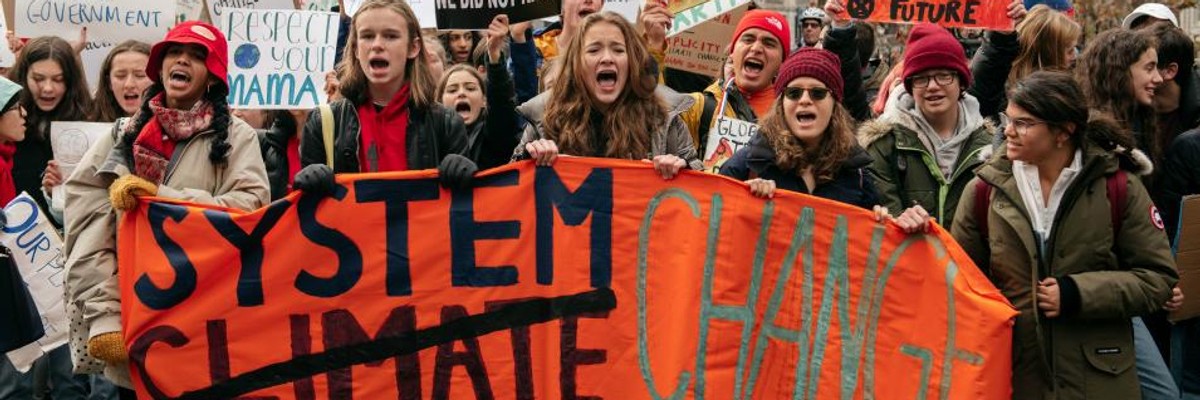
Demonstrators from several environmental groups including Extinction Rebellion and Sunrise Movement demand broad action at a youth-led climate strike near City Hall on December 6, 2019 in New York City. (Photo: Scott Heins/Getty Images)
Youth voices at COP represent the needs of the upcoming generations who will have to either assert our rights to a just climate future or figure out how to survive the catastrophic impacts that accompany a warmer planet.
Donald Trump is once again elected president of the United States only days before more than 30,000 people are expected to attend COP29 in Baku, Azerbaijan to negotiate new global commitments on protecting the planet not only for those inhabiting it today, but also for future generations. Trump’s victory is sounding alarm bells in the climate community as his administration has made their disregard for global climate action abundantly clear across their campaign, but the world recognizes we cannot afford inaction.
When Trump announced his plans in 2017 to withdraw the country from the Paris agreement, an international treaty to limit global temperature rises to 1.5°C, Gebru Jember Endalew, chair of the Least Developed Countries group, which represents 48 countries, stated “global climate momentum will continue with or without the U.S.” China also joined the E.U., Canada, and many more governments to reiterate their commitment to the agreement and global climate action.
Even if the Trump administration chooses to ignore the importance of investing in our planet, climate change will continue to affect our lives.
In 1995, the first Conference of the Parties (COP) was held in Berlin, Germany and subsequent COPs have produced targets to curb emissions, appropriate much-needed funds to tackle climate change, and build transparent reporting processes. The U.S. often sets the tone at COP as the country’s decisions around climate ambitions and climate finance have a global ripple effect. This year’s conference will be the fifth COP I’ve attended. It’s always been clear to me that youth climate activists and frontline communities are a crucial part of the COP process—pushing governments, like the U.S., which is the world’s largest historical polluter, to create and abide by ambitious targets and to address loss and damage so the planet is livable for all. And it’ll be no different this year, especially with a Trump win. Youth voices at COP represent the needs of the upcoming generations who will have to either assert our rights to a just climate future or figure out how to survive the catastrophic impacts that accompany a warmer planet.
We need all the help we can get. U.S. state and local officials are stepping up, as they did in 2017. A coalition of more than two dozen governors committed to achieving “the Paris agreement’s goal of keeping temperature increases below 1.5°C” as did large coalitions of U.S. mayors, county officials, and business leaders. In fact, I had the honor of being present as an intern for the City of San Antonio when my mayor signed a resolution with his commitment. The bipartisan group consists of governors from Washington state all the way to Puerto Rico who are committed to curbing emissions and accelerating climate action. States like California have also been working with other nations, such as China, to promote climate policy. Even if the U.S., at a national level, fails to act once again, it’s encouraging to see local and global communities committed to multilateral action.
My first COP was under the first Trump administration, and I remember feeling disappointed and embarrassed seeing my country failing to step up and lead on climate action. While everyone else had pavilions, announcements, and a large presence, the U.S. had a small office. Because of all the advantages the U.S. has gained by exploiting other communities, cultures, and nature, the U.S. had and still has so much historical and current responsibility to do better. Seeing national and global leaders reiterate their climate commitments gave me hope then and serves as a reminder today—efforts to tackle the climate crisis will continue regardless of the U.S. election results.
Even if the Trump administration chooses to ignore the importance of investing in our planet, climate change will continue to affect our lives. Attribution studies show human-induced climate change is making heatwaves, like the ones in the Southwest, hotter and more likely, while hurricanes and droughts have become more severe and destructive. Climate change is severely costing the environment and the economy. According to the World Economic Forum, “climate change is costing the world $16 million per hour.”
This horrific and costly reality isn’t inevitable. Phasing out fossil fuels, the biggest contributor to climate change, and investing in a greener and cleaner future for all are the antidotes. This is not the time to give up on climate cooperation, but rather strengthen the commitment to it. We cannot be paralyzed by fear. We’ll be at Baku calling for equitable and funded climate solutions, because if climate multilateralism is in jeopardy, so is our future, and we can’t afford to give up on either.
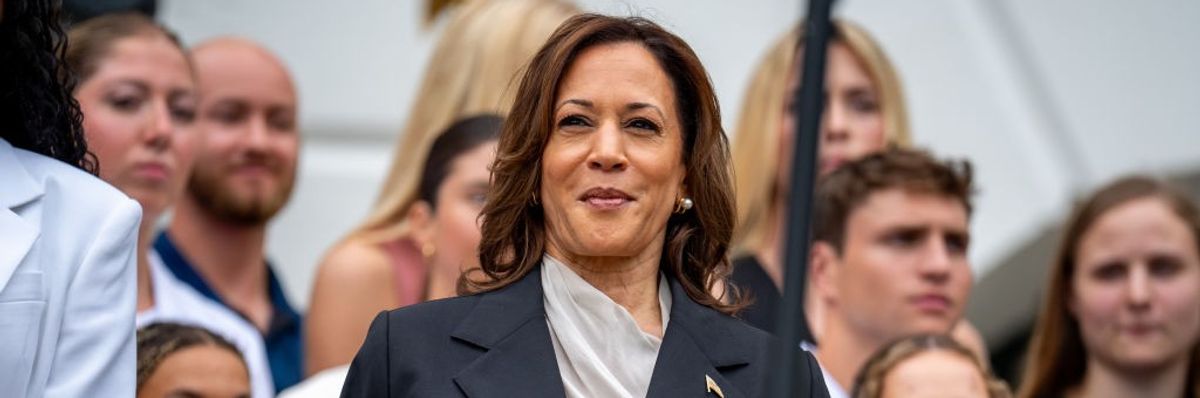
Vice President Kamala Harris arrives for an NCAA championship celebration on the South Lawn of the White House on July 22, 2024 in Washington, D.C. (Photo: Andrew Harnik/Getty Images)
“This is your chance to energize young people and our communities to vote, mount one of the greatest political comebacks in decades, and deliver a resounding defeat to the far-right agenda of Trump and Vance.”
Four youth-led groups on Thursday urged Vice President Kamala Harris, the presumptive Democratic presidential nominee, to “fight for our future” by pursuing a policy agenda the coalition unveiled in a March letter to U.S. President Joe Biden.
It’s been less than a week since Biden left the race and endorsed Harris, who is expected to face former Republican Donald Trump and his running mate, U.S. Sen. JD Vance (R-Ohio), in the November election. Since then, she’s racked up endorsements from Democratic members of Congress and progressive groups focused on issues including climate, labor, and reproductive rights.
March for Our Lives, which was launched after the 2018 mass shooting at Marjory Stoneman Douglas High School in Parkland, Florida, honored Harris with the group’s first-ever endorsement on Wednesday, calling her “the right person to stand up for us and fight for the country we deserve.”
“To defeat Trump, you must rebuild support and enthusiasm among young voters.”
The gun violence prevention organization is part of the youth-led coalition behind the new letter, which also includes the climate-focused Sunrise Movement; Gen-Z for Change, which advocates on a range of issues; and the national immigrant network United We Dream Action.
“You have an urgent and important task. To defeat Trump, you must rebuild support and enthusiasm among young voters,” the coalition told Harris on Thursday, noting that she sought the Democratic nomination during the last cycle. “You should build on your 2020 campaign platform where you put forward a strong vision to make the economy work for everyday people and ensure a livable future for us all.”
The groups urged Harris to support the Green New Deal, Medicare for All, and the Reverse Mass Incarceration Act. They pushed her to expand pathways to citizenship, keep families together, end fossil fuel subsidies, and create good, union jobs. They also called on her to prioritize gun violence prevention and investments in public health solutions and green, affordable housing.
This is what it takes to WIN the youth vote.
We're proud to stand with our friends and call for a bold campaign that promises bold action for our futures. https://t.co/E0EaoL5zTz
— March For Our Lives (@AMarch4OurLives) July 25, 2024
“Democrats are at a critical crossroads with young people,” the coalition wrote to Harris on Thursday. “Polls showed Biden and Trump neck-and-neck among young voters.”
ANew York Times/Siena College poll conducted July 22-24 shows Trump leading Harris 48% to 47% among likely voters and 48% to 46% among registered voters—differences that fall within the margin of error.
Forbes noted Thursday that “Democrats are far more enthusiastic about Harris than they were Biden, the Times/Siena survey found, with nearly 80% of voters who lean Democrat saying they would like Harris to be the nominee, compared to 48% of Democrats who said the same about Biden three weeks ago.”
The outlet also pointed to two other polls conducted by Morning Consult and Reuters/Ipsos since Biden dropped out, which both show Harris with a narrow lead over Trump.
“You have an opportunity to win the youth vote by turning the page and differentiating yourself from Biden policies that are deeply unpopular with us, such as approving new oil and gas projects, denying people their right to seek refuge and asylum, and funding the Israeli government’s killing of civilians in Gaza,” the youth coalition highlighted Thursday. “You must speak to the economic pain young people are facing from crushing student debt and skyrocketing housing and food prices.”
Looking beyond November, the groups told Harris—who could be the first Black woman and person of Asian descent elected to the country’s highest office—that “you could be a historic president. Not just because of who you are, but what you can accomplish.”
“Young people are energized and ready to organize against fascism and for the future we deserve,” they concluded. “This is your chance to energize young people and our communities to vote, mount one of the greatest political comebacks in decades, and deliver a resounding defeat to the far-right agenda of Trump and Vance.”
Portuguese young people claim their human rights have been violated, while accused countries argue the lawsuit should be thrown out.
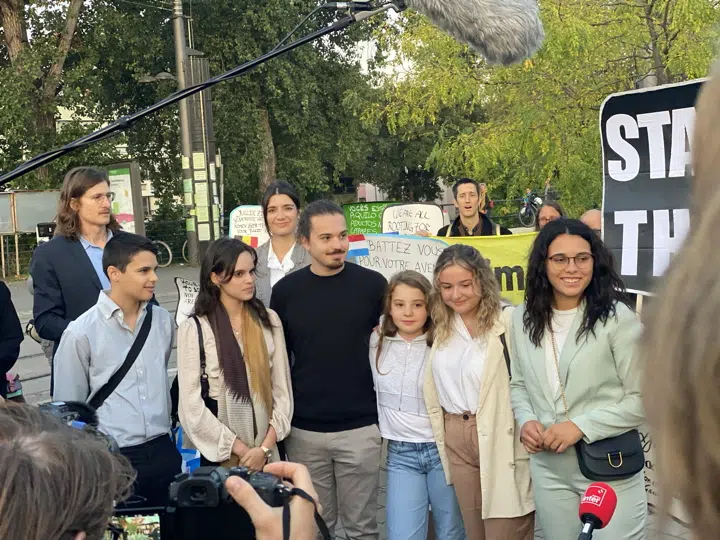
Portuguese youth, from left, André dos Santos Oliveira, Sofia dos Santos Oliveira, Martim Duarte Agostinho, Mariana Agostinho, Cláudia Duarte Agostinho and Catarina dos Santos Mota talk to the press before their landmark hearing in front of the European Court of Human Rights in Strasborg, France. Credit: Courtesy of the Global Legal Action Network (GLAN)
After Portugal experienced massive wildfires and extreme heat waves this summer, six children and youth from the nation appeared in the European Court of Human Rights Wednesday for a landmark lawsuit against 32 European nations charged with violating their human rights due to the impacts of climate change.
At the hearing in Strasbourg, France, lawyers representing six Portuguese young people said the youth were being discriminated against by state inaction in cutting greenhouse gas emissions, the effects of which have been “foreseeable for decades.”
Inadequate action to curb global emissions, the lawyers argue, violates the youths’ rights to life, privacy and family life, and to be free from torture, inhuman or degrading treatment. Additionally, it violates their rights to be free from discrimination on grounds of their age, the lawyers said. All of these are enshrined in the European Convention on Human Rights, which the court is responsible for upholding.
This case is “truly historic,” said Sébastien Duyck, senior attorney at the Center for International Environmental Law. It forces the national governments in the suit “to lay out a legal defense justifying the gap between their climate policies and what science says is needed to avoid climate breakdown.”
Cláudia Duarte Agostinho, age 24, Catarina dos Santos Mota, 23, Martim Duarte Agostinho, 20, Sofia dos Santos Oliveira, 18, André dos Santos Oliveira, 15, and Mariana Agostinho, 11, are suing 32 countries, including all EU member states, the United Kingdom, Norway, Turkey, Switzerland and Russia, for failing to act on the climate crisis. It is unprecedented that so many governments have to defend themselves in front of any court in the world.
In 2017, damaging wildfires in Portugal, made worse by climate change, killed more than 100 people and sparked the youths to file the lawsuit, which began in 2020. Over the past three years, the young people’s legal team filed a number of supporting documents, including a detailed climate science briefing. The documents show that the current global trajectory for cutting greenhouse gas emissions falls far short of keeping the global temperature rise under the 1.5C threshold agreed by states at the COP27 climate talks last year.
Portugal hit hard by climate change
Portugal describes itself as the European country most affected by the adverse impact of climate change. Since 1976, it has seen a significant trend in heat waves and tropical nights, with high temperature records broken in 2018, 2019 and 2022. This summer, severe drought hit the country and wildfires blazed again.
The young people live in Lisbon and Leiria, parts of Portugal that are particularly at risk. And according to the Intergovernmental Panel on Climate Change, the country faces “hard limits” to its ability to adapt.
The young claimants in the lawsuit point to research by Climate Action Tracker, which calculates a “fair share” of emission cuts for the 32 countries at the center of the case, based on their levels of development, capacity and/or historic responsibility. Most of these cuts are higher than the states’ current goals for the year 2030.
To address this, they want all 32 states to increase their climate ambitions and meet these goals by cutting the production and export of fossil fuels, lowering their consumption emissions, and forcing companies domiciled within their territories to clean up their global supply chains.
The lawsuit describes the young people as both current and future victims of climate change, outlining the existing effects on their physical and mental health.
It notes the dangerous impacts of extreme heat, including heatstroke and the exacerbation of chronic conditions such as asthma and other respiratory problems experienced by Martim Duarte Agostinho, Catarina dos Santos Mota and André dos Santos Oliveira. During periods of extreme heat, some of the youth in the suit have had had to stop playing and exercising outdoors, while extremely hot nights have made it difficult to sleep, leaving them more tired and less able to study and work.
A psychological assessment showed they were all experiencing symptoms of anxiety or depression. The three also describe a form of mental suffering called “moral injury” caused by an awareness of the failure by those in authority to protect them.
The severity of all these impacts, the legal team concludes, will only get worse if nations can’t meet the 1.5C warming threshold. Although climate change affects everyone, lawyer Alison Macdonald argued in court that it will have a disproportionate impact on the young people at the heart of the case, “as they will have to live longer with the consequences of the respondents’ failures.”
This is the third climate case heard by the European Court of Human Rights this year. In March, a group of older Swiss women known as the KlimaSeniorinnen argued that they were disproportionately affected by the climate crisis and wanted the court to order Switzerland to do more to cut its emissions. This was followed the same day by a claim brought by a former French politician who also argued France was breaching his human rights.
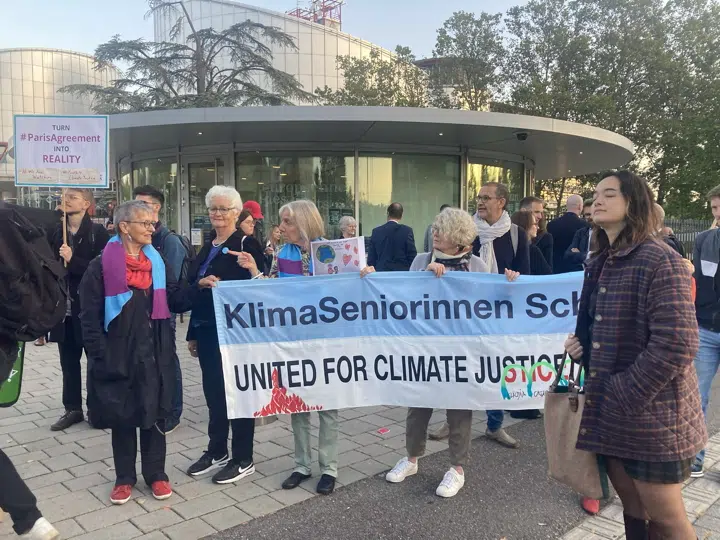
Swiss women involved in another European climate lawsuit support the Portuguese youth at the courthouse in Strasbourg. Credit: Courtesy of the Global Legal Action Network (GLAN)
But the claimants in the Portuguese youth case have some big technical hurdles to overcome before judges even begin to consider the merits of their lawsuit.
The governments named in the lawsuit submitted individual responses to the court, and all except Russia and the Netherlands also submitted a joint statement, which says the states recognise the severity of the threat of climate change and the need for urgent action.
But it says the case should be thrown out for failing to meet the court’s basic rules on admissibility. These include the requirement to have exhausted all national legal options before filing a claim at the ECHR. Ignoring this, it says, would involve “radically overhauling” legal precedent.
The young people’s legal team argues that the rule should be lifted in their case because climate change is such an urgent issue and because it would be a practically and financially unreasonable burden, taking huge legal resources, time, and money, for the group.
All states. except Portugal, also argue they should not be held to account for harms in another country. The claimants contend that the impacts of greenhouse emissions do not respect national boundaries.
Representing 30 states in court, UK lawyer Sudhanshu Swaroop said the lawsuit requires the court to “exceed its mandate.”
“The applicants in reality are asking the court to build a new model of extra-territorial jurisdiction, contrary to legal principles and with the effect that any person on the planet that claims to be affected by climate change could claim,” he noted.
He added that these issues are being addressed through the UN Framework Convention on Climate Change (UNFCCC) and that the young people “are asking the courts to act as legislators rather than judges, and to legislate for a global challenge without having global jurisdiction.”
Ricardo Matos, a lawyer for Portugal, said the young people could not claim to be victims of the 2017 wildfires, and were effectively trying to bring an actio popularis – a claim on behalf of the wider public rather than themselves as individuals. The European Convention on Human Rights does not allow such claims.
The governments also argued that the young people are not ‘victims,’ pointing out they cannot prove that they suffer more than the general population by virtue of their age.
The young people’s legal team believes these hurdles can be overcome. “This court is uniquely well placed to address these legal issues in the transnational way that climate change requires,” Macdonald told the court. “Piecemeal regulation across Europe represents no effective remedy.”
According to Climate Action Network, which submitted a third-party intervention, a successful judgment in this case would be “like a new, legally binding treaty, directly obligating 32 European governments to act urgently on the climate crisis.”
It also wields “remarkable influence” in the broader context of global litigation, said Duyck, “given that the European Court of Human Rights holds a prominent role in setting legal precedents within Europe and beyond.”
Speaking outside the court after the hearing, the oldest claimant, Cláudia Duarte Agostinho, said what she had just heard was “very sad.”
“The governments have just said that what’s happening all around us is not important,” she added. “They are minimising the effects that climate change has on our human rights.
“Outside the courtroom they say all the right things about the climate emergency,” she continued. “But today they are denying the reality that what we are experiencing is getting worse and worse.”
Travel to report on this lawsuit was supported by a grant from the Foundation for International Law for the Environment.
Claimants to argue lack of adequate action is breach of human rights, in largest climate legal action to date
Six young people are preparing to appear at the European court of human rights to try to compel 32 nations to rapidly escalate their emissions reductions in the world’s largest climate legal action to date.
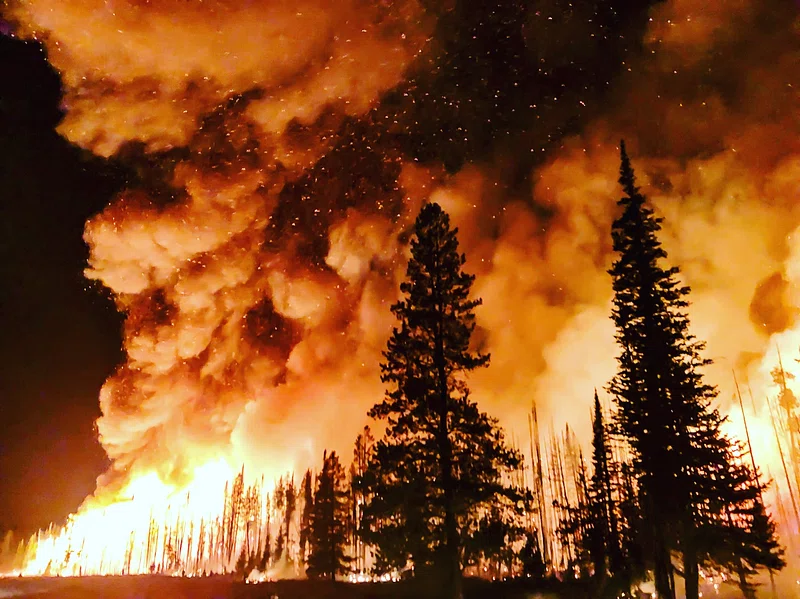
Aged from 11 to 24, the six Portuguese claimants, say they were driven to act by their experiences in the wildfires that ripped through the Leiria region in 2017, killing 66 people and destroying 20,000 hectares of forest.
After another summer in which wildfires raged across Portugal, Greece, Spain, Croatia and Italy, the young people will argue in the grand chamber of the Strasbourg court in 13 days’ time that the 32 European nations’ policies to tackle global heating are inadequate and in breach of their human rights obligations.
Crowdfunded by people around the world, who have donated more than £100,000, they are seeking a binding ruling from the judges to force the countries to rapidly escalate their emissions reductions in what would be a historic milestone in climate litigation.