Year: 2025
More than a million pounds spent on influencers by UK government since 2024
https://www.theguardian.com/media/2025/dec/25/uk-government-spending-social-media-influencers

Keir Starmer is interviewed by the campaigner and influencer Anna Whitehouse for her Mother Pukka podcast in 10 Downing Street. Photograph: Simon Dawson/No 10 Downing Street Figures from FoI request show increase in ministerial use of social media personalities to present campaigns
More than half a million pounds has been spent since 2024 on using social media influencers to promote UK government campaigns on subjects ranging from the environment to welfare.
The spending has included hiring 215 influencers since 2024, of which there were 126 in 2025 – an increase on the 89 hired in 2024 – and is seen as an attempt to use platforms such as TikTok to reach younger people.
Among the branches of government that provided figures after a freedom of information request, the largest amount of spending was by the Department for Education, which spent £350,000 since 2024. It used 53 influencers this year, compared with 26 in the previous one.
The Home Office, Ministry of Justice, Ministry of Defence, and the Department for Work and Pensions (DWP) were among the departments using the most paid-for social media influencers to promote their work since 2024.
…
https://www.theguardian.com/media/2025/dec/25/uk-government-spending-social-media-influencers
Heat, drought and fire: how extreme weather pushed nature to its limits in 2025
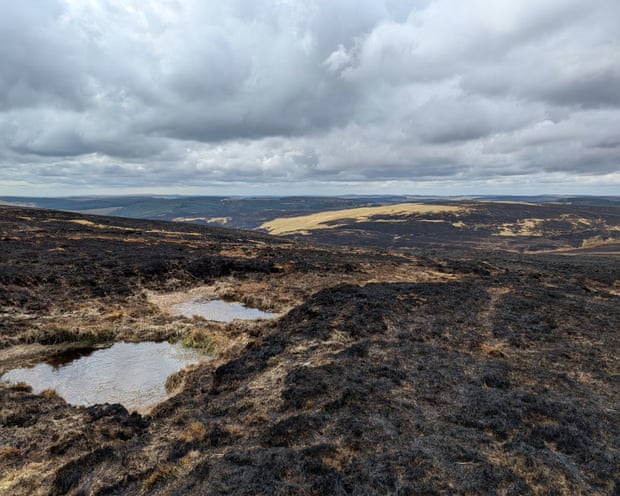
The effects of a huge wildfire on Abergwesyn Common, mid Wales. Habitats for many species such as reptiles and birds were destroyed. Photograph: Chris Smith/National Trust National Trust says these are ‘alarm signals we cannot ignore’ as climate breakdown puts pressure on wildlife
Extremes of weather have pushed nature to its limits in 2025, putting wildlife, plants and landscapes under severe pressure, an annual audit of flora and fauna has concluded.
Bookended by storms Éowyn and Bram, the UK experienced a sun-soaked spring and summer, resulting in fierce heath and moorland fires, followed by autumn floods.
The National Trust, which provides a snapshot of how the weather is hitting wildlife every Christmas, described it as a rollercoaster of conditions that tested nature’s resilience like never before in modern times.
Ben McCarthy, the head of nature conservation at the charity, said: “Heat, drought and fire are the defining headlines of 2025.
“Extremes in weather is nothing new, but the compounded impact of several drought years in a short period – 2018, 2022 and now 2025 – is putting untold strain on habitats and making life even more difficult for wildlife. These are alarm signals we cannot ignore, and we need to work faster, smarter and in a more joined-up way.”
…

Donald Trump urges you to be a Climate Science denier like him. He says that he makes millions and millions for destroying the planet, Burn, Baby, Burn and Flood, Baby, Flood. 
Nigel Farage urges you to ignore facts and reality and be a climate science denier like him and his Deputy Richard Tice. He says that Reform UK has received £Millions and £Millions from the fossil fuel industry to promote climate denial and destroy the planet. 
Elon Musk urges you to be a Fascist like him, says that you can ignore facts and reality then. US continues pursuit and seizure of Venezuelan oil tankers amid condemnation at UN Security Council
Original article by Pablo Meriguet republished from peoples dispatch under a Creative Commons Attribution-ShareAlike 4.0 (CC BY-SA) license.

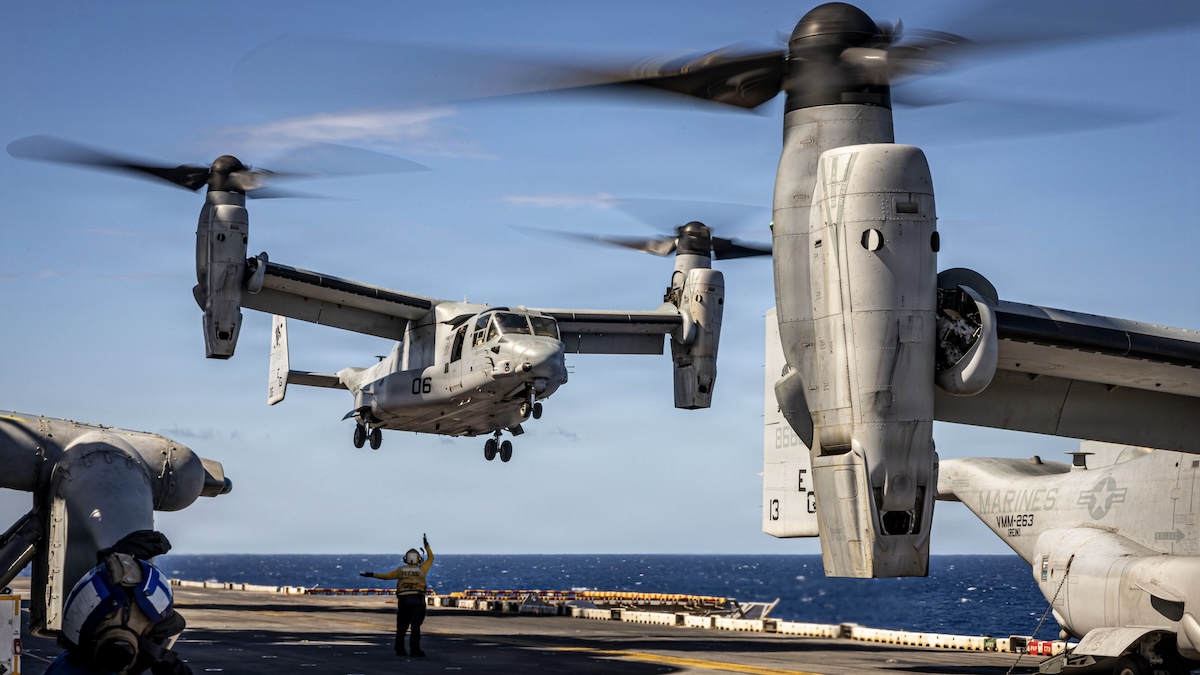
Marines aircraft on the USS Iwo Jima deployed to Caribbean Sea as part of SOUTHCOM’s Operation Southern Spear. Photo: US Marines / X Tensions continue to rise in the Caribbean. The United States continues to confiscate and pursue Venezuelan oil tankers, while Caracas denounces what it considers an “act of international piracy” at the UN.
US hostilities continue in the Caribbean. The US Coast Guard has gone after its third “prey” in international waters. According to information from US authorities, the ship “Bella 1” was headed to Venezuela to pick up oil when US forces attempted to apprehend it. “Bella 1” continued sailing, which led to a maritime chase, according to Kristi Noem, US Secretary of Homeland Security.
“The US Coast Guard is actively pursuing a sanctioned vessel from the dark fleet that is part of Venezuela’s illegal sanctions evasion … It is sailing under a false flag and under a court order for seizure,” said an anonymous official who spoke to CNN.
Washington confirmed on December 20 that it had intercepted and forcibly confiscated a second oil tanker off the coast of Venezuela, called “Centuries”, something that the Chavista government has now repeatedly denounced as an act of “international piracy”.
Although White House spokeswoman Anna Kelly said “Centuries” was a sanctioned vessel, it does not appear on the list of vessels unilaterally sanctioned by Washington, leading several analysts to fear that it is no longer just the 30 sanctioned vessels that are being targeted, but all Venezuelan ships, which will be seized by force if the opportunity arises.
Caracas’ diplomatic and legal rejection
For her part, Venezuelan Vice President Delcy Rodríguez stated: “Venezuela rejects the theft and hijacking of a new private vessel carrying Venezuelan oil … [We will take] all appropriate actions, including reporting this to the United Nations Security Council, other multilateral organizations, and the governments of the world.”
Furthermore, it is important to note that the Venezuelan National Assembly has proposed a law that seeks to fine and imprison for up to 20 years anyone who promotes, solicits, supports, finances, or participates in acts of piracy, blockades, and other similar acts against national institutions.
Pursuing and capturing Venezuelan ships: the new mission of the US Coast Guard
Following the seizure of the first Venezuelan oil tanker, “Skipper”, US forces are continuing their plan to economically strangle Venezuela by seizing more Venezuelan oil in the Caribbean Sea.
Read more: “Piracy”: Venezuela responds to the US seizure of its oil tanker
In recent days, Trump said, “we will keep” the oil seized from the first ship on December 10. A few hours later, through his social network, Truth Social, Trump went further and claimed that Venezuelan oil was “ours”, that is, the United States’.
According to Trump, the nationalization of Venezuelan oil in the 1970s was “theft”.
These statements led Venezuelan authorities to confirm suspicions that the main reason for taking action against Venezuela has more to do with economic issues than national security or the fight against drug trafficking.
Washington has claimed that the Chavista government is part of a criminal structure called the Cartel of the Suns. However, Caracas flatly denies the accusations and affirms that the flimsy accusation is a media ploy to justify a military invasion that would change the government to one in favor of the US; essentially, a US-puppet president. Following this, foreign companies would take over the Caribbean country’s natural resources, as has been promised by far-right opposition leader María Corina Machado. Venezuela has the largest oil reserves in the world.
The beginning of a new blockade in the Caribbean
For more than 60 years, the United States has maintained an economic and commercial blockade on Cuba. This has caused enormous difficulties for the socialist country to maintain and develop its economy. Despite this, Cuba, to the surprise of humanity, has managed to circumvent the blockade and resist attempts to boycott the revolutionary process on the island.
The United States hopes that this strategy will have a different effect in Venezuela. Under the constant threat of a military invasion, which would cause the deaths of hundreds or thousands of people, Washington is betting on blocking Venezuelan tankers to destroy an economy that is deeply dependent on oil.
Last week, Trump ordered a “blockade” of sanctioned oil tankers entering and leaving Venezuela for allegedly trading with groups that pose a threat to US security. About 30 of the 80 Venezuelan ships that transport oil have been sanctioned by the United States, which significantly reduces the Venezuelan economy’s room for maneuver, without ruling out future sanctions or a total blockade.
Read More: “Venezuela will never again be a colony”: Maduro government denounces Trump’s oil blockade
International condemnation
The Venezuelan government has denounced the confiscation of Venezuelan oil tankers to the highest international bodies. Before the UN Security Council, which met in emergency session on December 23, Samuel Moncada, Venezuela’s representative, said that the United States wants to impose a colonial system on his country. “[These operations are] the greatest extortion known in our history, a gigantic crime of aggression unfolding outside of any national parameters, legal logic, or historical precedent.” Moncada emphasized, “It’s not drugs, it’s not security, it’s not freedom; it is oil, it’s the mines, it’s the land.”
For his part, Washington representative Mike Waltz justified the actions as part of the fight against drug trafficking, which is why his country considers the matter to be a “non-international armed conflict”. “The United States will apply maximum sanctions to deprive Maduro of the resources he uses to finance the Cartel of the Suns, designated as a terrorist organization by the United States,” Waltz said.
Read More: Trump threatens military operations in Colombia and Mexico
Both Russia and China have publicly questioned Washington’s actions, considering them “dangerous”. Russian Ambassador Vasily Nebenzya stated: “The actions committed by the United States violate all fundamental norms of international law.” Sun Lei, China’s representative, said that his country “opposes all acts of unilateralism and intimidation and supports all countries in defending their sovereignty and national dignity … Venezuela has the right to independently develop mutually beneficial cooperation with other countries.”
Iranian President Masoud Pezeshkian added his voice to these denunciations. According to Telesur: “Iranian President Masoud Pezeshkian sent his support in a phone call to Venezuelan President Nicolás Maduro in response to the new threats and aggressions by the United States against the Venezuelan people and the Caribbean. Masoud said he hopes to consolidate cooperation ties with Venezuela by 2026.”
Similarly, Algeria’s representative to the Security Council, Amar Bendjama, said: “Algeria is closely following the latest developments in the Caribbean region and we are also following them with great concern, particularly with regard to actions against Venezuelan oil tankers.”
Original article by Pablo Meriguet republished from peoples dispatch under a Creative Commons Attribution-ShareAlike 4.0 (CC BY-SA) license.

Orcas discuss how Trump was re-elected and him being an obviously insane, xenophobic Fascist. Netanyahu to Press for ‘Another Round of War With Iran’ in Meeting With Trump This Week
Original article by Stephen Prager republished from Common Dreams under Creative Commons (CC BY-NC-ND 3.0).

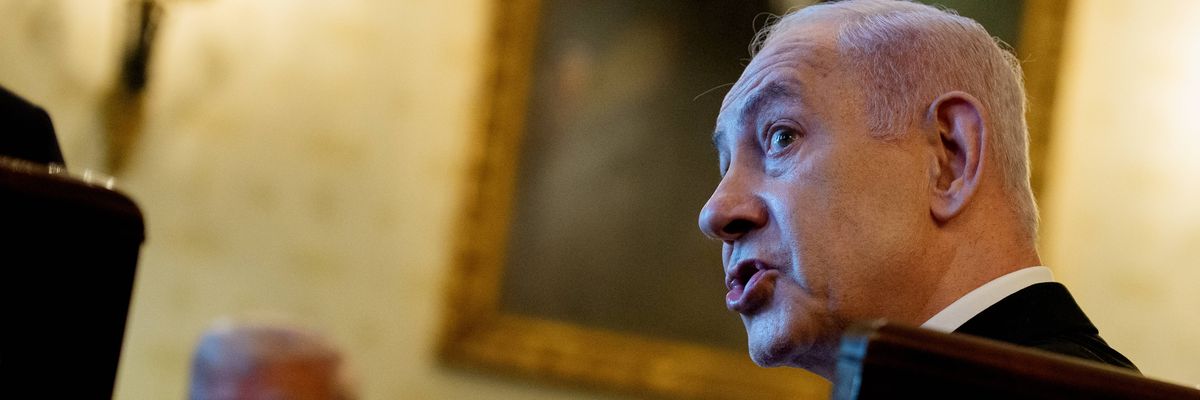
Israeli Prime Minister Benjamin Netanyahu, accompanied by US President Donald Trump speaks during a dinner in the Blue Room of the White House on July 7, 2025 in Washington, DC. (Photo by Andrew Harnik/Getty Images) Amid a growing rift between Israel and the White House, one foreign policy analyst says the meeting “will signal whether Washington is prepared to continue underwriting open-ended escalation.”
As Israeli Prime Minister Benjamin Netanyahu heads to Mar-a-Lago to meet with US President Donald Trump on Monday, amid a growing rift with the president and his advisers, reports say he’ll seek to push the US back toward war with Iran.
Last week, NBC News reported that at the meeting, “Netanyahu is expected to make the case to Trump that Iran’s expansion of its ballistic missile program poses a threat that could necessitate swift action” and that “the Israeli leader is expected to present Trump with options for the US to join or assist in any new military operations.”
RECOMMENDED…

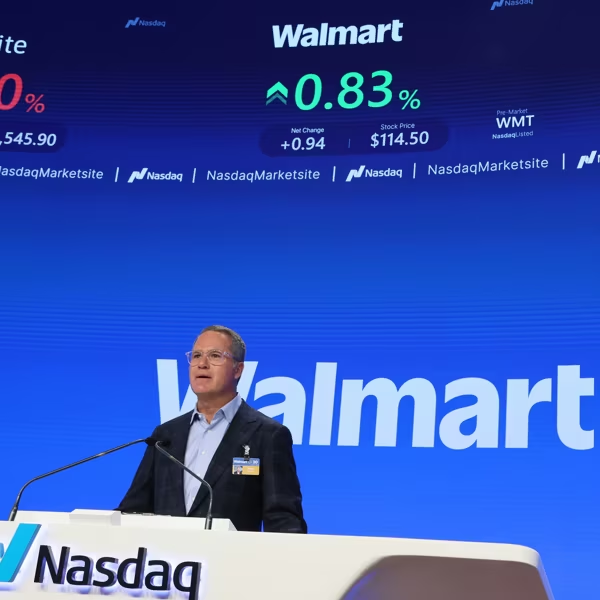
As Wage Growth Slows and Unemployment Rises, Trump Tax Cuts Deliver Big for Mega-Rich Retail CEOs

Investigation Shows How Decades of Corporate Consolidation Have Devastated US Cattle Ranchers
“Netanyahu plans to press Donald Trump for US backing for another round of war with Iran, now framed around Iran’s ballistic missile program,” said Sina Toossi, a senior fellow at the Center for International Policy. “Netanyahu’s pivot to missiles should therefore be read not as the discovery of a new threat, but as an effort to manufacture a replacement casus belli after the nuclear argument collapsed.”
He noted criticisms levied against Netanyahu by Yair Golan, chair of the Democrats, a center-left party in Israel, earlier this week: “How is it possible that last June, at the end of the war with Iran, Benjamin Netanyahu solemnly declared that ‘Israel had eliminated Iran’s nuclear threat and severely damaged its missile array’; and that this was a ‘historic victory’—and today, less than six months later, he is running to the president of the United States to beg for permission to attack Iran again?” Golan said.
Iran is just one of several areas the two will likely discuss on Monday. According to Israeli officials who spoke to the Washington Post, Netanyahu also reportedly wants Trump to “take a tougher stance on Gaza and require that Hamas disarm before Israeli troops further withdraw as part of the second phase of Trump’s 20-point peace plan.”
The chief of Israel’s armed forces suggested earlier this week that its occupation of more than half of Gaza would be permanent, but walked those comments back after reported behind-the-scenes outrage in the White House. Meanwhile, Trump—invested in his image as a peacemaker—has reportedly balked at Israel’s routine violations of the ceasefire agreement he helped to broker in October.
Near-daily strikes have resulted in the death of at least 418 Palestinians, according to the Gaza Media Office. Meanwhile, Israel’s continued blockade of humanitarian aid has left hundreds of thousands of people—displaced from homes destroyed by Israeli bombing—to languish in the cold without tents. Desperately needed fuel, food, and medicine have entered the strip at far lower numbers than the ceasefire agreement required.
As Axios reported on Friday, Trump’s advisers increasingly fear that Netanyahu is intentionally slow-walking and undermining the peace process in hopes of resuming the war.
Netanyahu also seeks Trump’s continued backing of Israel’s territorial expansion in Syria. Earlier this month, the Israel Defense Forces (IDF) pushed through a UN-monitored demilitarized zone between Israeli and Syrian-held positions in the Golan Heights, which Israel illegally occupies.
This push into southern Syria went against the wishes of the Trump administration, which feared it could destabilize the Western-backed government that rules in Damascus following the ouster of former President Bashar al-Assad.
Israel has also routinely struck Lebanon in violation of the US-brokered ceasefire it signed with Hezbollah in late 2024, with bombings becoming a near-daily occurrence in December. Last month, the UN reported that at least 127 civilians, including children, had been killed in Israeli strikes since the ceasefire began.
“Netanyahu’s visit unfolds against a backdrop of unresolved fronts, with widening disputes with Washington over the second phase of the Gaza ceasefire, including postwar governance, reconstruction, and Turkish involvement,” Toossi said. “At the same time, Israel is seeking greater latitude to escalate again against Hezbollah in Lebanon, an end to US accommodation of Syria’s new leadership, and firm assurances on expanded military aid.”
“Taken together, Netanyahu’s visit is less about resolving any single crisis than about postponing strategic reckoning,” he continued. “The outcome will signal whether Washington is prepared to continue underwriting open-ended escalation, or whether this meeting marks the beginning of clearer limits on Israel’s regional strategy.”
Original article by Stephen Prager republished from Common Dreams under Creative Commons (CC BY-NC-ND 3.0).