A number of articles from Middle East Monitor. They state that Israeli Prime Minister Benjamin Netanyahu recognised Somaliland without appropriate authority and that it is part of a deal the intention of which is to forcibly remove Palestinians to Somaliland.
This work by Middle East Monitor is licensed under a Creative Commons Attribution-NonCommercial-ShareAlike 4.0 International License

Israeli opposition leader Yair Lapid lashed out at Prime Minister Benjamin Netanyahu on Monday over Israel’s recognition of the breakaway region of Somaliland and his talks with US President Donald Trump without a clear plan for Gaza, Anadolu reports.
Netanyahu announced Israel’s recognition of Somaliland as an independent state on Friday, a move Lapid said did not receive approval from either the government or the security cabinet.
“Israel announced it was the first country in the world to recognize Somaliland as a sovereign state,” Lapid said in a meeting of the Knesset’s Foreign Affairs and Defense Committee, as cited in a video published by the Knesset Channel.
“This was not a decision of the government or the security cabinet. It was a decision of the prime minister’s office,” he added.
Lapid said several countries, including states in the region, condemned the recognition, adding that the Israeli move reflected the absence of a coherent foreign policy.
Israel became the world’s first country to recognize Somaliland as a sovereign state, drawing condemnation from Türkiye, a close ally of Somalia, and countries in Africa and the Middle East, among others.
READ: Saudi royal source: Israel’s recognition of Somaliland distances it from normalisation
Global backlash grows over Israel’s recognition of Somaliland, with many countries condemning the move as a violation of international law and a threat to regional stability.
Somaliland, which has lacked official recognition since declaring independence from Somalia in 1991, operates as a de facto independent administrative, political, and security entity, with the central government struggling to assert control over the region and its leadership unable to secure international recognition of independence.
Lapid also criticized Netanyahu for travelling to meet Trump on Monday night without presenting an Israeli vision for Gaza.
“When an Israeli prime minister meets a US president, we wish him success,” he said. “But Netanyahu is arriving without a clear vision for Gaza. When you don’t have a vision, others decide for you.”
Lapid said that if Israel does not present a plan for Gaza, other actors, including the US and Hamas, will shape the outcome.
Netanyahu arrived in Florida late Sunday for a visit expected to last five days. The trip began with a preparatory meeting with US Secretary of State Marco Rubio, according to the public broadcaster KAN.
Netanyahu is scheduled to meet Trump on Monday night to discuss several issues, including Iran and the Gaza ceasefire agreement, with talks expected to focus on moving to a second phase of the deal.
The second phase includes forming a temporary technocratic committee to administer Gaza, reconstruction efforts, the creation of a peace council, the establishment of an international force, additional Israeli military withdrawals, and Hamas’ disarmament.
The ceasefire took effect on Oct. 10, halting two years of Israeli war that has killed over 71,200 Palestinians, mostly women and children, and injured more than 171,200 others since October 2023.
READ: Israeli prime minister departs for US to meet Trump
This work by Middle East Monitor is licensed under a Creative Commons Attribution-NonCommercial-ShareAlike 4.0 International License.

Somalia’s President Hassan Sheikh Mohamud said the breakaway region of Somaliland has agreed to resettle Palestinians and host an Israeli military base in return for recognition by Israel, citing intelligence reports.
Tel Aviv’s recognition of Somaliland was “very unexpected and strange,” Mohamud told the Qatari news network Al Jazeera in an exclusive interview, adding that it came “out of nowhere” as Israel became the first since 1991 to recognize the region as an independent state.
Somaliland, which declared independence from Somalia in 1991, has operated as a de facto self-governing region without international recognition, as the central government in Mogadishu has failed to reassert control.
Mogadishu rejects Somaliland’s independence claim, considers the region part of Somalia, and views any direct engagement with it as a violation of the country’s sovereignty.
OPINION: The recognition of Somaliland as an Israeli geopolitical weapon
“We’ve been trying to reunite the country in a peaceful manner,” Mohamud said.
He said Somaliland also accepted joining the Abraham Accords, signed in 2020 between Israel and the United Arab Emirates, Bahrain, Sudan, and Morocco to normalize their relations.
Israel is seeking to control strategically important waterways such as the Red Sea, the Gulf, and the Gulf of Aden, and its recognition of Somaliland merely normalizes an existing covert presence there, the Somali president said, citing intelligence reports.
He said Israel is not in the region for peace and seeks to forcibly displace Palestinians to Somalia.
Global backlash is growing over Tel Aviv’s recognition of Somaliland, with many countries condemning the move as a violation of international law and a threat to regional stability.
On Monday, countries at the UN Security Council raised concerns at an emergency meeting that the move appears aimed at relocating Palestinians from Gaza.
Nearly all council members condemned Israel’s recognition, while the US abstained from condemnation, saying its stance on the breakaway region, however, had not changed.
This work by Middle East Monitor is licensed under a Creative Commons Attribution-NonCommercial-ShareAlike 4.0 International License.

Malaysian Prime Minister Anwar Ibrahim on Tuesday rejected Israel’s recognition of the breakaway Somali territory of Somaliland, while linking the move with the alleged “forced transfer of Palestinians”, Anadolu agency reported.
“Such actions violate international law and humanitarian principles, and would only perpetuate injustice rather than contribute to peace,” he said during a news conference, according to the Malaysian daily The New Straits Times.
Anwar said that any attempt to use the territory “for the forced transfer of Palestinians is totally and wholly unacceptable.”
The remarks come as the Palestinian group Hamas on Saturday rejected Israeli plans to forcibly displace Palestinians from Gaza, including to Somaliland, following Tel Aviv’s recognition of the breakaway region.
Anwar, while noting the recent discussions held in Florida for the next phase of the peace process, warned that any return to large-scale violence would exact an “intolerable cost” on civilians and further weaken fragile prospects for peace.
READ: Israeli prime minister under fire over recognition of Somaliland, Gaza talks with Trump
“Israel must be held accountable for its actions and obligations under international law,” he added.
Israel became the world’s first country to recognize Somaliland as a sovereign state on Friday.
Global backlash grew over Israel’s recognition of Somaliland, with many countries condemning the move as a violation of international law and a threat to regional stability.
On Friday, Somalia reiterated its absolute and non-negotiable commitment to its sovereignty, national unity, and territorial integrity following Israel’s recognition of Somaliland.
Somaliland, which has lacked official recognition since declaring independence from Somalia in 1991, operates as a de facto independent administrative, political, and security entity, with the central government struggling to assert control over the region and its leadership unable to secure international recognition of independence.
READ: Israel’s decision to recognize Somaliland illegitimate, unacceptable: Turkish President Erdogan


The head of one of Scotland’s foremost disability rights charities says she turned down an MBE in the recent new year honours because the UK government was “fuelling hatred, blame and scapegoating of people with disabilities”.
Tressa Burke, chief executive officer of the Glasgow Disability Alliance, had been recommended by the prime minister for the honour for her services to people with disabilities. Over two decades, Burke has grown the organisation from seed into a nationally recognised voice for disabled people in Scotland’s largest city, and supported more than 5,000 members through the pandemic.
But in her letter declining the proposed award, seen by the Guardian, Burke told the Cabinet Office: “I feel that I cannot accept a personal honour because disabled people are being so dishonoured at this time.
“In fact we are being demonised, dehumanised and scapegoated for political choices and policy failures by consecutive governments.”
…
Burke, who emphasises she means no disrespect to colleagues in the voluntary sector who have accepted similar honours, explains that she received the letter of recommendation on the day of the UK budget, which introduced stricter assessments for personal independent payments, frozen or reduced universal credit health top-ups and cuts to the Motability scheme.
“The budget was an opportunity to send out a signal not about how much disabled people cost but about how much disabled people are worth and are valued by society.”
Instead, she says, it has “supercharged the inequalities and unfairness disabled people face”.
…

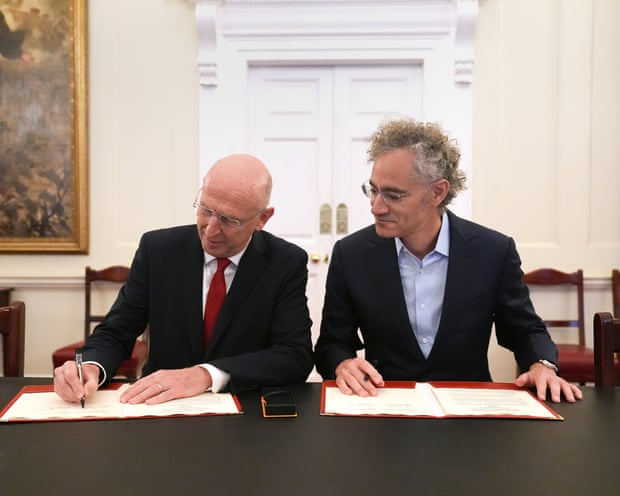
UK MPs have raised concerns about the government’s contracts with Palantir after an investigation published in Switzerland highlighted allegations about the suitability and security of its products.
The investigation by the Zurich-based research collective WAV and the Swiss online magazine Republik details Palantir’s efforts, over the course of seven years, to sell its products to Swiss federal agencies.
Palantir is a US company that provides software to integrate and analyse data scattered across different systems, such as in the health service. It also provides artificial intelligence-enabled military targeting systems.
The investigation cites an expert report, internal to the Swiss army, that assessed Palantir’s status as a US company meant there was a possibility sensitive data shared with it could be accessed by the US government and intelligence services.
British MPs have voiced concerns over the US data company in light of the report.
“Palantir … is an organisation that the British government, in terms of the NHS, in terms of contracts, should stay very far away from … I think the Swiss army is right to be suspicious,” said the Labour MP Clive Lewis.
The government “needs to undertake transparent due diligence” on the conduct of Palantir and other big tech companies, said Rachael Maskell, the MP for York Central.
…
https://morningstaronline.co.uk/article/no-new-north-sea-drilling-2025-new-analysis-finds

 Campaigners from Oceana UK protest outside the Royal Courts of Justice in London, where the environmental group is taking the government to court over 31 licences for oil and gas exploration, March 26, 2025
NOT a single exploration well was drilled in North Sea waters in 2025 – the first year since oil and gas was discovered there in the 1960s, analysis finds.
Energy consultants Wood Mackenzie found oil and gas investment on the UK continental shelf, which stood at £4 billion this year, is set to plunge by more than 40 per cent in the next to £2.5bn, its lowest level for more than 50 years.
…
Greenpeace UK’s Paul Morozzo said: “This isn’t a temporary blip.
“The North Sea’s days as an oil and gas basin are coming to an end. Investment is falling because of physical constraints and decreased profitability.
“The real risk now is chasing a declining industry instead of preparing for what comes next.
“Doubling down on oil and gas won’t protect jobs, energy security or household bills.
“It’s time the government took action on the cost of living crisis, as well as to protect us all against the worst impacts of climate change.
“The way to do that is by investing in the industries of the future, not clinging to one that’s in terminal decline.”
https://morningstaronline.co.uk/article/no-new-north-sea-drilling-2025-new-analysis-finds