Then prime minister David Cameron (left) welcomes then newly-elected Newark MP Robert Jenrick to the Houses of Parliament in London, June 11, 2014
SOLOMON HUGHES finds one-time Cameron-centrist EU fans now promote vicious anti-migrant rhetoric in their bid to get attention for their ailing party
Robert Jenrick’s complaints about “not seeing another white face” in Birmingham’s Handsworth show the Tories will push racism to try to grab votes.
Jenrick’s hard right turn is creepy because this formerly “Liberal” Tory, who was so blandly Cameron-centrist-pro-EU that he was called “Robert Generic,” now uses the language of the National Front.
At Tory conference anti-migrant, anti-asylum-seeker, prejudiced and racist language was ubiquitous: Mirroring Jenrick’s manoeuvre, it spread to supposedly “liberal” Tories.
I went to a conference meeting of Tory group Bright Blue. Founded when David Cameron was leader, Bright Blue see themselves as a socially conscious liberal Tory group.
Their slogan is “Our work is about defending and improving liberal society.” Their “advisory board” has Labour figures — former ministers Margaret Hodge and John Denham and former Blair adviser John McTernan — alongside a dozen leading Tories.
This supposed liberalism evaporated over migration. They had a debate on “How Conservatism can be popular and effective again.”
Shadow home secretary Chris Philp was on the panel. Philp is pushing his anti-migrant message hard: he attacks asylum-seekers as criminals. He also attacks the much greater numbers of “legal” migrants, claiming “mass migration has certainly damaged social cohesion.”
But what Philp said for the “Bright Blue” crowd was instructive: Bright Blue wrote a list of 10 Tory objectives. Philp said this wouldn’t work, because “it is hard to get attention” for the Tories, so any list had to be reduced to two: immigration and the economy. Philp was making clear the Tories are going hard on immigration mostly to get “attention.”
Philp was joined on the panel by Jesse Norman MP, a “Bright Blue” favourite, seen as a Tory liberal. In 2022 Jesse Norman wrote a “no-confidence” letter to then PM Boris Johnson, complaining “the Rwanda policy is ugly, likely to be counterproductive and of doubtful legality.”
So did Norman object to Philp and the Tories’ plan to reinstate their policy of deporting all asylum-seekers to Rwanda, or his “ugly“ language?
No. Norman argued pushing against “immigration” was essential, saying “it’s almost a threshold condition for seriousness” for would-be Tory voters.
This is the current Tory position, across the board, from former “liberals” like Jenrick to supposedly current “liberals” like Norman — they want to hammer the anti-immigrant button, because they can’t see any other way to beat Reform.
The Tory conference was quite direct about this manoeuvre: the conference slogan was “Stronger Economy. Stronger Borders.”
They want to have a “stronger economy” — which for the Tories means more privatisation, deregulation and lower taxes, and will use their “stronger borders” message — meaning their newly supercharged anti-migrant and racist prejudices — to get it.
Those cynically adopting this hard anti-migrant persona are more sinister in some ways than lifelong bigots. They are willing to play with prejudice without principle.
If the Conservatives end up in coalition with Farage — a distinct possibility — we can’t expect the Tories to blunt Reform’s prejudices in government. Quite the opposite, they might lean into them more, and deliver them with more efficiency.
Morning Star copyright to this article is recognised.
UK Conservative Party leader Kemi ‘not a genocide’ Badenoch explains her reality that the Earth is flat, the Moon is made of cheese and that she was born from
Unicorn horn dust
The UK’s Climate Change Act is a landmark piece of legislation that guides the nation’s response to global warming and has proved highly influential around the world.
Increasingly, the law has come under attack from right-wing politicians, who want to scrap the UK’s net-zero target and the policies supporting it.
Conservative leader Kemi Badenoch has announced that her party would “repeal” the Climate Change Act entirely, if her party is able to form the next government.
The opposition leader said she still believed that “climate change is real”, but offered no replacement for the legislation that the Conservatives have backed since its inception.
Her proposal drew intense criticism from scientists, business leaders and even senior Conservatives, who argued that abandoning the act would harm the UK economy and drive more climate extremes.
Meanwhile, the hard-right populist Reform UK party – which is currently leading in the polls – has also rejected climate action and promised to “ditch net-zero”.
Below, Carbon Brief explains what the Climate Change Act does – and does not – mean for the UK, correcting inaccurate comments as the UK’s political right veers further away from the previous consensus on climate action.
It is well-known that the Climate Change Act was voted through the UK parliament with near-unanimous cross-party support. In October 2008, some 465 MPs voted in favour, including 263 Labour members, 131 Conservatives, 52 Liberal Democrats. Just five Conservatives voted against.
Less widely appreciated is the fact that the Labour government only agreed to legislate in the face of huge public and political pressure, including from then-Conservative leader David Cameron.
Jill Rutter, senior fellow at thinktank the Institute for Government (IfG), tells Carbon Brief that the Conservatives “can also claim significant credit for the Climate Change Act”.
This is at odds with comments made by Badenoch, who described it as “Labour’s law”, when pledging to repeal it if she were ever elected as prime minister.
In early 2005, two Friends of the Earth campaigners – Bryony Worthington and Martyn Williams – had drafted a Climate Change Bill, inspired by the “worsening problem of climate change and the inadequacy of the government’s policy response”, according to a 2018 academic paper.
Worthington tells Carbon Brief they had “decided [the government’s plan] was rubbish and we needed a different approach”, based on five-yearly carbon budgets rather than single-year goals.
Their draft was introduced into parliament that July, as a private members’ bill, by high-profile backbench MPs from the three main political parties: Labour’s Michael Meacher; the Conservatives’ John Gummer (now Lord Deben); and Norman Baker for the Liberal Democrats.
This was the centrepiece of Friends of the Earth’s “Big Ask” campaign, gaining huge public support and backing from more than 100 other NGOs, 412 MPs and celebrities such as Radiohead frontman Thom Yorke.
Then, in December 2005, Cameron was elected Conservative leader, using support for climate action as part of his efforts to “‘decontaminate’ the Tory brand”, according to an IfG retrospective.
With the Labour government still resisting the idea of new climate change legislation, Cameron made what the IfG called a “really significant political intervention” on 1 September 2006, throwing his weight behind the “Big Ask” and publishing his own draft bill, on green recycled paper.
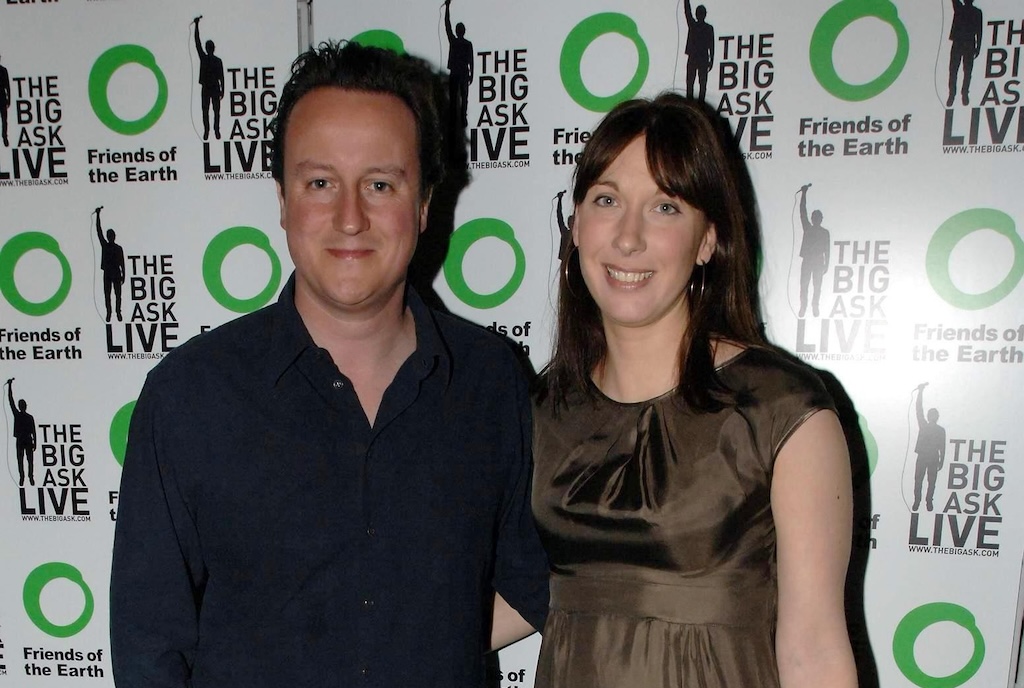
Former UK conservative leader David Cameron and his wife Samantha at Friends of the Earth’s “Big Ask” Benefit Concert, 2006. Credit: PA Images / Alamy Stock Photo
As the Guardian reported at the time, a letter from Cameron and others “call[ed] on the government to enshrine annual targets for carbon dioxide (CO2) emissions into a bill, to be introduced in the next Queen’s speech…the government believes a bill is unnecessary”.
At prime minister’s questions on 25 October 2006, Cameron continued to press Labour prime minister Tony Blair, who was still not committed to legislation.
Cameron went beyond the “Big Ask” draft by calling for an independent commission with executive powers, able to adjust the UK’s climate goals. Cameron asked Blair:
“Are we getting a bill: yes or no?…Will it include the two things that really matter: annual targets and an independent body that can measure and adjust them in the light of circumstances?”
The IfG says a former aide to David Miliband, who was then environment secretary, “remembers him commenting that Labour could not get into the position of being the only major party not in favour of the proposed bill”.
Finally, in November 2006, the Labour government confirmed in the Queen’s speech that it would introduce a new climate change bill.
Emphasising the cross-party consensus, Lord Deben tells Carbon Brief: “It was the Tories who wrote it and it was the Labour Party who accepted it – and all parties supported it.” He adds:
“It’s not just that every Tory leader since [then] has supported climate change, the Climate Change Act [and the] Climate Change Committee, but it’s simply that, actually, they ought to, because they invented it.”
The Labour government published its own draft climate change bill in March 2007 and this, after lengthynegotiation, went on to become the 2008 act.
Cameron continued to campaign for “independent experts, not partisan…ministers” to set the UK’s statutory climate targets, but this responsibility was, ultimately, left to the government.
Rutter tells Carbon Brief that, in pledging to repeal the 2008 act, Badenoch is “rejecting” a Conservative “inheritance” on climate change that runs back to Margaret Thatcher. She says:
“One of the defining features of climate policy to date in the UK has been the political consensus that has underpinned it. That may have been because Margaret Thatcher was the first leading world politician to draw attention to climate change in 1989 [via a speech at the UN in New York].”
Rutter adds that David Miliband had only been able to convince then-chancellor Gordon Brown to accept legally binding targets as a result of Cameron’s enthusiasm for the cause. She says:
“Although it was Labour legislation, brought forward by David Miliband (though implemented by brother Ed), the reason Miliband was…able to convince a sceptical Gordon Brown at the Treasury that the UK should set legally binding targets, was the enthusiasm with which new Conservative leader David Cameron embraced the Friends of the Earth ‘Big Ask’ campaign as part of his moves to detoxify the Conservative party after its 2005 defeat. Theresa May then increased the target [in 2019] from 80% to net-zero as part of her legacy. It is that long Conservative inheritance on climate action that Badenoch is now rejecting.”
The Climate Change Act sets out an overall “framework” for both cutting the UK’s emissions and preparing the country for the impacts of climate change.
At its heart is a legally binding goal for reducing greenhouse gas emissions by 2050. Originally envisaged as a 60% reduction on 1990 levels, this was quickly increased to 80%.
In 2019, amid a surge in concern about climate change, the then-Conservative government strengthened the target again to a reduction to “at least 100%” below 1990 levels, more commonly referred to as net-zero.
Section 1 of the Climate Change Act. Source: UK government.
On the pathway to this long-term goal, the act also requires the government to set legally binding interim targets known as ”carbon budgets”. These must be set 12 years in advance, to allow time for the government and the rest of the economy to plan ahead.
The carbon budgets set limits on emissions over five-year periods, providing greater flexibility than annual goals, while tackling the cumulative emissions that determine global warming.
Section 13 of the act specifies that the government has a “duty to prepare proposals and policies for meeting carbon budgets”. There is also a requirement for the government to explain how its actions will achieve its climate goals.
(In addition, the act requires the government to set out a programme of measures for climate adaptation and how it intends to meet them.)
The final key pillar of the act is the creation of the Climate Change Committee (CCC), an independent advisory body. The CCC advises – but does not decide – on the level at which carbon budgets should be set and the climate-related risks facing the UK.
The committee also produces annual assessments of “progress” and recommendations for going further, which the government is obliged to respond to, but not to accept.
Each time the secretary of state sets out their plan for a new carbon budget – taking the CCC’s advice into account – or responds to a progress report from the committee, parliament scrutinises the government’s activities.
Contrary to recent criticisms from the opposition Conservatives and the hard-right populist Reform UK, however, the act says nothing at all about how the government should meet its targets.
The only requirement is that the government’s plan should be capable of meeting its targets.
Moreover, it was the Conservatives under Cameron that had wanted to give the CCC executive and target-setting powers. This was opposed at the time by the then-Labour government.
Rachel Solomon Williams, executive director of the Aldersgate Group, notes on LinkedIn that this was a “closely debated” issue, but that, ultimately, the act puts the government “in control”:
“A closely debated aspect of the bill at the time was whether the CCC should have an executive or an advisory function. In the end, it was appointed as an expert advisory committee and the government remains entirely in control of delivery choices.”
The Conservative press release announcing Badenoch’s plan to “repeal” the act is, therefore, incorrect to state that the legislation “force[s]” governments to introduce specific policies.
(Speaking at the 2025 Conservative party conference, shadow energy secretary Claire Coutinho caricatured what she called “Ed Miliband’s…act” as requiring “1970s”-style “central planning” that “dictate[s] what products people must buy, and when”.
Just 18 months earlier, she, as energy secretary, had written of her “government’s unwavering commitment to meeting our ambitious emissions targets, including the legislated carbon budgets and the net-zero by 2050 target”.)
The press release also falsely describes the targets set under the act as “arbitrary” and falsely suggests they were set without consideration for the impact on jobs, households and the economy.
(In 2021, Badenoch herself, then a government minister, told parliament: “We will put affordability and fairness at the heart of our reforms to reach net-zero.”)
Specifically, section 10 of the act lists “matters to be taken into account” when setting carbon budgets, including the latest climate science, available technologies, “economic circumstances”, “fiscal circumstances” and the impact of any decisions on fuel poverty.
As for the net-zero target, the Intergovernmental Panel on Climate Change (IPCC) has concluded that reducing emissions to net-zero is the only way to stop global warming. The target was set on this basis, following detailed advice from the CCC that took climate science, economic and social factors into account.
The Conservatives have also taken aim at the CCC itself as part of their rejection of the Climate Change Act, highlighting the committee’s advice on meat consumption and flying.
In an echo of widely circulated conspiracy theories, Badenoch even told the Spectator that the CCC “wants us to eat insects”. This is not true.
Despite the framing by right-leaning media and politicians, the CCC’s recommendations for contentious topics such as meat consumption and reductions in flight numbers are modest.
The committee notes that “meat consumption has been falling” without policy interventions and says this will help to free up land for tree-planting. It says “demand management measures” to curb flight numbers “may” be needed, but only if other efforts to decarbonise aviation fail.
More importantly, the government decides how to meet the carbon budgets. It can – and often does – ignore recommendations from the CCC, including those on diets and airport expansion.
Yet serious efforts to weigh up the costs and the benefits have concluded – again and again and again – that it would be cheaper to cut emissions than to face the consequences of inaction.
Indeed, this was precisely the conclusion of the landmark 2006 Stern Review, to which the 2008 Climate Change Act partly owes its existence. The review said:
“[T]he evidence gathered by the review leads to a simple conclusion: the benefits of strong and early action far outweigh the economic costs of not acting.”
More specifically, it said that the cost of action “can be limited to around 1% of global GDP [gross domestic product]”, whereas the damages from climate change would cost 5% – and as much as 20% of GDP.
When the act was passed in 2008, it was again estimated that the UK would need to invest around 1% of GDP in meeting its target of cutting emissions to 80% below 1990 levels by 2050.
Since then, estimates of the cost of cutting emissions have fallen, as the decline in low-carbon technology costs has outperformed expectations. At the same time, estimates of the economic losses due to rising temperatures have tended to keep going up.
(Some years after the review’s publication, Stern said he had “got it wrong on climate change – it’s far, far worse…Looking back, I underestimated the risks.”)
When it recommended the target of net-zero by 2050, the CCC estimated that the UK would need to invest 1-2% of GDP to hit this goal. It later revised this down to less than 1% of GDP.
Most recently, the CCC revised its estimates down once again, putting the net cost of reaching net-zero at £116bn over 25 years – roughly £70 per person per year – or just 0.2% of GDP.
In July 2025, the independent Office for Budget Responsibility (OBR) went on to estimate that the UK could take an 8% hit to its economy by the early 2070s, if the world warms by 3C.
It concluded that while there were potentially significant costs to the government from reaching net-zero, these would be far lower than the costs of failing to limit warming.
Despite all this, Conservative leader Badenoch has falsely argued that the UK’s net-zero target will be “impossible” to meet without “bankrupting” the country and that the the Climate Change Act has “loaded us with costs”.
Her party has also pledged to “axe the carbon tax” on electricity generation – a significant source of government revenue – claiming that this “just adds extra costs to our bills for no reason”.
Prof Jim Watson, director of the UCL Institute for Sustainable Resources, tells Carbon Brief that the costs of climate policies are “sometimes exaggerated” and are not the main reason for high bills:
“Policies that are in place to meet the UK’s carbon targets have costs, but these costs are sometimes exaggerated. These policies are not the primary cause of the energy price shock businesses and households have experienced over the past three years.”
Watson says that high gas prices were the “main driver” of high bills and adds that shifting away from fossil fuels “will also reduce the UK’s exposure to future fossil-fuel price shocks”.
How nearly 70 countries followed the UK’s Climate Change Act
In the interview announcing her ambition to scrap the Climate Change Act, Badenoch falsely told the Spectator that the UK was “tackl[ing] climate change…alone”. She said:
“We need to do what we can sensibly to tackle climate change, but we cannot do it alone. If other countries aren’t doing it, then us being the goody-two-shoes of the world is not actually encouraging anyone to improve.”
This is a common claim among climate-sceptic politicians and commentators, who argue that the UK has gone further than other nations and that this is unfair. Badenoch’s predecessor, Rishi Sunak, used similar reasoning to justify net-zero policy rollbacks.
The UK has indeed been a leader in passing climate legislation, but it is far from the only country taking action to tackle climate change.
The Climate Change Act was among the first comprehensive national climate laws and the first to include legally binding emissions targets.
It has inspired legislation around the world, with laws in New Zealand, Canada and Nigeria among those explicitly based on the UK model.
Indeed, 69countries have now passed “framework” climate laws similar to the UK’s Climate Change Act, as the chart below shows. This is up from just fourwhen the act was legislated in 2008. Of these, 14 are explicitly titled the “climate change act”.
Cumulative number of countries with “climate change framework laws”, as defined by the Climate Change Laws of the World database. When countries have updated laws or introduced additional framework legislation, duplicates have been removed. Source: Climate Change Laws of the World.
The UK was also the first major economy to legislate a net-zero target in 2019, but since then virtually every major emitter in the world has announced the target. (Not all of these targets have been put into law, as the UK’s has.)
When the UK announced its target in June 2019, around 1% of global emissions were covered by net-zero targets. By the end of that year, France and Germany brought this up to nearly 4%.
Over the following years, major economies including China and India announced net-zero targets, meaning that around three-quarters of global emissions are now covered by such goals, as the chart below shows.
(This figure would be even higher if the Trump administration in the US, which accounts for around a tenth of annual global emissions, had not abandoned the nation’s net-zero target.)
Global greenhouse gas emissions covered by national net-zero targets (dark blue) and those that remain uncovered (light blue). Shares of emissions are derived from a 2024 dataset that includes both fossil-fuel and land-use emissions. Source: Net Zero Tracker, Jones et al (2024).
While it is true that the UK is “only responsible for 1% of global emissions”, as Badenoch has also noted, this does not mean its actions are inconsequential. Around a third of global emissions come from countries that are each responsible for 1% of global emissions or less.
Moreover, as a relatively wealthy country that is responsible for a large share of historical emissions, manyargue that the UK also has a moral responsibility to lead on climate action.
This historical responsibility is implicitly invoked by the Paris Agreement, which recognises countries’ “common but differentiated responsibilities” for current climate change.
Finally, Badenoch’s position diverges from that of recent Conservative leaders.
Theresa May and Boris Johnson spoke positively of the UK “leading the world” in low-carbon technology and expressed pride about the nation’s climate record.
They framed the UK’s success in tackling climate change as a good reason to do more, rather than less. “Green” Conservatives also argue that the UK should race to gain a competitive advantage in producing low-carbon technologies domestically.
Responding to Badenoch’s plan to scrap the act, May issued a statement criticising the “retrograde step” following nearly two decades of the UK “[leading] the way in tackling climate change”.
The debate over the future of the Climate Change Act, triggered by the Conservative pledge to repeal it, comes ahead of two key moments for the legislation.
First, the government has until the end of October 2025 to publish a new plan for meeting the sixth carbon budget (CB6), covering the five-year period from 2033-2037.
In 2021, the then-Conservative government passedlegislation to cut emissions to 78% below 1990 levels during the sixth carbon budget period, centred on 2035. The government set out its “carbon budget delivery plan” for CB6 in October 2021, as part of a wider net-zero strategy.
In July 2022, however, this plan was ruled unlawful by the High Court for failing to publish sufficient details on exactly how the target would be met. The revised plan, published in March 2023, was once again found unlawful by the High Court in May 2024.
The High Court then gave the government a deadline of May 2025 to publish another version, later extended to October 2025 as a result of last year’s general election.
Second, the government has until June 2026 to legislate for the seventh carbon budget, covering the period 2037 to 2042. This legislation will be subject to a vote in parliament.
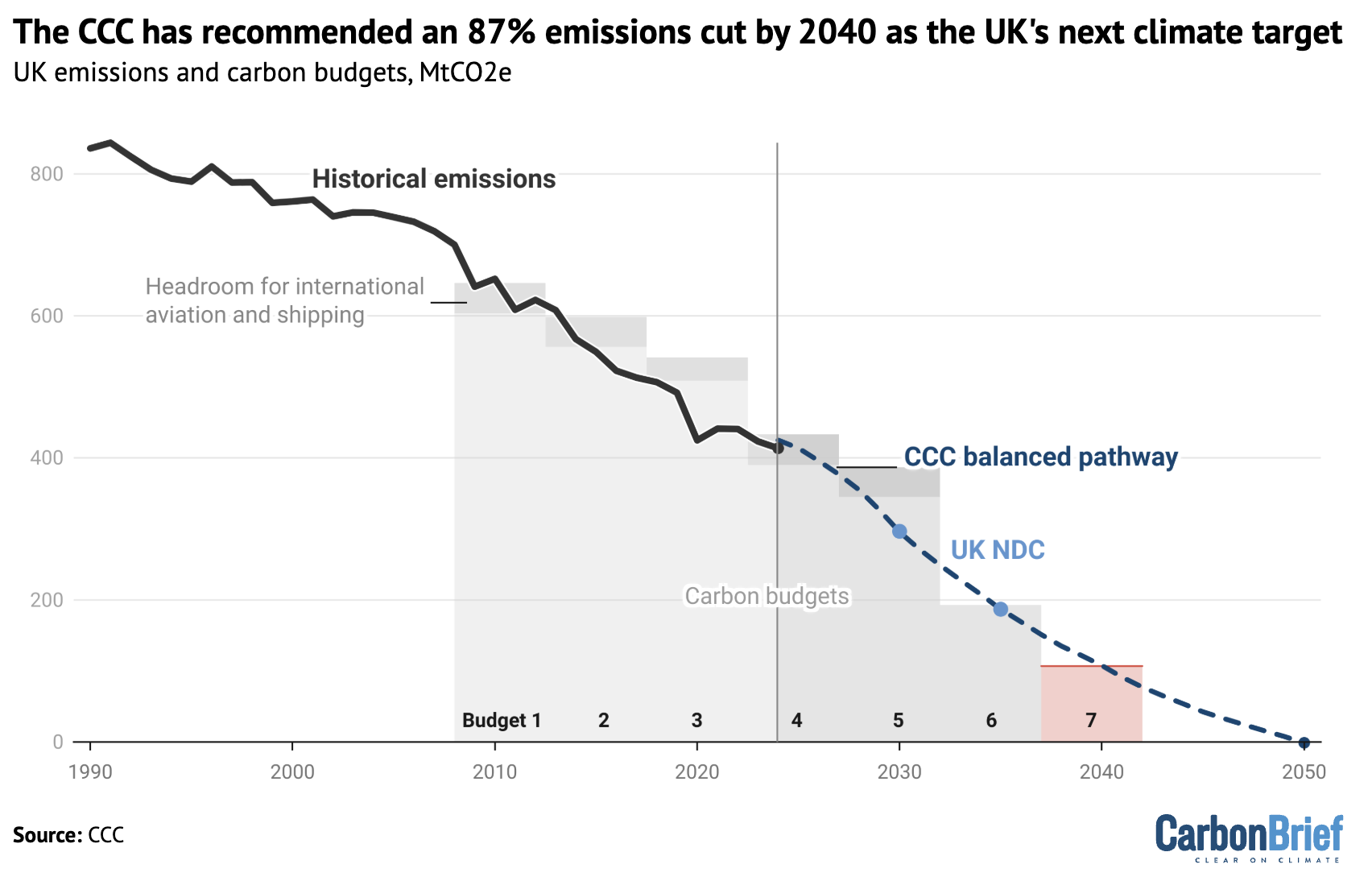
In February 2025, the CCC advised the government to set this budget at 87% below 1990 levels, in order to stay on track for the goal of net-zero by 2050, as shown in the chart below.
UK greenhouse gas emissions, including international aviation and shipping (IAS), MtCO2e. Lines show historical emissions (black) and the CCC’s “balanced pathway” to reaching net-zero. Legislated carbon budgets levels are shown as grey steps. The first five budgets did not include IAS, but “headroom” was left to allow for these emissions (darker grey wedges). Source: CCC.
Both the CB6 delivery plan this October and the parliamentary vote over CB7 next June are likely to be hotly contested, with the Conservatives and Reform having come out against climate action.
After publishing two unlawful carbon budget delivery plans and ahead of a widely anticipated election loss, the Conservatives began calling for greater scrutiny around carbon budgets in 2023.
Then-prime minister Rishi Sunak said in September of that year that parliament should be able to debate plans to meet the next carbon budget, before voting on the target. He said:
“So, when parliament votes on carbon budgets in the future, I want to see it consider the plans to meet that budget, at the same time.”
Then-secretary of state Coutinho subsequently wrote that a draft delivery plan for CB7 should be published alongside draft legislation setting the level of the carbon budget. She also argued that CB7 be debated on the floor of the House, rather than in the “delegated legislation committee”.
In response, the current government has pledged to provide “further information” to parliament, ahead of the vote on CB7. In a July 2025 letter to the chair of the House of Commons Environmental Audit Committee (EAC), energy secretary Ed Miliband wrote:
“Prior to parliament’s vote, we will publish an impact assessment which will clearly articulate the full range of benefits and costs of the government’s chosen CB7 target and the cross-economy pathway to deliver it.”
However, Miliband said the government would not publish a CB7 delivery plan until “as soon as reasonably practicable after” the parliamentary vote on the level of the budget.
The EAC itself is holding an inquiry on the seventh carbon budget and how the “costs of delivering it will filter through to households and businesses”. It is likely to report back in February 2026.
What would happen if the Climate Change Act was repealed?
If any future government wanted to repeal the Climate Change Act and its legally binding net-zero goal, it would not be a straightforward process.
The government would need to introduce a new bill in parliament just to repeal the act.
This process would involve seeking approval from both the House of Commons and the House of Lords before receiving Royal Assent to become law. Within the make-up of the current UK parliament, it is likely that such a bill would face significant challenges.
Any new law repealing the Climate Change Act would need to introduce new climate commitments of a similar nature – or else the UK would be in breach of several international laws and treaties, explains Estelle Dehon KC, a barrister specialising in climate change. She tells Carbon Brief:
“In short, repeal of the Climate Change Act without any replacement commitments of a similar type would be in breach of the UK’s international obligations under: the climate change treaties (so UNFCCC, Kyoto and Paris); international human rights law and customary international law, as well as specific sources like UN Convention on the Law of the Sea.”
Under the Paris Agreement, the UK has made pledges to cut its emissions by 2030 and 2035, known as “nationally determined contributions” (NDCs).
The UK’s NDCs are directly informed by its domestic emissions-cutting targets, known as carbon budgets. The act specifies that the government has a “duty to prepare proposals and policies for meeting carbon budgets”.
Any move in breach of international laws and treaties could be vulnerable to legal challenges, particularly in light of a recent opinion on climate change by the International Court of Justice.
Repealing the Climate Change Act could also put the UK in opposition with its international trade agreements.
The most recent trade agreement between the UK and the EU states that each party “reaffirms its ambition of achieving economy-wide climate neutrality by 2050”.
It also contains rules on “non-regression” in relation to climate protection.
Nigel Farage urges you to ignore facts and reality and be a climate science denier like him. He says that Reform UK has received £Millions and £Millions from the fossil fuel industry to promote climate denial and destroy the planet.Donald Trump urges you to be a Climate Science denier like him. He says that he makes millions and millions for destroying the planet, Burn, Baby, Burn and Flood, Baby, Flood.Elon Musk urges you to be a Fascist like him, says that you can ignore facts and reality then.
He likes to keep a low profile. But Sir Trevor Chinn is one of the most powerful men in British politics.
The retired businessman has donated millions to politicians, facilitated Prime Minister Keir Starmer’s rise to power, helped destroy the movement around Jeremy Corbyn, and, above all, has made sure that both major parties support Israel and its expansionist project in the Middle East.
MintPress News profiles perhaps the most influential man in the pro-Israel lobby and lifts the veil of anonymity he hides behind.
Israel’s Man
In November, President Isaac Herzog personally awarded Chinn the Israeli Medal of Honor for his “service to the state [of Israel] and the Jewish people.” The past year, President Herzog said in his presentation speech, was “the most difficult since the founding of the state.” However, he noted, his country was extremely fortunate to have “great friends and supporters in the world who fight alongside us against antisemitism, defend Israel’s name in the media, and have long fought for Israel’s place among the nations.”
Chinn has a decades-long history of promoting Israeli interests in the United Kingdom and beyond. In 2005, as co-chairman of the Israel-Britain Business Council, he led a delegation to Israel to participate in Prime Minister Ariel Sharon’s Conference for Export and International Cooperation. The conference was an attempt to bring back economic growth to Israel after three years of stagnation as a result of the Second Palestinian intifada.
In 2018, he co-hosted a high-profile celebration of former Israeli President Chaim Herzog attended by some of the most powerful figures in British politics, including former Prime Minister Tony Blair. Held at the exclusive Spencer House in London, the event celebrated the British-born president, honoring him as a “warrior and statesman.” Herzog was an officer in the Israeli military during the Nakba, the ethnic cleansing of around 750,000 Palestinians in order to establish the State of Israel.
As the longstanding president of United Jewish Israel Appeal, a group that aims to increase British Jews’ connections to Israel, Chinn has helped to raise millions to fund free birthright-style trips to the Middle East. One 2023 event at London’s Kensington Palace alone raised £1 million (U.S. $1.36 million). The function was attended by former prime minister Naftali Bennett, who praised his work profusely.
Chinn’s ties to Israel go far beyond economics and culture. Last October, at the height of the Israeli attack on Gaza, the 89-year-old tycoon quietly met with the U.K. Foreign Office to advise them on arms exports to Israel. Officially, the British government claimed they were merely “discussing geopolitics with [a] businessman.” Documents obtained by investigative journalist John McEvoy, however, revealed the real purpose of the meeting was far less innocent.
Bankrolling the British Cabinet
Chinn, McEvoy told MintPress, plays an “important but overlooked role in British politics.” Since the 1980s, he noted, Chinn has funded both Labour Friends of Israel (LFI) and Conservative Friends of Israel (CFI), pressure groups within the U.K.’s two largest political parties. He was also a member of the executive committee of the Britain Israel Communications and Research Centre (BICOM), the most influential pro-Israel lobbying organization in the United Kingdom.
“Quantitative analyses of these groups’ activities are instructive,” McEvoy said, adding:
Eighty percent of Tory MPs are members of CFI and, between 2012 and 2022, the organization paid for elected members to go on more overseas trips than any other donor. Last year, LFI counted some 75 MPs as supporters, while 32 sitting Labour members had accepted funding from the group. For its part, BICOM has flown scores of journalists to Tel Aviv since the turn of the century.”
As such, Chinn sits at the head of a massive influence operation aiming to make sure that Great Britain continues to support Israeli interests. The scope of this operation is staggering; pro-Israel lobby groups have funded the majority of the British cabinet. In total, 13 out of 25 sitting cabinet members have accepted money directly from Chinn, or pro-Israel groups, according to McEvoy’s investigation.
This includes many extremely powerful figures, such as Foreign Secretary David Lammy, Home Secretary Yvette Cooper, and Health Secretary Wes Streeting. Chinn himself has donated hundreds of thousands of pounds to these individuals.
Without a doubt, though, the most important recipient of his largesse is Prime Minister Keir Starmer himself. In 2020, Chinn donated £50,000 (approximately $68,000) to Starmer, bankrolling his campaign to become leader of the Labour Party. The donation was not registered until five days after the election.
It was around this time that Starmer very publicly began to shift his position on Israel. Until 2019, he had been a member of Labour Friends of Palestine and the Middle East, and promised to “put human rights at the heart of foreign policy.” Yet just a few weeks after he received Chinn’s money, he publicly stated, “I support Zionism without qualification.”
His administration has vocally supported Israel, sending weapons to the country and providing other military assistance from U.K. military bases in Cyprus. It has also cracked down on pro-Palestine protests at home and defended Israel in international bodies such as the United Nations. In 2021, Starmer’s office even went so far as to hire Assaf Kaplan, a former Israeli spy, to conduct what it calls “social listening” within the party.
Lowkey, a rapper, activist, and host of “The Watchdog” on MintPress, has tracked Chinn’s activities closely, stating that:
Trevor Chinn is a key officer of the Zionist movement in this country. He is a vehicle through which the Israel lobby is able to fund key political figures, like Keir Starmer and David Lammy, and thus extend Israeli influence over what happens in British politics.”
Shaping the Labour Party
Tony Blair was the driving force behind Labour’s move away from social democracy and its embrace of big business, and Chinn’s cash helped make it possible. According to a 1996 report in The Independent, Chinn was one of several Labour megadonors who each contributed around £500,000 to bankroll Blairism and ensure its success.
Along with its economic approach, Labour’s traditional foreign policy positions also shifted. As former chairman of LFI, Baron Mendelsohn approvingly noted at the time,
Blair has attacked the anti-Israelism that had existed in the Labour Party. Old Labour was cowboys-and-Indians politics, picking underdogs to support, but the milieu has changed. Zionism is pervasive in New Labour. It is automatic that Blair will come to Labour Friends of Israel meetings.”
To this day, Blair maintains a close relationship with Israel. He is a patron of the Jewish National Fund, the largest builder of illegal settlements in the West Bank. His wife, Cherie, meanwhile, worked as an adviser to NSO Group, the controversial Israeli software firm behind the Pegasus spying software.
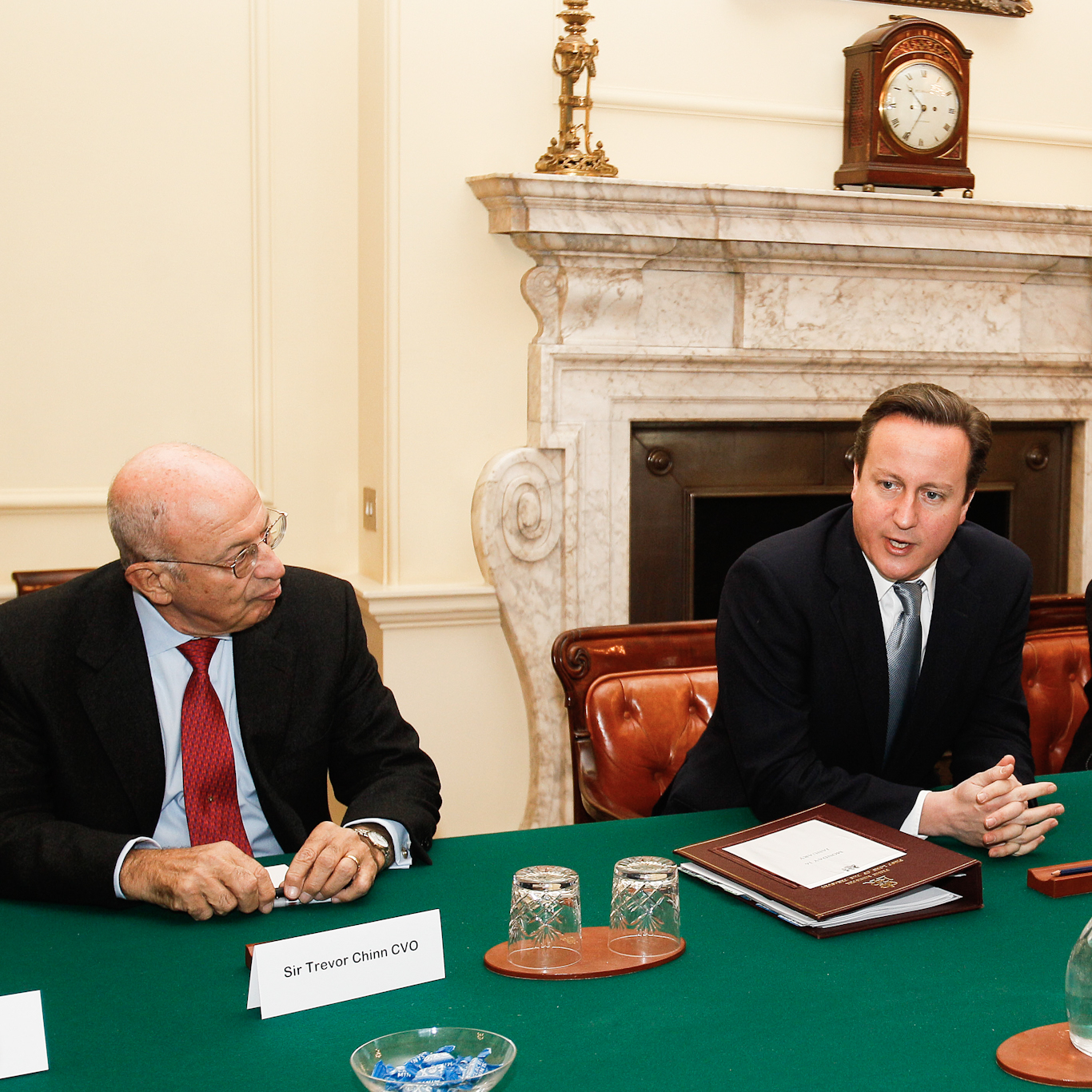
Chinn (left) looks at British Prime Minister David Cameron during a Jewish Leadership Council meeting at 10 Downing Street, Jan. 16, 2012. Kirsty Wigglesworth | AP
Since Blair, Chinn has continued to fund senior Labour figures. The one notable exception was during Jeremy Corbyn’s tenure, from 2015 to 2020. Corbyn, a lifelong socialist, anti-imperialist, and advocate for Palestinian statehood, was unexpectedly elected leader of the party in a landslide.
Almost immediately, senior figures in the Labour establishment began organizing against him. And they were helped by Chinn’s money and connections.
Chinn provided the financial backing for Labour Together, a think tank of right-wing figures with the stated goal of “defeat[ing] Corbynism,” and “win[ning] Labour back from the left.” He also financed the political ambitions of Corbyn opponents, including Owen Smith, Ruth Smeeth, and Deputy Leader Tom Watson. Corbyn was relentlessly attacked from all sides and suffered constant accusations of antisemitism designed to undermine public support for his project.
Also in Labour Together’s crosshairs were Corbyn-supporting media outlets, such as The Canary. A left-wing alternative media site, The Canary rapidly expanded its reach to 8.5 million monthly viewers. Labour Together devised a plan to, in their own words, “Kill The Canary.” To that end, they launched a sham “stop funding fake news” drive, claiming the outlet was spreading antisemitic content, and putting pressure on advertisers to pull their commercials from the site. Like the campaign against Corbyn, the antisemitism claims were false, but effective, and The Canary’s finances and reach were dealt a serious blow.
Equal Opportunities Oligarch
Chinn, however, is far from a strictly partisan donor. The elderly business magnate has also funded the Conservative Friends of Israel, the Tory equivalent of Labour Friends of Israel. CFI is, if anything, more influential than its Labour counterpart. Publicly available data shows that the organization has funded at least 118 Conservative members of parliament to travel to Israel on 160 occasions, providing over £330,000 (U.S. $450,000) towards the visits. Around 80% of Conservative MPs are members of CFI.
CFI wields significant influence within the halls of power, enough to force Prime Minister Boris Johnson to drop his plans to appoint Alan Duncan as his Middle East Minister. In his memoirs, Duncan noted that their opposition was “for no other reason than that I believe in the rights of the Palestinians.” Johnson was reportedly indignant. “They [the Israelis] shouldn’t behave like this,” he said. “The CFI and the Israelis think they control the Foreign Office. And they do!’” Duncan said, adding that Israeli penetration into British politics amounts to what he called “entrenched espionage” and a national security threat.
Going further back, Chinn repeatedly lobbied the administration of John Major (1990-1997) on its Middle East policy. “He can be quite a tough protagonist of the Israeli cause and is by no means a dove… My own feeling is that he is not very subtly tuned into the Israeli political scene,” one Foreign Office official wrote about Chinn in 1991.
The overall goal of his activities—the political donations, private meetings, funded trips and media work—McEvoy told MintPress, is to “persuade politicians and journalists that supporting Israel is in their interests.” Chinn and the wider pro-Israel lobby employ a “carrot and stick approach,” whereby good behavior is rewarded with free trips, favorable media coverage and political donations, and bad behavior is punished with a loss of funding, political flak, and pressure campaigns. Thus, McEvoy concludes:
While many legislators in Britain are already avowed Zionists and need little persuading, the carrot and stick approach can achieve an important disciplining effect on politicians who are either equivocal or easily shunned into silence, which accounts for a significant proportion given the extent of careerism and cowardice present in Westminster.”
You Can Cut Down the Flowers, But You Can’t Stop the Spring
Sir Trevor Chinn is far from a self-made man. He inherited his substantial wealth and power from his father, Rosser, who owned the automotive giant, Lex Services, now called the Royal Automobile Club (RAC). In addition to his business interests, Rosser was also the president of the Jewish National Fund, helping Israel dispossess Palestinians of their land.
Trevor served as chief executive of the RAC and later became chairman of its chief competitors, the Automobile Association (AA) and Kwik Fit. Since 1973, he has served as president of the United Jewish Israel Appeal and holds or has held a number of other significant positions of influence. These include serving as a governor of Tel Aviv University, and his positions on the executive committees of the Jewish Leadership Council and BICOM.
In 2023, BICOM participated in an attempt to remove the music of MintPress’ Lowkey from the streaming service Spotify. Their plan failed, thanks to massive public pushback and widespread resistance from top names in the entertainment industry.
“I was, at that time, identified as a key target. But we defeated them, thanks to MintPress, The Electronic Intifada, and all the amazing people who supported me,” Lowkey said. “It really does go to show that these lobby groups are really only powerful when they are not confronted.”
One successful cancellation operation Chinn did participate in, however, was the 2014 campaign against a north London arts venue. After finding out that the event was sponsored by the Israeli Embassy, the Tricycle Theater refused to host the U.K. Jewish Film Festival.
Israel, at the time, had just launched Operation Protective Edge, a bombardment of Gaza that killed over 2,000 people. Chinn sprang into action, threatening to pull his funding from the theater unless they reversed their decision. “We are as a community under pressure from the boycott movement. We can’t accept boycotts and whenever one comes along we have to fight it,” he said.
Tricycle was eventually forced to concede after Culture Minister Sajid Javid—himself a member of Conservative Friends of Israel—“made it absolutely clear what might happen to their funding if they, or if anyone, tries that kind of thing again.”
For all his work, though, Chinn has not been able to stem the tide of pro-Palestinian sentiment across the United Kingdom and beyond. In November 2023, an estimated one million people attended a London demonstration calling for a ceasefire.
Since then, polling shows that public attitudes towards Israel have only hardened.
A recent YouGov survey found that more than twice as many Britons support Palestine (32%) as Israel (14%). Only 17% of the country holds positive views of Israel (including 4% that are very positive), compared to 63% negative (including 39% that are highly negative). And the vast majority of the country supports an arms embargo, with only 13% opposing an end to weapons sales to Tel Aviv. Worse still for Israel, these are among the best numbers in Europe for their cause.
In response, both Conservative and Labour governments have cracked down on public support for Palestine, suppressing demonstrations, arresting protesters, and harassing and intimidating pro-Palestine journalists.
How much, if any, influence Chinn had on these responses is a matter of debate. But what is incontrovertible is that he and his network of pro-Israel organizations are not an omnipotent force. This is especially true when they and their activities are exposed to the wider public.
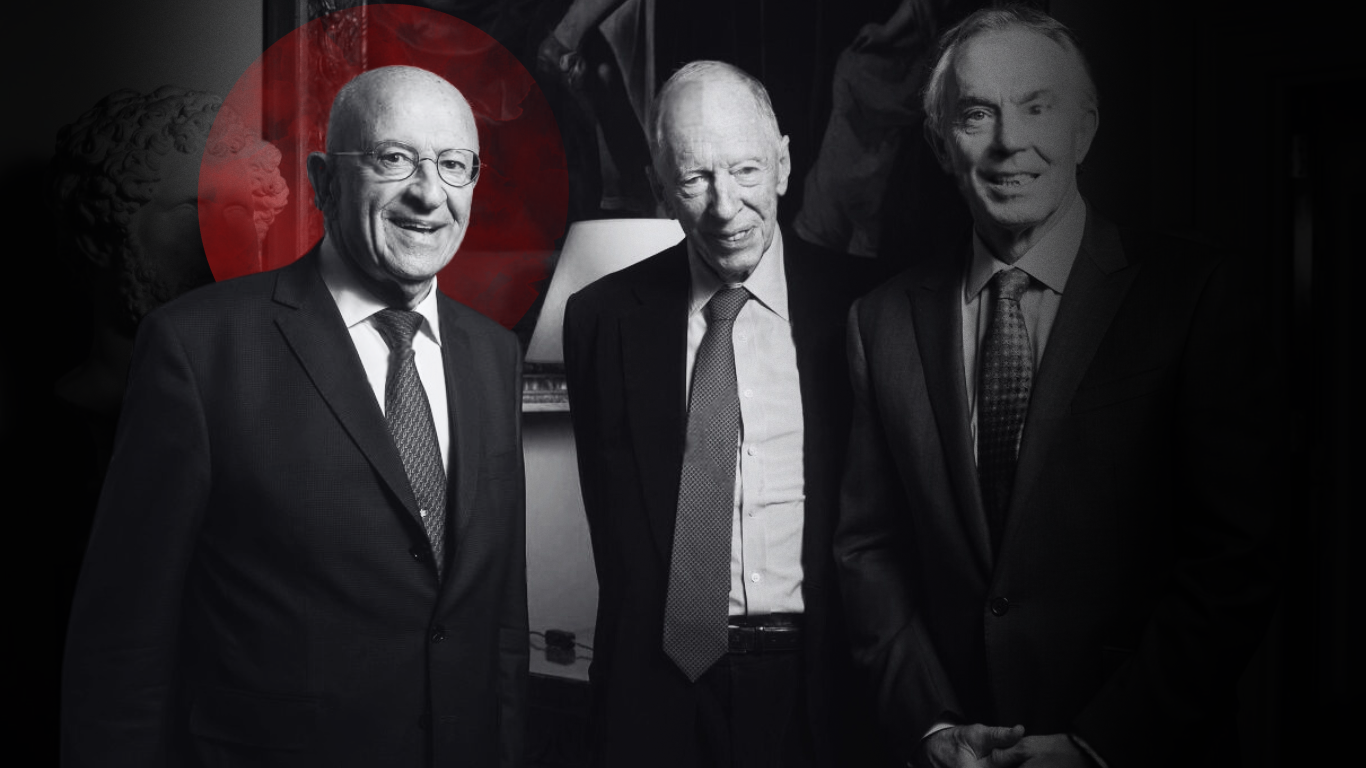
Feature photo | Sir Trevor Chinn (left), pictured alongside Jacob Rothschild (center) and former British Prime Minister Tony Blair (right) | Editing by MintPress News
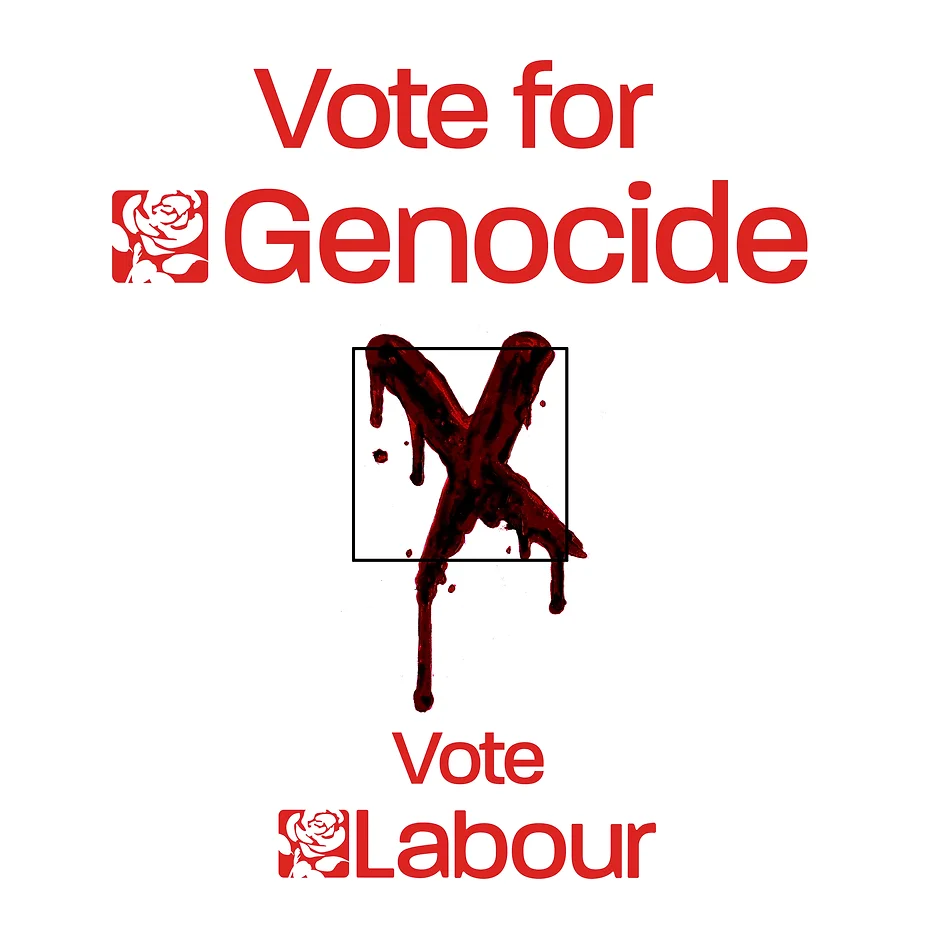
Genocide denier and Current UK Prime Minister Keir Starmer is quoted that he supports Zionism without qualification. He also confirms that UK air force support has been essential in Israel’s mass-murdering genocide. Includes URLs https://www.declassifieduk.org/keir-starmers-100-spy-flights-over-gaza-in-support-of-israel/ and https://youtu.be/O74hZCKKdpAUK Labour Party government Keir Starmer, Angela Rayner and Rachel Reeves explain that they are participants and complicit in Israel’s Gaza genocide providing Israel with army and air force support. They explain that they don’t do gas chambers but do do forced marches, starvation, destroy hospitals, mass-murders of journalists and healthcare workers.Vote Labour for Genocide.Keir Starmer warns against following the https://onaquietday.org blog.
Keir Starmer confirms that he’s proud to be a red Tory continuing austerity and targeting poor and disabled scum.
WES STREETING appointed Baroness Camilla Cavendish, who previously led David Cameron’s Number 10 Policy Unit, onto the board of the Department for Health this month, saying he wanted to have “cross-party” figures of “different political persuasions” to guide the NHS.
He wants to build a “cross-party consensus” to “reform the NHS.” But what is this consensus? In 2007, when Labour’s Gordon Brown was prime minister Cavendish wrote that “the hungry maw of the NHS is swallowing more and more resources, at the expense of virtually everything else.”
Cavendish denounced the NHS as “Britain’s last big state monopoly,” complaining that “its powerful unions view any slowdown in spending growth as a ‘cut.’ And cut is a deadly word in political terms.”
Cavendish said the NHS badly needs more “innovation,” which is only possible “by introducing competition.” Cavendish said New Labour had not gone far enough down this road. She welcomed Tony Blair’s attempts to “introduce competition” by letting private providers carry out some operations, and the introduction of foundation trusts, but claimed: “Ministers are too easily persuaded that the battle is between public and private provision. They are ashamed to endorse the private.”
She was worried Brown did not believe enough in “market-based reform” of the NHS. She said the health service was “a bloated state” and argued “the writing is on the wall: a tax-funded free healthcare system is looking ever less sustainable.”
The NHS was certainly in better state in 2007 than now. However, while the idea it was bloated, overfunded and needed more privatisation might appeal to Streeting, it doesn’t appeal to Labour voters. Cavendish went on to join Cameron’s No 10 operation in 2015, when the Tory PM did indeed stick with more NHS privatisation and less NHS money.
Cavendish is expected by Streeting to sit with former Labour health minister Alan Milburn on the Department of Health board and build up a consensus for NHS reform. Both seem drawn to Cameron’s approach — accepting and accelerating New Labour’s NHS privatisation, while adding Tory spending reductions.
Original article by ALAN MACLEOD republished from MPN under a Creative Commons Attribution-NonCommercial-ShareAlike 3.0 International License.
Without a sympathetic media, Israel’s powerful military would be next to useless in its attempts to ethnically cleanse Gaza. It relies on crucial Western support for its project, and no one is as important in manufacturing consent for Israel as Rupert Murdoch. The Australian-born press baron has close and extensive personal ties to the Israeli political elite and myriad business connections to the country. He has used his media empire to defend Israel and sing its praises, even amidst an attack on Gaza commonlycondemned as genocidal. As such, his holdings effectively serve as an unofficial arm of the Israeli propaganda machine.
The Murdoch machine comprises well over 100 newspapers – some of them among the world’s most well-known and influential, as well as dozens of TV channels and a formidable publishing empire. This power allows him to set the political agenda across much of the world. Former British Prime Minister Tony Blair claimed that Murdoch was an “unofficial member” of his cabinet and that he was one of the four most powerful men in the United Kingdom.
Political Connections
President Joe Biden, meanwhile, has described him as the world’s “most dangerous” individual. His influence on American public life – through ventures like The Wall Street Journal and Fox News – is well documented. Less understood, however, are his close ties to Israel, and in particular, to its political leadership.
In 2010, Israeli newspaper Yedioth Ahronoth published a leaked list compiled by Prime Minister Benjamin Netanyahu of whom he considered his best sources of campaign contributions. Murdoch’s name appears on the list alongside the designation of number two, meaning Netanyahu considered him a close ally and one of the most likely sources of funds. An estimated 98% of Netanyahu’s contributions came from abroad.
Did Piers Morgan's boss at Talk TV, Rupert Murdoch, fund Benjamin Netanyahu in the past?
At 93, Murdoch has relinquished much of the day-to-day running of his businesses to his son, Lachlan. Earlier this year, Lachlan traveled to Israel to meet Netanyahu and former prime minister Benny Gantz. While the details of the meetings remain murky, it is clear that support for the Israeli offensive in Gaza and beyond was a principal topic.
This was not the first time the younger Murdoch had met Netanyahu, In 2016, he flew to Israel for secret meetings with the prime minister, where, according to local newspaper Haaretz, he attempted to convince Murdoch to purchase Yedioth Ahronoth, and to start a Fox News-style TV channel for Israel.
Netanyahu, however, is far from the only prime minister with a close relationship with Murdoch. Ariel Sharon, for instance, has enjoyed a decades-long friendship with the Australian mogul. Murdoch stayed with him on his farm and was treated to a helicopter tour of Israel, where the supposed vulnerability of Israel from its hostile neighbors was stressed.
Economic Ties
In addition to his political ties, Murdoch has several economic commitments to Israel. In 2010, he and banking billionaire Lord Jacob Rothschild each purchased equity stakes in Genie Energy and joined the company’s board of directors.
While he was on the board, Genie was awarded a contract to drill for oil and gas over approximately 400 square kilometers of Golan Heights, Syrian territory that Israel has illegally occupied since 1967. In effect, Genie was attempting to profit from an occupation deemed illegitimate under international law.
Murdoch also owned Israeli software company NDS, which was at the center of a hacking scandal that brought down British television company ITV Digital. NDS’s activities helped huge numbers of Britons access paid TV for free, causing the corporation to fold under reduced revenues.
Another ethically questionable connection is Murdoch’s reliance on lobbying firm LLM Communications. The billionaire hired the group, co-founded by Lord Jonathan Mendelsohn, to help them overturn British government laws that ensured trade unions could ballot for workplace recognition. Lord Mendelsohn was the chairman of the Israel lobbying group Labour Friends of Israel, which was crucial in smearing and defeating the leadership of Jeremy Corbyn, a lifelong peace activist and proponent of Palestinian rights.
Image of InBedWithBigOil by Not Here To Be Liked + Hex Prints from Just Stop Oil’s You May Find Yourself… art auction. Featuring Rishi Sunak, Fossil Fuels and Rupert Murdoch.
Zionist Hardliner
“My ventures in media are not as important to me as spreading my personal political beliefs,” Murdoch said, and supporting Israel and its expansionist policies is one of the core values the Australian has tirelessly worked towards.
At a 2009 meeting of the American Jewish Committee, he explained that he saw Israel as the linchpin underwriting Western civilization:
In the West, we are used to thinking that Israel cannot survive without the help of Europe and the United States. I say to you: maybe we should start wondering whether we in Europe and the United States can survive if we allow the terrorists to succeed in Israel… In the end, the Israeli people are fighting the same enemy we are: cold-blooded killers who reject peace… who reject freedom… and who rule by the suicide vest, the car bomb and the human shield”.
In 2005, he wrote the foreword to the book, “Israel In The World: Changing Lives Through Innovation,” a fawning tome lionizing Israel as an unqualified success that has built a robust democracy and a vibrant economy despite setbacks and threats from its neighbors.
He has also put his money where his mouth is: in 2007, his News Corp business donated to the Jerusalem Foundation, a group that builds illegal Israeli settlements in the West Bank, including in the Sheikh Jarrah neighborhoods of Jerusalem.
Murdoch has led the fight against the global Boycott, Divestment and Sanctions (BDS) movement, claiming that it represents an “ongoing war against the Jews.” “The war has entered a new phase,” he said.
“This is the soft war that seeks to isolate Israel by delegitimizing it. The battleground is everywhere – the media, multinational organizations, NGOs. In this war, the aim is to make Israel a pariah.”
He made these comments at an Anti-Defamation League (ADL) event, where the organization presented him with its International Leadership Award. That the ADL, which purports to be a group standing against racism, would honor Murdoch with such an award, despite his networks pumping out relentless bigotry, underlines how little emphasis it places on genuine anti-racism and how much it works to simply promote Israeli interests.
The ADL is hardly the only Jewish organization that has heaped praise on the media mogul, however. The Simon Wiesenthal Center decorated him with their humanitarian laureate award; other groups, such as the Museum of Jewish Heritage and the American Jewish Committee, have also sung his praises. The United Jewish Appeal Federation of New York declared him their “humanitarian of the year” at a lavish ceremony, where Henry Kissinger presented him with the award.
Rupert’s Empire
Murdoch took over his father’s Adelaide newspaper in 1952 and quickly built a giant global enterprise, particularly across the English-speaking world. He used this power to spread his conservative agenda.
His British holdings, including The Sun, The Times and Sunday Times, constitute one-quarter of newspaper circulation in the country. His News Corp company also operates Sky television, TalkTV, TalkRadio and TalkSPORT.
Murdoch is widely believed to have swung both the 1992 elections for the Conservatives and the 1997 election towards Labour after Tony Blair struck a deal with him. “It’s difficult to think of a prime minister in the last 40 years who has won against the Murdoch instinct,” said former Guardian editor-in-chief Alan Rusbridger.
In the United States, Murdoch owns influential outlets such as The Wall Street Journal, The New York Post, and much of the Fox network. This is in addition to owning the influential Harper Collins publishing house.
He is known as an unusually hands-on owner, insisting that the tone and political line of all his outlets conform to his thinking. “For better or for worse, The News Corporation is a reflection of my thinking, my character, and my values,” he admitted.
This included wholehearted support for the 2003 invasion of Iraq. “We can’t back down now, where you hand over the whole of the Middle East to Saddam… I think Bush is acting very morally, very correctly, and I think he is going to go on with it,” he said. He also made sure that every one of his 175 global newspaper titles expressed similar vociferous support for the invasion.
Inside the industry, Fox News is known for its particularly strict, top-down editorial procedure. One former contributor claimed that working under Murdoch was “almost as if we were being monitored by a Stalinist system … it is very much an environment of fear”. A second confided that “if you don’t go along with the mind-set of the hierarchy, if you challenge them on their attitudes about things, you are history”.
But it is in his local Australia that his power reaches almost banana republic-like proportions. Murdoch owns 7 of the country’s 12 national or capital daily newspapers. In half of the country’s state or territory capitals, there is no local alternative to the Murdoch publication. Former prime minister, Kevin Rudd labeled his empire a “cancer” on Australian democracy.
Piers Morgan Exposed
Until he recently went independent with his talk show, Piers Morgan was one of Murdoch’s most recognizable anchors. Hosting a popular talk show that reached millions, Morgan has played a crucial role in informing the public about Israel and Palestine. Although he has claimed he is entirely neutral on the issue and does not support either side, Morgan has a number of close connections to Israel worth noting. Firstly, he has supported the Norwood Charity on a number of occasions, helping to raise hundreds of thousands of dollars for the group.
Norwood is headed by the aforementioned Israel lobbyist, Lord Mendelsohn, alongside his wife, Lady Nicola Mendelsohn. Lady Mendelsohn is also head of global business for social media giant Meta (the parent company of Facebook, WhatsApp and Instagram). She has consistently lobbied for Israeli causes and even met former president Shimon Peres. During her time at Meta, the company has begun to employ dozens of former agents of the Israeli spying group, Unit 8200 – all in sensitive positions within the company. Facebook in particular has grown closer to Israel, even appointing former General Director of the Israeli Ministry of Justice Emi Palmor to its oversight board, the group that decides what direction the company goes and what content to allow and disallow on the platform.
Norwood’s previous president was Sir Trevor Chinn. Chinn is currently head of United Jewish Israel Appeal, a British-Israeli group whose goal is to increase young British Jews’ sense of connection to Israel. He is also on the executive committee of Britain’s largest Israel lobby group, BICOM, and has funded Labour Friends of Israel.
On October 22, at the height of Israel’s attack on Gaza, Morgan met Lady Mendelsohn in New York for dinner. Also present at the meal was Welsh singer Katherine Jenkins, who has raised money for the Jewish National Fund, the largest settler-building body in Palestine. It is unclear what they discussed, but given their careers and interests, it is hard to see how news from the Middle East did not arise.
Thus, while Morgan may have invited individuals from all points of the spectrum of debate on Gaza, he does appear to move in circles filled with top Israel lobbyists.
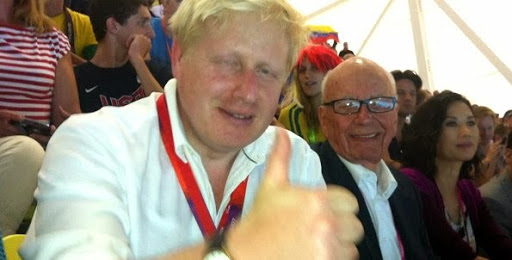
Boris Johnson sucking up to Rupert Murdoch
Blatant Propaganda
Unsurprisingly, given what we have seen, Murdoch’s top publications have displayed an overwhelming bias in their coverage of Israel’s war on Gaza, constantly defending Israeli actions and demonizing both Palestinians and those who have opposed the violence.
On October 19, an Israeli airstrike targeted the Church of Saint Porphyrius in Gaza City, where hundreds of refugees had taken shelter. In describing the attack, the Wall Street Journal ran with the headline “Blast goes off at Orthodox Church Campus in Gaza,” turning what was one of the most notorious incidents in Israel’s months-long assault on Gaza into a regrettable accident. At no point during the article did the Journal suggest that the “blast” might have been an attack or even hint at Israeli involvement.
The Journal has also led the attack on Americans protesting the onslaught. “Who’s Behind the Anti-Israel Protests: Hamas, Hezbollah, the Houthis and others are grooming activists in the U.S. and across the West,” ran the headline of one story, clearly intended to vilify people opposing a genocide as agents of a foreign power. Another story, entitled “Welcome to Dearborn, America’s Jihad Capital,” echoed Bush-era levels of Islamophobia in its attempts to equate the heavily Arab-American city with anti-American hatred. Campus demonstrations, meanwhile, were written off as “terrorist-glorifying protestors” who constitute “the left-wing counterparts to the Charlottesville mob that chanted ‘Jews will not replace us.’”
The newspaper has also published articles demanding the U.S. go to war with Iran. “The U.S. and Israel Need to Take Iran On Directly. Make the ayatollahs pay for sowing chaos through their Hamas, Hezbollah and Houthi proxies,” wrote former Israeli prime minister Naftali Bennett.
And for Palestine? The Wall Street Journal envisages its future as a giant arms factory making the weapons for Israel’s assault on Iran. In an op-ed entitled “A Plan for Palestinian Prosperity,” columnist Andy Kessler wrote that producing the weapons for the next Israeli attack would bring middle-class jobs to Gaza. “They can even work on Saturdays” and “without handouts from the politicized United Nations,” he claimed, although he cautioned that perhaps the explosives should be added elsewhere by more trustworthy employees.
Murdoch’s other publications have followed suit, relentlessly supporting Israel and demonizing its critics. Fox News, for example, spread the now-debunked assertion that Palestinian fighters had beheaded 40 Israeli babies on October 7. In reality, no babies were beheaded, although Israeli bombs or bullets have since decapitated countless Palestinian children.
The New York Post, meanwhile, published a remarkable article titled “Just how many of Gaza’s civilians are entirely ‘innocent’?” in which it repeatedly insinuated that essentially every adult in Gaza was a legitimate target, even using the word “civilian” in scare quotes.
On Israel/Palestine, journalists in corporate media are under enormous pressure to toe an ownership-imposed line. The New York Times, for example, has told its reporters not to employ words such as “genocide,” “slaughter,” and “ethnic cleansing” when discussing Israel’s actions. It has even forbidden the use of terms like “refugee camp,” “occupied territory,” or even “Palestine,” making it virtually impossible to report accurately on the situation.
Murdoch publications are surely no different. Indeed, this sort of stifling censorship has been in place for decades, if former employees are to be believed. In 2001, Sam Kiley, a former correspondent for The Times of London, revealed that he was instructed never to refer to Israel as “assassinating” or “executing” their opponents. And when he was tasked with interviewing an Israeli Army unit responsible for killing a 12-year-old Palestinian boy, he was asked to file the article without somehow mentioning the dead child at all.
Boris Johnson confirms his thumbs up from Rupert Murdoch
Friends in High Places
The nine-month-long Israeli attack on Gaza has inspired outrage across the world. While its standing has dropped even further in the Global South, Israel still maintains a considerable base of support in the West. This is down in no small part thanks to oligarchs such as Rupert Murdoch, who have marshaled their considerable resources to fight a committed media war in support of the Israeli state, attempting to hide its atrocities and shore up support for its expansionist project.
For Israel, which could not continue in its current form without outside support (particularly from the United States), the battle for public opinion is every bit as important as the fight on the ground. Fortunately for Netanyahu and his ilk, they can rely on Rupert Murdoch, who has for decades championed Israel’s cause and is now pushing his media empire into overdrive to defend the indefensible. If the pen is indeed mightier than the sword, then Rupert Murdoch is one of Israel’s most powerful weapons.
A new report from the ADL claims that anti-Semitic incidents across the US have skyrocketed by more than 400%. But as Alan Macleod reveals, the numbers do not add up unless one equates opposition to Israel’s bombardment of Gaza with hatred of Jews.

 Then prime minister David Cameron (left) welcomes then newly-elected Newark MP Robert Jenrick to the Houses of Parliament in London, June 11, 2014

![The target for 2050: (1) It is the duty of the Secretary of State to ensure that the net UK carbon account for the year 2050 is at least [F1100%] lower than the 1990 baseline. (2)“The 1990 baseline” means the aggregate amount of— (a)net UK emissions of carbon dioxide for that year, and (b)net UK emissions of each of the other targeted greenhouse gases for the year that is the base year for that gas.](https://www.carbonbrief.org/wp-content/uploads/2025/10/cca-rag-scaled.webp)