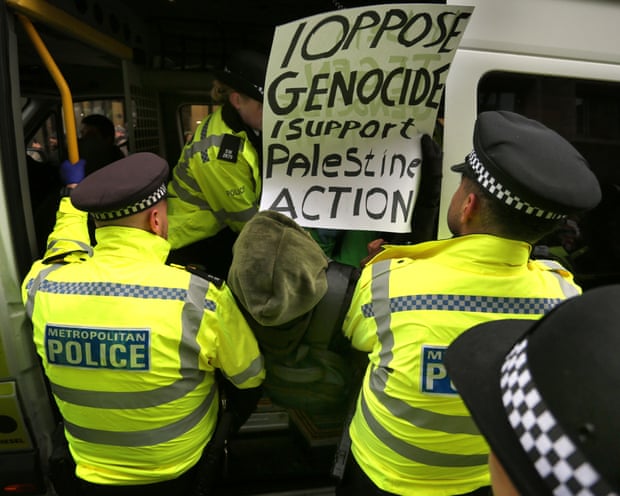
A person holding a sign saying ‘I oppose genocide, I support Palestine Action’ is detained by police in London. Photograph: SOPA Images/LightRocket/Getty Images
Increase coincides with proscription of Palestine Action last year which has led to thousands of arrests for allegedly supporting the protest group
Almost half of all terrorism arrests in Great Britain since the 9/11 attacks on the twin towers in 2001 have come in the past year, official data shows.
There have been 6,539 arrests for terror-related activity in Great Britain since the 2001 attacks and 3,021 of those arrests were in the year ending 31 March 2026, according to the Home Office.
The increase coincides with the proscription of Palestine Action, which came into effect on 5 July last year and has led to thousands of arrests of people for allegedly supporting the direct action protest group, the first such group to be banned under the Terrorism Act.
The ban, which has been criticised by UN experts, NGOs, a former director of public prosecutions and a former director of the security services, is the subject of a continuing legal challenge, which will next be heard at the UK supreme court on 4 November.
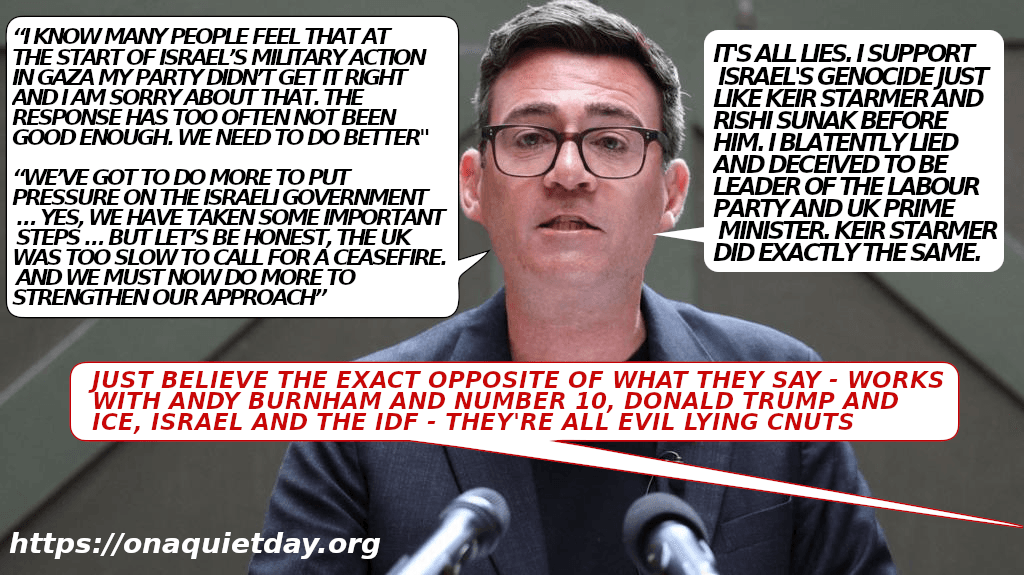
UK Prime Minister Andy Burnham admits to blatently lying and engaging in deception to become leader of the UK Labour Party and Prime Minister.Keir “I support Zionism without Qualification” Starmer supporting genocide. He berates Palestine Action for upholding international law and prevent his – Labour and Israel’s – Gaza genocide. Starmer says that that they’ve got a genocide to achieve, forced marches like the Nazis did, hospitals to bomb into obliteration, journalists, healthcare workers and starving people queuing for food to mass-murder and that they have to murder all Gazans for Zionism.Palestine Action joke that appeared in the UK satirical magazine ‘Private Eye’.
The US has issued sanctions against the UK-based direct action organisation Palestine Action, describing it as a “transnational terror group”.
The US Department of the Treasury labelled Palestine Action a specially designated global terrorist on Wednesday, which allows the US to freeze the assets of foreign individuals and entities.
The powers used to sanction the organisation in the US were introduced by President George W Bush shortly after the 9/11 attacks by al-Qaida on the twin towers in New York.
Announcing the sanctions on Palestine Action and two other organisations, the Treasury secretary, Scott Bessent, said: “Far-left extremists, their fronts, and their enablers should be on notice: we will bring the full weight of our economic tools to bear. Political terrorism has no place in our society and we will continue to cut the financial lifelines of these groups until they are eliminated.”
Climate science denier Donald Trump confirms that he knows nothing about democracy and that more liquid gold is being secured according to his policy of global privateering.Donald Trump warns against following the Onaquietday.org blog, says that he’s heard that she’s a which with a black cat and a dangerous kitchen.Palestine Action joke that appeared in the UK satirical magazine ‘Private Eye’.
Keir Starmer objects to criticism of the IDF. He asks how could anyone object to them starving people to death, forced marches like the Nazis did, bombing Gaza’s hospitals and universities, mass-murdering journalists, healthworkers and starving people queuing for food, killing and raping prisoners and murdering children. He calls for people to stop obstructing his genocide for Israel. New Labour UK Prime Minister Andy Burnham continues Labour party policy of active support and complicity in Israel’s genocide.
I mentioned a short time ago that I needed to write a piece on terrorism. This is the first published draft, it may well change.
I decided to publish a piece on terrorism while Anne Widdicombe murder featured prominently in the UK press. Anne Widdicombe was a well-known UK politician who like many Reform politicians had transferred her allegiances from the Conservative Party to Nigel Farage’s Reform UK party plc. An intolerant bigot, it’s unclear whether she was immigration and justice spokesperson for the Reform party plc when she was violently murdered by a 28 year old man repeatedly wielding a hammer.
The London Metropolitan Police lead on terrorism policing in the UK. An alleged possible terrorism connection allowed the transfer of the investigation from the regional Devon and Cornwall Police force to the Metropolitan police.
Normal people understand terrorism as being about using bombs to kill people indiscriminately. This is actually very difficult to do because – I suggest that by definition you have to be divorced from normal life, mentally ill to do this – and what we find instead is that nutters attack and kill people using knives, etc.
Palestine Action joke that appeared in the UK satirical magazine ‘Private Eye’.
In UK, terrorism is defined as attempting to influence the government. It follows that political activists engaging in the democratic process are terrorists – including myself wanting government action addressing climate change, disagreeing with fossil fuel exploitation in the North Sea, objecting to and wanting and end to UK’s complicity in Israel’s genocide for colonial expansion. I have a long history of UK police treating me as a suspected terrorist and interfering in my life for my actions as a political activist.
But this is selective of course. Super rich proprietors of newspapers Rupert Murdoch, Lord Rothermere, etc not only attempt to influence the government but no way are these cnuts regarded as terrorists when they are the de-facto the weilders of power. These are cnuts who support Israel’s genocide and deride climate activists as eco-zealots, etc.
As I said earlier, people understand that terrorism is about people indiscriminately killing the public using bombs. This is what Israel is doing with the UK government complicit in it’s actions. This intolerant Fascist government instead accuses people damaging arms factories complicit in genocide, painting military planes, painting banks or retired vicars and other pensioners holding signs with words banned by the government of terrorism.
Orcas discuss Genocide-supporting and complicit Zionists. Donald Trump, Keith Starmer, David Lammy, Rachel Reeves, Angela Rayner and Wes Streeting are acknowledged as evil genocide-complicit and supporting cnuts.
Palestine Action and Defend Our Juries protesters outside Westminster Magistrates’ Court, London, July 30, 2026
AT LEAST 50 people were arrested outside Westminster Magistrates’ Court today as they demanded the ban on Palestine Action be lifted.
An estimated 200 protesters prepared to read a statement inviting support for the proscribed group as a review hearing began for the prosecution of 1,579 people under section 13 of the Terrorism Act 2000, for holding signs in support of Palestine Action during mass silent vigils in Parliament Square last year.
It is understood that at least four arrests were made before the action started, two under section 13 for articles of clothing and two for setting up a small stage.
From midday, a programme of speakers took place, with many being arrested while speaking.
Among them was Sir Jonathan Porritt, a campaigner and author who served as director of Friends of the Earth and was an adviser to current King Charles III for more than 30 years
Ahead of the protest, deputy assistant commissioner Andy Valentine said: “The law is clear. Expressing support for proscribed organisations is a criminal offence and anyone doing so can expect to be arrested.”
Protesters wore red to echo the jumpsuits worn during direct actions organised by Palestine Action, many of which targeted weapons factories to disrupt arms supply to Israel amid its genocide.
A Defend Our Juries spokesperson said: “We had hoped to see a different response from the Met Police today, but yet again they are embarking on making hundreds of arrests of regular people who refuse to do nothing as the judiciary criminalised those who act to save lives as terrorists.
“These arrests, like that of thousands of others, 1,855 of whom were listed as needing to appear in court today, are an assault on our democracy, our civil liberties and our moral obligation to step in to prevent genocide.
“We urge the new PM to stop this insanity, at a time when there is so much positive work to be done in our country, Andy Burnham needs to put a stop to huge sums of taxpayer money being used for these arrests and prosecutions that the public at large do not support.”
As arrests continued, court records revealed that Palestine Action co-founder Huda Ammori will be permitted to challenge the proscription at the Supreme Court.
Keir Starmer objects to criticism of the IDF. He asks how could anyone object to them starving people to death, forced marches like the Nazis did, bombing Gaza’s hospitals and universities, mass-murdering journalists, healthworkers and starving people queuing for food, killing and raping prisoners and murdering children. He calls for people to stop obstructing his genocide for Israel. New Labour UK Prime Minister Andy Burnham continues Labour party policy of active support and complicity in Israel’s genocide.
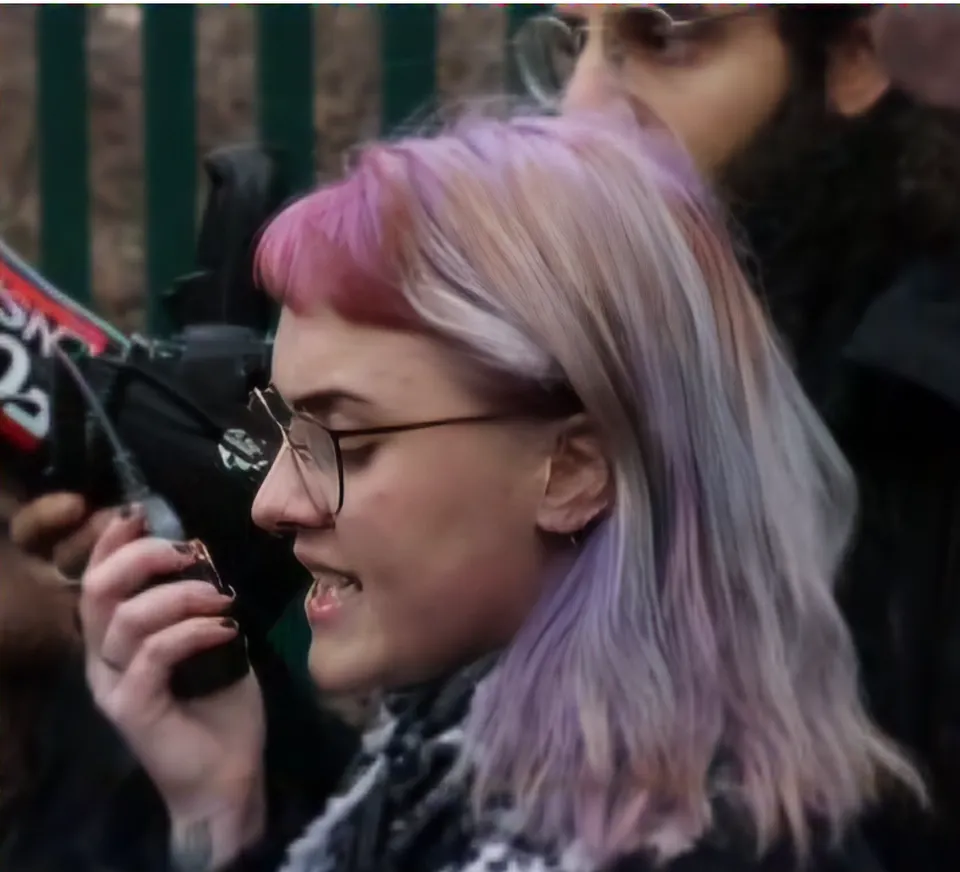
Charlotte Head speaking outside Woolwich Crown Court in 2026 | Filton24 Defence Committee
My lawyer faces jail over a speech to jurors – a first in English history – as state seeks to silence Palestine solidarity
Editor’s note: Shortly after this piece was published, Rajiv Menon was granted a last-minute stay on his appeal. His case will now be heard in September.
England prides itself on its legal system, supposedly a pinnacle of fairness, neutrality and justice.
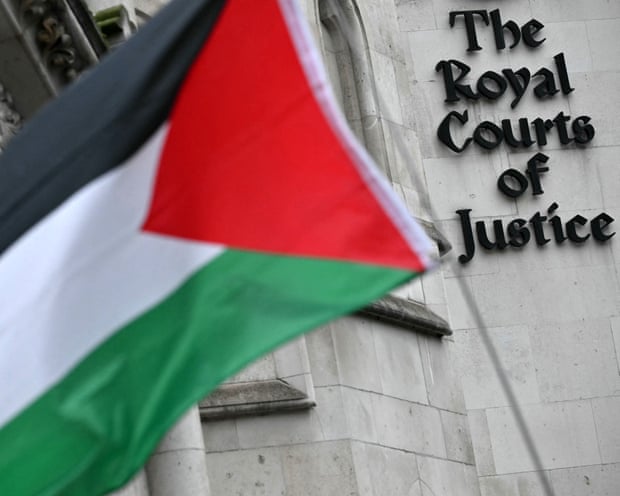
Having faced two trials and 18 months’ incarceration before a verdict was even reached, I’ve witnessed the falsity of these claims. Today will mark another low: the lead barrister on my case, Rajiv Menon, will appear at the Royal Courts of Justice accused of contempt of court over remarks he made in a closing speech to the jury.
If found guilty, he’ll face up to two years in prison.
This is the first time in English legal history that a barrister has been prosecuted for defending their client in this way. The Garden Chambers, where Menon is a KC, has said it is “extremely concerned about the chilling effect on the Bar of the state seeking to criminalise barristers for their representation of their clients”. The Criminal Bar Association (CBA) has warned that other lawyers are now afraid of doing their jobs.
“[They] have become uncertain and scared of what they can and can’t say; scared that somehow they might be – at the end of a trial where they have faithfully represented their client themselves – facing a charge of criminal contempt,” said Riel Karmy-Jones KC, chair of the CBA. “It is starting to feel like it’s about the politics of the subject matter of the trial, rather than the core principles of how a barrister represents his client.”
That has certainly been my experience.
In August 2024, I entered an Israeli weapons factory in Filton, Bristol, along with other activists. We destroyed military drones created by Elbit Systems: quadcopters set to be exported for use in Israel’s illegal genocide against the Palestinians in Gaza.
Any nation found to be supporting or abetting those committing a genocide is complicit and culpable under international law; there are legal precedents that allow an offence to be committed to prevent a greater offence occurring, as we did at Filton. Yet upon arrest we were held incommunicado for almost three weeks in counter-terrorism custody, which the UN warned may amount to ‘enforced disappearance’.
We were presented at magistrates’ court, charged with criminal damage, violent disorder and aggravated burglary. These were ordinary offences, but Judge Johnson later granted himself the right to use a ‘terrorism connection’ at sentencing. We were denied bail and imprisoned under the Terrorism Act. Johnson introduced reporting restrictions to ban the media from mentioning that, if the jury found us guilty, he could sentence us as terrorists, which would drastically lengthen our jail time and impact our futures. Jurors were also not made aware of this fact.
Despite the restrictions, media coverage of our case blew up during my 18 months in custody awaiting trial, with grand accusations made about my co-defendants and me.
In June 2025, five months before our trial, Yvette Cooper, then the home secretary, discussed her decision to proscribe Palestine Action in the Commons. She specifically acknowledged that she could not discuss our case “to avoid prejudicing future criminal trials”. Yet just moments earlier, she had referred to the “attacks at […] Elbit Systems UK in Bristol”, saying Palestine Action had “committed acts of serious damage to property with the aim of progressing its political cause and influencing the government”.
Two months later, Cooper went further still. In an Observer article titled “Palestine Action ‘is not lawful protest’”, she referenced the charges in our case, which she said, “in the assessment of the independent Crown Prosecution Service, [had] a terrorism connection”. She also accused Palestine Action of “intimidation, violence, weapons, and serious injury to individuals”.
Given that our trial had yet to take place, it seemed a case of putting the cart before the horse – and one that risked prejudicing jurors. Given Cooper’s position in government and the role she played in the legal proceedings to proscribe Palestine Action, it is inconceivable that she did not understand the reporting restrictions surrounding our trial. She has faced zero repercussions for what may amount to breaking the law on contempt of court.
For Rajiv Menon, the sole KC for the defence, it is a very different story.
At our trials, a heavy burden fell on Menon’s shoulders as he and the other defence barristers were forced to contort themselves to keep up with Johnson’s ever-increasing restrictions on what he deemed permissible as evidence.
As well as being prohibited from telling the jury about the terrorist connection, we were forbidden from referencing material the prosecution had included in its own evidence bundles. Elbit’s actions in supporting Israel’s genocide were deemed irrelevant.
In his closing speech, Menon reminded the jury of their role. He spoke about the case of Penn and Mead in 1670, which saw a jury imprisoned and fined for contempt of court after acquitting two Quakers of unlawful assembly. As Menon said, that case it is the cornerstone of the British legal system as we know it – it established the right of juries to make decisions freely and without threat of repercussions.
Menon also spoke emotionally and passionately about my background and how I ended up involved in this action, highlighting the centrality of the Palestinian cause to my motivations. His has since been dubbed a historic speech by legal professionals and the public alike.
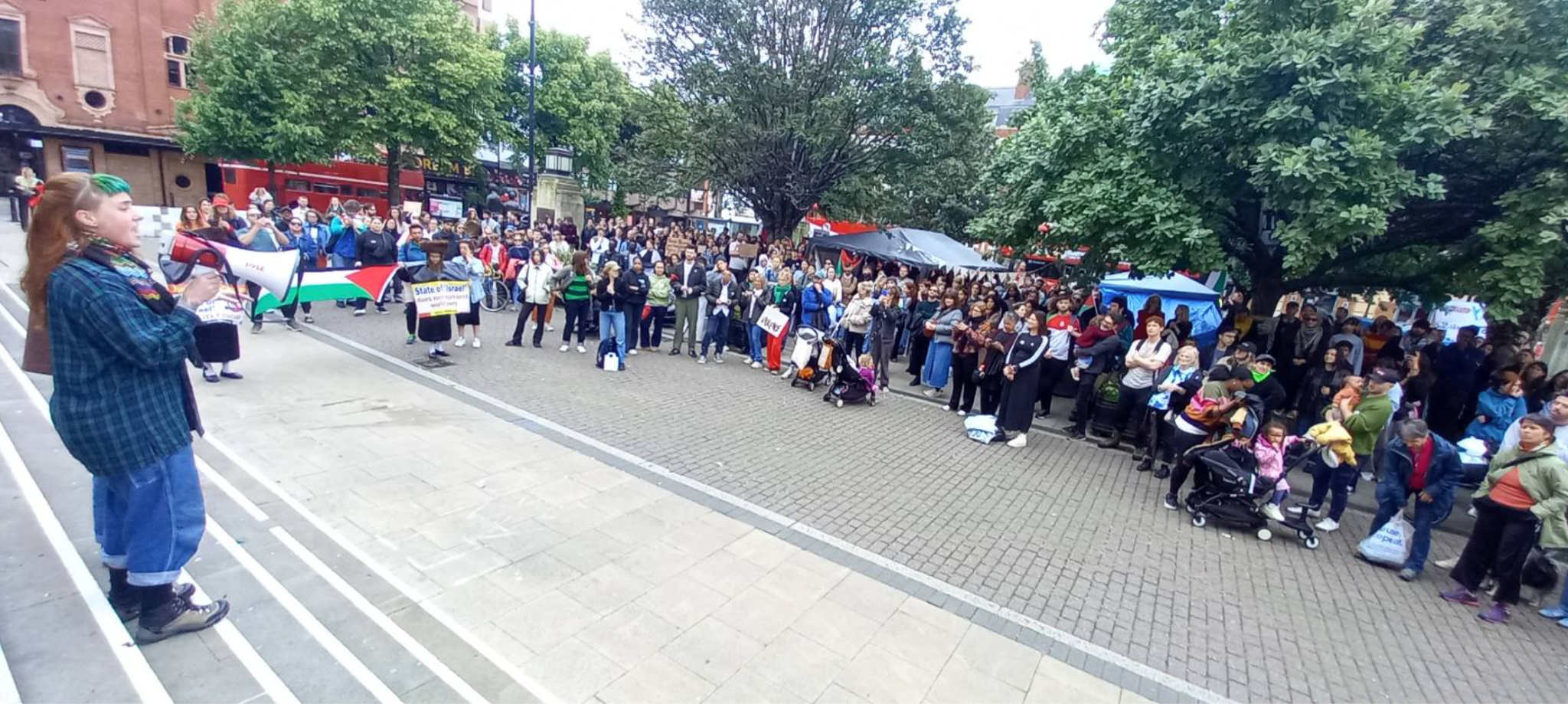
Charlotte Head speaking at a protest for Gaza in Hackney | Filton24 Defence Committee
On 4 February, after 36 hours of deliberating, the jury found us not guilty of aggravated burglary. It was unable to reach a verdict on the other charges of criminal damage and violent disorder. Two weeks later, we were released.
Around this time, the Crown Prosecution Service announced it would seek a retrial and Johnson advised that he would refer Menon for criminal proceedings, a fact that could only be reported on last week.
Johnson alleged Menon committed contempt of court by referencing a plaque commemorating the Penn and Mead case, which highlights “the right of juries to give their verdict according to their convictions”. This plaque isn’t hidden, it’s in the entryway of the Old Bailey, where our trial would have taken place had it not been for space and timetabling constraints. Our jurors would have had to pass it several times a day.
Menon was not threatened for being inaccurate; he was persecuted for jeopardising what has become a lynchpin case in the British state’s war against Palestine Action.
The crucial question is why. Why was a government minister – the home secretary, no less – allowed to publicly and repeatedly prejudice our right to a fair trial and get away scot-free, whilst a renowned human rights lawyer was punished for doing his job?
Did the government feel the Filton defendants were too close to winning, thereby undermining its proscription claim? Did it want to issue a warning, to create a chilling effect on legal professionals and defendants in subsequent trials? Or is our legal system simply a two-tier system, where those in power are above the law and the rest of us can be punished for simply being irksome?
During our retrial earlier this year, further restrictions were placed on the scope of evidence. The jury was told that in that courtroom, Justice Johnson was the law – and in a courtroom, the law is tantamount to God.
We were found guilty of criminal damage. We had never been charged with terrorism, yet Judge Johnson sentenced us as terrorists on 12 June. I am serving six years in prison and will face a further 15 years on notification once I am released, during which time I will have to regularly check in with the authorities, and will have to register any new device, bank account, telephone number, email address, vehicle, relationship and overseas travel plans with the police for the rest of my life.
The UK abolished the divine right of kings long ago; but it is alive and kicking in our legal system. The privileged few in the upper echelons are permitted to bend the law to breaking point to further the government’s political agenda. The same people are trying to rob the British public of the right to a jury of their peers by blaming jury trials for our backlogged court systems. It is not juries that are the problem; it is our courts that are beleaguered by pressure from those in Parliament, the intelligence services and the police.
The Home Office has interfered with our case again and again in a bid to shore up its proscription of Palestine Action by using us as political scapegoats. Yet, for his work in defending me, my barrister may be disbarred and potentially face prison time himself.
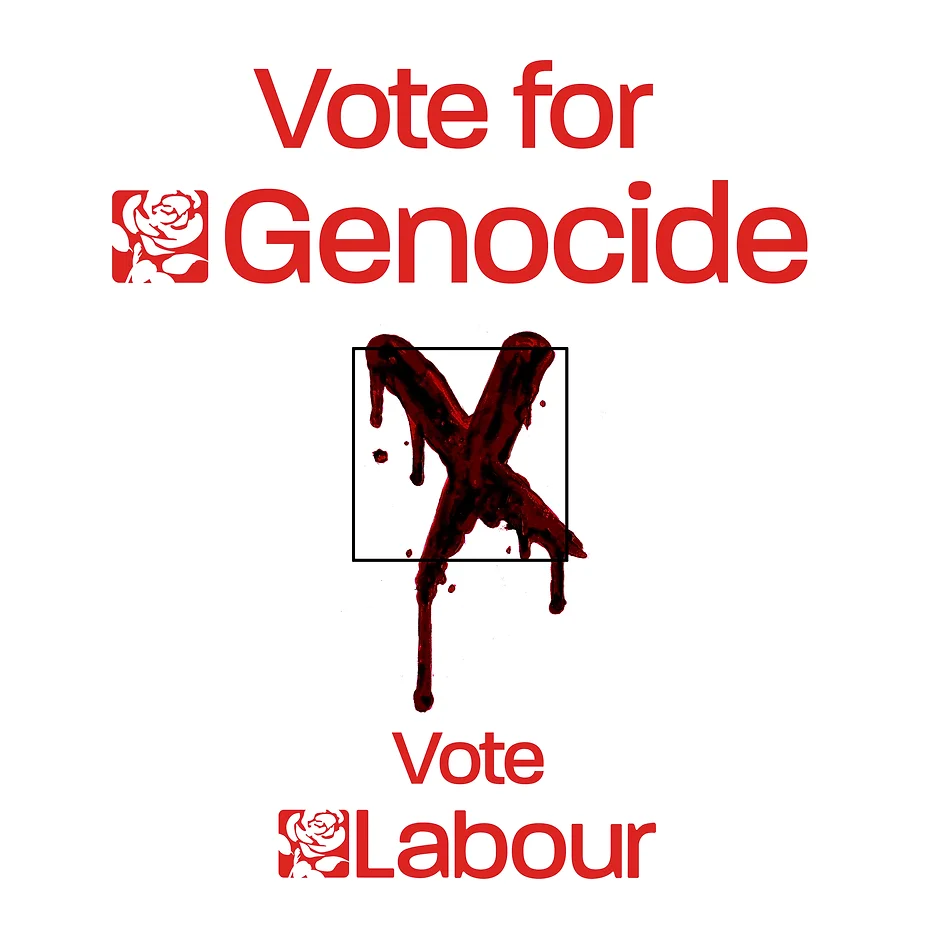
Keir Starmer objects to criticism of the IDF. He asks how could anyone object to them starving people to death, forced marches like the Nazis did, bombing Gaza’s hospitals and universities, mass-murdering journalists, healthworkers and starving people queuing for food, killing and raping prisoners and murdering children. He calls for people to stop obstructing his genocide for Israel. New Labour UK Prime Minister Andy Burnham continues Labour party policy of active support and complicity in Israel’s genocide.Vote Labour for Genocide.




 Palestine Action and Defend Our Juries protesters outside Westminster Magistrates’ Court, London, July 30, 2026