Waste firm Veolia pays £27k after ‘Yes It’s A Genocide’ banner taken by Greater London Authority was destroyed
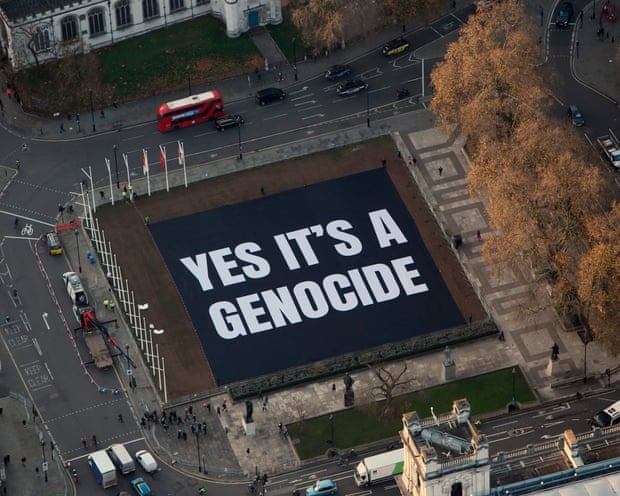
The banner was unflurled in Parliament Square in London in December 2024. Photograph: Haroon Siddique/Jiri Rezac/Led by Donkeys
The campaign group Led By Donkeys has received £27,000 in compensation after a giant banner it displayed in Parliament Square saying “Yes It’s A Genocide” was seized by Greater London Authority officials and destroyed.
Representatives of the GLA arrived on the scene in central London and confiscated the 40-metre by 40-metre banner after it was unfurled on 4 December 2024, just over a year after Israel began its assault on Gaza after the 7 October 2023 attacks by Hamas.
…
Ben Stewart, a co-founder of Led By Donkeys, said: “The Parliament Square banner was in collaboration with one of the world’s leading genocide scholars, but still the authorities threw process out the window and simply seized and destroyed our property. Pursuing compensation was never about the money, it was about defending space to protest Israel’s war crimes.
“Palestine protests are treated differently in Britain to all other forms of activism. Direct action is regarded as terrorism and words on a placard are rendered illegal. Over the years we’ve delivered banners, put up billboards and done guerilla projections across the country, but the only time our equipment has been seized and destroyed was when it related to Palestine.”
The banner was videoed from the air and a film created that was posted on social media featuring a voiceover from the renowned Israeli scholar Prof Amos Goldberg, a historian of the Holocaust, who said: “This is exactly what a genocide looks like.”
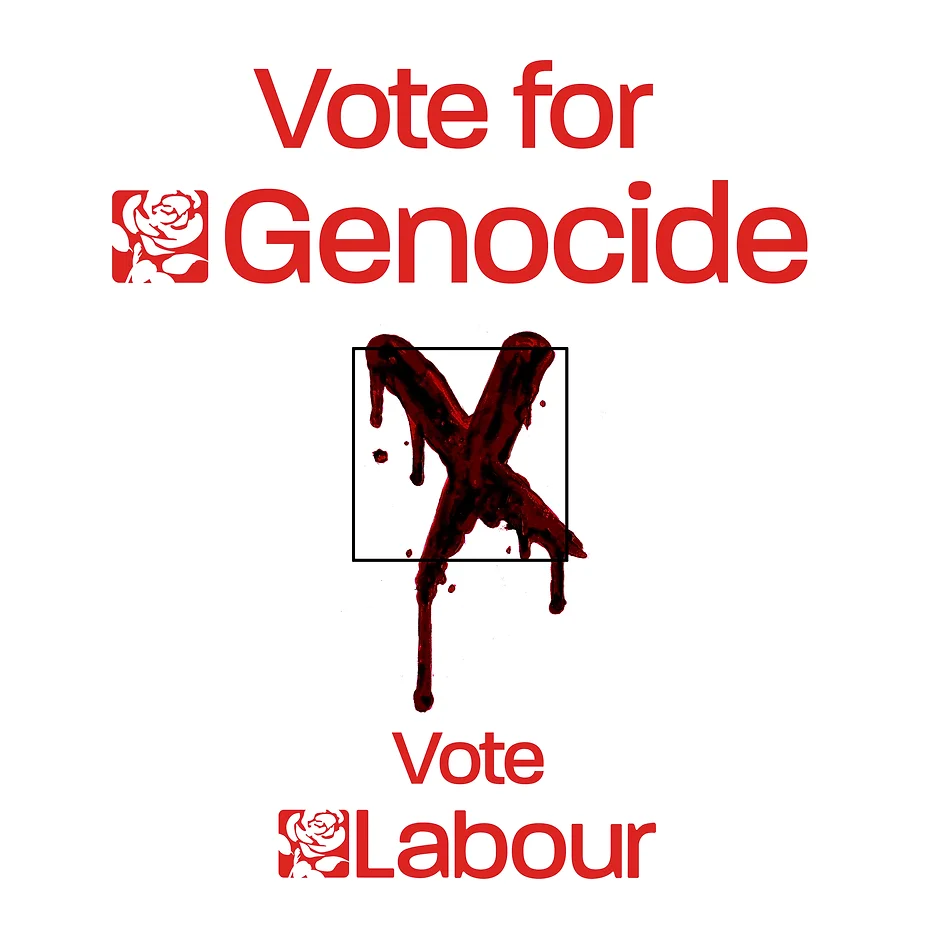
Vote Labour for Genocide.Keir Starmer objects to criticism of the IDF. He asks how could anyone object to them starving people to death, forced marches like the Nazis did, bombing Gaza’s hospitals and universities, mass-murdering journalists, healthworkers and starving people queuing for food, killing and raping prisoners and murdering children. He calls for people to stop obstructing his genocide for Israel.Donald Trump sings and dances, says that it’s fun to kill everyone … unless he gets distracted or falls asleep.
We’ve turned their street into Jabaliya camp in Gaza. A genocide is happening, but the Labour government is supplying weapons, intelligence and diplomatic cover to the perpetrator. Protesting this is not terrorism. pic.twitter.com/vQzFn3p7D0
Led by Donkeys remind Keir Starmer of his commitment to proportional representation.
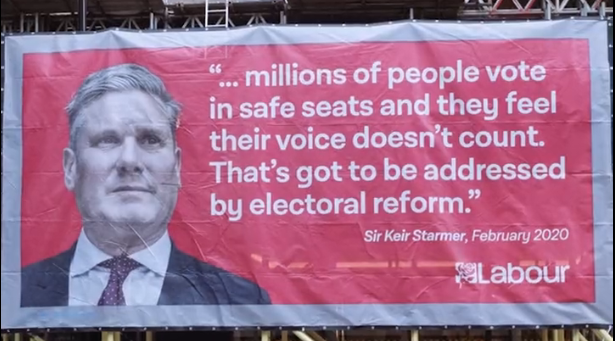
Campaigners have draped a giant banner outside the headquarters of the Labour Party to ‘remind Keir Starmer what he once said about proportional representation.’Led By Donkeys – a group which specialises in creative and high profile political stunts – organised the action.
The group installed a banner with a photo of Keir Starmer and a quote of comments he made during the Labour leadership election. The banner quoted Starmer as saying in February 2020: “…millions of people vote in safe seats and they feel their voice doesn’t count. That’s got to be addressed by electoral reform.”
Led by Donkeys shared a video of their banner drop on Twitter, and said: “We’ve scaled the scaffolding at Labour’s London HQ to remind Keir Starmer what he once said about proportional representation.”
Sir Keir Starmer has since distanced himself from his 2020 comments on electoral reform.
…
We’ve scaled the scaffolding at Labour’s London HQ to remind Keir Starmer what he once said about proportional representation. pic.twitter.com/oK9q0G5lzE
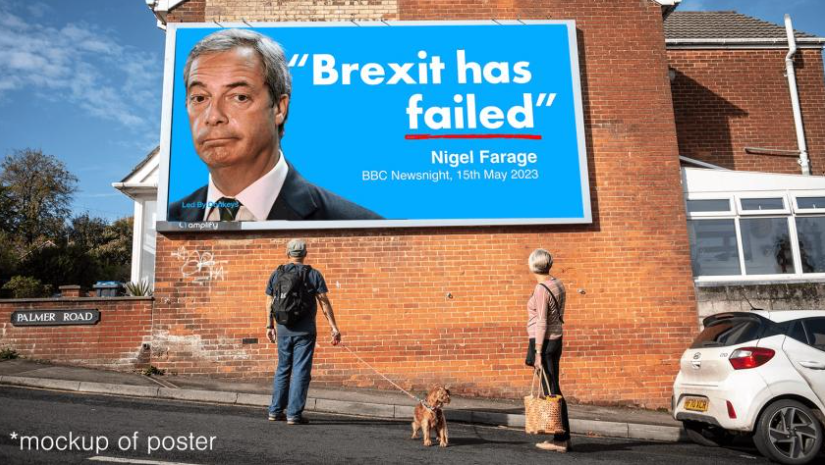
The fabulous folk atLed By Donkeys have pulled out another corker of a campaign… this time focused on Nigel Farage’s extraordinary admittance that Brexit has been a flop.
Appearing on BBC Newsnight this week, the former UKIP leader, who played a leading role in Britain’s exit from the EU, admitted that Brexit has failed. Presenter Victoria Derbyshire informed Farage of a recent poll that showed around one in five Leave voters regret their decision.
…
Led By Donkeys, which established in December 2018 as an anti-Brexit group, and have since been vocal critics of the actions of the Conservative government, are urging people to chip in to raise money to get ‘Brexit has failed’ Nigel Farage billboards erected across the UK. For every £10,000 raised, they can get 20 billboard sites installed.
Unsurprisingly, within just a few days, the campaign smashed its £75,000 target.
Yet public ownership is opposed passionately by the Conservative government, while the leader of the opposition has said he is “not in favour” of it – despite his election on a platform that committed to “bring rail, mail, water and energy into public ownership to end the great privatisation rip-off and save you money on your fares and bills”.
Public ownership is on the media’s radar, too. When Labour leader Keir Starmer announced his policy to freeze bills this week, he was asked why he wouldn’t also nationalise energy, replying that: “In a national emergency where people are struggling to pay their bills … the right choice is for every single penny to go to reducing those bills.”
But so long as energy remains privatised, every single penny won’t. Billions of pennies will keep going to shareholders instead.
The energy market was fractured under the mass privatisations of the Thatcher governments in the 1980s. It contains three sectors: producers or suppliers (those that produce energy), retailers (those that sell you energy), and distribution or transmission (the infrastructure that transports energy to your home).
It is important to bear this in mind when we’re talking about taking energy into public ownership. We need to be clear about what we want in public ownership and why.
By 2019, Labour had a detailed plan on how to do this – worked up by the teams around then shadow business and energy secretary Rebecca Long Bailey and then shadow chancellor John McDonnell. The plan is not the only way, but it illustrates what exists and how one could go about re-establishing a public energy ecosystem, run for people not profit.
The recent TUC report shows the cost of nationalising the ‘Big 5’ energy retailers – British Gas, E.ON, EDF, Scottish Power and Ovo – to be £2.8bn, which would go on buying all the companies’ shares. That’s a lot of money, equivalent to more than the annual budget of the Sure Start programme in 2009/10 (its peak year). But it’s a one-off cost, not an annual one.
And it’s not like the current privatised system doesn’t have its costs: since June 2021, the UK government has spent £2.7bn bailing out 28 energy companies that collapsed because they put short-term profits ahead of long-term stability – companies like Bulb Energy. We have spent billions of pounds already to get nothing in return. So £2.8bn is not a large amount of money to pay to gain these assets, rather than just bailing them out.
The big energy retail companies made £23bn in dividends between 2010 and 2020 according to Common Wealth, and £43bn if you include share buy-backs. What you choose to do with that surplus in public ownership is another matter: you could use it to invest in new clean energy or to lower bills or fund staff pay rises, rather than subject your workers to fire-and-rehire practices as British Gas did last year.
Labour’s previous plan also involved taking the distribution networks – the National Grid – into public ownership. This would end the profiteering at this level, too – with £13bn paid out in dividends over the five years prior to 2019. As Long Bailey said at the time, we need “public driven and coordinated action, without which we simply will not be able to tackle climate change”. Like previous nationalisations, the purchase of the grid and distribution networks could be achieved by swapping shares for government bonds. By international accounting standards, the cost is fiscally neutral as the state gains a revenue-generating asset, which more than pays for the bond yield.
The final part of the plan – and the most complicated – is production and supply. It would be impossible to nationalise the oilfields of Saudi Arabia or Qatar – and for good reasons we should want to leave fossil fuels in the ground, anyway, rather than contest their ownership.
And so what Labour proposed in 2019 was a mass investment in new renewable energy generation projects, with the public sector taking a stake and returning profits to the public. For example, under the ‘People’s Power Plan’, we proposed 37 new offshore wind farms with a 51% public stake, delivering 52GW alone by 2030, equivalent to 38 coal power stations. There were additional proposals for onshore wind, solar, and tidal schemes, as part of a 10-year £250bn Green Transformation Fund, which included other schemes like the Warm Homes insulation initiative.
Labour’s new shadow chancellor Rachel Reeves has promised a similar level of investment – a £28bn a year climate investment pledge.
Any surplus energy would then be sold on international markets, with a People’s Power Fund – a sort of sovereign wealth fund – to deliver public investment in local communities’ social infrastructure: a genuine levelling-up fund, perhaps.
Many people will say this can’t be done, but of course it has been before. The 1945 Attlee government nationalised energy and successive Conservative governments – including those of Churchill, MacMillan and Heath – were happy to have a nationalised asset. Harold MacMillan famously accused Margaret Thatcher of “selling off the family silver” when she privatised state industries.
When I was born in 1979, the National Coal Board, British Gas and British Petroleum were all publicly-owned or majority publicly-owned companies. Between them, they were the major suppliers of our energy. Our gas bills came from British Gas and our electricity bills from our regional electricity board (in my case Seeboard, the South Eastern Electricity Board), and coal and oil fuelled our power stations.
The regional electricity boards had been brought into being by the Attlee government’s Electricity Act 1947, when electricity companies were forcibly merged into regional area boards and nationalised. The Coal Industry Nationalisation Act 1946 and the Gas Act 1948 had together brought energy into public ownership.
Seeboard was privatised in 1990, and later became part of EDF Energy – ironically, the nationalised French energy company, whose profits from the UK’s stupidity are used to subsidise French consumers.
The French government has now fully nationalised EDF (previously it was 84% publicly owned), and household energy bills rose by just 4% this year – compared to over 50% in the UK and a forecast 200% by January 2023.
If Starmer doesn’t want to listen to me (or his own commitments from 2020), perhaps emulating the centrist Emmanuel Macron in this instance would be palatable?
From the depletion of fish stocks to the burning of the Amazon, profit has proved a failed regulator for use of our natural resources
In his later years, Robin Cook argued: “The market is incapable of respecting a common resource such as the environment, which provides no price signal to express the cost of its erosion nor to warn of the long-term dangers of its destruction.”
From the depletion of fish stocks to the burning of the Amazon, profit has proved a failed regulator for use of our natural resources. The market has also failed to decarbonise at pace, or to end the scourge of fuel poverty.
On the media this week, shadow energy secretary Ed Miliband said Labour is “continuing to look at what the right long-term solution is for our energy system”. It is up to all of us to campaign for that solution to be public ownership – whether that’s from within the Labour Party (like me) or from the outside.