Category: Reform 2025 Ltd (Reform UK)

  • AI Was Supposed to Cut Emissions. Instead, Fossil Fuel Companies Are Using It to Find More Oil and Gas.

    Spread the love

    Article by Sarah Hofmann republished from DeSmog.
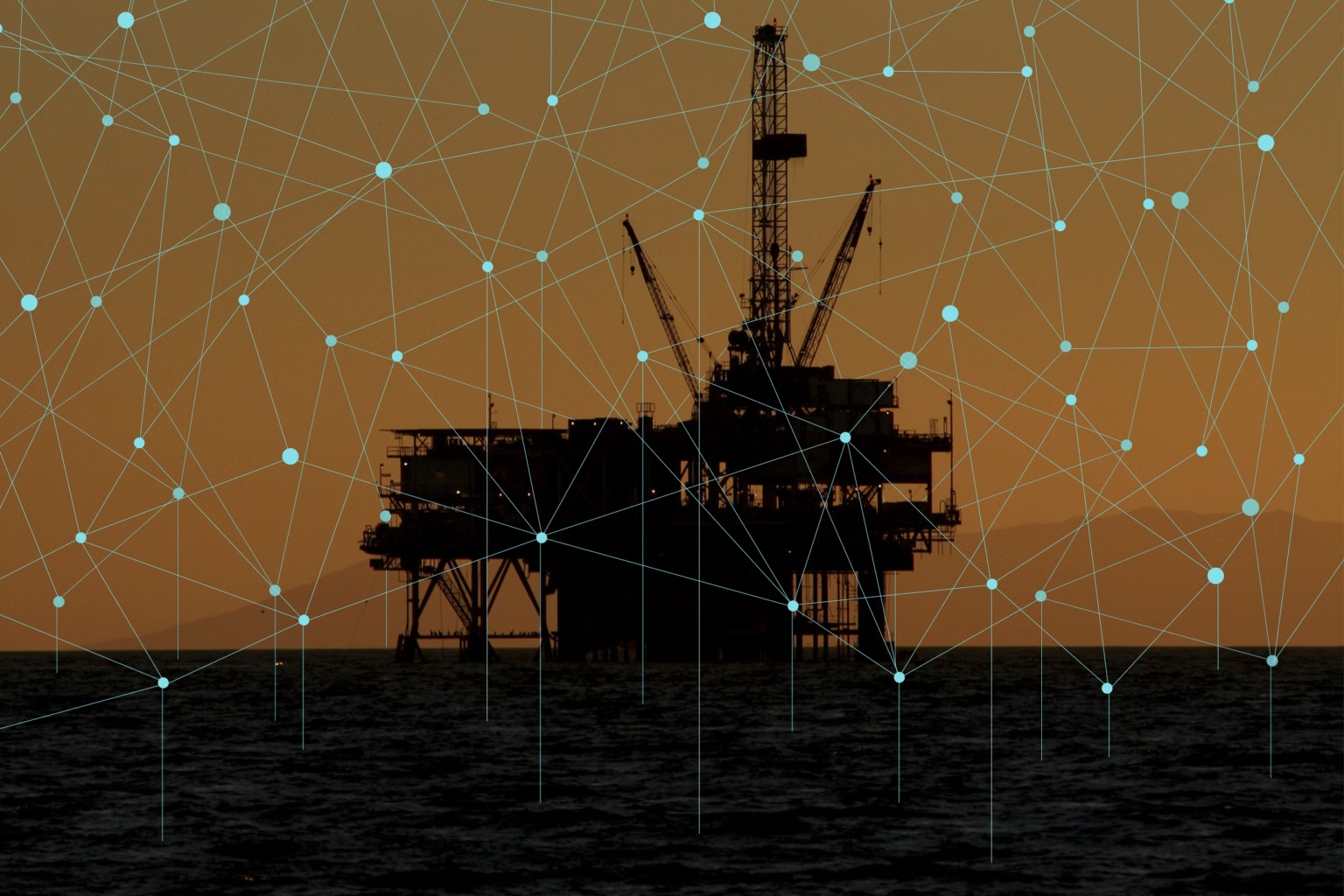
    Credit: Sarah Hofmann/arbyreed via Flickr (CC-BY-NC-2.0)

    A new study found AI-driven fossil fuel productivity could increase emissions. Here are examples of companies already using AI to boost production.

    When United Nations Secretary-General António Guterres warned world leaders last week in his UN address about the unchecked power of both Big Oil and artificial intelligence, he treated them as two of the defining challenges facing governments.

    The fossil fuel industry is turning to AI to map seabeds, identify new oil reservoirs, assess oil wells’ “abandonment risks”, inspect facilities, and streamline regulatory processes, potentially adding to the emissions of an industry that Guterres said governments must move away from. 

    At the same time, the technology companies providing these AI tools are not generally held accountable for the additional fossil fuel production and emissions their products may enable.

    “The danger is not technology,” Guterres told the UN General Assembly. “The danger is technology without accountability.”

    A DeSmog review of company announcements, industry presentations, and other publicly available information found that, across major fossil fuel companies — Aramco, Chevron, Equinor, ExxonMobil, Shell, TotalEnergies and others — AI is increasingly being integrated into fossil fuel operations, from seismic exploration and drilling to equipment monitoring and field development.

    The examples provide a real-world look at the mechanism behind a recent study published in Nature: that AI can increase emissions not only because of the electricity required to run data centers, but because it can make fossil fuel production more productive and profitable.

    The study found that AI-driven productivity gains in fossil fuel production accounted for most of the modeled increase in global energy-related carbon dioxide emissions. It estimated that AI could increase global energy-related carbon dioxide emissions by between 1.2 and 4.8 percent, with productivity gains in fossil fuel production accounting for most of that increase. 

    In one example of AI gains, Norwegian energy company Equinor re-scanned the Norwegian continental shelf with “new seismic technology and AI,” resulting in 27 new discoveries of oil, Hege Skryseth, the company’s executive vice president, chief technology officer, said during a June presentation for Equinor’s Capital Market Day.

    “By reprocessing the data, the seismic image became much sharper, leading to the discoveries,” Skryseth said. “AI was key here, from automated data interpretation to efficient well planning.”

    AI saved Equinor $130 million last year, according to a January 2026 press release.

    Chevron is also using AI to produce oil that was “previously considered unreachable.” 

    In the oil company’s recently launched podcast — in which racing driver Tanner Foust and Chevron Chief Technology and Engineering Officer Ryder Booth chat from a pickup truck tailgate — Booth said that breakthroughs at Anchor, an oil and gas development, represented the “first time unlocking kind of a new horizon around the world.”

    “AI, it’s attracted to big data and big opportunities, and the oil and gas industry has big data,” Booth said. Last year, Chevron said it had improved drilling and fracking efficiency in the Permian Basin by over 30 percent.

    The value of these productivity gains is significant. A recent McKinsey & Co. report estimated that, for the upstream oil and gas sector, AI can generate $65 billion in profits annually in the short term, which could increase to $230 billion when the technology is deployed at its “full potential.”

    AI-driven efficiency gains have already reduced operational costs by up to 18 percent; and industry executives attribute about 5 percent of their current revenue to “AI-driven initiatives,” according to a 2025 report from IBM, which has multiple partnerships with oil and gas companies.

    ‘Done in seconds and live-streamed’

    At Equinor’s enormous Johan Sverdrup oil field in the North Sea, “data flows up from the ground faster than the oil,” the company’s site states, at the rate of “10,000 Netflix movies a second.”

    The company is also using AI to optimize the placement of subsea equipment and wells.

    “What used to take 2-3 weeks and involved flying hard disks to shore with helicopter for analysis can now be done in seconds and live-streamed,” Equinor said.

    ExxonMobil is also embracing enormous datasets. In 2019, ExxonMobil partnered with Microsoft to use AI in its Permian Basin operations, a move Exxon said would “generate billions of dollars in value” and produce up to an additional “50,000 oil-equivalent barrels a day by 2025.”

    The oil giant also said that gains in efficiency from advanced technologies, including AI, “is a first step” towards letting systems respond to events without human intervention.

    Holly Alpine, a coauthor of the Nature study, said the significance of such partnerships is easy to miss when attention focuses on the emissions produced by powering AI systems.

    “For some reason, tech companies are exempt from accountability for the tech they are creating,” she told DeSmog.

    Alpine and her husband, Will Alpine, another author of the Nature study, previously worked for Microsoft, but left after coming to the conclusion that the company hid how its products were harming the climate. The couple then founded the Enabled Emissions Campaign, a nonprofit that calls attention to tech’s role in fossil fuel production and advocates for better regulations.

    She said that now, oil companies like Exxon pumping 50,000 barrels a day is “actually quite a small deal.” 

    “The deals have only grown in size, and we realized that that was not part of Microsoft’s accountability whatsoever, even though they are the company creating the technology that is making this happen.”

    A recent Reuters article about Exxon’s use of automated drilling in the Permian Basin, which said the company plans to increase production in the region to 2.5 million barrels a day, didn’t mention if Microsoft was still involved with the project; on Exxon’s website, references to Microsoft partnerships still link to the announcement from 2019.

    Microsoft did not confirm whether it’s still partnering with Exxon on those operations, but the tech company is the leading cloud provider for the oil and gas industry, according to Kimberlite Research, followed by Amazon and Google. 

    Data Centers Are Intertwined with AI

    Just two years ago, fossil fuels’ share of the world’s energy supply was projected to decline in coming years. Then, AI data centers began expanding rapidly, and with them, the argument that fossil fuels must scale up, too, for the U.S. to win the “AI arms race.”

    At the same time, the fossil fuel and technology industries are becoming increasingly intertwined. AI data centers require enormous amounts of electricity, and natural gas supplies more than 40 percent of the power used by U.S. data centers, according to the International Energy Agency (IEA).

    “AI’s advance will depend not only on the design labs of Silicon Valley, but also on the gas fields of the Permian Basin,” Mike Wirth, Chevron’s chairman and CEO, said in 2024.

    In the face of power grid constraints, some data centers are turning to natural-gas power plants built onsite, a setup known as “behind-the-meter” generation, like Chevron’s Kilby project with Microsoft. U.S. data centers’ investments in new gas turbines recently surpassed the total investments of every country except the U.S., according to an IEA report. 

    Meanwhile, the oil and gas companies are benefiting both from using AI to increase efficiency, and from supplying the additional energy that its data centers demand.

    AI and Net Zero Aims

    Online, Microsoft promotes AI tools as a way to “accelerate the energy transition,” “reduce emissions,” and “accelerate climate innovation.”

    Instead, AI may be having the opposite effect, prolonging our reliance on fossil fuels and delaying a broader transition to cleaner energy.

    “In the absence of continuous reinvestment, oil and gas production would fall by approximately 8 percent annually,” the Nature paper says, quoting IEA reports, and “technological progress has repeatedly delayed ‘peak oil’ forecasts by unlocking resources previously considered un-viable.”

    Equinor’s website recognizes the growing scarcity of oil reserves, noting that undersea oil and gas discoveries have dramatically declined in recent decades. “Even with planned projects, the (production) trend is downward,” it states. “Gently at first, but more noticeably if we don’t act fast to create new resource opportunities. This will affect value creation across Norway.”

    Chevron’s Booth, meanwhile, says there’s still enough oil, “and technology and innovation will unlock that,” though he also admitted we would need all forms of energy to meet the world’s demand.

    In spite of concerns about future scarcity, wartime windfalls and beneficial policies have recently brought record profits for major oil and gas companies, news reports show.

    After the August Nature article showing that AI helps the fossil fuel industry create more pollution, Johanna Fornberg, a Greenpeace senior research specialist, said in a statement that, while Big Tech continues to promise that AI technologies will benefit humanity and offer climate solutions, “what is hidden from that story is the aggressive support tech companies provide to fossil fuel companies to continue producing oil and gas that harms communities and the climate.”

    Microsoft says it plans to “become carbon negative by 2030,” though the company’s emissions increased by 25 percent last year, driven in part by expanding data centers, according to its 2026 Environmental Sustainability Report.

    Microsoft’s 2025 Responsible AI Transparency Report also said that its enterprise contracts “incorporate our AI Services Code of Conduct, which requires our customers to implement responsible practices (such as human oversight and access controls) and prohibits using our AI services in ways that inflict harm on individuals, organizations, or society, or affects individuals in any way that is otherwise prohibited by law.”

    Alpine said very little action is being taken to regulate the use of AI’s climate impacts. Microsoft announced in 2022 that it would only work in certain capacities with companies with net zero targets, she said, but “they don’t follow any standards for net zero.”

    That principle, which is listed on Microsoft’s website, says the company may provide “technical or engineering resources to develop or co-develop specialized subsurface exploration and extraction services” or provide products at no cost to energy customers with goals to reach net zero Scope 1 and 2 carbon emissions by 2050.

    Exxon and Chevron have both walked back their plans to reach net zero by 2050, saying that necessary advancements in technology and policy that are beyond their control haven’t materialized. Exxon now says it’s on track to achieve net zero across its Permian Basin operations by 2035, while Chevron “continues to have the aspiration” to achieve net zero, but without a timeline.

    Microsoft did not respond to a question about whether the changes to Exxon’s and Chevron’s net zero goals has affected the companies’ agreements. Chevron, Equinor, and Exxon also did not respond to requests for comment.

    Equinor says it intends to become net zero by 2050 “as part of its commitment to do zero harm to people, the environment, and material assets.”

    Article by Sarah Hofmann republished from DeSmog.

    UK Prime Minister Andy Burnham says ignore facts and reality and be a climate science denier like him. He says that he's delayed the go-ahead for Jackdaw and Rosebank North Sea oil and gas extraction until after the Holborn and St. Pancras by-election - don't want democracy interfering with Capitalism.
    UK Prime Minister Andy Burnham says ignore facts and reality and be a climate science denier like him. He says that he’s delayed the go-ahead for Jackdaw and Rosebank North Sea oil and gas extraction until after the Holborn and St. Pancras by-election – don’t want democracy interfering with Capitalism.
    Donald Trump urges you to ignore facts and reality and be a Climate Science denier like him. He says that he makes millions and millions for destroying the planet, Burn, Baby, Burn and Flood, Baby, Flood.
    Donald Trump urges you to ignore facts and reality and be a Climate Science denier like him. He says that he makes millions and millions for destroying the planet, Burn, Baby, Burn and Flood, Baby, Flood.
    Nigel Farage urges you to ignore facts and reality and be a climate science denier like him and his Deputy Richard Tice. He says that Reform UK has received £Millions and £Millions from the fossil fuel industry to promote climate denial and destroy the planet.
    Nigel Farage urges you to ignore facts and reality and be a climate science denier like him and his Deputy Richard Tice. He says that Reform UK has received £Millions and £Millions from the fossil fuel industry to promote climate denial and destroy the planet.
  • UK shares findings of damning climate crisis national security report suppressed under Starmer

    Spread the love

    https://www.theguardian.com/environment/2026/sep/23/uk-climate-crisis-national-security-report-suppressed-starmer-ed-miliband

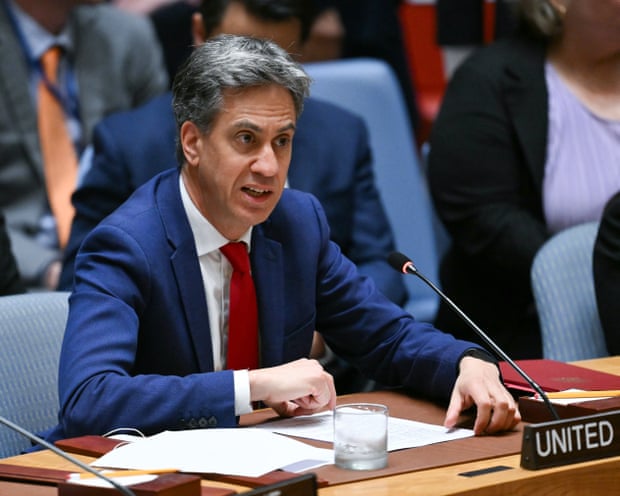
    Miliband at the UN security council on Wednesday. The UK’s foreign secretary later briefed fellow foreign ministers about the UK climate report. Photograph: Angela Weiss/AFP/Getty Images

    El Niño poses critical threat to nations’ defences, says Ed Miliband in presentation to global foreign ministers

    The UK has warned countries around the world that the climate and nature crises and the coming El Niño threaten their national security and defence, presenting foreign ministries with the findings of an explosive report suppressed under Keir Starmer.

    Ed Miliband, the UK’s foreign secretary, made a presentation to the foreign ministers of the EU as well as Kenya and other countries on Wednesday night at a private meeting during the UN general assembly in New York, based on the report by the UK’s spy chiefs that found the collapse of natural systems around the world would lead to conflict, migration and food shortages.

    Miliband told the meeting, the first such discussion among foreign ministers, that the coming El Niño, which has been supercharged by climate breakdown, would test the world’s food systems as never before.

    “We face an El Niño that is already set to be the most intense in living memory,” he said. “This will intensify climate shocks that compound and cascade across borders, threatening food and water security, displacing communities, putting pressure on markets and scarring economies.”

    …

    With the backing of Andy Burnham, the UK prime minister, Miliband presented the research that found the collapse of global ecosystems such as in the Amazon and Congo rainforests, driven by the climate crisis and the destruction of nature, would have impacts on national security around the world.

    The joint intelligence committee (JIC) report, revealed by the Guardian, was scheduled to be published last October, but was suppressed on the eve of its launch by Downing Street. A redacted version was issued in January under the Freedom of Information Act, but ministers have continued to resist calls for the full report to be made public.

    …

    https://www.theguardian.com/environment/2026/sep/23/uk-climate-crisis-national-security-report-suppressed-starmer-ed-miliband

    Donald Trump urges you to ignore facts and reality and be a Climate Science denier like him. He says that he makes millions and millions for destroying the planet, Burn, Baby, Burn and Flood, Baby, Flood.
    Donald Trump urges you to ignore facts and reality and be a Climate Science denier like him. He says that he makes millions and millions for destroying the planet, Burn, Baby, Burn and Flood, Baby, Flood.
    Nigel Farage urges you to ignore facts and reality and be a climate science denier like him and his Deputy Richard Tice. He says that Reform UK has received £Millions and £Millions from the fossil fuel industry to promote climate denial and destroy the planet.
    Nigel Farage urges you to ignore facts and reality and be a climate science denier like him and his Deputy Richard Tice. He says that Reform UK has received £Millions and £Millions from the fossil fuel industry to promote climate denial and destroy the planet.
    Elon Musk urges you to be a Fascist like him, says that you can ignore facts and reality then.
    Elon Musk urges you to be a Fascist like him, says that you can ignore facts
    and reality then.
  • Greta Thunberg Is Taking Sweden to Court Over Climate Crisis Again

    Spread the love

    https://novaramedia.com/2026/09/22/greta-thunberg-is-taking-sweden-to-court-over-climate-crisis-again/

    Greta Thunberg was detained by police in The Hague along with other climate protesters. Photograph: Peter Dejong/AP
    Greta Thunberg. Photograph: Peter Dejong/AP

    Her youth-led group has raised more than £180k to fund the lawsuit.

    Greta Thunberg and Swedish youth climate organisation Aurora are suing the Swedish government over its failures to tackle the climate crisis.

    While Sweden has reduced its greenhouse gas emissions at a rate faster than the EU average, the country is not on track to meet its own target of net zero by 2045.  

    Thunberg said on Monday that Aurora has filed a second lawsuit, arguing that Sweden is failing in its legal duty to protect its citizens – especially children and the young – from the effects of climate change.

    The group is demanding that Sweden take action to limit global warming to 1.5C by cutting emissions and protecting ecosystems like forests. A third demand involves accounting for emissions that it says are currently excluded from government calculations such as burning imported biomass.

    “Sweden, as a rich country with high historical and current emissions, has a legal duty to lead the climate transition,” the group wrote in its fundraiser. “A safe and just world is still possible, but only if rich, high-emitting states like Sweden stop violating their duty to protect people from the devastation of the climate crisis, and start transforming their societies before 2030.” 

    …

    Atrticle continues at https://novaramedia.com/2026/09/22/greta-thunberg-is-taking-sweden-to-court-over-climate-crisis-again/

    Orcas discuss Donald Trump and the killer apes' concept of democracy. Front Orca warns that Trump is crashing his country's economy and that everything he does he does for the fantastically wealthy.
    Orcas discuss Donald Trump and the killer apes’ concept of democracy. Front Orca warns that Trump is crashing his country’s economy and that everything he does he does for the fantastically wealthy.
    Donald Trump urges you to ignore facts and reality and be a Climate Science denier like him. He says that he makes millions and millions for destroying the planet, Burn, Baby, Burn and Flood, Baby, Flood.
    Donald Trump urges you to ignore facts and reality and be a Climate Science denier like him. He says that he makes millions and millions for destroying the planet, Burn, Baby, Burn and Flood, Baby, Flood.
    Nigel Farage urges you to ignore facts and reality and be a climate science denier like him and his Deputy Richard Tice. He says that Reform UK has received £Millions and £Millions from the fossil fuel industry to promote climate denial and destroy the planet.
    Nigel Farage urges you to ignore facts and reality and be a climate science denier like him and his Deputy Richard Tice. He says that Reform UK has received £Millions and £Millions from the fossil fuel industry to promote climate denial and destroy the planet.
  • Ben Delo: how Reform’s record donor created a ‘magnet for money laundering’

    Spread the love

    Article by Nathaniel Peutherer , Lawrence Marzouk republished from TBIJ under a Creative Commons Attribution-NonCommercial-NoDerivs 3.0 Unported License.

    Britain’s record donor made his fortune from a crypto exchange that asked few questions of its customers

    In brief

    • Man who recently pledged £36m to Reform was convicted of failing to maintain proper money-laundering controls, before being pardoned by Trump
    • The platform demanded little more than an email from customers for long periods and as a result became a lure for dirty money, the US government argued
    • Delo pleaded guilty to one offence and other allegations, including fraud, were not tested at trial

    When Ben Delo handed Reform UK £36m last week to become the biggest donor in British political history, a flurry of articles quickly followed seeking to explain exactly who this so-called “crypto billionaire” was.

    Most told some version of the same story: Delo is an Oxford graduate who co-founded the cryptocurrency exchange BitMEX, became Britain’s youngest self-made billionaire at 34, gave millions to philanthropy and, along the way, fell foul of an obscure US financial law.

    By and large, the articles did not dwell on that last part. Delo himself has described his offence under the Bank Secrecy Act as a “spurious blip”.

    But US court records we have examined, building on reporting by Democracy for Sale, raise far more troubling questions about the business that made Delo his fortune. The prosecution’s wider case extended far beyond the single offence Delo admitted. Those allegations were disputed by Delo and BitMEX and were never tested at trial.

    Documents filed by US prosecutors said Delo’s decisions turned BitMEX into a “magnet for money laundering and criminal activity”. They said the company processed trillions of dollars of transactions for its customers. For much of this time, they were required to provide nothing more than an email address. “No real name or other advanced verification is required,” trumpeted the website.

    A document filed by US prosecutors ahead of Delo’s sentencing

    The FBI said BitMEX, in which Delo owned almost a third of the shares during the period covered by the case, deliberately kept these requirements loose in order to drive up revenue. Delo personally intervened to help customers dodge restrictions on US trading, prosecutors claimed.

    BitMEX generated more than $1.3bn in revenue during the five years covered by its criminal case, with prosecutors describing Delo as a “critical organiser and leader” of the “criminal decision” not to install the required safeguards.

    In 2020, the US Department of Justice charged Delo and three other BitMEX executives with violating the Bank Secrecy Act by failing to maintain proper anti-money-laundering controls. Meanwhile, the US derivatives regulator, CFTC, brought a civil action against the founders and five companies behind BitMEX.

    https://frontend.poool.fr/engage/56TXL-DGRM7-IPY34-9YVAW/67b3726b9f79a3dc6ea9504c?theme=JTIybGlnaHQlMjI%253D&computedTheme=JTIybGlnaHQlMjI%253D

    In response to the DoJ’s charges, Delo pleaded guilty to one offence as part of a pre-trial plea agreement in which the US government agreed not to prosecute him over other alleged offences it had investigated. At the sentencing, prosecutors set out this wider case against Delo, much of which was refuted by his lawyers who argued that his role was not compliance-related, but neither case was tested at trial.

    Delo’s lawyers told us: “There is no truth in the serious allegation that our client was guilty of the types of improper, unlawful or criminal conduct that the DoJ crowed about but did not even try to prove.

    “The prosecutors’ unproven references to money laundering, sanctions evasion and fraud were irrelevant to the charges brought against Mr Delo and were put forward purely for prejudice and no attempt was even made to evidence or otherwise substantiate them in court.”

    Reform UK and BitMEX did not respond to our requests for comment. Nor did co-founder Arthur Hayes, whose own defence relied on similar arguments to Delo’s.

    Delo, the “D” in BitMEX parent company HDR Global Trading, co-founded the company in Hong Kong in 2014 and, as chief operating officer, built and oversaw the exchange’s trading software. US regulators later said all three founders worked together on critical decisions.

    After receiving a pardon from Donald Trump in 2025, Delo said “a legal wrong has been righted”, claiming he and his co-founders had been “sacrificed for political reasons”, referring to the Biden administration.

    While Delo’s “crypto billionaire” label comes from the value of his stake in BitMEX during its height, the size of his wealth today is much less clear.

    The current rules governing political donations are clearly not fit for purpose

    Tim Picton, Spotlight on Corruption

    But certainly the company described by prosecutors as a “platform for money-laundering” made Reform’s largest donor extremely rich. Prosecutors said he and his two co-founders each withdrew between $100m and $150m in dividends between 2014 and 2020.

    Tim Picton, senior advocacy adviser at Spotlight on Corruption, told us: “Political parties should be required to check a donor’s source of funds before accepting any large sum of money.

    “In the age of mega donors who have derived their wealth from loosely regulated sectors such as crypto, this is urgently needed alongside a cap on donations.”

    Before BitMEX even launched, its founders were discussing how much they really needed to know about its customers. The answer, initially at least, was as little as possible.

    “Basically just valid email address until we feel significant pressure to do otherwise,” said co-founder Arthur Hayes in an internal message to Delo in November 2014. And for years, that was all users needed – with BitMEX’s own website advertising this fact to prospective customers.

    Prosecutors argued that without knowing who was behind an account, BitMEX was ill-equipped to check whether the bitcoin flowing through it belonged to an ordinary trader, a hacker, a darkweb marketplace or someone in a sanctioned country. Nor could it report suspicious customers to the authorities.

    The upshot, prosecutors said, was that BitMEX became “in effect, a money laundering platform”.

    Regulators in the US demand tighter customer ID controls than this – so BitMEX banned US customers. But it also launched what it described as a “hidden service” on Tor, a web system that obscures the user’s location.

    A document filed by US prosecutors ahead of Delo’s sentencing

    Delo admitted that BitMEX recorded logins from users known to be in the US and “did not immediately act to restrict [their] trading”.

    In October 2018, Delo said BitMEX had frozen roughly 2,000 accounts associated with restricted jurisdictions, but not those in the US. When one valuable customer was caught logging in from a US territory, Delo instructed a colleague to “tell them to log in from Canada like they normally do”.

    Delo’s lawyers said such examples gave a misleading picture of his wider conduct, producing evidence of hundreds of occasions on which he personally restricted US-linked users. Judge John Koeltl acknowledged that Delo had been “actively involved” in enforcing controls on US customers. He said BitMEX had introduced procedures over time to exclude US customers and “did screen out a considerable amount of business from United States customers”. But he said that “given the admittedly wilful nature of the violation, the crime remains a serious one”.

    They said the exchange used distinctive bitcoin addresses, making funds easier to trace, and said BitMEX had an “excellent track record” of cooperating with US law enforcement.

    Comprehensive identity checks for all customers were not introduced until 2020, by which point the “significant pressure” Hayes had anticipated had arrived. Prosecutors argued BitMEX had started strengthening controls only after US regulatory scrutiny in 2018; BitMEX disputed this, saying it decided to do so independently in 2019.

    The US Attorney’s Office later described BitMEX’s restrictions on US customers as “toothless or easily overridden” in pursuit of its ultimate goal: US money.

    At BitMEX’s corporate sentencing in January 2025, Judge Koeltl found that US users accounted for about $2bn in deposits and $155m of the exchange’s revenue.

    For years, BitMEX knew remarkably little about many of its customers. It turned out that some of them had good reasons to want it that way.

    FinCEN, the US Treasury’s financial crime regulator, identified at least $209m in BitMEX transactions, including from unregistered money services and so-called darknet markets, where drugs and counterfeit goods are bought and sold. BitMEX settled this case without admitting or denying the findings.

    Among the criminal customers linked to the BitMEX, prosecutors cited Elliot Gunton, a hacker from Norwich who had been convicted as a teenager for accessing the personal information of thousands of people as part of the notorious 2015 TalkTalk cyberattack. Prosecutors said Gunton had an account linked to BitMEX.

    There is no suggestion BitMEX was involved in Gunton’s hacking or that Delo knew who he was.

    FinCen found that in October 2018, the company identified more than 40,000 accounts registered in the US; US territories; or US- or UN-sanctioned countries such as Cuba, Iran, Syria, North Korea or Sudan; as well as people logging in from Quebec. Delo’s lawyers told us that because he was not a US citizen and the companies were not US companies they were not “bound by US sanctions law when acting outside the US”.

    Delo also had dealings with Sam Bankman-Fried, years before the entrepreneur was convicted of fraud.

    Court papers describe how in December 2018, BitMEX blocked an account belonging to Bankman-Fried’s trading firm Alameda Research over US activity. By then, prosecutors said, it had traded from the US for more than six months without providing onboarding documents and deposited more than $100m into its BitMEX account.

    Sam Bankman-Fried was helped by a BitMEX employee to overcome his company’s log-in banMichael M Santiago / Getty

    When Bankman-Fried contacted Delo, he was put in touch with an employee who recorded that Alameda was “very appreciative we took care of their US log-in ban this week so quickly”. The employee then encouraged Bankman-Fried to move the account to a non-US entity, settling on the British Virgin Islands, despite prosecutors saying there was “no indication” Alameda stopped logging in from the US.

    BitMEX maintained that Alameda supplied BVI incorporation documents and later provided evidence that its authorised traders lived outside the US. At sentencing, the Judge accepted a government calculation that counted Alameda’s deposits as coming from US customers, rejecting BitMEX’s broader challenge to the way US customers had been identified.

    Prosecutors said the episode showed BitMEX knew US crypto traders could easily circumvent its restrictions.

    When BitMEX itself pleaded guilty to the same breach of the Bank Secrecy Act in 2024, US attorney Damian Williams said the absence of meaningful anti-money laundering controls had opened the exchange up as a “vehicle for large-scale money laundering and sanctions evasion schemes”.

    BitMEX’s issues with regulation were not confined to its dealings with its customers. As a crypto company, it had a banking problem.

    So in 2015, the prosecution alleged, it acquired a Hong Kong company called Shine Effort before quickly transferring it to Delo for $1. Although Delo owned the company on paper, they said, he was holding it on behalf of the true owner, BitMEX.

    Assisted by Hayes, Delo opened an HSBC account in Shine Effort’s name. Prosecutors alleged that he and Hayes presented Shine as an independent IT company.

    Documents filed by the US attorney against BitMEX

    Sentencing papers filed by prosecutors even allege that he, Hayes and another executive doctored internal BitMEX documents to present to the bank. More than $100m subsequently passed through the account.

    The US Attorney’s Office later described the arrangement in starker terms. It said BitMEX, as part of its “willful evasion” of US anti-money-laundering laws, had lied to a bank so it could “pump millions of dollars through the US financial system”.

    BitMEX, through its lawyers, told the court that it denied these allegations and the claims were never tested at trial. Under Delo’s plea agreement, prosecutors agreed not to bring bank- and wire-fraud charges relating to alleged misrepresentations to HSBC. Judge Koeltl said he would not consider the Hong Kong bank conduct at BitMEX’s sentencing as he believed it “too tangential” to the case; he did not rule on whether it happened.

    In February 2022, Delo pleaded guilty to violating the Bank Secrecy Act by wilfully failing to establish the required anti-money-laundering programme at BitMEX.

    Delo admitted knowing Americans were trading on BitMEX, knowing this required the exchange to identify its customers and knowing its existing controls were inadequate. When asked by the judge whether he knew at the time that what he was doing was “wrong and illegal”, Delo replied: “Yes, your honour.”

    He admitted that he had not acted “quickly enough or effectively enough” to stop US customers illegally using the exchange.

    “It was a terrible decision, the consequences of which I have to carry the rest of my life,” he told the court.

    His lawyers, however, argued that his principal role at BitMEX was technical and that he was not involved in setting compliance policies. They said he had taken “numerous steps” to deal with problematic customers, including personally restricting hundreds of accounts.

    Judge Koeltl accepted that others had “more responsibility over the company’s marketing and compliance functions than Mr Delo”, BitMEX had introduced controls over time and “did screen out a considerable amount of business from United States customers”. But, he added, “given the admittedly willful nature of the violation, the crime remains a serious one”.

    Recommended Articles

    Delo told the court that his guilty plea represented a “fair resolution” of the case. He was not convicted of money laundering, fraud or breaching sanctions, and was sentenced to 30 months’ probation and fined $10m.

    His financial connection to BitMEX, however, did not end when he stepped down in 2020 after being charged. A 2024 court filing by BitMEX in 2024 said that he and his two co-founders still collectively owned 91% of its parent company, HDR Global Trading.

    The following year, a federal judge fined HDR $100m after it pleaded guilty to the same Bank Secrecy Act offence. The money was due on 28 March 2025. On 27 March, Donald Trump pardoned the company and its founders, writing off the fine.

    BitMEX settled with the CFTC and FinCEN in 2021 on a “neither admit nor deny” basis, while Delo and the other founders separately settled the CFTC case against them in 2022, each agreeing to pay $10m.

    Delo neither admitted nor denied the CFTC’s allegations, except those admitted to in his guilty plea, and his $10m CFTC payment was counted as his $10m criminal fine.

    What Delo has called a “blip” was also a period in which his business generated more than $1bn in revenue and paid him, according to prosecutors, more than $100m in dividends.

    His fortune is now being used to boost the bank balance – and the election hopes – of Reform.

    Delo’s record donation comes as parliament considers some of the biggest changes to political funding rules in years, including a £100,000 annual cap on donations from overseas voters and a ban on cryptoasset donations.

    Steve Goodrich, head of research and investigations at Transparency International UK, said political parties relying on funding from a handful of individuals presents a “major corruption risk”.

    “No politician or party should leave themselves so dependent on so few sources of funds, especially when one of them has been convicted for serious anti-money laundering failings,” he said, adding that a wider cap would reduce the risks surrounding the source of these donations and “what might be expected in return”.

    Picton from Spotlight on Corruption said: “The current rules governing political donations are clearly not fit for purpose. The government must ensure that its new know your donor regime is tightened up to more closely mirror the customer due diligence checks as laid out by anti-money laundering regulations.”

    What next?

    • The Representation of the People Bill, currently making its way through Parliament, would introduce new checks on outsized political donations and a cap on donations from overseas voters
    • We will continue to report on the crypto money flowing into British politics, contact us at info@thebureauinvestigates.com with your tips

    Reporters: Nathaniel Peutherer and Lawrence Marzouk
    Enablers editor: Lawrence Marzouk
    Production editor: Alex Hess
    Deputy editor: Chrissie Giles
    Editor: Franz Wild

    The Bureau has a number of funders, a full list of which can be found here. None of our funders have any influence over editorial decisions or output.

    Article by Nathaniel Peutherer , Lawrence Marzouk republished from TBIJ under a Creative Commons Attribution-NonCommercial-NoDerivs 3.0 Unported License.

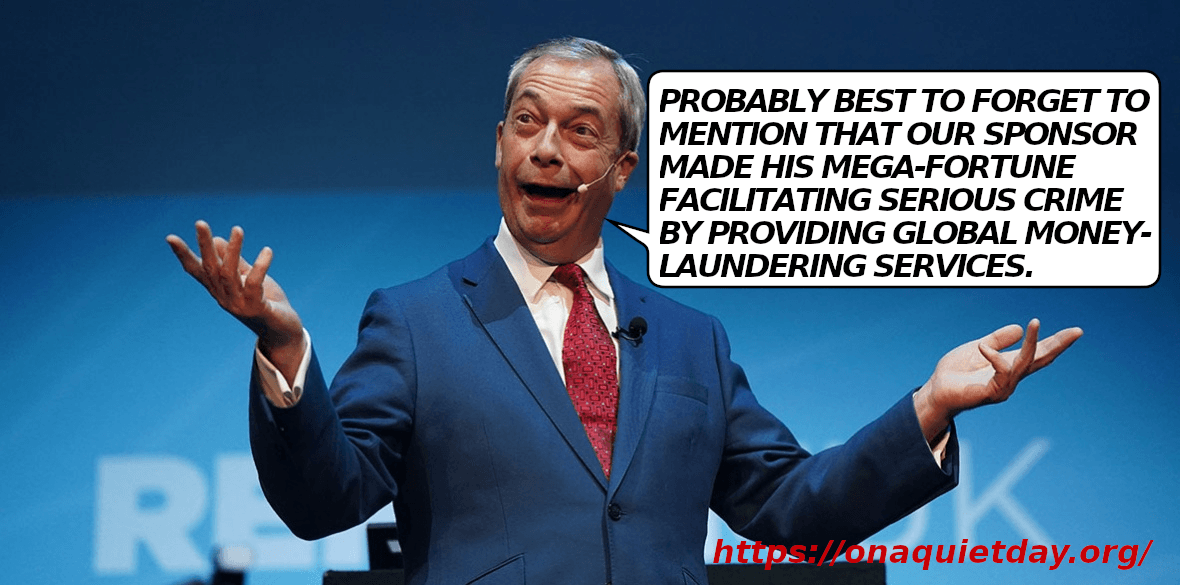
    Reform UK 2025 Ltd's Nigel Farage says it's probably best to forget to mention that their sposor made his mega-fortune facilitating serioius crime by providing global money-laundering services.
    Reform UK 2025 Ltd’s Nigel Farage says it’s probably best to forget to mention that their sposor made his mega-fortune facilitating serioius crime by providing global money-laundering services.
    Orcas discuss how Trump was re-elected and him being an obviously insane, xenophobic Fascist.
    Orcas discuss how Trump was re-elected and him being an obviously insane, xenophobic Fascist.
  • Busting the myths: five lies you’ve been told about net zero

    Spread the love

    Article by Grace Murray republished from The Bureau of Investigative Journalism under Creative Commons Attribution-NonCommercial-NoDerivs 3.0 Unported License.

    Is net zero pushing up our bills? Ruining British industry? A worthless target? We weighed these claims up against the facts

    “This is what climate change looks like, here and now,” Andy Burnham said last month, reflecting on a summer of catastrophic fires, drought and heatwave after heatwave. People were left without water, crops failed and emergency services had their busiest summer ever.

    And yet with disaster on our doorsteps – and the government now recommending we stockpile in preparation for future extreme weather – there remains a sustained opposition to the UK’s plan to tackle it all: net zero.

    In fact, many have doubled down on “ditching net zero” this summer. And in some fringes this is accompanied by claims that our changing climate has nothing to do with human activity. Let’s be clear: this goes against the overwhelming majority of scientists and scientific study.

    We’ve already reported on how this sort of straight-up climate denial is creeping back into UK politics. But what about the softer arguments against net zero, those that appeal to people’s anxieties about the cost of living, job losses and the supposed need for pragmatism?

    Many of these are also based on fallacies and falsehoods – some of them warping the scientific concept of net zero into something different altogether. Let’s dig into some of the most common myths out there.

    ‘Net zero is a made-up term’

    The UK became one of the first major economies to bring net zero into national law in 2019, under Theresa May’s Conservative government. In a nutshell it means reducing greenhouse gas emissions by 100%, from 1990 levels, by 2050. The “net” part is that some emissions may still exist but are balanced out by removing emissions through carbon sinks, such as tree planting, or technology.

    It’s a legal commitment enshrined in an amendment to the 2008 Climate Change Act, and it is based on rigorous climate science.

    And yet one of the more common narratives online is that net zero is some arbitrary idea, a figure plucked out of thin air to make us poorer, colder, and plunder our economy. Reform MPs regularly refer to “net stupid zero” and Conservative leader Kemi Badenoch has called it “political fiction”. Conservative MP Andrew Bowie, who acted as May’s parliamentary private secretary when the target was brought in said in an interview with Politico last year: “What’s quite clear is that the setting of arbitrary targets with no clear plan on how to deliver them does not work for the country.”

    Professor Myles Allen from Oxford University is one of the leading scientists on net zero, and has worked on the need for a finite carbon budget for over 20 years. “When I hear politicians saying, ‘I’m not a climate denier, I’m a net zero denier’, that doesn’t make any sense,” he told us. “The implication of that, obviously, is, ‘I’m comfortable with the world warming forever.’”

    Key fact: Net zero by 2050 is a legal commitment, rooted in physics and atmospheric science, based on a finite carbon budget to stay within 2 degrees of warming.

    ‘Net zero is sending our energy bills through the roof’

    Energy bills are extremely high, and set to rise further next month when the price cap increases. We are all feeling this. And many – including Reform in its election manifesto and Restore Britain’s energy policy paper – blame net zero for pushing up prices and “crippling our economy”.

    But the main culprit has nothing to do with net zero.

    Wholesale gas prices – the sums paid by our suppliers when they buy gas in bulk – have skyrocketed since the Iran war. In the last year, they have more than doubled. And our bills, which include a unit cost based on that wholesale price, have risen accordingly. Depending on where you live and the tariff you’re on, you’ll be paying around 7p per kilowatt-hour this September.

    But what about electricity – surely that’s unaffected by price shocks in the gas industry?

    This is where a concept called “marginal pricing” comes in. It’s a principle of all commodity markets, and it’s where the last available technology sets the price for what all energy suppliers receive. So if all of the UK’s energy demand is met by renewables suppliers (the cheapest option), it’s renewables setting the price. But if renewables aren’t being offered on the markets, or if demand is high, then it’s more expensive options – like gas – that set the wholesale electricity price. (Analysis from the Energy and Climate Intelligence Unit earlier this year found that wind power had reduced electricity prices by over 30%.)

    The last part of the bill is the standing charge. This covers network operating costs, the maintenance of infrastructure, debt recovery and VAT. It also includes costs for some government policies such as social or environmental schemes – but this is a small percentage. So yes, our standing charges are helping pay for net zero. But they are mainly going towards upgrading pipelines and cables or claiming back unpaid bills. And they tend to make up between a fifth and a third of the total bill.

    Adam Berman, policy director at Energy UK, the trade body for energy companies, explains that network costs have hugely increased because “successive governments have made the decision to finance our electricity infrastructure entirely through bills”. This is instead of “some balance between bills and general taxation which is what almost everyone else across the OECD does”. And it is this difference which makes our electricity bills more expensive than gas when you compare your two bills side by side.

    However, he said: “If we hadn’t invested, in five or 10 years we would be close to the water sector, in that you’d have to be doing massive levels of investment”.

    Key fact: Sky-rocketing energy bills are due to extremely high gas prices, which make both gas and electricity more expensive.

    ‘Net zero is destroying British industry’

    Jobs are being lost in the UK’s oil and gas sector in the North Sea, and industries like steel have taken a hammering in recent decades. Reform and the Conservatives have put this down to net zero.

    While it is true that the oil and gas industry reports staggering job losses – unions say 1,000 direct and indirect jobs are being lost each month – the reasons are complex. For a start, production in the North Sea has largely been in decline since 1999. Many of the wells and basins are reaching maturity, meaning that the fossil fuels are harder and more costly to extract. And as production has waned, so have jobs. (In fact, new research has shown that even in the small windows when production increased, jobs still declined.)

    Losing your job can be a traumatic experience. But there is cause for hope: a recent government analysis found that oil and gas workers’ skills will be in high demand in critical sectors including clean power, construction, defence, advanced manufacturing and life sciences. It found that around 70% of oil and gas workers are already employed in occupations identified as a priority for these sectors. (For more on North Sea oil myths see Carbon Brief’s excellent analysis.)

    On the other side, jobs in the UK’s renewable energy sector are growing – and have topped 145,000 for the first time according to a recent report.

    Key fact: Oil and gas production in the North Sea has been in decline long before Net Zero, and jobs are declining too. However, renewables jobs are growing, and oil and gas skills are highly sought after in other industries.

    ‘The UK achieving net zero would make no difference anyway’

    The UK’s carbon emissions have been in overall decline for decades and now account for less than 1% of the global total.

    There are many variations on this myth: from “How will it make any difference?” to “Why should we make an effort when we aren’t as bad as other countries?” Rishi Sunak said it when he was prime minister in 2023. And Reform MP Lee Anderson last year asked in Parliament: “If the UK went net zero tomorrow, by how much would it reduce the Earth’s temperature by?”

    Less than 1% does sound very low. However, we are also the 22nd highest emitter in the world; there are over 160 other countries with lower emissions than us.

    And if you add together all the countries accounting for less than 2% of emissions, it comes to just under half the global total. If all of them took the “Why bother?” approach, it would write off our chances of a net zero world.

    It’s also important to note that while China, the US and India make up the top three (with 26%, 11% and 8% respectively) this doesn’t tell the full story when it comes to emissions per person. China is the 35th highest country for emissions per capita, way behind the US and all the petrostates. The UK is 83rd, putting us roughly in the middle.

    Nor does the 1% figure take into account historic emissions. England was among the first countries to industrialise. Our emissions have risen since the mid-1800s, while other countries’ did not until closer to the end of the century. When you look at historic cumulative emissions from 1750, the UK is the fifth worst offender.

    A final caveat: when looking at global emissions the aviation and shipping industries are not included. They are grouped together like a separate country and according to 2024 data count for just over 3% of global emissions. So flights taken by British people don’t count towards the UK’s reported emissions. And British people take a relatively high number of flights.

    If anything, the 1% figure is obscuring the fact that the UK is in fact an outsized contributor to global emissions. A net zero UK would make a huge difference to the world.

    (None of this is to mention the simple argument that we have a moral duty to clean up after ourselves, regardless of the size of the mess – as summarised by this caller to LBC).

    Key fact: The UK is a lower emitting country at less than 1% of global emissions. However there are over 160 low emitting countries and if everyone gave up on net zero that’s around 42% of global emissions.

    ‘Climate change is happening. Let’s just accept it’

    Climate change is certainly happening. Forecasters warn of a “super” El Niño into 2027, with droughts, flash floods and extreme heat likely to get worse.

    And yet some instruct us to simply look on the bright side and adapt to the changing world. “When it’s a bit warm, let’s enjoy it,” said Reform’s Richard Tice last month. “And if it means that English wine and sparkling wine gets better and better, fantastic.” A fortnight earlier, Sunday Telegraph editor Allister Heath had written a column titled: “Britain can’t stop climate change. Let’s just embrace a Mediterranean lifestyle.”

    Pallavi Sethi, a researcher into climate misinformation at the LSE’s Grantham Institute, described the suggestion that we should simply accept climate change and scrap net zero as “dangerous and misleading”.

    Reform’s Richard Tice told a press conference that there is ‘no evidence’ net zero would stop climate changeOli Scarff / AFP via Getty

    At Jordan Peterson’s Alliance for Responsible Citizenship conference in London, and most recently Reform’s party conference in Birmingham, participants have raised the need to adopt more air conditioning, like the US.

    It is true that we need more money to be spent on adaptation. The Climate Change Committee estimates that we need investments of around £11bn per year of both public and private investment to adapt homes, hospitals, infrastructure and many industries for a changing climate. A recent report states that “the UK was built for a climate that no longer exists today”.

    Sethi told us: “Accepting that climate change is happening while giving up on efforts to limit further warming means accepting greater risks, more damage, as well as higher costs in the years ahead.”

    However this is not an “either/or” scenario, and increasing temperatures lay bare the increased inequality in the UK. Some people can afford to adapt where they live, installing air con or heat pumps, or planting trees in their garden. Others cannot: they do not have the money, or the agency over Council property or a landlord’s private home. Enjoying England’s vineyards is not for the many.

    Key fact: The fact that the climate crisis is already here doesn’t mean we can’t still mitigate it.

    Reporter: Grace Murray
    Deputy Editor: Chrissie Giles
    Editor: Franz Wild
    Production Editor: Alex Hess
    Fact checker: Lydia Morrish

    The Bureau has a number of funders, a full list of which can be found here. None of our funders have any influence over editorial decisions or output.

    Article by Grace Murray republished from The Bureau of Investigative Journalism under Creative Commons Attribution-NonCommercial-NoDerivs 3.0 Unported License.

    Donald Trump urges you to ignore facts and reality and be a Climate Science denier like him. He says that he makes millions and millions for destroying the planet, Burn, Baby, Burn and Flood, Baby, Flood.
    Donald Trump urges you to ignore facts and reality and be a Climate Science denier like him. He says that he makes millions and millions for destroying the planet, Burn, Baby, Burn and Flood, Baby, Flood.
    Nigel Farage urges you to ignore facts and reality and be a climate science denier like him. He says that Reform UK has received millions and millions from the fossil fuel industry to promote climate denial and destroy the planet.
    Nigel Farage urges you to ignore facts and reality and be a climate science denier like him. He says that Reform UK has received millions and millions from the fossil fuel industry to promote climate denial and destroy the planet.
    UK Prime Minister Andy Burnham says that he's going to permit the Jackdaw and Rosebank North Sea fossil fuel projects. He urges you to ignore facts and reality and be a climate science denier like him
    UK Prime Minister Andy Burnham says that he’s going to permit the Jackdaw and Rosebank North Sea fossil fuel projects. He urges you to ignore facts and reality and be a climate science denier like him. The proof is in the pudding.