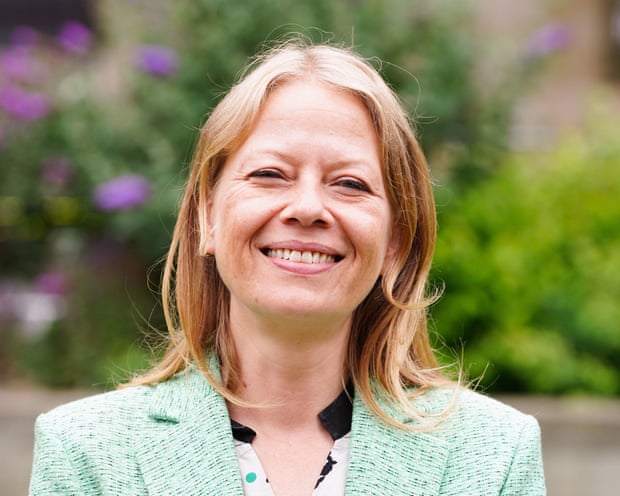
Siân Berry has a long history in politics and success was sweet when she took the Brighton seat. Photograph: Ian West/PA
Since Zack Polanski took over as leader, the party has doubled its membership and its four MPs want to take on Reform’s anger and build community spirit
“Someone has to be out there making the narrative for social security. Someone has to fight the corrosive attitudes to people on benefits,” says Siân Berry, who has just finished her first year as a Green MP in the House of Commons.
She is speaking to the Guardian in her Brighton constituency office, formerly occupied by the legendary Caroline Lucas who flew a lone flag as the only member of parliament for the Green party for 14 years.
Now, however, there are four MPs including Berry, battling together, she says, to hold the space for the left at a moment when it feels the far right has hypnotised the entire political body. “Often Adrian [Ramsay, MP for Waveney Valley] is the only one bringing up animal welfare in Defra questions, or Carla [Denyer, MP for Bristol Central] will be the only person arguing for a refugee’s right to work to the Home Office.” They have all, at different times, been the only party to raise the need for taxes on extreme wealth.
“Caroline was a lone voice in parliament,” she says. ‘But there are four of us so we can share responsibilities. We each shadow six government departments.” Berry’s portfolio covers crime and policing, justice, transport, work and pensions, culture, media and sport and democratic standards. “We absolutely have to be ready if an issue comes up. There are some issues where if a Green isn’t in the chamber asking a question, that question won’t be asked.
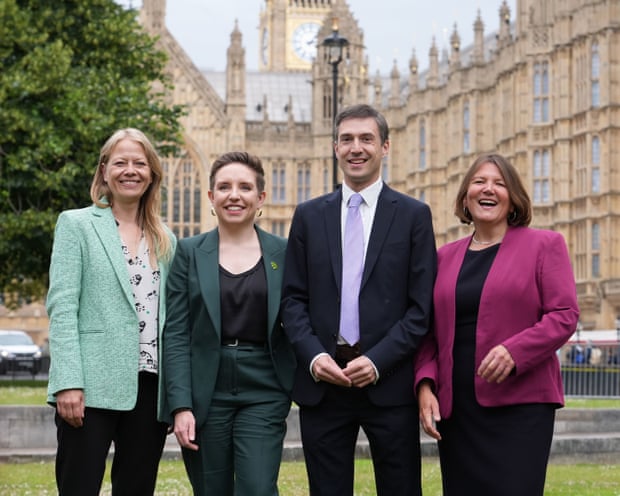
‘There are four of us so we can share responsibilities’: from left, Siân Berry, Carla Denyer, Adrian Ramsay and Ellie Chowns. Photograph: Ian West/PA
…
Most of all, Berry longs to see strong action on climate. “The climate situation is awful. A two degree rise is within sight. We are on a knife-edge of whether we can protect this ecosystem. It’s our only home.”
Nigel Farage urges you to ignore facts and reality and be a climate science denier like him and his Deputy Richard Tice. He says that Reform UK has received £Millions and £Millions from the fossil fuel industry to promote climate denial and destroy the planet.Neo-Fascist Climate Science Denier Donald Trump says Burn, Baby, Burn.
Zack Polanski is the new leader of the Green party in England and Wales after winning a leadership election promising a programme of “eco-populism”. Polanski beat incumbent leader Adrian Ramsay and his partner on the ticket, Ellie Chowns.
It’s been just over a year since the party celebrated its best ever results in the most recent general election. In July 2024, it doubled its vote share and quadrupled its representation in the House of Commons to four MPs.
The same election saw terrible results for the Conservatives and even for Labour, despite its win, raising questions about whether two-party politics was well and truly over. Since then, as professor John Curtice has vividly described, things have started to look even shakier.
This year’s local election saw a “record-breaking” fragmentation of the vote in which less than a quarter of local council seats went to the two main parties. The Greens now hold over 800 seats in more than 170 different councils, adding to their electoral portfolio – which also includes two members of the House of Lords and three London Assembly members.
While Polanski will be celebrating today, party members will look to him to raise their electoral fortunes even further. The electoral challenge for the Greens in England and Wales is two-pronged.
First, the party needs to maintain its position in the seats it has already secured. Its four MPs have fairly comfortable majorities, the smallest being Chowns’ 5,800 majority in North Herefordshire. Second, and perhaps most importantly, it needs to maximise its success in the 40 constituencies where it came second. All but one of these constituencies were won by Labour, which makes Labour voters the prime targets.
My research has shown how the Green party has followed a policy of “total engagement” in recent years. It takes its parliamentary work very seriously, using any and every opportunity to get its message across, even in lower-priority policy areas.
The goal here is to build credibility with the electorate. Small parties tend to want voters to think they are bigger than they are, so they can present themselves as realistic contenders for taking on the heavy work and responsibility of government. Caroline Lucas did a fantastic job of this, punching well above her weight as the party’s only MP between 2010 and 2024.
Together, the Green MPs have made over 380 contributions in the House of Commons. Chowns in particular has been a prolific backbencher, making 161 contributions, while the previous co-leaders Carla Denyer and Ramsay have been much quieter.
With Polanski sitting in the London Assembly rather than the House of Commons, this will inevitably change. The four Green MPs will collectively have more time on their hands and, with the right direction from their new leader, will have the space to be more strategic in their parliamentary activities.
Outsiders
But the Greens have always acted as something of an atypical party too, keeping one foot outside Westminster. Lucas was regularly involved in activism, joining protesters campaigning against tuition fee increases and fracking and to support refugees, to name just a few. She was even arrested in 2013 after joining a protest against energy firm Cuadrilla in Sussex (she was later cleared of all charges in court).
The new Green MPs have continued in this vein, with Sian Berry joining a peaceful protest against far-right agitators in Brighton last year and Chowns pressing the government to water down anti-protest laws.
The new leadership will need to decide whether this strategy enhances their electoral appeal. Does it highlight the Greens’ distinctiveness from the establishment parties, or does it imply they aren’t responsible enough to manage being a party of significant size? The answer depends on who you ask. Polanski has participated in several protests in the past, so chances are this activism will continue to be a core feature of Green party politics.
An added complication for the Greens is that two other parties are also chasing left-leaning voters. One of these is Reform UK. Although associated with rightwing views on social issues, the party came second in many Labour seats in 2024 and needs to appeal to both sides of the political spectrum.
This may explain why the Greens have focused their efforts on highlighting Reform’s failures. Berry, for instance, recently challenged Nigel Farage and his colleagues to publish a log of all their meetings since entering the Commons, arguing that it would be in the public interest.
The other outside threat is Jeremy Corbyn and Zarah Sultana’s new and currently nameless party of the left. While we know little about this party’s policy platform right now, it seems to be veering towards a similarly bottom-up democratic model of organisation which has long been favoured by the Greens – possibly even with co-leaders.
The challenge for the Greens will be to better establish their niche on the left, to ensure they capture voters who are disillusioned with Keir Starmer’s wobbly start. Part of the solution could be to focus on a handful of key policy areas which go beyond the Green party’s niche of environmental issues. At the moment, its MPs take something of a scattergun approach in the Commons, contributing on everything from local buses and universal credit to Ukraine and the Middle East.
Some of the most recent questions asked during Prime Minister’s Questions by Greens hint at the options they might pursue. Ramsay has pushed for a wealth tax on the super rich, and an end to the two-child benefit cap. Both Corbyn and Sultana have, of course, been outspoken on these issues in the past.
If the Greens can’t forge a different path to this new left party, they may have no choice but to consider an electoral pact to avoid splitting the anti-Labour vote right down the middle.
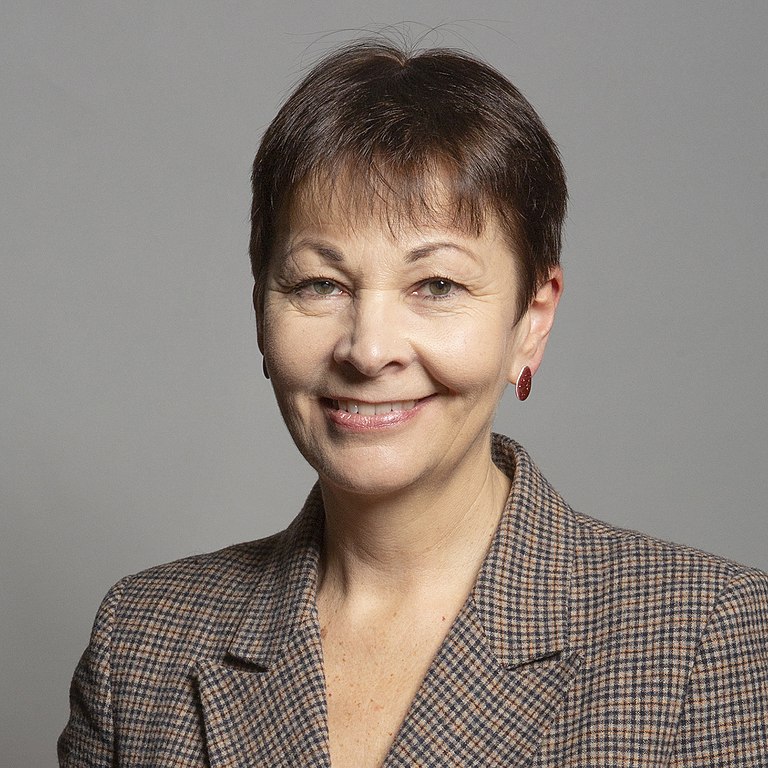
Caroline Lucas, Former Green Party MP for Brighton Pavilion. Official image by David Woolfall Creative Commons Attribution 3.0 Unported license.
Former Green Party MP, Caroline Lucas, has given her reaction to suggestions that plans for a Natural History GCSE have been shelved because it is “seen as a Conservative party initiative.” Caroline was one of the key drivers of the GCSE in the last parliament. She said:
“I very much hope that Labour will look at this again, and appreciate both the popularity of the proposed Natural History GCSE, and the urgency of its introduction. The GCSE enjoys huge support, including from WWF and the Wildlife Trusts through to the Natural History Museum, the Association of School and College Leaders, 17 universities and thousands of young people themselves.
“It was a privilege to work with author and former BBC producer Mary Colwell, who has spearheaded the campaign, to persuade the last Government to agree to it. The curriculum has been prepared over several years by the OCR exam board, and it’s close to being ready to roll out. Stalling at this point would be a disaster, doing a massive disservice to students who desperately want to learn more about the natural world; failing to equip them with the skills of the naturalist which have increasingly been lost, and making it harder for all of us to restore and protect nature.
“Over the last half century, the world has lost 60% of the mass of mammals, birds, fish and reptiles – our education system urgently needs to rise to the challenge of reversing this shocking scale of loss.”
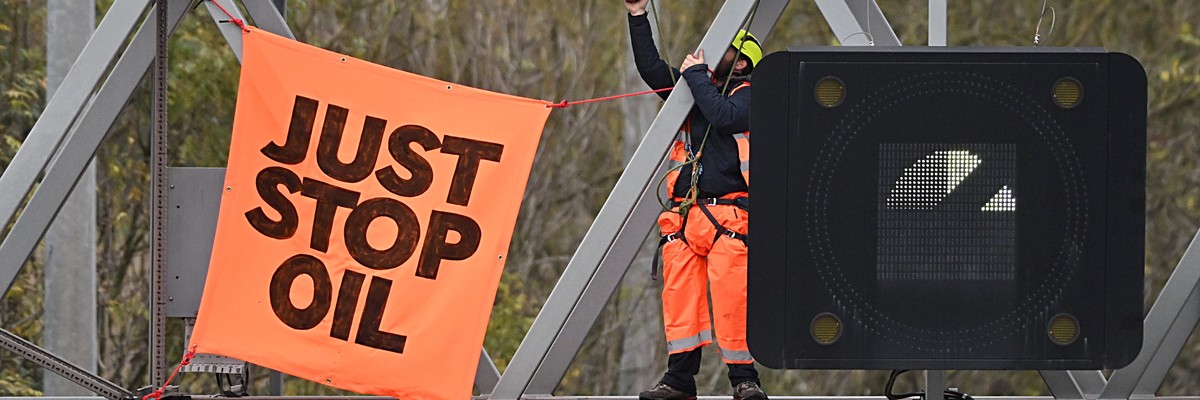
An activist puts up a banner reading “Just Stop Oil” atop an electronic traffic sign along M25 on November 10, 2022 in London, United Kingdom. (Photo: Leon Neal/Getty Images)
“Rulings like today’s set a very dangerous precedent, not just for environmental protest but any form of peaceful protest,” a U.N. official said.
In a decision that one United Nations official called “beyond comprehension,” a U.K. judge on Thursday sentenced five Just Stop Oil activists to a combined 21 years in prison over a Zoom call in which they discussed plans to disrupt London’s orbital M25 highway.
The sentences are believed to be the longest on record for nonviolent protest in U.K. history, The Guardian reported.
“The sentences handed to the five Just Stop Oil campaigners are utterly disproportionate,” environmentalist and author George Monbiot wrote on social media. “Four and five years in prison for peaceful protest? This is what you might expect in Russia or Egypt, not in a supposed democracy.”
“Why are we punishing the people trying to prevent disaster while allowing the oil company giants causing it to reap super profits?”
The five activists—Roger Hallam, Daniel Shaw, Louise Lancaster, Lucia Whittaker De Abreu, and Cressida Gethin—were found guilty last week of conspiring to cause a public nuisance due to a four-day direct action protest on the M25 that Just Stop Oil ultimately held in November 2022. All of the defendants participated in a Zoom call in which they planned to recruit volunteers for the protest, which was intended to pressure the U.K. government to end oil and gas exploration in the North Sea, a policy that the incoming Labour government has now adopted. The Zoom call had been infiltrated by a Sun journalist, who shared its contents with the Metropolitan Police.
On Thursday, Judge Christopher Hehir sentenced Hallam to five years in prison and Shaw, Lancaster, De Abreu, and Gethin to four each.
🧡 The #WholeTruthFive being cheered as they leave court and are taken to prison.
⛓️ They have received 4 and 5 year prison sentences after a zoom call about a nonviolent action being planned in 2022. This is not what a functioning democracy looks like. pic.twitter.com/JKKg2f8gtb
The sentences sparked outrage from humans rights advocates and environmental campaigners.
Michel Forst, U.N. special rapporteur on environmental defenders who also observed part of the trial, said the sentencing “marks a dark day for peaceful environmental protest, the protection of environmental defenders, and indeed anyone concerned with the exercise of their fundamental freedoms in the United Kingdom.”
Forst added: “Rulings like today’s set a very dangerous precedent, not just for environmental protest but any form of peaceful protest that may, at one point or another, not align with the interests of the government of the day.”
Former Green Party leader and Member of Parliament Caroline Lucas called the sentences “obscene.”
“Why are we punishing the people trying to prevent disaster while allowing the oil company giants causing it to reap super profits?” she asked on social media.
Current Deputy Leader of the Green Party Zack Polanski said: “‘Conspiracy to commit a public nuisance’ is a deeply authoritarian description that should send shivers down the spine of all of us who want to live in a free society. Even worse when the real crime is consecutive governments who have played down the climate emergency.”
Campaigners and experts also criticized the trial itself, in which Hehir did not allow the defendants to present evidence about the climate crisis to explain their actions.
“Defendants should be allowed to explain why they have decided to use nonconventional but yet peaceful forms of action, like civil disobedience, when they engage in environmental protest,” Forst told The Guardian after attending part of the trial.
Bill McGuire, emeritus professor of geophysical and climate hazards at University College London—who Hehir did not allow the defendants to call as a witness—called the trial and verdict a “farce.”
“They mark a low point in British justice, and they were an assault on free speech,” McGuire in a statement said Thursday. “The judge’s characterization of climate breakdown as a matter of opinion and belief is completely nonsensical and demonstrates extraordinary ignorance. Similarly to suggest that the climate emergency is irrelevant in relation to whether the defendants had a reasonable case for action is crass stupidity.”
The verdict and sentencing also come amid an increasing crackdown on climate protest, both globally and in the U.K. The previous longest known civil disobedience sentences in the country were also for Just Stop Oil activists.
“The U.K. is a nightmare for climate activists from this point of view, in the sense that the sentences imposed in other countries are neither that harsh, nor that widespread,” Forst said July 12.
Greenpeace U.K.’s program director Amy Cameron said on Thursday: “These sentences are not a one-off anomaly but the culmination of years of repressive legislation, overblown government rhetoric, and a concerted assault on the right of juries to deliberate according to their conscience. It’s part of the mess the Labour government has inherited from its predecessor, and they must fix it by giving back to people the right to protest that’s been slowly being taken away from them.”
Forst also called on the new government to reverse course.
“Given the gravity of the situation, I urge the new United Kingdom government, with absolute urgency and without undo delay, to take all necessary steps to ensure that Mr. Shaw’s sentence is reduced in line with the United Kingdom’s obligations under the Aarhus Convention,” Forst wrote on Thursday.