TUC calls for tax increase on bank profits to pay for social tariff to cut household bills
HOUSEHOLD energy bills will hit a three-year high in yet “another nail in the coffin” for budgets after Ofgem announced a 4 per cent rise from October.
The regulator confirmed today that gas unit rates are set to rise from 6.29p per kWh last winter to 8p, up around 27 per cent year on year.
It means the new cap is £1,723, which is £147 more than the same period last winter, when the October cap stood at £1,576, and 150 per cent higher than at the end of 2020.
From October, the government’s cut to VAT on electricity bills from 5 to 0 per cent will shave around £45 a year off the average bill.
But with experts predicting a further 9 per cent rise in January, unions and campaigners have urged the government to act again.
Cornwall Insight predicts the January 2027 price cap will rise to £1,872, 18 per cent higher than January 2026.
Thames Water sign at a water works in Islington, north London, July 23, 2026
CAMPAIGNERS demanded the government take back control of debt-ridden Thames Water after its “indefensible” decision to give a £1 million golden handshake to its finance chief amid likely drought conditions in large parts of the country.
Britain’s largest water company gave Steve Buck the huge sign-on fee in July as it continues to struggle with a debt pile of around £20 billion, as well as public outcry over pollution and mismanagement of the utility.
The payment, which a senior company figure admitted would be seen as “unjust” by customers, was made despite renewed strain on southern England’s water systems, as Amber heat alerts were issued for most of the country yesterday.
More areas across England are likely to plunge into drought this week, as the Met Office predicted temperatures are to soar into the mid-30°Cs yet again this week.
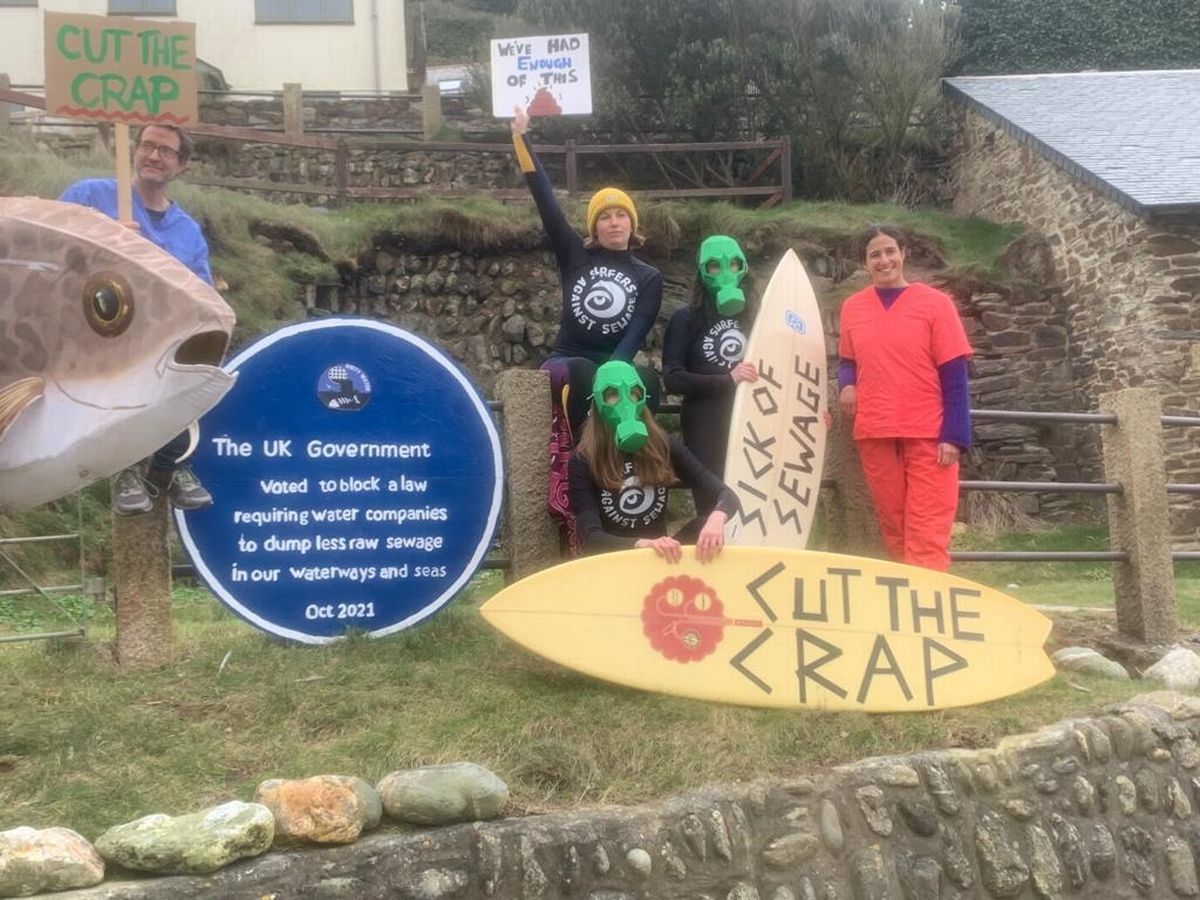
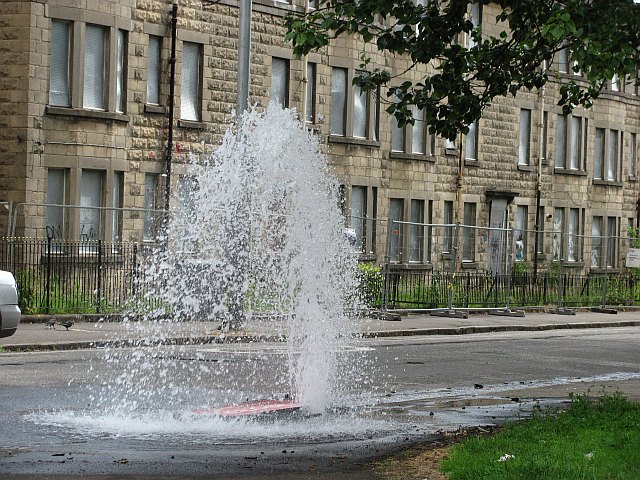
April 2023 Surfers Against Sewage and Extinction Rebellion protests in St Agnes, Perranporth, Truro and Charlestown which unveiled spoof Blue Plaques to the MPs and Conservative Government who allowed raw sewage to be dumped in the sea (Image: Surfers Against Sewage)Image of a burst water main.
An aerial view of water treatment ponds and solar panel farm at Thames Water’s Chertsey Water Works in Surrey
ANYTHING less than a full restructure of the water industry would be a “total insult” to the public, ministers were warned today as the majority of English waters failed to meet ecological standards.
Clean water campaigners and the GMB demanded PM Andy Burnham take decisive action after new Environment Agency (EA) figures revealed only 14 per cent of England’s waterways are in good health.
While 15 per cent of rivers are classed as good, only around 7 per cent of lakes reached that threshold, the EA said.
Researchers cited phosphate as the largest individual polluter, which comes from sewage and farming runoff. About half of rivers still exceed safe levels.
Surfers Against Sewage (SAS) senior policy manager Henry Swithinbank recognised that Mr Burnham previously said “some promising things” on the water sector.
“But now is not the time for lip service,” Mr Swithinbank told the Morning Star. “Burnham must turn those words into urgent action. Anything less will be a total insult to our waters and the public.”
He added: “Despite promises from water companies, and government policies and targets, our waters continue to be degraded into an even more dire state.
“Are we surprised? After years of limp policies, slap on the wrist fines and tinkering, sadly, we are not.
“But we are furious. Our beaches, rivers and lakes are poisoned by sewage. This cannot be allowed to continue.
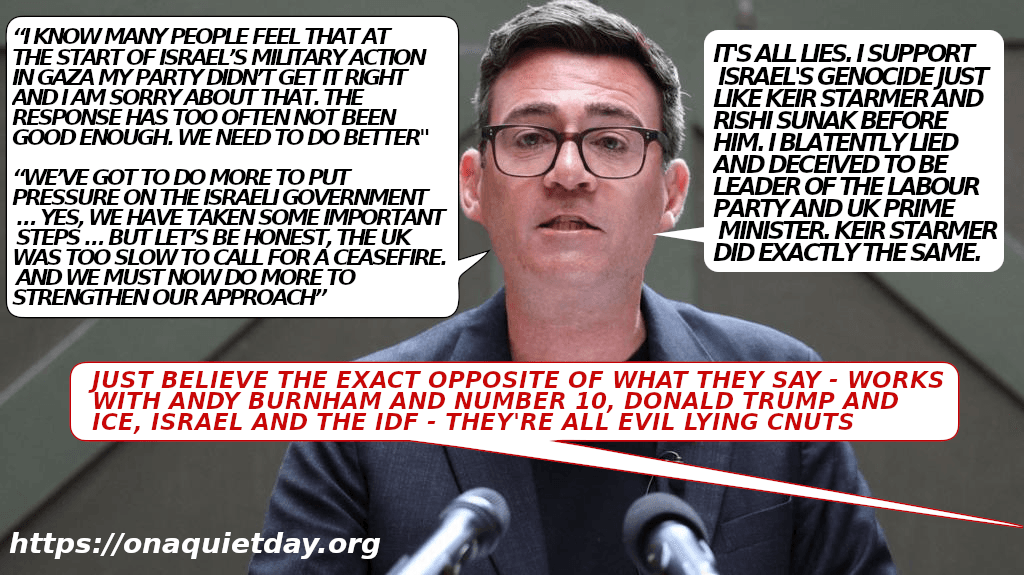
Surfers Against Sewage (SAS) protest sewage discharges.Image of a burst water main.UK Prime Minister Andy Burnham admits to blatently lying and engaging in deception to become leader of the UK Labour Party and Prime Minister.
At a press conference today, Zack Polanski delivered a ‘reality check’ to the Prime Minister as he sounded the alarm on the emergency of extreme heat and outlined three immediate actions he would take to tackle the crisis.
After highlighting the multiple threats we face – to our safety, our food and water supply, and our way of life – Zack called for action to keep people cool and safe, taxes on oil and gas giants to fund our fire services, and public ownership of water to end the failed experiment of privatisation.
Zack was joined on stage by an ex-soldier and engineer, a doctor, and a firefighter, who described the consequences of extreme weather they had seen in their work – as well as broadcaster and environmental campaigner Chris Packham who warned of the present and future risks of the climate crisis.
“Trees reduced to charcoal”
Zack started his press conference with a vivid description of the consequences of the extreme heat that has hit the UK this year.
The day before he had witnessed the aftermath of the devastation caused by a wildfire in Oxfordshire.
“Trees reduced to charcoal. Cars turned to burnt out wrecks. The smell of smoke still lingering in the air, on the site of what was once a thriving local business – now reduced to ash.
“Wildfires. Literal scorched earth. And that looming sense that this is only the beginning.
“These days feel exceptional, but what we’re living through right now are likely some of the least extreme summer temperatures we’ll experience in our lifetimes.”
This is what climate failure looks like. Nature, homes and livelihoods are being destroyed. The Government must act now.
The week before, while a wildfire the size of two hundred football pitches was raging across Suffolk, Zack had called on the Prime Minister to urgently call a COBRA meeting to address the crisis.
Six days later, and with another heat alert having just ended, where is the Government response? There has been no COBRA meeting, no emergency briefing, no new plan.
And so Zack stepped up to challenge the Prime Minister to act.
“We are facing the biggest threat to this country since the Second World War”
His challenge to the PM started with a stark reality check: “We are facing the biggest threat to this country since the Second World War.”
“Extreme weather is now the new normal – and without action, the impact on the people of this country will be unimaginably grave.”
And Zack broke down exactly what that impact will be.
First, the threat to our safety.
The dangers of extreme heat to our health are very real – especially for older people and those with pre-existing conditions – forcing people to stay indoors for days on end, to try to wait out the heat.
Zack Polanski delivers ‘reality check’ to Burnham over ‘biggest crisis since WWII’ after summer of extreme heat
As Zack explained, “Almost three thousand people have died from the effects of extreme heat this summer.”
Those “whose bodies were under such intense strain in trying to stay cool that their hearts or kidneys could no longer cope.”
And then there are the fires – forcing hundreds to evacuate their homes, “while many thousands more wait anxiously with flames on the horizon and smoke in their lungs.”
And Zack pointed to Europe as a warning of how bad things can get.
“Hundreds of thousands evacuated. Half a million acres burnt.
“The sheer scale of the devastation is hard to comprehend. But we need to look it in the face – because this is only a taster of what’s to come if we don’t act now.”
Decimated crops, leaking pipes, and no new reservoirs since 1992
After the danger to our physical safety, the second threat Zack identified concerned the basis of any society: our food and water supply.
Half of England is currently experiencing serious drought, and eight of our water reservoirs are at risk of running dry.
“The threat is so severe”, Zack said, “that the UK’s national risk register warns that if we had three years of exceptionally dry weather like this, we could face water rationing.”
And what of the private water companies?
The private water companies that haven’t built a single new reservoir since 1992.
Well, they are losing nearly three billion litres of water a day from leaky pipes – or as Zack put it “five times more than a nationwide hosepipe ban would save”.
Our farmers and growers, meanwhile, are on the frontlines of climate breakdown – facing in turn the extreme rainfall and flooding of recent winters, and the extreme heat and drought of our summers.
Zack noted that despite farmers working through the nights to avoid the heat, food production has been hit by this chaotic combo of flooding and drought, and food prices are set to rise as a result.
“A threat to our way of life”
The third threat Zack named was far-reaching: the threat to our way of life.
“Parents unable to take their children to the playground because the slides are so hot it could burn their skin off. Temperatures so high they keep us inside for days for the sake of our health. Cities feeling like ghost towns. Parks turned into deserts.”
As climate change progresses – bringing more frequent, more damaging extreme weather – the way each of us lives our life will be more severely impacted.
Zack Polanski holds a press conference to deliver an urgent message to Prime Minister Andy Burnham. (Photo: Aldo Ciarrocchi)
And we don’t have to look far to see what may face us in the years ahead.
Zack pointed to the “apocalyptic” scenes of “Wildfires. Droughts. Deadly floods.” coming out of Europe, noting that the continent “is heating at twice the rate of the rest of the world.”
It is there for all of us to see.
And yet the response from the Government, and most of the media, has been to look the other way.
In Zack’s words: “It’s an astonishing dereliction of duty from those whose first responsibility is to keep us safe.”
Zack’s demands for action: cool spaces, water in public hands, and taxing oil and gas giants to fund fire services
The need for action is urgent.
And Zack set out immediate steps the Prime Minister could take “to protect people right now and keep us safe from what we know is coming down the track.”
“We need to keep people safe from extreme temperatures. That means a free, accessible cool space in every local area. And financial support for households to heatproof their home.”
Secondly, Zack called for a robust wildfire prevention strategy – and a fire service with the resources it needs to tackle blazes when they come.
“This should be funded,” Zack said, “by taxing the fossil fuel giants who are profiting from fuelling these infernos.”
And thirdly Zack called for public ownership of our water.
“To secure our water supply, prevent droughts and protect our food system we need to bring water back into public hands.”
“Every penny households pay for their water needs to go back into strengthening our infrastructure, building new reservoirs, and protecting us from the droughts of the future.”
Extreme weather is now the new normal.The Prime Minister must act like this is the emergency it is.
Zack’s message to the PM: “There can be no new drilling for oil and gas”
Before handing the microphone over to the assembled experts, Zack finished with a powerful message direct to the Prime Minister.
“If we are to secure a liveable future for our children and grandchildren, there can be no new drilling for oil and gas. On this, the science is crystal clear.
“As politicians, we have a moral responsibility to do what’s right for the people we serve, even when it’s not politically convenient.
“And I know that whatever our differences, we both care deeply about the people of this country – and the future of our world.
“So when the time comes, I hope you will have the courage to be truthful, be brave – and hold firm to your party’s commitment to no new oil and gas drilling in the north sea – including both Rosebank and Jackdaw.
“Some will say we can’t afford to make these changes. These last few weeks are showing we can’t afford not to.”
“A dereliction of duty”: four expert voices on extreme heat
Zack was followed by four speakers with unique expertise on the extreme heat emergency.
First up was Carl Benfield, a former soldier and engineer, who since leaving the military has turned his engineering expertise to the challenges posed by climate breakdown.
His view? “Climate change is the single greatest threat to human security that we face.”
And his conclusion on successive governments’ failure to prioritise this threat was damning: “A government’s first duty is to keep its citizens safe. Ignoring extreme heat and raging fires isn’t just complacency, it’s a dereliction of duty.”
He was clear about what’s required: “We need an immediate COBRA-level response. We need climate change reinstated at the top of our defence and security agenda. And we need the bold leadership of Zack Polanski for our nation.”
"Ignoring extreme heat and raging fires isn't just complacency. It's a dereliction of duty."Experts warn the climate crisis is already costing lives and urgent action from the Government is needed.
Next to speak was London firefighter James Rodgers.
His powerful testimony of a worker on the frontlines of extreme heat highlighted the immediacy of the crisis, and how rapidly the conditions in which firefighters work are changing due to extreme heat.
“When people talk about climate change, they often talk about the year 2050. I’m a firefighter and I want to talk about now.”
“Because for firefighters, climate change isn’t a prediction. It’s a shift we are already working.
“Climate change is the fire call to multiple back gardens alight, children’s clothing burning on the washing line.
“Climate change is the acrid smell as you affect entry into a flat because someone has succumbed to heat stroke and hasn’t been checked on in weeks. Climate change is the sound of people in floods of tears when they are stuck in a lift 20 floors up in 30 degree heat.
“Climate change is the taste of dust in your dry mouth, watching a fire sweep uncontrollably across a park you used to play football in as a child in your summer holidays. Climate change is this becoming a day to day reality. ”
Dr Veena Aggarwal speaks at the press conference on the emergency of extreme heat. (Photo: Aldo Ciarrocchi)
Next was Dr Veena Aggarwal, a GP in Bristol and the Climate and Sustainability Co-Lead and Clinical Adviser at the Royal College of GPs.
She emphasised the growing danger to health, and – as with the fire services – the extreme pressure placed on health services by the heat:
“As a GP, I’ve been seeing firsthand the health impact of the recent heat waves.
“Ambulances are so stretched we couldn’t get an ambulance for a patient with sepsis or another one with very low oxygen levels, because the ambulance service was so completely overwhelmed.
“The London Ambulance Service saw its busiest ever day during the heatwave in June, on 26th June. That’s even busier than the days at the height of the Covid pandemic emergency.
“We’re seeing people having more asthma attacks; having flares up of their chronic lung disease so extreme they need to be in hospital; more people having heart attacks, strokes; or having falls and collapsing due to the heat, especially those who are frail and more vulnerable.”
Dr Aggarwal also highlighted the impact of the heat on staff and patients in NHS buildings, the human cost of the heat waves, and the need for immediate action.
“An extra almost 3000 deaths occurred within just one week in June during the heatwaves. That’s almost double what was recorded in that season in 2025. In Europe those deaths are 14,000 in that same period.
“We need to act now. The climate crisis is a health crisis.”
Chris Packham speaks at the press conference on the emergency of extreme heat. (Photo: Aldo Ciarrocchi)
The final speaker was broadcaster and nature campaigner Chris Packham.
Chris was excoriating in his appraisal of the Government and media’s response to the climate crisis.
Citing the same death figures as Dr Aggarwal, he said “If these deaths had been the result of terrorism or a pandemic, the Government would have cancelled its summer holiday.
“There would have been COBRA meetings, and there would have been public information campaigns the likes of which we saw during Covid, designed to protect us in this time of crisis.”
“And yet what do we get?
“We get rumours of possibly more drilling for oil and gas, and we get articles in the Telegraph suggesting we ought to adapt to a Mediterranean climate…
“If that isn’t reckless and irresponsible, I don’t know what is.”
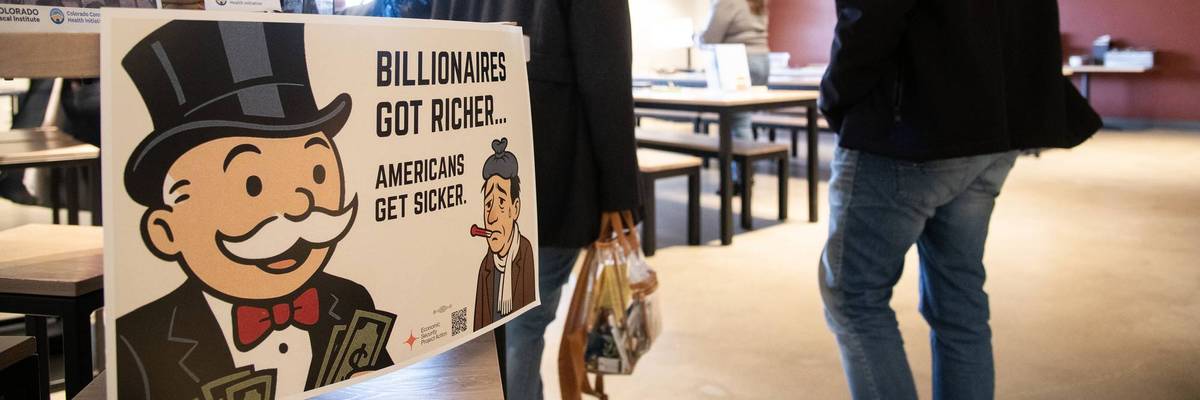
Colorado residents fill out cards and share their stories for content to send to congressional representatives regarding healthcare cuts and the Affordable Care Act during an event called “Don’t Let the Ghouls Gut Our Healthcare!” on November 1, 2025 in Northglenn. (Photo by Tom Cooper/Getty Images for Economic Security Project)
“As working families continue to get squeezed left and right by GOP-driven healthcare cost hikes and bureaucratic red tape, millions more Americans will lose the care they rely on to stay alive and healthy.”
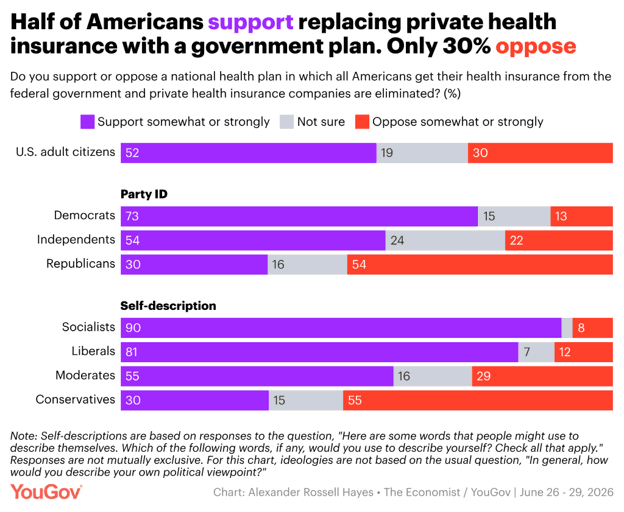
On the heels of data revealing that millions of people have lost health insurance coverage during US President Donald Trump’s second term amid a series of GOP attacks on access to care, polling published Monday shows that a majority of Americans support eliminating private insurers.
The 1,606 adult US citizens surveyed by The Economist/YouGov June 26-29 were asked: “Do you support or oppose a national health plan in which all Americans get their health insurance from the federal government and private health insurance companies are eliminated?”
Fifty-two percent expressed support, and the proposal was even more popular than that among respondents under age 45 as well as registered Democrats and Independents. Just 30% of those polled were opposed, while the rest said that they were “not sure.”
The polling follows the administration’s quiet release of data showing that 4.2 million lost Affordable Care Act (ACA) coverage as of February. Trump and his Republican allies in Congress have come under fire for letting ACA subsidies expire at the end of last year—as well as for enacting the so-called One Big Beautiful Bill Act, which is expected to leave more working-class Americans uninsured over the next decade. Already, Protect Our Care estimates that 3.8 million people have lost coverage under Medicaid and the Children’s Health Insurance Program, bringing the total for Trump’s term to around 8 million.
“A mind-boggling number of Americans have found themselves joining the ranks of the uninsured,” Protect Our Care president Brad Woodhouse said in a Tuesday statement. “And this is just the beginning. As working families continue to get squeezed left and right by GOP-driven healthcare cost hikes and bureaucratic red tape, millions more Americans will lose the care they rely on to stay alive and healthy.”
“These are diabetic patients rationing insulin and parents skipping cancer screenings,” he continued. “These are small business owners and farmers shutting down their life’s work because they can no longer afford to buy insurance on their own. These are moms, veterans, and seniors. These are the millions who will hand Trump and Republicans in Congress a withering rebuke at the ballot box in November for making healthcare unaffordable so they could make billionaires and big corporations richer.”
As premiums soar and Americans begin to endure the consequences of the national Republican healthcare agenda, a sweeping coalition of groups that support a universal single-payer system declared earlier this month that “now is the time for Medicare for All.”
Sen. Bernie Sanders (I-Vt.) and Reps. Pramila Jayapal (D-Wash.) and Debbie Dingell (D-Mich.) have repeatedly introduced the Medicare for All Act in Congress, and support for it has grown among elected Democrats and the US public—as suggested by the new polling.
In a statement about the healthcare findings, the pollsters explained:
While eliminating insurance companies may sound like a radical change to healthcare, the share of Americans who want to replace private insurance with a government health plan (52%) is larger than the share who want to expand the existing Obamacare (the health coverage system established by the Affordable Care Act) (38%). The share who favor repealing Obamacare (28%) is about as large as the share who oppose replacing private insurance with a government plan (30%).
Americans who support a national healthcare plan do not universally see expanding Obamacare as a step in the right direction. Only a little more than half (56%) of the Americans who support creating a national health plan also support expanding Obamacare. On the other hand, most Americans who support expanding Obamacare would also support a national health plan that replaces private insurance (77%).
Although “only 8% of Americans would describe themselves as socialists,” which is “smaller than the shares who describe themselves with several other ideological adjectives offered in a poll question, including progressive (17%), liberal (23%), and conservative (34%),” the pollsters also noted, “many policy proposals championed by democratic socialists draw significant support from Americans.”
For example, majorities of respondents endorsed the government covering the cost of college tuition for all students (55%) and building public housing (57%).
When asked, “Do you think Donald Trump has had the right priorities or hasn’t paid enough attention to the country’s most important problems?” 60% of respondents said the president “hasn’t paid attention to the most important problems.”
The polling comes just over four months away from the November midterm elections, in which Democrats hope to reclaim majorities in both chambers of Congress. Some Democratic candidates, including US Senate hopefuls Graham Platner in Maine and Abdul El-Sayed in Michigan, are explicitly running on support for Medicare for All.
After multiple progressives running to represent various New York districts in the US House of Representatives won their primaries last week, Sanders called their victories proof that Americans “are sick and tired of status quo politics,” while Jayapal similarly celebrated that “bold, people-powered candidates took on the Democratic establishment and won.”
“They ran on Medicare for All. On a public option for housing. On a foreign policy that centers human dignity over political convenience. And they won,” Jayapal said. “This is what happens when movements build power. People-powered movements win.”
Climate science denier Donald Trump confirms that he knows nothing about democracy and that more liquid gold is being secured according to his policy of global privateering.Orcas discuss rotting brain. Front Orca says “Wish someone would lock him up”.

 A gas hob burning on a stove, August 26, 2022
 Thames Water sign at a water works in Islington, north London, July 23, 2026