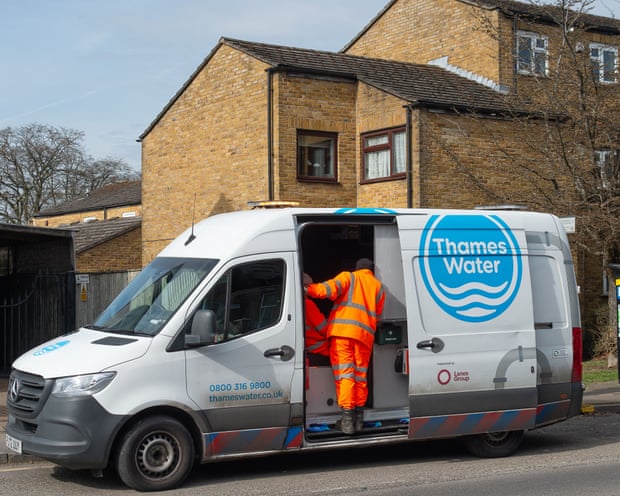
A tanker pumps out excess sewage from the Lightlands Lane sewage pumping station in Cookham, Berskhire, January 10, 2024
THAMES WATER’s debts have ballooned to £16.8 billion and it made a loss of £1.65bn in the year to March, the company revealed today, sparking fresh calls for renationalisation.
Appearing before the Commons environment committee, chief executive Chris Weston admitted that the company was “extremely stressed” and would take “at least a decade to turn around.”
Britain’s largest water supplier also revealed a sharp increase in pollution incidents over the past year.
Gary Carter, a national officer at water industry union GMB, said: “Thames Water is drowning under a mountain of debt.
“Hiking customer bills has led to a rise in operating profit, money that should go on investment but is being swallowed up by monstrous loans needed to keep the company afloat.
“While Thames lurches from crisis to crisis, the solution is clear: it must be taken back into public ownership, with workers’ terms, conditions and pensions protected.”
If you thought RAF jets were owned by the RAF, think again.
The RAF squadron targeted for a repaint by Palestine Action due to its involvement in supplying Israel’s genocide, does not in fact belong to the RAF at all. It belongs ultimately to Polygon Global Partners LLP, a Hedge Fund.
Through a chain of seven cutout companies, which I will take you through, the direct ownership is with Airtanker Ltd, which gives its address as RAF Brize Norton. It owns, maintains and operates the RAF’s Voyager refuelling aircraft, which have been providing mid-air refuelling to the Israeli Defence Forces as well as carrying, in their cargo role, munitions to the IDF.
…
Airtanker Ltd screenshot
Airtanker Ltd states that five of the Voyager aircraft while available to the RAF: “can also be made available to other parties. This can include providing military capability to other nations…”.
Whether the aircraft have been operated by the RAF on behalf of the Israelis, or whether they have been “provided to” the IDF direct, is an interesting question. Is this designed to build in plausible deniability for the UK government?
Eight of the Voyager Aircraft though fully painted in RAF livery, actually are the property of Airtanker Ltd.
…
The RAF’s Voyager aircraft are effectively being provided under the Private Finance Initiative. Exactly how much money the hedge fund managers and this string of companies are taking out of the defence budget is hard to know.
One particularly surprising fact is that it is plain that the private companies are also providing the RAF ground crew. Who employs the flight crews is not entirely clear.
That such an obviously rotten and corrupt arrangement exists in the RAF I had no idea. Some British military personnel are in fact contracted mercenaries. It gives new context to the active RAF involvement in the Genocide in Gaza.
Palestine Action’s excellent act of resistance in vandalising this Hedge Fund Air Force has brought all of this to our attention. Which is yet a further reason to be grateful to Palestine Action.
A view of the Little Cheyne Court Wind Farm amongst existing electricity pylons on the Romney Marsh in Kent
MORE than 7,000 manufacturing businesses will have up to 25 per cent cut from their electricity costs under the government’s 10-year industrial strategy.
Under a new British Industrial Competitiveness Scheme announced today, they will be exempted from levies on bills including the renewables obligation, feed-in tariffs and the capacity market from 2027 — reducing bills by up to £40 per megawatt hour.
Around 500 of the most energy-intensive firms, including the steel industry, will also see their network charges cut with bigger energy discounts, along with measures to speed up the time it can take to connect new factories and projects to the energy grid.
…
Unite general secretary Sharon Graham welcomed the moves to cut energy costs, but said: “Unite would like to have seen the government go further.
“Our energy system is broken beyond repair; it will never function in the interests of business and consumers until it is brought back into public ownership.
“That must start with the National Grid to ensure industry can get the power it needs when it needs it and is not left waiting forever for new connections.”
Thames Water’s £20bn debt reduces its value, argues thinktank, Common Wealth. Photograph: Maureen McLean/REX/Shutterstock
[Guardian] Exclusive: Common Wealth report argues debt, pollution and underinvestment justify process known as special administration
Ministers could bring water companies into public ownership for minimal cost through a process designed to safeguard vital public services when the companies running them are failing, a thinktank report has argued.
According to the report by Common Wealth, ministers could use a process known as special administration to take over a company like Thames Water and, rather than transfer it to another private company, keep it under permanent public ownership.
Writing for the thinktank, Ewan McGaughey, professor of law at King’s College London, said that while a figure of £99bn was commonly cited as the cost of taking over the industry in England, this was based on an estimate from a thinktank paid for by water companies.
…
The actual market value of water companies, the report argued, seems to be lower, with the US private equity company KKR offering a £4bn injection of equity to take over Thames Water, when its supposed regulatory capital value is nearer £20bn.
It goes on to say that when debt levels of water companies are taken into account, for example Thames Water is about £20bn in debt, it would be possible for the government to argue that their appropriate value in law was notably less, even close to zero.
SIX water companies have been banned from paying bonuses to senior bosses under new rules that came into force today.
Thames Water, Yorkshire Water, Anglian Water, Wessex Water, United Utilities and Southern Water were all included in the ban, which covers the 2024-25 financial year.
Environment Secretary Steve Reed warned companies would be “extremely foolish” to try getting around the new ban by increasing salaries.
He warned water companies should avoid moves that would lose the “confidence” of customers and said there was a need to “rebuild their broken relationship.”
“Customers are furious at the fact that they’re seeing local waterways being polluted, but bosses taking multimillion-pound bonuses,” he told Times Radio.